
2027 Employee Assistance Program Social Worker: Responsibilities, Education, and Career Fit
Audited and Verified:
Our Editorial and Data Verification Process
Research.com uses government datasets, official education statistics and primary institutional information to support its career and degree guides. Our review process checks factual accuracy, occupational definitions, source dates and the requirements associated with the credentials discussed.
How This Article Was Fact-Checked
Our editorial team verifies salary estimates, employment projections, education requirements and program information against original data providers and official organizations. Salary figures are checked against the relevant occupational definitions and reporting periods. Information about licensure, accreditation and required in-person training is reviewed separately.
Fact-checked and verified on:

Co-Founder and Chief Data Scientist
An employee assistance program (EAP) can be an appealing workplace for a social worker who wants to help people address personal concerns affecting their well-being and work. But EAP jobs differ: one may center on brief counseling, while another emphasizes assessment, referrals, or organizational consultation. That difference determines which degree, license, and experience you need.
This guide explains the work, compares realistic entry routes, and shows students, career changers, and early-career social workers what to check before investing in training or applying for a role.
Key Things You Should Know
- EAP social workers commonly assess concerns, provide brief support within their scope, connect employees with ongoing care, and protect confidentiality; some also advise managers on workplace resources.
- Many clinical EAP roles seek an MSW and an independent clinical license, while referral or care-navigation roles may accept other qualifications. An MSW alone does not authorize independent psychotherapy.
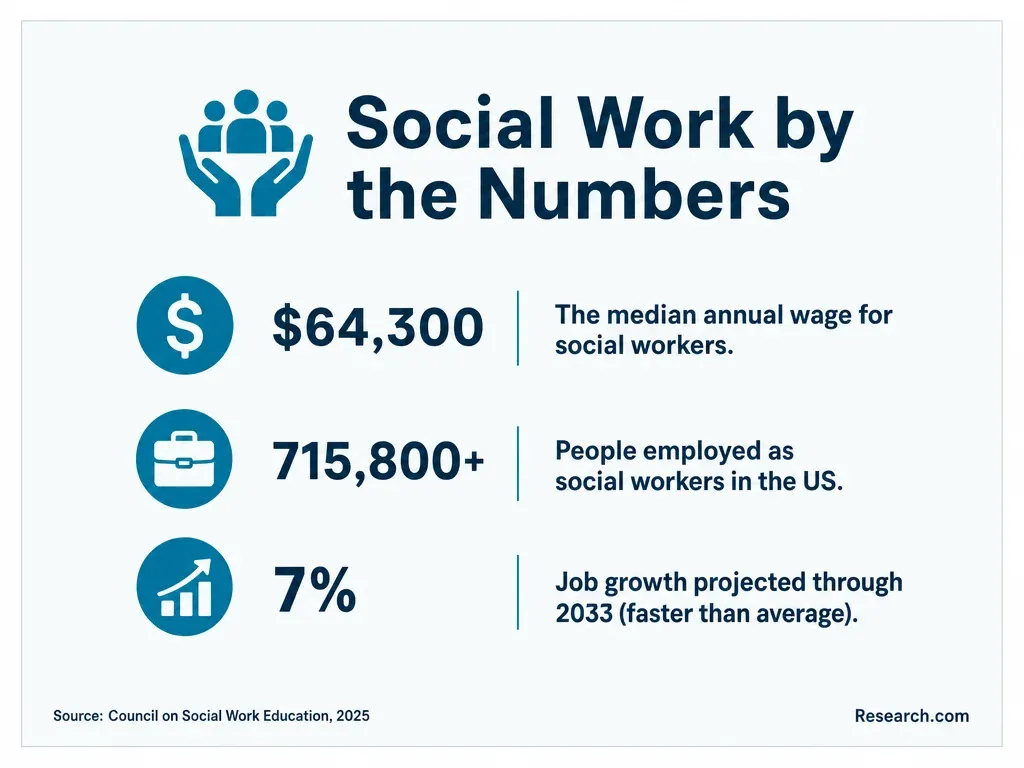
- The U.S. Bureau of Labor Statistics (BLS) reports a $61,780 May 2025 median annual wage and 6% projected 2025-2035 employment growth for social workers overall, not an EAP-specific salary or forecast.
What does an employee assistance program social worker do?
An EAP is an employer-sponsored resource that helps eligible employees, and sometimes household members, address concerns such as stress, substance use, family difficulties, or other problems affecting daily life. An EAP social worker may work for the employer, an outside EAP vendor, or a behavioral health organization contracted to provide the service.
Typical work includes an initial assessment, brief goal-focused support when authorized, safety screening and escalation under agency policy, referrals to appropriate care, and follow-up.
Some positions also involve manager consultations, educational presentations, or coordination after a disruptive workplace event. EAP is a service setting, not a uniform clinical scope or license category: the job description and state law determine what an individual worker can do.
Confidentiality is central but not absolute. Workers must explain what information, if any, may be shared with an employer; obtain appropriate consent; and follow applicable law and policy concerning records, safety, and reporting.
They also need boundaries when an employer wants information that a client has not authorized for disclosure. Readers comparing this setting with other MSW roles can use graduate social work career planning to put those duties in context.
What degree do you need to become an EAP social worker?
There is no single degree requirement for every EAP position. Start with the tasks in the job posting: independent counseling calls for different qualifications than referral coordination or benefits navigation. The comparison below identifies plausible routes, not guaranteed hiring eligibility.
| Preparation | Potential EAP fit | Important limit |
| BSW or relevant human services degree | Referral, resource coordination, outreach, or support roles where the employer accepts it | Does not itself authorize independent clinical care |
| Traditional MSW | Graduate social work preparation for applicants with a bachelor's degree in another field | Graduation is distinct from clinical licensure |
| Advanced-standing MSW | A potentially shorter MSW route for applicants with a qualifying BSW who meet program rules | A psychology or human services bachelor's degree does not ordinarily substitute for the qualifying BSW |
| Licensed clinical social work pathway | Positions requiring independent assessment or psychotherapy within state-authorized scope | Typically involves additional post-degree, board-approved steps |
A career changer whose target is employee resource navigation may not need a second degree at all; relevant service experience and employer training could be more direct.
Someone targeting independent clinical EAP work should check specific postings and the licensing board before choosing an MSW. For those starting at the undergraduate level, accredited bachelor's pathways into social work offer a starting point for comparing BSW options.
What licenses and certifications do EAP social workers need?
License requirements depend on the state, the worker's actual duties, and the employer. An EAP role involving independent psychotherapy may require an independent clinical social work license; a nonclinical coordination role may have different requirements.
State license names, examinations where required, supervised-experience rules, and permitted activities vary. Neither an MSW diploma nor a clinical concentration grants independent practice authority.
Employers may prefer EAP-specific training or a voluntary specialty credential, but a certificate does not replace a state license or expand legal scope. Before pursuing one, compare its eligibility requirements and cost with actual job postings.
If your goal is clinical practice, review MSW pathways for future clinical social workers, then confirm educational and post-degree requirements with the board in the state where you intend to work. Remote EAP service can also raise jurisdiction-specific practice questions; an employer's multistate client base does not itself authorize practice everywhere.
A BSW commonly takes about four years of full-time undergraduate study, subject to accepted credits and program sequencing. A traditional MSW is often designed around two academic years of full-time study; an advanced-standing route for eligible BSW graduates may be shorter.
Part-time enrollment, placement availability, and required course order can change either timeline. A future clinical EAP worker should also plan separately for any post-degree supervised practice required for independent licensure.
Published tuition alone understates the decision. Compare each school's total program estimate, fees, books, screening and onboarding expenses, placement travel, and income you might give up to complete field education. An online format may reduce commuting to class but does not eliminate in-person placement obligations.
Ask whether aid applies to your intended enrollment pace and whether an employment-based placement is permitted before assuming your current job can cover field requirements. An online social work master's affordability guide can help frame comparisons, but obtain a written, program-specific cost estimate before enrolling.
Is an EAP social work career a good fit for you?
EAP work may fit someone who enjoys focused conversations, practical referrals, and helping people navigate concerns in the context of employment. It also requires comfort with brief service models, careful privacy boundaries, documentation, and occasional tension between an employee's needs and an organization's expectations.
If you want sustained, long-term therapy, check whether a particular role actually provides it; many EAPs emphasize short-term support and referral onward.
For a career changer, the most efficient next step is to compare three real postings: one clinical, one care-navigation, and one organizational-consultation role. Note each employer's degree, license, experience, schedule, and supervision requirements.
If graduate study is necessary, assess its feasibility alongside work and caregiving; planning online MSW study around employment is useful only if you also verify live classes and field schedules. Choose the qualification that serves the work you want, not a more expensive credential merely because it sounds more advanced.
Other Things You Should Know About Social Work Programs
EAP services generally protect the substance of personal conversations, but confidentiality has legal and policy-based limits. Ask the provider what information may be shared, with whom, and under what circumstances before using the service.
Employers commonly cover a defined EAP service, but eligibility and session limits vary. Referrals to care outside the EAP may involve insurance coverage or out-of-pocket costs; check the specific benefit terms.
Not necessarily. Some programs also serve eligible family or household members, while certain positions focus partly on manager consultation or workplace education. The employer's contract defines the service.
Yes. Assessment, referral, brief intervention, and consultation skills can transfer to other roles. A move into a different clinical position still depends on its specific license, experience, and employer requirements.
- Levels and Eligibility Requirements | North Carolina Social Work Certification and Licensure Board https://www.ncswboard.gov/levels-and-eligibility-requirements/
- Profile of Small Employers in the United States and the... - PMC https://pmc.ncbi.nlm.nih.gov/articles/PMC9412145/
- List of Employee Assistance Programs (EAPs) | United States Department of State https://www.state.gov/global-community-liaison-office/foreign-service-life/eaps
- What is an Employee Assistance Program (EAP)? | U.S. Office of Personnel Management https://www.opm.gov/frequently-asked-questions/work-life-faq/employee-assistance-program-eap/what-is-an-employee-assistance-program-eap/
- Part 7, Chapter 7-1, Employee Assistance Program | United States Department of Justice https://www.justice.gov/jmd/hr-order-doj12001-chapter-7-1-employee-assistance-program
- Class Description and Minimum Qualifications for C4L | colorado.gov https://dhr.colorado.gov/state-hr-professionals/job-classifications/class-description-and-minimum-qualifications-for-c4l
- What do social workers do? Responsibilities and skills | Capella University https://www.capella.edu/blog/social-work-and-human-services/what-do-social-workers-do/
- 76254: An Introduction to Employee Assistance Programs | NetCE https://www.netce.com/course/content/an-introduction-to-employee-assistance-programs/76254/3152
- Brief Counseling Services from an Employee Assistance Program | thebrpi.org https://jpbs.thebrpi.org/article-jpbs-v13p12


