
2027 Ecomaps in Social Work: Mapping Support Networks and Environmental Connections
Audited and Verified:
Our Editorial and Data Verification Process
Research.com uses government datasets, official education statistics and primary institutional information to support its career and degree guides. Our review process checks factual accuracy, occupational definitions, source dates and the requirements associated with the credentials discussed.
How This Article Was Fact-Checked
Our editorial team verifies salary estimates, employment projections, education requirements and program information against original data providers and official organizations. Salary figures are checked against the relevant occupational definitions and reporting periods. Information about licensure, accreditation and required in-person training is reviewed separately.
Fact-checked and verified on:

Co-Founder and Chief Data Scientist
A client may have relatives nearby yet lack dependable help, or receive crucial support from people who never appear in a family history. An ecomap makes those connections - and gaps - visible. For social work students and practitioners, it offers a practical way to discuss support, stress, and access to services without reducing a person to a diagnosis or a list of referrals.
This guide explains how to draw and interpret an ecomap, use it in care planning, protect sensitive information, and decide what training is useful for your role.
Key Things You Should Know
- An ecomap places a person or household at the center and maps relationships with people, organizations, and systems; it shows both support and strain.
- Line styles and arrows can show relationship quality and the direction of support, but there is no universal symbol key - label your conventions and confirm their meaning with the client.
- Use an ecomap to guide collaborative questions and referrals, not to prove that help is available or replace a full assessment, client consent, or professional judgment.
What is an ecomap in social work, and what does it show?
An ecomap is a visual snapshot of a person's or household's connections to its surrounding environment. The person or household goes in a central circle; other circles represent connections such as relatives, friends, schools, employers, healthcare providers, faith communities, benefits offices, or housing services. Connecting lines show how the person experiences each relationship.
Unlike a directory of contacts, an ecomap can distinguish a dependable friend from a relative who is difficult to reach, or a helpful clinic from a service that creates stress through cost or transportation barriers. This makes the tool useful for person-in-environment assessment: it draws attention to both individual strengths and the systems that shape access to help.
An ecomap reflects a particular perspective at a particular time. It does not independently establish another person's willingness to help, an agency's eligibility decision, or the cause of a relationship difficulty. Students exploring online degree routes into social work careers may encounter the tool in assessment coursework, but its value comes from careful conversation and supervised practice, not the drawing alone.
How do you create a social work ecomap?
Begin by explaining the purpose and asking whether the person wants to make a map with you. A paper sketch is often enough. The steps below keep the client's account - not the worker's assumptions - at the center.
- Set the focus. Agree on whose connections to map and whether the question concerns overall support or a specific goal, such as discharge planning.
- Draw the center. Write the person's preferred name or an appropriate household label inside a circle; include household members only when relevant and appropriate.
- Add connections. Ask about people, groups, services, institutions, and places that provide help, demand time, create stress, or feel important.
- Describe each relationship. Draw and label lines for supportive, strained, or mixed connections; use arrows only after agreeing what their direction represents.
- Check gaps and strengths. Ask who could help with the stated goal, whether that help is realistically available, and what barriers the map may miss.
- Confirm and document. Invite corrections, agree on any next steps, and follow agency rules for storing or sharing the map.
In a BSW or MSW placement, a student should first check the agency's consent, documentation, and supervision expectations. A placement that supports observation and feedback is more useful for learning ecomapping than one that merely assigns a template; when comparing online MSW programs with field placement support, ask how students practice assessment skills with qualified oversight.
What do ecomap symbols, lines, and arrows mean?
Ecomap notation varies across textbooks, agencies, and templates. The following conventions are common examples, not a required clinical code. A written legend matters more than choosing a particular style.
This table shows how a simple notation might work and what to verify before interpreting it.
| Mark | Possible meaning | Interpretation caution |
| Circle | A person, group, or organization | Label the connection clearly; proximity on the page need not mean closeness. |
| Solid line | A supportive or active relationship | Ask what kind of support is actually available. |
| Dashed line | A weak, distant, or uncertain connection | Specify which meaning applies. |
| Jagged line | Strain or conflict | A relationship may be both helpful and stressful. |
| Arrow | The direction of help, resources, or effort | State what flows and which way the arrow points. |
For example, an arrow from a neighbor toward a client could mean that the neighbor provides rides. It should not imply that rides are guaranteed. If you are comparing MSW clinical concentration program choices, look for opportunities to practice this kind of careful interpretation; memorizing symbols is not the same as developing assessment judgment.
A genogram primarily depicts family relationships and patterns, often across generations. An ecomap focuses on a person's or household's current connections with the wider environment. Both can include family, but they answer different assessment questions.
This comparison helps you choose the tool that fits the conversation.
| Question | Ecomap | Genogram |
| Main focus | Connections to people, services, groups, and systems | Family structure, relationships, and patterns over time |
| Especially useful when | Exploring present support, stress, and service access | Exploring family history or intergenerational relationships |
| Important limit | A connection does not prove that support is available. | A family pattern does not establish a diagnosis or explain every current need. |
A worker might use both tools when family history and present-day service access matter, or neither when a simpler conversation serves the client better. Choosing a program is separate from choosing a diagram: comparisons of online social work master's programs by duration cannot tell you whether students receive meaningful feedback on either assessment skill.
An ecomap can disclose sensitive information about the client and people who have not agreed to participate. Before drawing one, explain why it is useful, who may see it, whether it will enter the record, and what choices the client has. Invite the client to decline a topic or use a less identifying label when details are unnecessary.
Collect only information relevant to the purpose. Avoid treating allegations, perceived conflict, immigration concerns, or a third party's health information as verified facts. Store digital maps only in approved systems; a convenient public diagramming app may not meet agency confidentiality requirements. Share the map with another provider or team only as permitted by applicable law, consent, and policy.
Supervision is appropriate when a map raises a safety or reporting concern, but the drawing itself does not decide whether a legal reporting duty applies. State law, setting-specific rules, and agency procedures control that question. Similarly, social work master's licensure disclosure questions concern authorization to practice; they should not be confused with permission to access, create, or share a particular client record.
Which social work careers use ecomaps, and what are their salaries and outlooks?
Child and family services, schools, healthcare, behavioral health, and community agencies may use ecomaps or similar network-mapping conversations. The work differs: a hospital social worker may examine discharge support, while a school social worker may focus on relationships that affect a student's access to help. Employers may use other assessment formats instead, so ask about actual duties and documentation practices rather than assuming the tool is required.
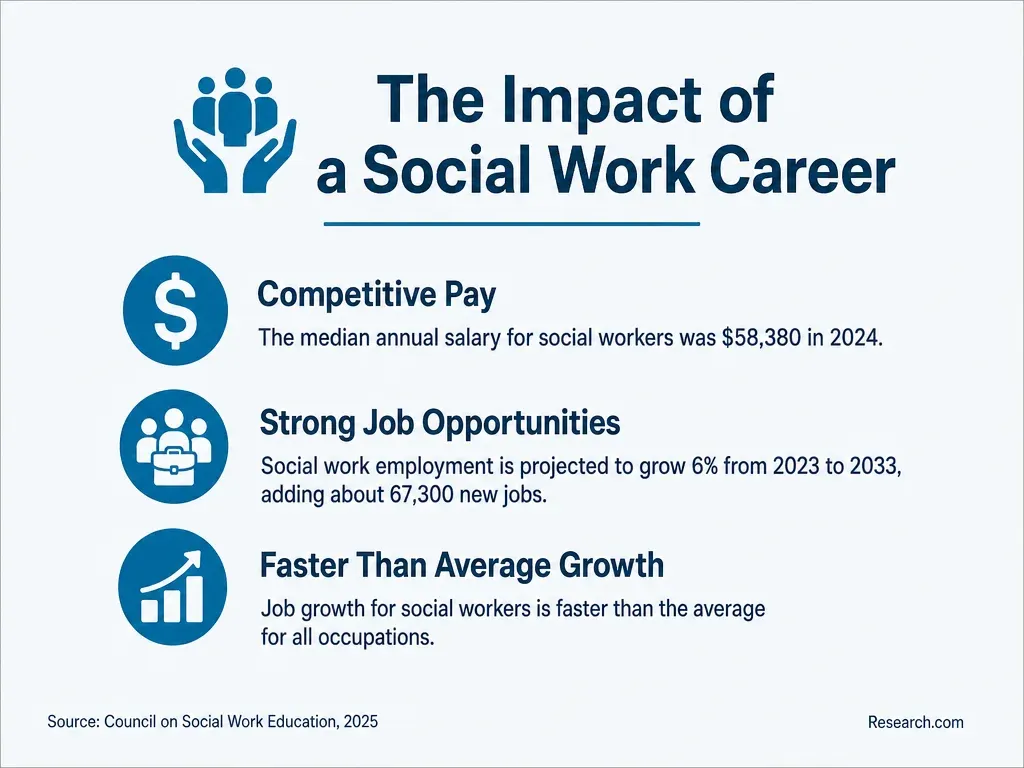
The U.S. Bureau of Labor Statistics reports the following occupation-wide figures. These categories are not ecomapping jobs, license categories, or salary promises for a particular degree.
| BLS occupation | May 2025 median annual pay | Projected employment growth, 2025-2035 |
| Child, family, and school social workers | $59,550 | 4% |
| Healthcare social workers | $67,880 | 8% |
| Mental health and substance abuse social workers | $60,280 | 10% |
These figures provide context for comparing settings, not a return on investment for learning one assessment tool. Pay also varies by location, employer, experience, and role; social worker earnings and location considerations can inform a broader job search. For an immediate next step, compare openings by required degree or license, supervision, caseload, and how much time the role allows for collaborative assessment.
Other Things You Should Know About Social Work
No. Paper or an agency-approved digital tool can work. Choose a format the client can understand and that meets your organization's record-security rules.
Respect that choice. You can discuss relevant supports and barriers without a diagram, while explaining any assessment or documentation requirements that apply to your role.
Yes, if they matter to the person's goals or well-being. Ask what support the community provides rather than assuming an online connection is either reliable or unimportant.
Yes, when the relationship matters to the person. A pet may be a source of comfort, a caregiving responsibility, or both; label its significance in the person's own terms.
- Patient Confidentiality - StatPearls - NCBI Bookshelf - NIH https://www.ncbi.nlm.nih.gov/books/NBK519540/
- Respecting privacy and upholding confidentiality: core ethical duties - PMC https://pmc.ncbi.nlm.nih.gov/articles/PMC12747445/
- Confidentiality | UW Department of Bioethics & Humanities | RAISE https://depts.washington.edu/bhdept/ethics-medicine/bioethics-topics/detail/58
- Standards and Indicators for Cultural Competence in Social Work Practice | socialworkers.org https://www.socialworkers.org/Practice/NASW-Practice-Standards-Guidelines/Standards-and-Indicators-for-Cultural-Competence-in-Social-Work-Practice
- What Is an Ecomap? Meaning, Symbols, Examples, and How to Create One | Creately https://creately.com/guides/understanding-ecomaps/
- 4.5 Visual Tools - Social Work Methods https://wisconsin.pressbooks.pub/social-work-methods/chapter/4-4-assessment-strategies/
- Ecomaps | Safeguarding Network https://safeguarding.network/content/ecomaps
- Patient Privacy and Confidentiality | AMA Code of Medical Ethics https://code-medical-ethics.ama-assn.org/chapters/patient-privacy-and-confidentiality


