2027 Ecological Assessment in Social Work: Connecting Personal Circumstances and Environments
Audited and Verified:
Our Editorial and Data Verification Process
Research.com uses government datasets, official education statistics and primary institutional information to support its career and degree guides. Our review process checks factual accuracy, occupational definitions, source dates and the requirements associated with the credentials discussed.
How This Article Was Fact-Checked
Our editorial team verifies salary estimates, employment projections, education requirements and program information against original data providers and official organizations. Salary figures are checked against the relevant occupational definitions and reporting periods. Information about licensure, accreditation and required in-person training is reviewed separately.
Fact-checked and verified on:

Co-Founder and Chief Data Scientist
A person's needs rarely make sense in isolation from housing, relationships, work, healthcare, and the services available nearby. Ecological assessment helps social workers examine those connections without reducing a client to a diagnosis or a list of problems.
For students and early-career practitioners, it is also a practical skill to look for in coursework and field education. This guide explains how to build and use an ecological assessment, where tools such as ecomaps help, and how to judge whether a social work program will prepare you to apply the approach responsibly.
Key Things You Should Know
- Ecological assessment examines the interaction between a person and their environment; an ecomap can display supports, stressors, and gaps, but it is not a diagnosis.
- A useful assessment combines the person's account with relevant context, such as family relationships, housing, transportation, discrimination, and service access, then links findings to goals the person chooses.
- BSW and MSW students can develop this skill through coursework and supervised field education; degree completion alone does not confer a license or independent clinical authority.
What is ecological assessment in social work?
Ecological assessment is a way of understanding how a person's circumstances and surrounding systems affect one another. It applies social work's person-in-environment perspective: rather than asking only what difficulty a person has, the social worker also considers what relationships, institutions, policies, and material conditions are helping or hindering them.
For example, difficulty attending medical appointments might involve symptoms, but also an unpredictable work schedule, inaccessible transit, a language barrier, or a clinic that cannot offer suitable hours. An ecological assessment helps identify which factors can realistically change and who has the ability to change them.
It is a framework for assessment, not a particular treatment or diagnostic test. It can inform case management, clinical work, school services, and community practice, but it does not replace a required clinical evaluation, safety procedure, or agency-specific assessment. Students considering social work degree planning for prospective students should look for opportunities to practice this kind of contextual reasoning, not just memorize its definition.
How do personal and environmental factors shape an ecological assessment?
Personal factors can include a person's goals, health, coping strategies, identities, skills, preferences, and past experiences. Environmental factors include relationships, housing, employment, schools, healthcare, neighborhood resources, public benefits, and policies. The important question is how they interact: reliable childcare may make a job feasible, while a benefits rule or long bus journey may make the same job difficult to sustain.
Assessment should identify strengths and constraints at more than one level. A supportive relative is an interpersonal resource; an inaccessible application process is an organizational barrier; a shortage of affordable housing is a structural condition. Treating all three as the client's personal responsibility leads to poor goal setting. Conversely, naming a structural barrier does not mean overlooking the person's own priorities and choices.
Clinical assessment may additionally require attention to symptoms and functioning within the practitioner's role and license. Ecological assessment supplies context; it does not authorize diagnosis or psychotherapy. Students interested in clinical practice preparation through an MSW should ask how a program teaches contextual assessment alongside clinical skills, supervision, and scope-of-practice limits.
How do social workers conduct ecological assessments using tools such as ecomaps?
Social workers usually begin with the person's reason for seeking help and the information needed for their role. An ecomap is a visual sketch of the person or household and its connections to people, organizations, and community systems. Labels or different lines can indicate supportive, strained, or limited connections. A genogram, by contrast, concentrates on family relationships across generations; neither diagram establishes facts merely because they appear on paper.
A practical sequence keeps the tool tied to the person's goals rather than turning it into an exhaustive inventory:
- Explain the assessment's purpose, how information will be recorded and shared, and any relevant limits to confidentiality.
- Ask which people, services, places, and institutions the person considers important; include strengths as well as sources of stress.
- Check what each connection actually provides, whether it is accessible, and whether relying on it creates risks or obligations.
- Agree on a manageable goal and an action within the social worker's role, such as exploring a referral or addressing a service-access barrier.
- Revisit the map when circumstances change, distinguishing the person's report from independently verified information.
An ecomap is optional when a conversation or another approved assessment format works better. Avoid contacting people shown on it without appropriate permission, and follow agency rules for records and information sharing. In field education, comparing social work placement support policies can help students find out whether placements offer supervised opportunities to practice assessment, receive feedback, and protect client information.
Accreditation and licensure answer different questions. Institutional accreditation concerns the university; Council on Social Work Education (CSWE) accreditation concerns eligible social work degree programs. A state licensing board decides whether an applicant meets its education and other requirements for a particular license. An employer may impose additional qualifications for an assessment role.
Before enrolling, confirm the exact program and cohort's accreditation status with CSWE and ask the relevant state board whether the degree meets its educational criteria. Then check the board's current application, examination, supervision, and scope rules for the intended license. State license categories differ, and an MSW or completed field placement does not itself authorize independent clinical practice.
This distinction matters when reviewing online BSW curriculum and field education options: an appealing online format is not a substitute for confirming the program's status, placement arrangements, and fit with the state where you intend to work.
Relevant courses commonly include human behavior in the social environment, practice methods, policy, research, and ethics. Their value lies in applying ideas to a case: noticing how a service rule affects access, asking about strengths without making assumptions, and selecting information that is relevant to a client-defined goal.
Simulations can help students practice interviewing, mapping relationships, and explaining their reasoning. Approved field education adds supervised work in an agency setting, where a field instructor can observe whether the student engages respectfully, documents accurately, recognizes uncertainty, and uses consultation. A diagram made for class is evidence of learning, not proof of competence with real clients.
Students interested in systems-level questions can ask whether MSW research assistant roles and academic preparation offer experience studying service access or evaluating programs. Research work can sharpen ecological thinking, but it does not replace the program's required practice and field competencies.
What are social workers' salary expectations and job outlook?
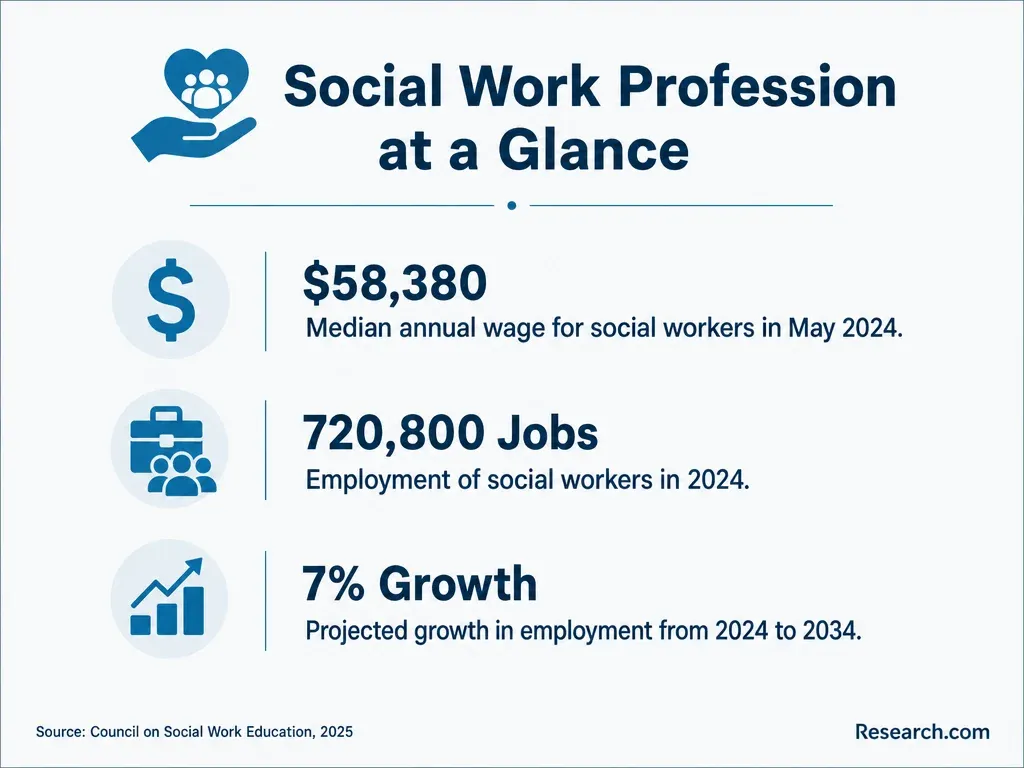
U.S. Bureau of Labor Statistics figures for May 2025 show different median annual wages and projected 2025-2035 growth across social work occupations. These categories describe jobs, not earnings guaranteed by a BSW, MSW, concentration, or license.
| U.S. occupation | May 2025 median annual wage | Projected employment growth, 2025-2035 |
| Social workers, all specialties | $61,780 | 6% |
| Child, family, and school social workers | $59,550 | 4% |
| Healthcare social workers | $67,880 | 8% |
| Mental health and substance abuse social workers | $60,280 | 10% |
Use the category closest to your intended duties, then compare local job postings by setting, required license, experience, and supervision. A national median should not be treated as an entry-level offer or used alone to justify graduate-school debt. MSW compensation and relocation considerations can help frame a geographic comparison, but confirm actual vacancies and living costs before making a decision.
Other Things You Should Know About Social Work
Revisit it when a meaningful circumstance changes, such as housing, caregiving, service eligibility, or the person's goals. Follow the agency's documentation schedule rather than assuming a universal interval.
Yes. Explain its purpose and offer another appropriate way to discuss relevant supports and barriers. Follow applicable agency requirements without pressuring the person to disclose relationships they do not wish to discuss.
No. A map records connections relevant to assessment; it is not blanket permission to contact others. Obtain any required consent and follow confidentiality, safety, and agency rules before sharing information or making contact.
Yes. Practitioners can examine how transportation, housing, services, and policies affect a community. Community-level analysis should use appropriate data and participation methods rather than treating one client's experience as representative of everyone.
- Community health needs assessment | who.int https://iris.who.int/bitstreams/38cf794a-f57d-4a24-b212-199888f8e91f/download
- Use of eco-mapping in health services research - PMC - NIH https://pmc.ncbi.nlm.nih.gov/articles/PMC10230964/
- Social determinants of health | who.int https://www.who.int/news-room/fact-sheets/detail/social-determinants-of-health
- The Importance of Contextual Fit when Implementing Evidence-Based Interventions | ASPE https://aspe.hhs.gov/reports/importance-contextual-fit-when-implementing-evidence-based-interventions
- Social Determinants of Health | Public Health Infrastructure Center | CDC https://www.cdc.gov/infrastructure/public-health-systems-emerging-practices/social-determinants-of-health.html
- Cultural Humility & Cultural Competence in Social Work | du.edu https://socialwork.du.edu/news/cultural-humility-cultural-competence-social-work
- Benefits of Using an Ecomap in Social Work | VCU MSW https://onlinesocialwork.vcu.edu/blog/eco-map-social-work/
- Confidentiality at IU School of Social Work https://socialwork.iu.edu/professional-standards/confidentiality.html
- Chapter 17., Section 5. Addressing Social Determinants of Health and Development - Main Section | Community Tool Box https://ctb.ku.edu/en/table-of-contents/analyze/analyze-community-problems-and-solutions/social-determinants-of-health/main
- 3.2: Systems Theory- Person in Environment/Ecological Perspective - Social Sci LibreTexts https://socialsci.libretexts.org/Courses/Western_Technical_College/Introduction_to_Human_Services/03%3A_Unit_Three--Theoretical_Foundations_of_Human_Services/3.02%3A_Systems_Theory-_Person_in_Environment_Ecological_Perspective