2027 Developmental Systems Theory in Social Work: Understanding Change Across Contexts
Audited and Verified:
Our Editorial and Data Verification Process
Research.com uses government datasets, official education statistics and primary institutional information to support its career and degree guides. Our review process checks factual accuracy, occupational definitions, source dates and the requirements associated with the credentials discussed.
How This Article Was Fact-Checked
Our editorial team verifies salary estimates, employment projections, education requirements and program information against original data providers and official organizations. Salary figures are checked against the relevant occupational definitions and reporting periods. Information about licensure, accreditation and required in-person training is reviewed separately.
Fact-checked and verified on:

Co-Founder and Chief Data Scientist
A client's circumstances can change even when their personal goals stay the same: a caregiver loses work, a school changes its support, or a housing program closes. Developmental systems theory helps social workers understand these shifts without reducing a person's situation to individual choices or a single life stage. This guide is for social work students and early-career practitioners who want to apply the theory thoughtfully. You'll learn what it explains, how to use it in supervised practice, and whether studying it calls for a degree, a particular placement, or more focused training.
Key Things You Should Know
- Developmental systems theory views change as a continuing interaction among people, relationships, institutions, and historical conditions - not as a fixed sequence of age-based stages.
- In practice, use it to revisit assessments and goals as circumstances change; the theory does not replace an evidence-informed intervention, safeguarding procedure, or clinical judgment.
- No separate developmental systems theory license exists. For career planning, match the work you want to do to its actual degree and state licensing requirements; BLS reports a $61,780 median annual wage for social workers across specialties in May 2025, not a guaranteed graduate salary.
What is developmental systems theory in social work?
Developmental systems theory explains human development as an ongoing, two-way process between a person and their changing contexts. Those contexts can include family and chosen supports, schools, workplaces, neighborhoods, services, policies, and broader economic conditions. Experiences accumulate over time, but they do not determine one inevitable outcome.
Consider a hypothetical teenager whose school attendance changes after a family move. A developmental systems perspective asks about the young person's priorities and coping skills and the new commute, peer relationships, caregiver schedules, school responses, and housing stability. It avoids assuming that attendance alone reveals the cause or the appropriate response.
The theory overlaps with person-in-environment and ecological approaches, but it adds particular emphasis on reciprocal change over time: people affect their settings, and settings affect their opportunities and behavior.
It is an explanatory framework, not a diagnosis or a treatment with a single prescribed protocol. Students comparing online social work degree programs should look for coursework and field learning that connect human development to policy, assessment, and intervention rather than expecting a course with this exact theory in its title.
What are the key principles of developmental systems theory?
The principles below help turn a broad theory into questions a student or practitioner can examine. They describe what to attend to; they do not establish a client's needs without assessment.
- Reciprocity: A person shapes relationships and settings while being shaped by them; neither side is the sole cause of change.
- Multiple levels: Individual capacities, close relationships, organizations, communities, and policy conditions can interact.
- Development across time: Earlier experiences matter, but new supports, barriers, and opportunities can alter a trajectory at any age.
- Variation and agency: People respond differently to similar circumstances and should help define their own goals and meaningful supports.
- Context and inequity: Discrimination, inaccessible services, and resource gaps can constrain choices; an assessment should not mistake those barriers for personal deficits.
These principles can inform both generalist and clinical education, but they are not a substitute for learning a specific intervention. When comparing clinical social work master's curriculum options, distinguish courses that explain development from supervised training in assessment and particular treatment approaches.
How do social workers apply developmental systems theory in practice?
Application begins with a collaborative, revisable understanding of the client's situation. The following sequence is useful in a supervised placement or agency role because it links contextual observations to decisions that can be checked later.
- Identify the person's priorities: Ask what they want to change, what is already helping, and whose involvement they welcome.
- Map relevant contexts: Examine relationships, service access, institutional rules, and material conditions without collecting unnecessary private information.
- Choose an action within your role: This might be service coordination, a referral, advocacy about an access barrier, or a supervised intervention - not an unsupported conclusion drawn from the theory alone.
- Reassess over time: Agree on observable indicators, check whether circumstances or goals have changed, and revise the plan with the client and appropriate supervisor.
In the attendance example, a student might learn that transportation is a barrier and, with appropriate consent and supervision, help the family explore available options. They should not infer a diagnosis or disclose information to a school simply because the theory highlights that setting. Agency policy and applicable confidentiality, safety, and reporting rules still govern the work.
Field education is where students can test their reasoning against feedback rather than treating a classroom case as proof of competence. Compare MSW programs with organized practicum resources by asking who arranges placements, what supervision is available, and whether learning tasks let students assess change at more than one level.
There is no license specific to developmental systems theory. Licensure depends on the state and the activities a person intends to perform. State boards set their own education criteria, license categories, application procedures, examinations where required, and rules for supervised experience and clinical practice.
A degree, a field placement, passing an examination, and receiving a license are separate milestones. In particular, an MSW does not by itself authorize independent psychotherapy, and curricular field hours should not be presumed to count as post-degree clinical supervision.
Before choosing a program for a regulated role, check the intended state board's current rules and the school's documentation of how its education meets them. Guidance on social work master's education requirements for licensing can help organize questions, but the board makes the eligibility decision.
What are the salary and job outlook for social workers?
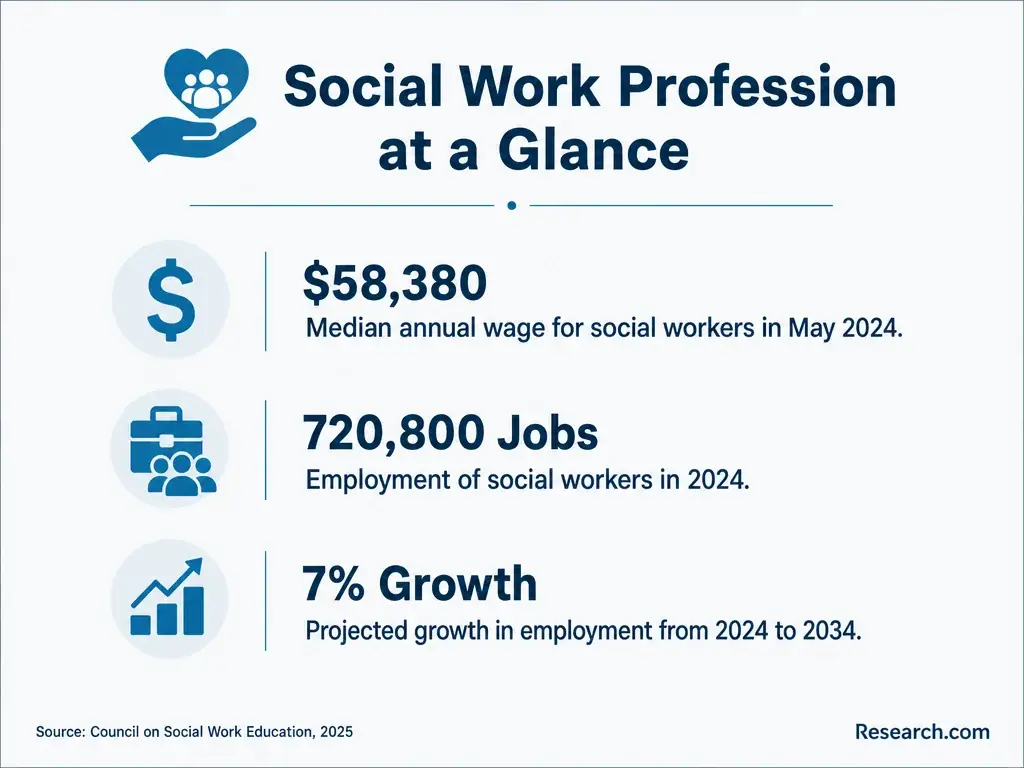
U.S. Bureau of Labor Statistics figures distinguish social work occupations by their work, not by the theories practitioners use. The May 2025 median annual wages and projected employment changes below provide context for related career decisions.
| Occupation | May 2025 median annual wage | Projected employment growth, 2025-2035 |
| Social workers, all specialties | $61,780 | 6% |
| Child, family, and school social workers | $59,550 | 4% |
| Healthcare social workers | $67,880 | 8% |
| Mental health and substance abuse social workers | $60,280 | 10% |
These are occupation-wide medians and national projections, not starting salaries, local job offers, or returns attributable to an MSW or this theory. Pay also depends on setting, location, experience, and role. If additional education is under consideration, pair likely job requirements and local wages with online MSW tuition comparisons and the placement-related costs that published tuition may exclude.
Other Things You Should Know About Social Work
Yes. It encourages a worker to examine what changed in the person's circumstances and supports rather than treating a setback as proof that earlier progress was not real. The explanation still needs to be tested through assessment.
In a case discussion or approved field assignment, explain how the person and relevant settings influence one another over time, identify what information is missing, and justify a revisable goal. Use fictional or properly de-identified material as required by the school and agency.
Yes. Development continues beyond childhood. Changes in work, caregiving, health, housing, relationships, and service access can create new constraints and opportunities throughout adulthood.
Start with the client's account and goals. Treat the worker's contextual interpretation as a question to explore, not a verdict; seek supervision when differences affect safety, consent, or the proposed plan.
- Core Intervention Components: Identifying and... - HHS ASPE https://aspe.hhs.gov/reports/core-intervention-components-identifying-operationalizing-what-makes-programs-work-0
- Understanding social work's role in abortion care - PMC - NIH https://pmc.ncbi.nlm.nih.gov/articles/PMC12021202/
- Developmental Systems | DeLTA Center - The University of Iowa https://deltacenter.uiowa.edu/developmental-systems
- Full article: Drivers of human development: How relationships and context shape learning and development1 https://www.tandfonline.com/doi/full/10.1080/10888691.2017.1398650
- Social Work Theories: Key Frameworks & Models for Practice | CU Online https://online.campbellsville.edu/social-work/social-work-theories/