
2027 Comparing MSW Tuition with Post-Graduation Supervision Costs
Audited and Verified:
Our Editorial and Data Verification Process
Research.com uses government datasets, official education statistics and primary institutional information to support its career and degree guides. Our review process checks factual accuracy, occupational definitions, source dates and the requirements associated with the credentials discussed.
How This Article Was Fact-Checked
Our editorial team verifies salary estimates, employment projections, education requirements and program information against original data providers and official organizations. Salary figures are checked against the relevant occupational definitions and reporting periods. Information about licensure, accreditation and required in-person training is reviewed separately.
Fact-checked and verified on:

Co-Founder and Chief Data Scientist
MSW tuition is usually the largest visible price of preparing for clinical social work, but it may not be the last. After graduation, a prospective independent clinical social worker may need supervised employment, a qualified supervisor, and licensing fees—all under state-specific rules. For students and new graduates weighing programs or job offers, the useful comparison is not tuition versus a single supervision fee. It is the total cost of reaching the intended license, including lost earnings and any supervision an employer does not cover. This guide shows how to build that comparison before committing to a program or position.
Key Things You Should Know
- Compare the full pathway: MSW tuition and fees, field-related costs, post-degree supervision you must pay for, licensing expenses, and earnings affected by either stage.
- Clinical supervision is not priced like an MSW: your direct bill could be $0 if an employer provides qualifying supervision, while externally purchased sessions create an additional cost.
- Use your state board's required experience and supervision rules—not MSW field hours—to calculate the post-degree obligation; the two forms of learning are not interchangeable.
How much does an MSW degree cost?
There is no reliable single tuition price for an MSW. Calculate it from the credits you will actually need and your program's charges for your entry term. A traditional or foundation sequence generally includes more coursework than an advanced-standing sequence, but each school sets its curriculum and prices. Per-credit rates, flat-rate terms, residency classification, enrollment pace, and required fees can all change the total.
Request a written estimate that separates tuition from mandatory university and program fees. Ask whether the quoted rate applies to field semesters, summer terms, online courses, and the entire expected period of enrollment. A comparison of graduate social work costs duration and earnings can help frame questions, but the school's current bill and degree plan must determine your budget.
For a first estimate, multiply required credits × your applicable tuition rate, then add mandatory fees. Keep field placement travel, supplies, and reduced work hours in a separate column: they are real costs, but they are not tuition.
How much does post-graduation clinical supervision cost?
Post-graduation clinical supervision is oversight of qualifying work experience on a state's path toward an independent clinical license. It differs from supervision during an MSW field placement. Depending on the state and job, an employer may provide an eligible supervisor at no direct charge, pay an outside supervisor, share the expense, or leave the graduate to arrange and pay for approved supervision.
If you must purchase it, calculate required sessions or supervision hours × the supervisor's quoted rate. Ask whether the quote covers group or individual supervision, documentation, missed appointments, and any required review of your work. A cheaper arrangement is not a saving if the supervisor, format, or employment setting fails board rules. School-provided field support also should not be mistaken for post-degree coverage; online MSW field coordination models address the educational placement stage.
Direct payments are only part of the picture. A job that supplies qualifying supervision may pay less than an alternative position, while an outside supervision arrangement may require unpaid time away from work. Compare both options using the compensation and schedule actually offered.

How do MSW tuition and supervision costs compare?
Tuition is a defined educational charge; supervision is a conditional post-degree expense whose direct price depends on state rules and the employment arrangement. The table separates amounts you can obtain from a school or employer from costs that require a board-approved supervision plan.
| Cost | What determines it | Best figure to obtain |
| MSW tuition and mandatory fees | Required credits, rates, enrollment, and fees | School estimate for your specific track |
| Field and study-related expenses | Placement location, schedule, travel, and work hours | Personal budget based on likely placements |
| Post-degree supervision | Board rules, eligible employer coverage, and any outside rates | Written job terms and supervisor quote |
| Licensing expenses | State application and examination rules, where applicable | Current board and exam-provider fee schedules |
For a comparable decision, estimate total pathway cost = MSW charges + school-related expenses + supervision you pay for + licensing expenses + income you forgo. Subtract only confirmed grants, reimbursement, or paid-work income that the competing option would not provide. Then compare the result with your expected time to eligibility—not just the advertised tuition. Listings of online MSW programs organized by cost are a starting point, not a substitute for this personalized calculation.
State requirements can change the number of eligible work hours, the amount and frequency of supervision, acceptable individual or group formats, supervisor qualifications, documentation, and the period over which experience must be completed. Work hours are not the same as paid supervision hours: multiplying every required experience hour by a supervisor's hourly rate would greatly overstate a typical supervision bill.
Check the board rules for the state where you intend to qualify, including whether a preliminary license or registration is needed before hours can count. If you might relocate, assess the destination state before accumulating experience; another state may not accept every hour or supervisor arrangement. Differences in compensation also matter when comparing locations, so consider social work salary differences across states alongside—not in place of—each board's requirements.
Ask the board or consult its official materials about eligible settings, remote supervision, documentation, and how a change of supervisor is handled. Obtain an approved plan when the state requires one. A low session rate has little value if the resulting experience cannot be credited.
Neither format is automatically cheaper. An online program may reduce commuting or relocation costs but add technology charges, required campus visits, or travel to a field placement. A campus program may have a lower applicable tuition rate or nearby agency partnerships. Both formats can require scheduled skills activities and in-person field education.
Compare the same entry route and number of required credits, then add fees and realistic travel and scheduling costs. Ask each program where students in your area can complete placements, who secures the site, and whether the program accepts students in your state. When exploring online social work qualifications, confirm the exact MSW program's accreditation status and the educational requirements of the state where you plan to seek licensure. Online delivery does not remove either obligation.
A traditional MSW admits eligible applicants from a range of undergraduate disciplines and includes foundational social work education. Advanced standing is a shorter, program-defined route generally intended for graduates of qualifying BSW programs. Fewer required credits can lower tuition and reduce time out of full-time work, but the actual savings depend on rates, fees, pacing, and aid. A psychology or human services bachelor's degree does not automatically qualify its holder for advanced standing.
If you already have a BSW, ask for a track-specific degree audit and confirm how the school evaluates its accreditation, graduation date, and academic record. If you are planning your undergraduate route, compare accredited bachelor's pathways into social work with a traditional MSW route rather than assuming a future school will award advanced standing. Neither MSW route automatically shortens the state's post-degree clinical supervision requirement.
Compare aid using the amount you can keep, not just the amount offered. Grants and scholarships may reduce charges; loans defer payment and add interest. Assistantships, employer tuition assistance, and paid or employment-based placements depend on eligibility, availability, and written program approval. Ask the financial aid office how enrollment pace and field semesters affect your award.
Build a term-by-term budget for books, technology, screening and onboarding, placement travel and parking, childcare, and paid hours you may need to reduce. Also reserve money for applicable license applications and examinations after graduation. Application costs can accumulate before enrollment: compare each school's fee and requirements—including online MSW reference policy comparisons if references affect which applications are feasible—before paying nonrefundable charges.
Keep field-related lost earnings distinct from later supervision costs. A paid job counts as an MSW field placement only if the program approves the arrangement; similarly, work after graduation counts toward a clinical license only if it satisfies the board's rules.
How do social work salaries and job prospects compare with licensure costs?
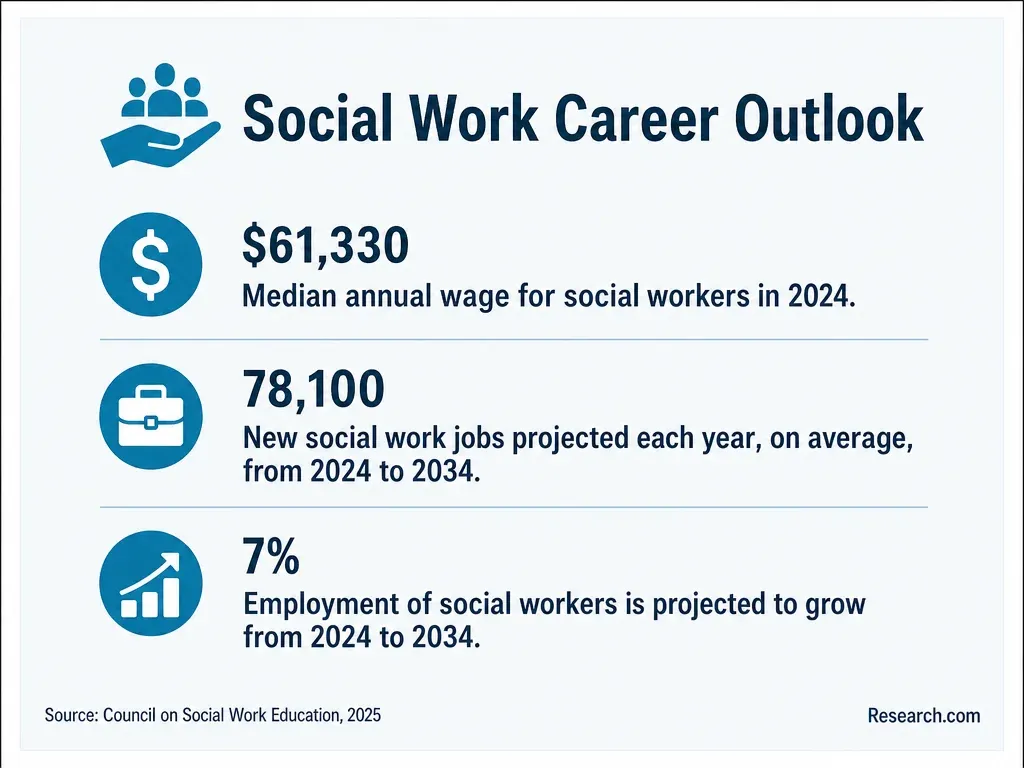
Salary data can test whether an education and licensure plan is affordable, but it cannot predict an individual return. The U.S. Bureau of Labor Statistics reports a May 2025 median annual wage of $61,780 for social workers across specialties and projects 6% employment growth from 2025 to 2035. Mental health and substance abuse social workers had a $60,280 median and 10% projected growth; healthcare social workers had a $67,880 median and 8% projected growth. These are occupational figures, not starting salaries or premiums guaranteed by an MSW or clinical license.
For your decision, compare actual local offers available before and after independent licensure, factoring in benefits, loan payments, and any supervision you must purchase. If the target job does not require independent clinical practice, paying for a clinical licensure pathway may not improve the return. A doctorate is not a substitute for required clinical supervision, either; consider affordable online Doctor of Social Work pathways only if doctoral-level practice leadership or another specific goal justifies their additional cost.
Other Things You Should Know About Social Work
Yes. Ask for a qualified supervisor, paid time for sessions, documentation support, and a backup plan in writing. The employer may decline, and any agreement must still satisfy board rules.
Do not assume loans for an MSW will cover expenses incurred after enrollment ends. Ask the financial aid office what costs your aid can cover and plan separately for post-graduation expenses.
Keep copies of completed, signed records and promptly check the board's procedure for changing supervisors. Do not assume experience accumulated without qualifying oversight will count.
First confirm that the job's duties and setting qualify, the proposed supervisor meets board standards, and the employer permits the arrangement. Obtain any required board approval before paying for sessions.
- Eligibility Requirements for the Practice of Social Work | njconsumeraffairs.gov https://www.njconsumeraffairs.gov/sw/Pages/eligibilityrequirements.aspx
- Social Worker and Social Worker Associate - Licensing Requirements | Washington State Department of Health https://doh.wa.gov/licenses-permits-and-certificates/professions-new-renew-or-update/social-worker-and-social-worker-associate/licensing-requirements
- NYS Social Work: LCSW License Requirements | nysed.gov https://www.op.nysed.gov/professions/licensed-clinical-social-worker/license-requirements
- Paying for Supervision: Barriers, Solutions, and Opportunities | nih.gov https://pmc.ncbi.nlm.nih.gov/articles/PMC10170001/
- Levels and Eligibility Requirements | North Carolina Social Work Certification and Licensure Board https://www.ncswboard.gov/levels-and-eligibility-requirements/
- Requirements for holders of an LMSW seeking an LCSW | Texas Behavioral Health Executive Council https://bhec.texas.gov/texas-state-board-of-social-worker-examiners/applying-for-a-social-work-license/how-to-become-an-lcsw/requirements-for-holders-of-an-lmsw-seeking-an-lcsw/
- GAC - Chapter 135-5 REQUIREMENTS FOR LICENSURE https://rules.sos.ga.gov/gac/135-5
- Cost of Attendance (Budget) | 2025-2026 Federal Student Aid Handbook https://fsapartners.ed.gov/knowledge-center/fsa-handbook/2025-2026/vol3/ch2-cost-attendance-budget
- College Cost and Financial Aid Terms Explained | Illinois State Treasurer https://illinoistreasurer.gov/home/individuals/college-savings/key-terms-for-understanding-education-costs/
- M.S.W. tuition and fees - Social Work - Virginia Commonwealth University https://socialwork.vcu.edu/admissions-and-aid/apply-to-msw/msw-tuition-and-fees/


