
2027 College Counseling Center Social Worker: Responsibilities, Education, and Career Fit
Audited and Verified:
Our Editorial and Data Verification Process
Research.com uses government datasets, official education statistics and primary institutional information to support its career and degree guides. Our review process checks factual accuracy, occupational definitions, source dates and the requirements associated with the credentials discussed.
How This Article Was Fact-Checked
Our editorial team verifies salary estimates, employment projections, education requirements and program information against original data providers and official organizations. Salary figures are checked against the relevant occupational definitions and reporting periods. Information about licensure, accreditation and required in-person training is reviewed separately.
Fact-checked and verified on:

Co-Founder and Chief Data Scientist
College counseling centers need clinicians who can address mental health concerns while recognizing how housing, finances, discrimination, and campus systems affect students. If you are considering this career, the important distinction is between supporting students and providing independently licensed therapy. This guide explains the work, education and licensing routes, salary context, and training choices. It also shows what to check in job postings and programs before committing to an MSW or a campus position.
Key Things You Should Know
- College counseling center social workers may provide therapy, crisis assessment, referrals, and campus consultation, but their duties depend on their license and the center's staffing model.
- An MSW is the usual educational route for social work therapy roles; independent clinical practice also requires the applicable state license and qualifying post-degree experience.
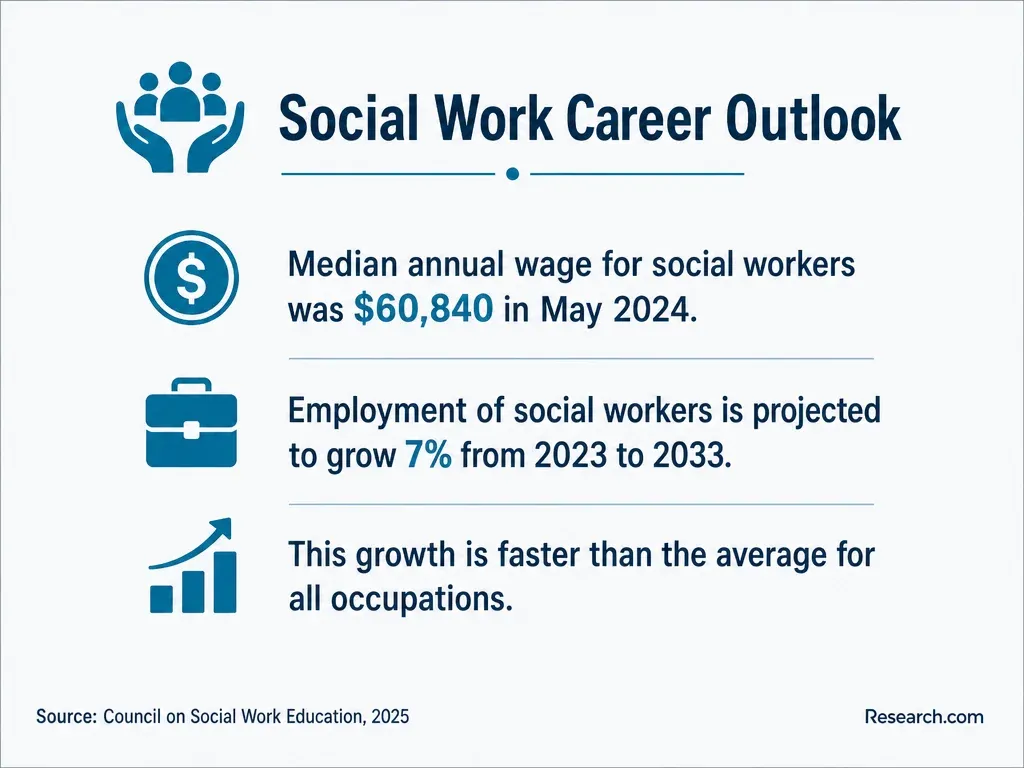
- The closest BLS category, mental health and substance abuse social workers, had a May 2025 median annual wage of $60,280 and projected employment growth of 10% from 2025 to 2035 - not a campus-specific pay forecast.
What does a college counseling center social worker do?
A college counseling center social worker helps students address mental health concerns in the context of academic demands, relationships, identity, finances, and access to services. Depending on the position, the work may include intake and biopsychosocial assessment, short-term individual or group therapy, crisis assessment, safety planning within center protocols, and referrals for longer-term or specialized care.
The role can extend beyond appointments. A social worker might coordinate with disability services or community providers, consult with campus staff without unnecessarily disclosing student information, or help a student navigate housing and financial resources. Centers differ: some primarily offer brief treatment, while others emphasize triage and referral. Ask whether a posting describes a therapist, a case manager, or a position combining both. For a wider view of social work master's roles and employment settings, compare the duties rather than relying on the job title alone.
What degree do you need to become a college counseling center social worker?
For a social work therapist position, an MSW from a qualifying program is generally the relevant degree. A BSW can prepare someone for generalist support or case-management roles, but it does not by itself qualify a person for independent clinical social work practice. A counseling or psychology graduate degree may fit some campus clinician openings, but it leads through a different licensing pathway.
The routes below matter most when deciding whether you need an MSW or a different qualification.
| Preparation | Potential campus role | Key limit |
| BSW | Student support or service coordination, where the employer accepts it | Not an independent clinical therapy qualification |
| MSW | Clinical or case-management roles, subject to license and employer requirements | Degree completion does not itself authorize independent therapy |
| Graduate counseling or psychology pathway | Campus mental health roles under the applicable professional license | Does not confer a social work license |
Someone with a bachelor's degree outside social work can apply to a traditional or foundation MSW program; advanced standing generally requires a qualifying BSW and satisfaction of the program's additional criteria. Review advanced standing and traditional MSW completion planning before assuming prior human-services coursework will shorten the degree. Neither a DSW nor a PhD is ordinarily necessary for an entry-level counseling center clinician role.

What licenses are required for college counseling center social workers?
Requirements depend on the state, the position, and the activities performed. Many therapist postings require an independent clinical social work license; some accept an MSW graduate working toward that license under approved supervision. A nonclinical student-support position may have different requirements. License names, permitted activities, examinations, supervisor qualifications, and experience rules vary by jurisdiction.
Distinguish four steps: completing a qualifying MSW, meeting any requirements for an initial license, documenting board-accepted post-degree supervised experience, and receiving independent clinical authorization. MSW field placement is educational training, not an automatic substitute for post-degree licensure hours. Before accepting a job, ask the employer who provides supervision, whether the position's duties and setting qualify under the state board's rules, and whether the required license must already be active on the start date. Use the relevant board's current rules when understanding degree and licensing expectations for MSW study.
Start by confirming the exact BSW or MSW program's Council on Social Work Education (CSWE) accreditation status and checking the licensing board's education rules in the state where you intend to practice. Institutional accreditation and CSWE program accreditation answer different questions. Then assess whether the program can prepare you for the work campus employers actually advertise.
A useful comparison focuses on evidence the program can provide, not a "clinical" label alone. Ask the program these questions before enrolling:
- Can students pursue behavioral health placements serving emerging adults, and who is responsible for securing and approving a site?
- What supervised opportunities exist to practice assessment, brief intervention, group work, crisis-related decision-making, and referrals?
- Where have graduates obtained relevant positions, and what licensing guidance does the program provide for your intended state?
A placement at a college counseling center is valuable but not essential if another approved site provides comparable supervised skills. If you are starting at the bachelor's level, compare accredited social work bachelor's study formats without assuming a BSW clinical focus replaces an MSW.
Is college counseling center social work a good career fit for you?
This role may suit you if you want direct mental health work with young adults, value attention to social and institutional barriers, and can work within a center's treatment limits while connecting students to continuing care. It also requires comfort with documentation, consultation, urgent concerns, and boundaries in a small campus community.
Before choosing a position, request a realistic account of weekly appointment volume, crisis coverage, after-hours expectations, clinical supervision, referral capacity, and how the center responds when students need care it cannot provide. Ask whether the job requires an independent license or supports an associate-level clinician toward one. If your main interest is benefits navigation or student advocacy rather than psychotherapy, a campus case-management or student-support role may be a more direct fit and may have different credential requirements.
If admission concerns are shaping your plans, planning applications to accessible MSW programs can be useful. Choose among programs you can enter only after checking accreditation, field support, total cost, and fit with the clinical work you hope to do.
Other Things You Should Know About Social Work
Do not assume they can. Privacy rules depend on the institution, the type of record, applicable law, consent, and limited exceptions. Follow the center's records policy and consult its privacy officer rather than making a blanket promise of confidentiality.
Not automatically. The student's physical location can affect licensing and telehealth rules. Check the applicable jurisdiction and employer policy before providing care across state lines.
A dual role can compromise boundaries and the student's freedom to choose care. Disclose the situation through the center's consultation process and determine whether another clinician should see the student.
It depends on the center and position. Some roles include an on-call rotation; others refer after-hours concerns to separate campus or community services. Confirm the schedule and compensation before accepting an offer.
- Interprofessional collaboration between social workers and... - PMC https://pmc.ncbi.nlm.nih.gov/articles/PMC10675993/
- What does a clinical social worker do in practice? | Capella University https://www.capella.edu/blog/social-work-and-human-services/what-does-a-clinical-social-worker-do/
- A Complete Guide to Becoming a Social Worker in California | UMass Global https://www.umassglobal.edu/blog-news/a-complete-guide-becoming-a-social-worker-california
- Field Experience Requirements - SOC-OFE Masters Students | Academics at Walden University https://academicguides.waldenu.edu/fieldexperience/soc/mastersFEM/section4/requirements
- What can you do as a licensed clinical social worker in California? | University of the Pacific https://socialwork.pacific.edu/blog/what-can-you-do-licensed-clinical-social-worker-california
- Medical Social Worker - Explore Healthcare Careers | Mayo Clinic College of Medicine and Science https://college.mayo.edu/academics/explore-health-care-careers/careers-a-z/medical-social-worker/
- Social Work Licensing By State - WNMU https://socialwork.wnmu.edu/social-work-licensing-by-state/
- Full article: Essential: The Roles and Impacts of the University and College Counseling Center | tandfonline.com https://www.tandfonline.com/doi/full/10.1080/28367138.2025.2583873
- What Is a Clinical Social Worker? A Complete Guide | New Mexico Highlands University https://online.nmhu.edu/resources/article/what-is-a-clinical-social-worker/
- Social Work Role | Center for Health Interprofessional Practice and Education https://healthipe.utexas.edu/social-work-role


