2027 Choosing Between an MSW and an MPH for Community Health Careers
Audited and Verified:
Our Editorial and Data Verification Process
Research.com uses government datasets, official education statistics and primary institutional information to support its career and degree guides. Our review process checks factual accuracy, occupational definitions, source dates and the requirements associated with the credentials discussed.
How This Article Was Fact-Checked
Our editorial team verifies salary estimates, employment projections, education requirements and program information against original data providers and official organizations. Salary figures are checked against the relevant occupational definitions and reporting periods. Information about licensure, accreditation and required in-person training is reviewed separately.
Fact-checked and verified on:

Co-Founder and Chief Data Scientist
Community health work can mean helping a family navigate care, designing a neighborhood prevention program, or evaluating health trends across a population. An MSW and an MPH can lead toward these goals, but they develop different skills and open different professional doors.
If you are choosing a graduate degree—or deciding whether you need one at all—this guide compares career fit, coursework, fieldwork, licensing, costs, and program formats. The aim is to help you choose the route that matches the work you want to do, not just the setting where you hope to work.
Key Things You Should Know
- Choose an MSW when your target role centers on social work practice with people and families, especially if it requires a social work license; choose an MPH when it centers on population health, prevention, epidemiology, or program evaluation.
- Neither degree guarantees a particular salary. U.S. Bureau of Labor Statistics figures supplied for May 2025 put healthcare social workers' median annual pay at $67,880, with 8% projected employment growth from 2025 to 2035; those figures describe an occupation, not all MSW graduates or MPH jobs.
- Before enrolling, check the exact program's accreditation, local field or practicum arrangements, total cost, and the qualifications listed in jobs you would actually apply for. An MSW alone does not authorize independent clinical practice.
What is the difference between an MSW and an MPH for community health?
A Master of Social Work (MSW) prepares students for social work practice with individuals, families, groups, organizations, and communities. A Master of Public Health (MPH) prepares students to address health at a population level through approaches such as prevention, epidemiology, policy, and program design. Both can serve communities; the distinction is usually the work you are trained to perform, not whether you care about health equity.
This comparison connects each degree's usual emphasis to the decisions a community health applicant must make. Concentrations vary, so compare actual curricula rather than relying on the degree label alone.
| Decision factor | MSW | MPH |
| Primary lens | People in their social environments; service access, relationships, and systems affecting clients | Health patterns and interventions across populations |
| Representative work | Assessment, care coordination, advocacy, community practice, and—where authorized—clinical services | Needs assessment, epidemiology, health education, prevention, policy analysis, and evaluation |
| Professional pathway | Can support eligibility to apply for state social work licensure, subject to board rules | Does not establish eligibility for social work licensure |
| Best fit when | You want social work roles involving direct service or a social work credential | You want population-level analysis, prevention, or public health program work |
The choice is not always "clients versus data." A community-focused MSW may teach organizing and policy advocacy, while an MPH may involve substantial community partnership. Start with three job descriptions you would want after graduation: if they require an MSW or social work license, an MPH is unlikely to substitute. If they emphasize epidemiologic methods or public health analysis, check whether an MSW offers enough methods training. For a wider view, see online guides to comparing social work degrees before enrollment.
What community health careers can you pursue with an MSW versus an MPH?
MSW graduates may pursue healthcare social work, behavioral health social work, care coordination, housing or benefits advocacy, and community or nonprofit program roles. In a hospital or community clinic, for example, a social worker might assess barriers to discharge, coordinate services, and work with a patient and family on a practical plan. Clinical duties depend on the state license, supervision, and employer—not the job setting alone.
MPH graduates may pursue health education, prevention programming, epidemiology, public health policy, community health assessment, or evaluation. They might analyze local health data, collaborate with residents on an outreach initiative, or measure whether a program reaches its intended population. Epidemiologist and other specialized roles may require particular coursework, technical skills, or experience beyond holding an MPH.
Many program coordination and outreach jobs accept applicants from either background. Read the duties closely: sustained client assessment and service navigation may favor an MSW; surveillance and quantitative evaluation may favor an MPH. Existing experience matters, too. A nonprofit manager with strong service-delivery experience may need targeted data training more than another degree, while an analyst moving into regulated social work needs qualifying social work education. Explore MSW careers across different practice settings to see how broadly MSW roles can differ.
How do salaries and job outlook compare for MSW and MPH careers?
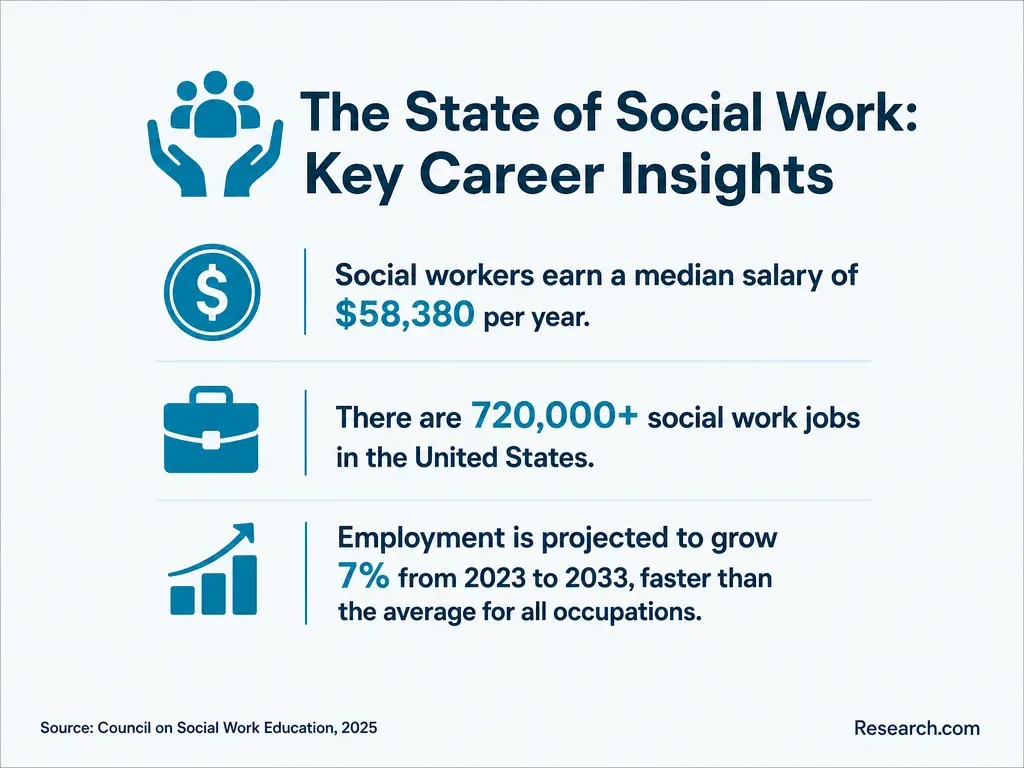
Neither "MSW salary" nor "MPH salary" is a single labor-market category. Pay follows the occupation, employer, location, experience, responsibilities, and sometimes licensure. The following U.S. Bureau of Labor Statistics figures describe social work occupations that may be relevant to community health; they are not starting salaries or earnings projections for degree holders.
| BLS occupation | Median annual pay, May 2025 | Projected employment growth, 2025-2035 |
| Healthcare social workers | $67,880 | 8% |
| Mental health and substance abuse social workers | $60,280 | 10% |
| Child, family, and school social workers | $59,550 | 4% |
| Social workers, all specialties | $61,780 | 6% |
There is no sound way to compare those numbers with a single MPH-wide wage: MPH graduates work in multiple occupations, some of which do not require an MPH. For a useful comparison, identify the specific public health occupation and location you are targeting, then compare its BLS wage and outlook with the relevant social work occupation. Also inspect local postings for pay ranges and credential requirements; understanding location differences in MSW earnings can help frame that research. Growth projections indicate occupational demand, not the likelihood that one graduate will be hired.
If you want a role that requires a social work license, the MSW is the relevant graduate route. States determine qualifying education, license categories, examination requirements where applicable, and any post-degree supervised experience. An MSW, clinical concentration, field placement, or passed examination does not by itself grant a license or independent psychotherapy authority. Check the licensing board in the state where you intend to practice before choosing a program or clinical track.
An MPH generally does not confer a broad public health practice license. An employer may request a role-specific certification, technical training, or another regulated professional credential; requirements differ by position. A voluntary public health certification is not a substitute for a state social work license, and an MPH does not qualify its holder to use a protected social worker title where state law restricts it.
If licensure is part of your decision, compare the exact educational and field requirements with your state board's rules, then confirm how the school supports that path. Guidance on understanding degree and licensing expectations for MSW study is a starting point, not a replacement for a board determination.
For an MSW, check the Council on Social Work Education (CSWE) directory for the exact program and its status. For an MPH, check the Council on Education for Public Health (CEPH) directory for the exact school or program and the degree you would earn. Accreditation of a university, another department, or a differently named degree is not enough to establish the status of your intended program.
Record the program name, campus or delivery arrangement, accreditation status, and your expected entry and graduation dates. Ask the program how its status applies to your cohort, particularly if a listing shows a developing or changing status. Then check any additional rules set by your intended state licensing board or employer; an accreditor does not issue practice licenses.
CSWE status also matters if you hope to use a BSW for advanced-standing MSW admission. Review the undergraduate program itself rather than assuming any social work major qualifies; this overview of online BSW curriculum and field education options can help you identify what to compare before confirming details in CSWE's directory.
MSW study commonly includes human behavior in the social environment, social policy, research, ethics, and practice with people and communities. Students progress through supervised field education tied to social work competencies; a community-health-focused placement might be in a clinic, housing organization, or public agency. Programs differ in their clinical and community or macro offerings, so examine the courses and approved placements rather than assuming every MSW teaches the same balance.
MPH study commonly covers public health foundations and applied methods such as epidemiology, biostatistics, health policy, and program planning or evaluation, with specialization varying by program. Its applied practice experience may center on a population-health project, such as an approved outreach assessment or evaluation deliverable, rather than supervised social work practice with clients.
The distinction affects scheduling and career preparation. Ask each school what students actually do at placement sites, who finds and approves sites, what supervision is available, and which hours must be completed in person. Paid employment or volunteering does not automatically satisfy either program's requirements. MSW field education also does not replace post-degree supervision required for an independent clinical license. When comparing MSW programs, examine social work master's field office services as closely as course descriptions.
Both degrees generally admit applicants with a bachelor's degree, but each school sets its own prerequisites and selection criteria. Applications may request transcripts, a statement of purpose, recommendations, and evidence of relevant work or service. MPH programs may pay particular attention to preparation for quantitative coursework; MSW programs may look for readiness for supervised practice and engagement with social work values. Do not assume a test, specific undergraduate major, or service-hour minimum is universal.
A bachelor's degree outside social work can qualify an applicant for a traditional or foundation MSW. Advanced-standing MSW tracks are different: they generally require a qualifying BSW, often from a CSWE-accredited program, plus any school-specific conditions. A psychology, sociology, or public health bachelor's degree does not automatically qualify for advanced standing. MPH programs may offer different concentration prerequisites, so a career changer should ask how missing statistics or other foundational preparation can be completed.
Compare admission policies alongside the curriculum you need, rather than choosing solely because an application appears simpler. A guide to less restrictive social work master's admission options may help you build a shortlist, but the admissions office must confirm your eligibility for a particular track.
Full-time traditional MSW and MPH programs are often planned around roughly two academic years, but credit loads, placement schedules, summer terms, and part-time options vary. An eligible BSW graduate may find a shorter advanced-standing MSW sequence. That shortened route is not available merely because an applicant already has another bachelor's or master's degree.
Compare the total completion cost, not the advertised price of one credit. For each offer, multiply required credits by the applicable tuition rate, add mandatory fees and expected books or technology costs, then account for travel, placement onboarding, and income you may forgo during field or practicum work. Check whether aid, employer assistance, paid placements, or employment-based placements are actually available and approved for your circumstances. A lower tuition rate may not be the cheaper option if the program requires substantially more credits or time away from paid work.
Request a written degree plan and cost estimate for your entry route and study pace. If an MSW fits your goal, lower-cost options for future MSW students can inform your shortlist; compare those options with MPH offers using the same cost assumptions.
Online classes can reduce commuting, but they do not eliminate applied learning. An online MSW still requires program-approved field education and may include live practice sessions or campus visits. An online MPH may also require synchronous classes, group projects, or an approved applied practice experience. Campus programs can offer easier access to local partners and in-person collaboration, though those advantages depend on the specific school.
For either format, ask for a sample weekly schedule, the location and timing of required experiences, campus-visit dates, placement-search responsibilities, and policies for students who relocate. This matters especially if you work or provide care for someone: an asynchronous lecture does not make a weekday placement asynchronous. Verify that the school can enroll you and support required experiences in the jurisdiction where you live.
Compare the fastest advertised schedule with a pace you can actually sustain. Information on online MSW timelines for working students can help frame questions, but your placement availability and course sequence will determine what is feasible.
How does a dual MSW/MPH degree work?
A dual MSW/MPH program awards both degrees through a coordinated course plan. Schools may allow some approved coursework to count toward both awards, but students must still meet each program's degree and applied-learning requirements. The amount of shared credit, total time, tuition, and placement structure are school-specific; "dual" does not automatically mean inexpensive or quick.
This route can make sense if your intended work genuinely combines social work practice and population-health methods—for example, leading a community behavioral health initiative while retaining eligibility to pursue a social work license. Before applying, identify which duties require the MSW, which require MPH-level methods, and whether one degree plus experience or targeted training would meet the same job requirements. Ask the school for a combined degree audit and separate confirmation of each award's accreditation and any relevant state licensure implications.
If the second degree adds little to the roles you want, compare its extra tuition and lost earnings with a single-degree route. Resources on lower-cost MSW choices and professional development offer one alternative to evaluate; they do not establish that an MSW alone will meet every public health job requirement.
Other Things You Should Know About Social Work
Not necessarily. Many outreach and community health worker positions have different entry requirements. Check local job postings before paying for a graduate degree if that is your immediate goal.
Yes, particularly in community partnerships, policy, and program roles. Data-intensive positions may require additional methods training or demonstrated analytical experience.
Some do, but requirements depend on the work. Compare postings for the populations served, management experience, analytical skills, and any required professional license.
Contact employers or people in similar roles to learn which skills they value. Relevant experience, a bachelor's degree, or targeted training may be a more direct first step than either master's degree.
- Levels and Eligibility Requirements | North Carolina Social Work Certification and Licensure Board https://www.ncswboard.gov/levels-and-eligibility-requirements/
- Social Workers, Marriage and Family Therapists and Professional Counselors Licensure Guide | pa.gov https://www.pa.gov/agencies/dos/resources/professional-licensing-resources/licensure-processing-guides-and-timelines/social-workers-guide
- MSW Tuition and Financial Aid | USC Social Work https://dworakpeck.online.usc.edu/msw/admissions/tuition-financial-aid/
- Concurrent Degree in Public Health (MSW/MPH) | Berkeley Social Welfare https://socialwelfare.berkeley.edu/msw-mph
- Dual Degree in Social Work (MSW/MPH) | NYU School of Global Public Health https://publichealth.nyu.edu/master-public-health/mph-dual-degrees/dual-degree-social-work-mswmph
- MPH/MSW dual degree | missouri.edu https://healthsciences.missouri.edu/public-health/masters-degree-mph/mph-msw-dual-degree/
- MSW/MPH Dual-Degree in Social Work and Public Health | stonybrookmedicine.edu https://socialwelfare.stonybrookmedicine.edu/academics/msw-mph
- Pathway Social Work Licensure in CA | USC Suzanne Dworak-Peck School of Social Work https://dworakpeck.usc.edu/pathway-to-social-work-licensure
- Combined MPH/MSW | Program in Public Health https://publichealth.stonybrookmedicine.edu/academics/degreeoptions/grad/msw
- Public Health, M.P.H. and Social Work, M.S.W. Dual Degree | Saint Louis University https://www.slu.edu/public-health-social-justice/programs/public-health/public-health-mph-social-work-msw-dual-degree.php