2027 BSW Policy Coursework: Connecting Social Programs and Frontline Roles
Audited and Verified:
Our Editorial and Data Verification Process
Research.com uses government datasets, official education statistics and primary institutional information to support its career and degree guides. Our review process checks factual accuracy, occupational definitions, source dates and the requirements associated with the credentials discussed.
How This Article Was Fact-Checked
Our editorial team verifies salary estimates, employment projections, education requirements and program information against original data providers and official organizations. Salary figures are checked against the relevant occupational definitions and reporting periods. Information about licensure, accreditation and required in-person training is reviewed separately.
Fact-checked and verified on:

Co-Founder and Chief Data Scientist
A benefits rule can determine whether a family receives housing support, healthcare, or food assistance - and what a frontline worker can do when an application is denied. BSW social policy coursework helps students connect those rules to the people and communities affected by them. This guide is for prospective and current BSW students who want to understand what they will study, how field placements put policy knowledge to work, and which program features matter if they hope to enter social services or policy-related roles.
Key Things You Should Know
- BSW policy coursework teaches students to examine who qualifies for services, how programs are funded and administered, and where rules create barriers; it does not authorize students to make legal or clinical determinations.
- The strongest connection to frontline work is an approved field placement where students can observe eligibility, referrals, documentation, and advocacy under supervision.
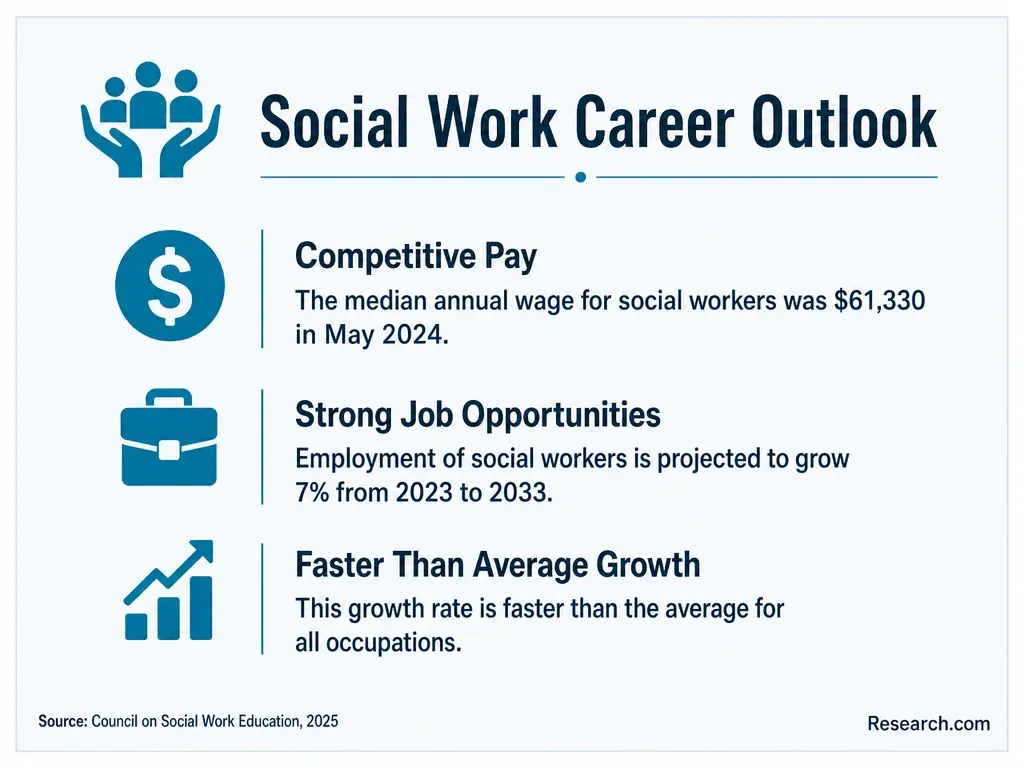
- For salary context, the U.S. Bureau of Labor Statistics reports a May 2025 median of $59,550 for child, family, and school social workers, with 4% projected employment growth from 2025 to 2035; those figures are not BSW starting-salary estimates.
What Is BSW Social Policy Coursework?
BSW social policy coursework studies how governments and organizations define social needs, establish eligibility, fund services, and put rules into practice. It typically combines the history of social welfare with analysis of current programs, legislation, administrative decisions, and their effects on individuals and communities. Course titles and assignments vary by school.
A policy course is not simply a list of benefits. Students may compare a program's stated goal with what happens when someone encounters an application deadline, a documentation requirement, or a service shortage. They learn to distinguish a statute from an agency procedure and to ask whose perspective is missing from a policy decision. Those habits support generalist practice alongside coursework in human behavior, research, ethics, and work with individuals, families, groups, and communities.
Policy study continues in some graduate programs, but a BSW course has a different purpose from specialized MSW preparation. Students considering that progression can use MSW curriculum and licensing preparation questions to identify what additional education a particular role may require.
What Social Welfare Policies and Programs Do BSW Students Study?
Programs commonly use major U.S. service systems to show how a policy moves from legislation and funding to an agency decision. The examples below are study areas, not a promise that every BSW program teaches each one in equal depth.
| Study area | Frontline policy question | Possible learning task |
| Income and food assistance | How do eligibility and reporting rules affect access? | Compare a program's stated purpose with its application process. |
| Healthcare coverage and services | How do coverage rules and provider availability shape referrals? | Trace a hypothetical referral through coverage and service constraints. |
| Housing and homelessness services | How are limited resources prioritized? | Examine how eligibility, waitlists, and local capacity interact. |
| Child and adult welfare | How do protection duties and family supports intersect? | Analyze the different roles of law, agency procedure, and professional judgment. |
| Disability and aging services | What affects access, accessibility, and service coordination? | Map the organizations involved in a service pathway. |
Students should check current federal and state program materials when completing assignments: eligibility, funding, and administration can change, and local implementation differs. A useful policy analysis asks not just whether a service exists, but whether a person can realistically reach it.
Students drawn to designing or evaluating systems over the long term may eventually investigate advanced study, including planning a shorter social work practice doctorate. A doctorate is not needed to learn benefits navigation or begin BSW-level frontline work.
How Does Social Policy Coursework Prepare BSW Students for Frontline Practice?
Policy knowledge helps a new worker identify the difference between a client's goal and the options an agency can actually offer. Consider a hypothetical renter seeking help after a loss of income. A BSW student can examine the relevant housing program's eligibility rules, application process, documentation requirements, and referral network while recognizing that the person may also face transportation, language, or internet-access barriers. The worker's role is to explain available processes accurately, coordinate within agency policy, and seek supervision when a decision is unclear - not to promise an award or provide legal advice.
This connection runs in both directions. Frontline observations can reveal recurring barriers, such as forms that are hard to access or referrals that lead to full programs. With appropriate supervision and privacy safeguards, students can bring those patterns into policy analysis or agency improvement discussions without disclosing identifiable client information.
Policy literacy supports clinical settings, too, but it is distinct from psychotherapy training or independent clinical authority. Students whose long-term goal is treatment work should compare choosing a clinically focused social work master's program with the state-specific licensing steps required after graduation.
An approved BSW field placement lets students see how agency rules, public programs, and professional judgment meet in everyday service. Depending on the site and learning agreement, a student might observe intake, help maintain a resource directory, support referrals, or examine a nonidentifying service-access problem. The school and agency determine permitted tasks, supervision, evaluations, and accepted hours; a paid job or volunteer position does not automatically count as field education.
Before accepting a placement, ask the field office whether the site offers supervised opportunities to learn about eligibility, referrals, documentation, and the population you hope to serve. Also ask who provides field instruction, what training and screening the agency requires, how concerns are handled, and whether the schedule and travel are workable. A placement focused entirely on repetitive administrative tasks may offer too little opportunity to connect policy concepts with generalist competencies.
BSW field education is a degree requirement, not post-degree supervised clinical practice. Students considering a later MSW can compare advanced standing and traditional field education differences; the receiving MSW program decides eligibility and its own field requirements.
Depending on the employer and state, a BSW graduate may pursue generalist social work, case management, service coordination, outreach, child or adult welfare, housing assistance, or community-program roles. Some policy-adjacent jobs involve gathering community input, maintaining referral information, tracking program operations, or helping an agency explain proposed changes. Job titles alone do not establish whether a position requires a BSW, a license, or another credential.
Compare openings by their actual duties. A benefits-navigation role may reward knowledge of eligibility systems and careful documentation; a community-outreach role may place more weight on partnerships and accessible communication. Ask about caseloads, training, supervision, safety procedures, travel, and whether the worker can escalate a policy barrier. Some assistant or coordinator positions also accept human services graduates, making targeted experience a possible alternative to another degree.
Later MSW study may open different specialized or leadership opportunities, depending on the job. Students considering that step can explore MSW education and career pathway connections rather than assuming a BSW policy course qualifies them for every policy or clinical position.
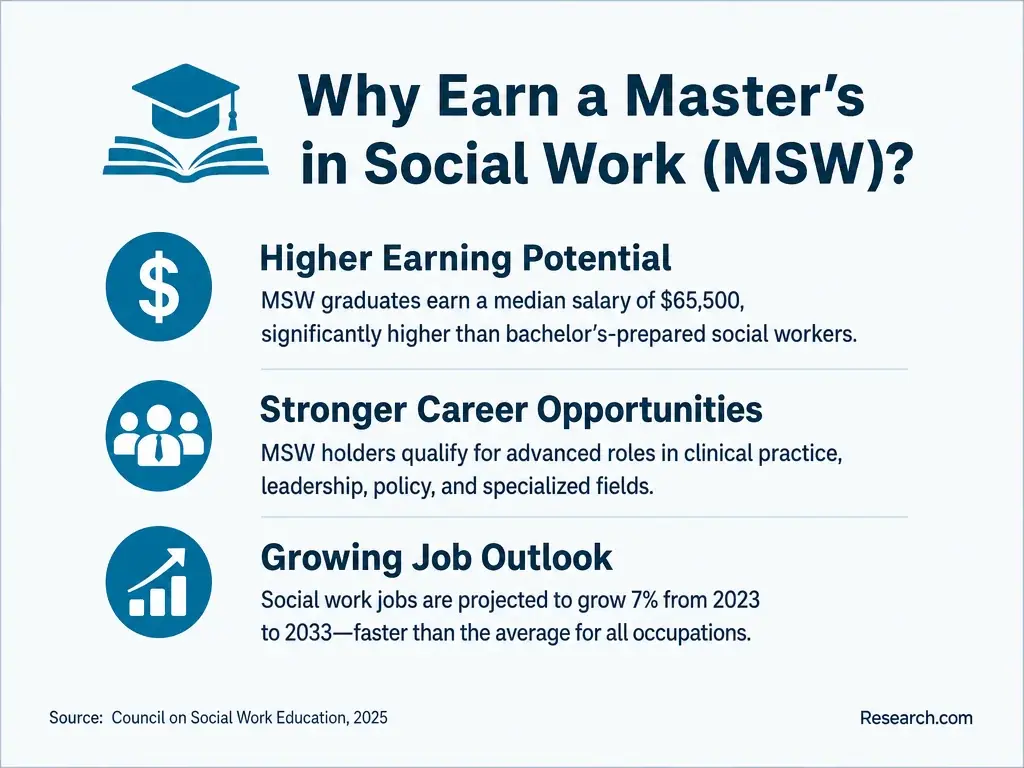
There is no single national salary for "BSW graduates." The U.S. Bureau of Labor Statistics (BLS) reports wages by occupation, not by undergraduate major or degree alone. These May 2025 medians and 2025-2035 projections provide context for social work occupations a graduate might investigate.
| BLS occupation | May 2025 median annual wage | Projected employment growth, 2025-2035 |
| Social workers, all specialties | $61,780 | 6% |
| Child, family, and school social workers | $59,550 | 4% |
| Healthcare social workers | $67,880 | 8% |
| Mental health and substance abuse social workers | $60,280 | 10% |
These medians include workers with different degrees, experience, licenses, locations, and employers. They should not be read as entry-level offers or evidence that a BSW alone qualifies someone for every job in a category. Compare local postings with the exact role and its credential requirements; public-sector pay may also follow a published civil-service scale.
If an MSW is part of your longer-term salary plan, consider its cost and time away from paid work alongside prospective earnings. Exploring graduate assistant roles during an MSW is one possible financing step, but availability and eligibility depend on the school.
The Council on Social Work Education (CSWE) accredits social work programs; institutional accreditation applies to the college or university. Both matter, but they are not interchangeable. Before enrolling, confirm the BSW program's CSWE status and how that status applies to your expected graduation cohort. The program - not a general claim about the institution - is the relevant starting point for this check.
A BSW does not issue a license. State licensing boards set their own education, application, examination, and other requirements, and license titles and permitted duties vary. An employer may impose additional qualifications even when a state does not require a license for a particular position. Students can use social work bachelor's accreditation questions to frame program inquiries, then confirm licensing eligibility with the board in the state where they intend to work.
CSWE-accredited BSW education may also be relevant to advanced-standing MSW admission, but each MSW program decides whether an applicant meets its criteria. Neither BSW graduation nor admission to an MSW grants independent clinical practice rights.
Online and campus BSW programs can teach the same core policy concepts, but delivery changes how students discuss cases, practice skills, meet instructors, and travel to field sites. An online course may be asynchronous while its skills lab, field seminar, or placement has fixed hours. A campus program may offer easier access to local partners but still require travel to an agency.
Compare programs using the schedule you would actually live with: required live sessions, campus visits, placement days, agency geography, and who helps secure an approved field site. Ask whether a placement near home is possible and what happens if a proposed site cannot provide qualified instruction. Online delivery alone does not make field education self-paced; discussions of self-paced MSW options and their scheduling limits illustrate why students should separate course flexibility from placement obligations.
Admission to a university and admission to its BSW major may be separate steps. Programs may review prior coursework, grades, writing, references, service experience, or an interview, but requirements differ. Field-placement onboarding can add conditions - such as agency screenings - after academic admission. Ask the program when the social work major begins and which policy or foundation courses must be completed before field education.
Applicants with another academic background should request a transcript evaluation showing which credits apply to the BSW, not just which credits the university accepts. Relevant community work can strengthen an application or clarify career fit, but it does not automatically replace required courses or an approved placement.
For students already planning beyond the BSW, comparing admission criteria across online MSW programs is a separate task. MSW admission rules should not be assumed to describe entry into a BSW major.
How Long Does a BSW Take, and What Does It Cost?
A BSW is ordinarily organized as an undergraduate degree, but time to completion depends on accepted transfer credit, course sequencing, enrollment pace, and field-placement availability. Request a written degree plan showing when policy courses and field education occur. A transfer student may save time on general education courses yet still need to complete the program's sequenced social work requirements.
For cost, compare more than advertised tuition: required fees, books, technology, agency screening, placement travel and parking, and any reduction in paid work during field education can affect affordability. Ask whether aid applies at your planned enrollment pace and whether an employment-based placement is possible under the school's rules; do not budget on the assumption that a paid position will be approved.
If graduate study is likely, evaluate its cost separately rather than treating a BSW tuition quote as the full price of the career plan. Online MSW tuition comparisons can help start that later calculation, provided you also account for fees and field-related costs.
Other Things You Should Know About Social Work
No. Focus on finding current authoritative rules, understanding how they are administered, and explaining their practical effects. Specific eligibility details can change.
Follow your school's and agency's privacy rules first. Use an approved, properly de-identified example or a clearly hypothetical scenario when permission to use real information has not been established.
No. Within their roles and agency rules, social workers may also identify access barriers, share community feedback, improve referral information, or contribute to program evaluation.
A focused question, current and clearly identified policy sources, attention to implementation and affected communities, and realistic conclusions that distinguish evidence from assumptions.
- A History of Social Work in Public Health - PMC - NIH https://pmc.ncbi.nlm.nih.gov/articles/PMC5731072/
- Policy Analysis | POLARIS https://www.cdc.gov/polaris/php/cdc-policy-process/policy-analysis.html
- MSW Program Pathways & Curriculum - School of Social Work | Boston College https://www.bc.edu/bc-web/schools/ssw/academics/msw-program/msw-curriculum.html
- 10 Careers You Can Pursue With a Bachelor's in Social Work | UMass Global https://www.umassglobal.edu/blog-news/careers-for-social-work-majors
- Program: Social Work, B.S.W. - CSU East Bay Catalog https://catalog.csueastbay.edu/preview_program.php
- BSW frequently asked questions - UNC School of Social Work https://ssw.unc.edu/bsw-frequently-asked-questions/
- What Classes Will I Take When Earning a BSW? | Walden University https://www.waldenu.edu/online-bachelors-programs/bachelor-of-social-work/resource/what-classes-will-i-take-when-earning-a-bsw
- Policy Advocacy and Practice in Social Work | Tulane University https://online.tulane.edu/social-work/blog/policy-advocacy
- Accreditation | Council on Social Work Education https://www.cswe.org/accreditation