2027 Area Agencies on Aging: How Social Workers Connect with Community Resources
Audited and Verified:
Our Editorial and Data Verification Process
Research.com uses government datasets, official education statistics and primary institutional information to support its career and degree guides. Our review process checks factual accuracy, occupational definitions, source dates and the requirements associated with the credentials discussed.
How This Article Was Fact-Checked
Our editorial team verifies salary estimates, employment projections, education requirements and program information against original data providers and official organizations. Salary figures are checked against the relevant occupational definitions and reporting periods. Information about licensure, accreditation and required in-person training is reviewed separately.
Fact-checked and verified on:

Co-Founder and Chief Data Scientist
An older adult may need meals, transportation, help at home, and caregiver support at the same time, but each service can have different eligibility rules and providers. Area Agencies on Aging (AAAs) help people navigate that fragmented system.
This guide is for social work students, early-career practitioners, and human services professionals considering aging-services work. It explains how referrals become coordinated support, what an AAA can and cannot provide, and how to judge whether a social work degree, license, or more targeted experience fits the job you want.
Key Things You Should Know
- Area Agencies on Aging are locally designated organizations in the Older Americans Act network; they coordinate services but do not necessarily provide every service themselves.
- Effective resource connection goes beyond handing someone a phone number: workers assess priorities, check eligibility and availability, make referrals with consent, and follow up when appropriate.
- Many Older Americans Act services focus on adults age 60 and older, but job qualifications and service eligibility vary by program; an MSW or clinical license is not required for every AAA role.
What are Area Agencies on Aging, and how do they serve older adults?
An Area Agency on Aging is an organization designated by a state or territory to plan and coordinate services within a defined geographic area under the federal Older Americans Act.
An AAA may be a government office or a nonprofit. It assesses local needs, funds or contracts with providers, shares information, and monitors parts of the service network. The Administration for Community Living oversees the federal aging-services framework, while state agencies and local AAAs administer it.
For an older adult, an AAA is often a practical starting point rather than a single provider of everything needed. Staff may explain options, connect someone to a meal program, or arrange a more detailed assessment.
Service availability depends on local funding, provider capacity, and program rules. Most core Older Americans Act services target people age 60 or older; some caregiver and related programs have different eligibility criteria.
This mix of individual assistance and regional planning is what distinguishes an AAA from a typical clinical practice. Students considering online social work study and professional preparation should ask whether a program offers field opportunities with AAAs or their community partners, not assume that every aging placement involves the same duties.
How do social workers connect older adults with community resources?
Social workers and other AAA staff begin with the person's priorities, not a standard list of services. They may ask about daily activities, food access, transportation, housing, caregiving, language access, and what the older adult wants to manage independently. They then match those needs with local programs while checking practical barriers such as waitlists, service areas, application requirements, and the cost to the person.
A useful referral process has several stages. These steps help a worker identify whether a connection actually works:
- Clarify the older adult's goals, immediate concerns, preferences, and permission to involve caregivers or other providers.
- Identify possible public benefits, nonprofit services, and informal supports; confirm current eligibility and capacity rather than relying on an outdated directory.
- Help with applications or a supported referral when needed, sharing only information the person has authorized and the receiving organization needs.
- Document the plan and follow up when the role and agency procedures call for it, especially if a waitlist, language barrier, or failed referral could leave a need unmet.
For example, a transportation referral is incomplete if the service cannot accommodate a wheelchair or does not operate on appointment days. A worker might explore a different provider or help the person plan another option. This is service coordination, not a guarantee that a scarce service will become available.
Some experienced social workers move from individual coordination into network design, contracting, or evaluation. A practice-focused doctorate can support certain leadership goals, but online DSW programs organized by tuition are not a prerequisite for making referrals or improving an AAA's resource directory. Relevant agency experience and targeted training may be the more direct route.
What services do Area Agencies on Aging coordinate for older adults and caregivers?
Offerings differ by location, but AAAs commonly connect people with home-delivered or congregate meals, transportation, in-home assistance, health promotion, caregiver support, and information about benefits.
They may also support access to legal assistance or long-term care options counseling. Some services are delivered by the AAA; others come from contracted or independent community organizations.
The distinction between coordination and direct provision matters when explaining choices to a client. This table shows common connections, not a promise that every AAA offers each service.
| Need | Possible connection | What to check locally |
| Food access | Home-delivered or community meals | Delivery area, enrollment criteria, and waitlists |
| Getting to appointments | Community transportation or ride programs | Accessibility, booking rules, and operating hours |
| Caregiver strain | Caregiver education, support, or respite | Caregiver eligibility, available hours, and provider capacity |
| Long-term care decisions | Options counseling or a referral to specialized assistance | Which organization provides impartial counseling and how to reach it |
| Benefits questions | Benefits screening or a State Health Insurance Assistance Program referral | Enrollment periods, documentation, and the counselor's scope |
AAAs may connect residents to long-term care ombudsman programs, but ombudsmen have a distinct advocacy role and should not be treated as the AAA's general case managers. Adult protective services likewise has separate responsibilities. Workers should explain these boundaries rather than promise that one referral resolves a complaint or safety concern.
People can help older adults navigate this network without immediately pursuing an MSW. Even accelerated Master of Social Work admission options are worth considering only when the intended job calls for graduate social work preparation; they do not substitute for learning local providers, benefits rules, and referral procedures.
There is no single national "AAA social worker" license. Requirements depend on the state, job duties, employer, and whether the position uses a protected social work title. A resource specialist may not need a social work license; a position advertised specifically as a licensed social worker may. Independent psychotherapy requires separate state-specific clinical authorization and is not part of ordinary resource referral.
Before applying, compare the posting's required credential with the state social work board's rules and the work you would actually perform. Graduation, eligibility to apply, passage of an exam where required, license issuance, and authority for independent clinical practice are different milestones.
For online study, MSW professional licensure disclosure comparisons can help frame questions, but the board and program must confirm the requirements for your jurisdiction and cohort.
Training in benefits counseling, dementia communication, or care coordination may improve job readiness. A course certificate or voluntary specialty credential does not replace a state license where one is required or expand a worker's legal scope of practice.
What are the salary and job outlook for social workers in aging services?
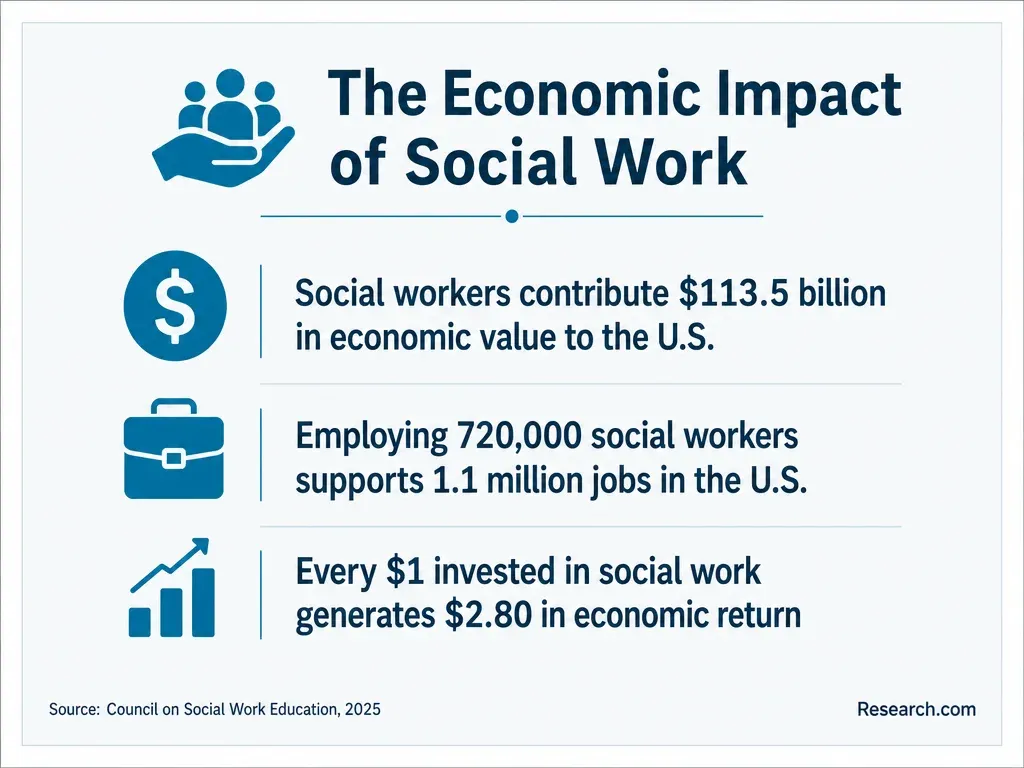
The U.S. Bureau of Labor Statistics does not publish a wage or growth rate specifically for AAA social workers. Its healthcare social worker category can provide context for some aging-related roles, but many AAA information-and-referral or administrative jobs are classified differently. The distinction matters when evaluating an offer.
These national BLS figures show occupational context, not expected pay or growth at an individual AAA.
| BLS occupation | Median annual pay, May 2025 | Projected employment growth, 2025-2035 |
| Healthcare social workers | $67,880 | 8% |
| Social workers, all specialties | $61,780 | 6% |
The broader social worker figure includes specialties unrelated to AAAs, and neither figure predicts a new graduate's starting salary. Compare local postings by duties, degree requirements, public-sector pay grade if applicable, benefits, and location. State-level salary context for MSW careers can supplement that comparison, but an actual AAA pay range is the better basis for a career decision.
Other Things You Should Know About Social Work Programs
Search for the state's aging agency or contact the federal Eldercare Locator at 1-800-677-1116. Have the older adult's ZIP code ready, because AAA service areas are geographic.
Possibly. Eligibility varies by program, and some caregiver services cover people caring for an eligible older adult. Ask the local AAA about the specific service and other organizations that serve younger adults.
Not always. Older Americans Act programs generally do not use income screening for core services and may invite voluntary contributions, while other referred programs may have charges or different eligibility rules. Confirm costs with the specific provider before enrolling.
Tell the referring worker what happened, such as a waitlist, ineligibility, or an inaccessible location, and ask whether another provider or program is available. A completed referral is not the same as receiving help.
- A Study of the Roles and Use of Licensed Social Workers in the United States | ASPE https://aspe.hhs.gov/study-roles-use-licensed-social-workers-united-states
- Aging Services Network | mass.gov https://www.mass.gov/info-details/aging-services-network
- What If I Suspect Abuse, Neglect, or Exploitation? | acl.gov http://acl.gov/programs/protection-and-advocacy-systems/what-if-i-suspect-abuse-neglect-or-exploitation
- Care Coordination | Agency for Healthcare Research and Quality https://www.ahrq.gov/ncepcr/care/coordination.html
- A Promising Model for Health and Social Care Coordination | nih.gov https://www.ncbi.nlm.nih.gov/books/NBK604800/
- Area Agencies on Aging | Department of Health and Human Services https://www.maine.gov/dhhs/oads/get-support/older-adults-disabilities/area-agencies-on-aging
- Functional Assessments and Quality Improvement | medicaid.gov https://www.medicaid.gov/medicaid/home-community-based-services/home-community-based-services-quality/functional-assessments-quality-improvement
- Older Americans Act: Overview and Funding | congress.gov https://www.congress.gov/crs-product/R43414
- Adult Protective Services (APS) | ca.gov https://www.cdss.ca.gov/inforesources/adult-protective-services
- Interventions and Response | National Center on Elder Abuse https://ncea.usc.edu/interventions/