
Most Affordable Diagnostic Medical Sonographer Schools & Training in Beaumont for 2027
Audited and Verified:
Our Editorial and Data Verification Process
Research.com uses government datasets, official education statistics and primary institutional information to support its career and degree guides. Our review process checks factual accuracy, occupational definitions, source dates and the requirements associated with the credentials discussed.
How This Article Was Fact-Checked
Our editorial team verifies salary estimates, employment projections, education requirements and program information against original data providers and official organizations. Salary figures are checked against the relevant occupational definitions and reporting periods. Information about licensure, accreditation and required in-person training is reviewed separately.
Fact-checked and verified on:

Co-Founder and Chief Data Scientist

Reviewed by Karolina Broda
Fact-Checker and Data Verification
Choosing an affordable sonography program is not just a tuition decision: clinical training, certification eligibility, and the cost of getting to a placement site can change its value. The U.S. Bureau of Labor Statistics projects 13.9% national employment growth for diagnostic medical sonographers from 2025 to 2035. For prospective students and career changers, this guide explains the trade-offs behind Beaumont training options. It also accompanies the Most Affordable Medical Sonographer Trade Schools in Beaumont for 2027 ranking, created by the Research.com team of data scientists to help students make an informed choice.
Key findings about medical sonographer degrees in Beaumont
- Compare the cost to become job-ready, not tuition alone. Clinical-site travel, required supplies, examinations, and time away from work can change which Beaumont option is most affordable.
- Check the exact program's clinical training and certification pathway. Institutional accreditation and a similarly named credential do not, by themselves, establish eligibility for an ARDMS examination.
- Use wages as context, not a starting-pay promise. The national median for diagnostic medical sonographers was $96,590 in May 2025, according to the U.S. Bureau of Labor Statistics; Beaumont offers may differ.
Table of Contents
- Most Affordable Diagnostic Medical Sonographer Schools & Training in Beaumont for 2027
- What can I expect from a medical sonographer trade school program in Beaumont?
- Where can I work with a medical sonographer trade school training in Beaumont?
What can I expect from a medical sonographer trade school program in Beaumont?
Diagnostic medical sonography training prepares students to use ultrasound equipment to produce images, assess image quality, document findings, and communicate with patients and interpreting clinicians. It combines classroom study, supervised scanning practice, and clinical rotations. A classroom-only credential is not equivalent to a program that arranges supervised patient examinations.
For a Beaumont applicant, the practical question is where rotations occur and whether their schedule and travel demands are workable. Ask Lamar Institute of Technology for its current program plan, clinical-site arrangements, and any placement conditions before comparing its published price with another option. A hospital job with employer-supported training may suit someone who already holds relevant clinical qualifications, but it should not be assumed to replace a full entry-level sonography program or meet a certifier's eligibility rules.
Where can I work with a medical sonographer trade school training in Beaumont?
Sonographers work in hospitals, outpatient imaging centers, physician practices, and specialty clinics, according to the U.S. Bureau of Labor Statistics. Beaumont-area applicants should search by both setting and specialty: a hospital may need coverage across shifts, while an outpatient practice may concentrate on a narrower range of examinations. The number and type of nearby openings can affect how quickly a new graduate finds a suitable role.
Before enrolling, review current Southeast Texas postings for requested certifications, specialties, and experience. Then ask the program whether its rotations expose students to those examinations. Students willing to commute or relocate may have a wider first-job search than those limited to one city.
The national median annual wage for diagnostic medical sonographers was $96,590 in May 2025, according to the U.S. Bureau of Labor Statistics. This is the midpoint for employed workers nationwide - not Beaumont-specific pay and not a likely offer to every new graduate. Specialty, shift, employer, certification, and experience can affect an offer.
Use local job postings and written offers when estimating a return on training. Compare the likely change from your current earnings against program costs and earnings forgone during clinical rotations, rather than applying the national median to your first year of work.
Duration depends on the credential, entry prerequisites, course sequence, and availability of clinical placements. An associate-degree pathway generally takes longer than a focused certificate intended for applicants who already have relevant healthcare training. Part-time study can spread tuition payments but may delay completion, especially if clinical rotations follow a fixed schedule.
Request a term-by-term plan rather than relying on an advertised completion time. Confirm the required lab, scanning, and clinical hours; whether those hours include evenings or travel; and what happens if a rotation is delayed. Do not assume another school's certificate and associate program provide the same hands-on preparation simply because both teach ultrasound.
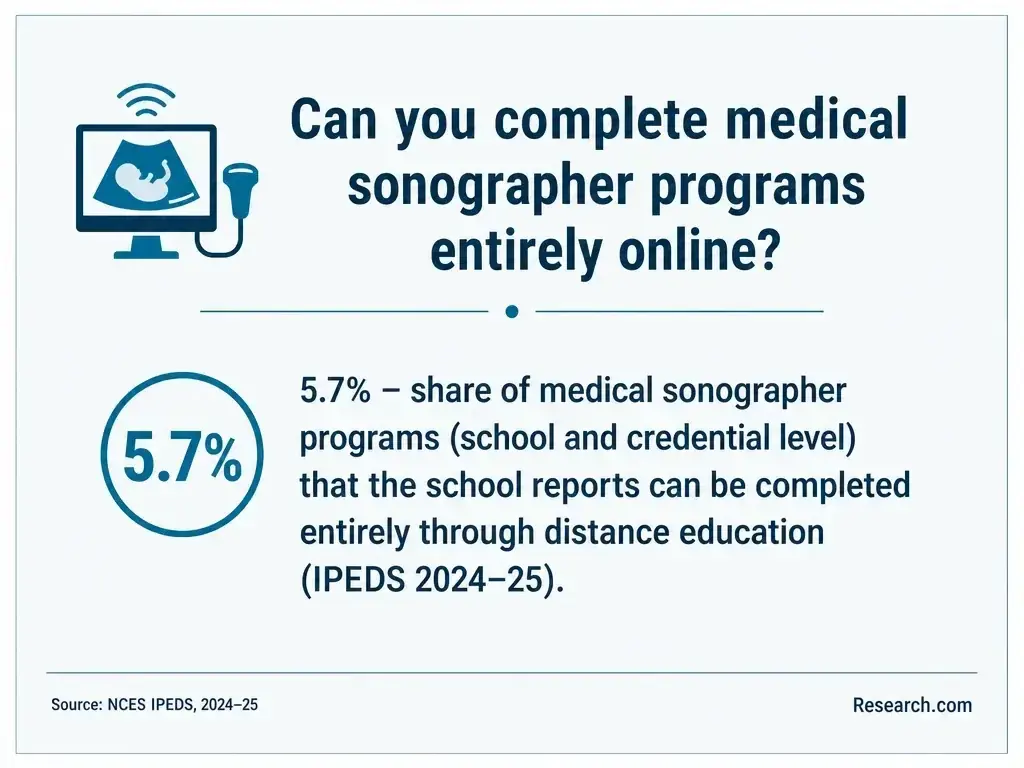
Online delivery can make lectures and some assignments easier to fit around work. Probe handling, image acquisition, patient positioning, and supervised examinations still require in-person practice. A fully remote course should not be treated as equivalent to clinical sonography training.
This comparison shows what each format changes - and what it cannot remove:
| Format | Potential advantage | Point to verify |
| On-campus | Regular access to scheduled scanning labs | Clinical-site location and travel schedule |
| Hybrid | Some coursework can be completed remotely | Required campus visits, labs, and supervised rotations |
| Online coursework | Flexible study for eligible theory courses | Where hands-on training occurs and whether the complete pathway meets certification prerequisites |
For someone working in Beaumont, hybrid study is useful only if its required labs and rotations are realistically accessible. Ask for the in-person calendar before paying an enrollment deposit.
A reliable Beaumont-wide average should not be inferred from a single school's posted tuition or from a ranking. Published charges can differ by residency, enrollment status, and program year, while clinical expenses may sit outside the tuition figure. Obtain a current, itemized estimate from Lamar Institute of Technology and any other provider under consideration.
For a meaningful comparison, add mandatory fees, books and software, uniforms, health requirements, background checks, certification examinations, and transportation to labs and clinical sites. Include wages you may forgo during rotations. Subtract grants or scholarships for which you qualify, but do not assume aid is guaranteed. Federal Student Aid says eligibility depends on both the student and the program; a school's presence among online schools that accept FAFSA does not establish aid eligibility for a particular sonography offering.
The least expensive tuition is not necessarily the lowest-risk investment. Compare the amount you would need to borrow, your chance of completing the clinical sequence, and the time until you could seek work.
The award depends on the specific program: an entry-level pathway may award an associate degree, while a qualifying post-entry pathway may award a certificate. The school credential documents completion; professional certification is a separate process. Ask Lamar Institute of Technology to identify the exact award on its current program page and transcript.
For diagnostic medical sonography, the American Registry for Diagnostic Medical Sonography (ARDMS) sets examination prerequisites and offers credentials tied to examinations such as Sonography Principles and Instrumentation and a specialty examination. A program's name or institutional accreditation alone does not prove that its graduates qualify under a particular ARDMS prerequisite. Confirm the current route with ARDMS and the program before enrolling.
Admission to a school and selection into its sonography cohort may be separate decisions. Programs can require prerequisite science courses, an application to the occupational program, and health or background documentation before clinical placement. Requirements and deadlines can change, so use the current program admissions materials rather than a general college application checklist.
Ask the admissions office which prerequisites must be completed before applying, whether prior coursework can transfer, how clinical eligibility is assessed, and whether entry into the college guarantees a program seat. If you already work in healthcare, ask whether prior learning changes your course plan; do not assume it waives scanning labs or supervised patient experience.
Training typically connects anatomy and physiology with ultrasound physics, equipment controls, image acquisition, patient care, and clinical documentation. Students must learn not only to obtain an image but also to recognize when image quality is inadequate and adjust the examination within their role. The U.S. Bureau of Labor Statistics describes patient interaction and image evaluation as central sonographer duties.
Compare programs at the level of actual practice: which specialties are taught, how scanning labs are supervised, and which examinations students perform during rotations. Because ultrasound techniques and equipment evolve, ask how the curriculum teaches students to adapt settings and assess image quality rather than memorize one machine's controls.
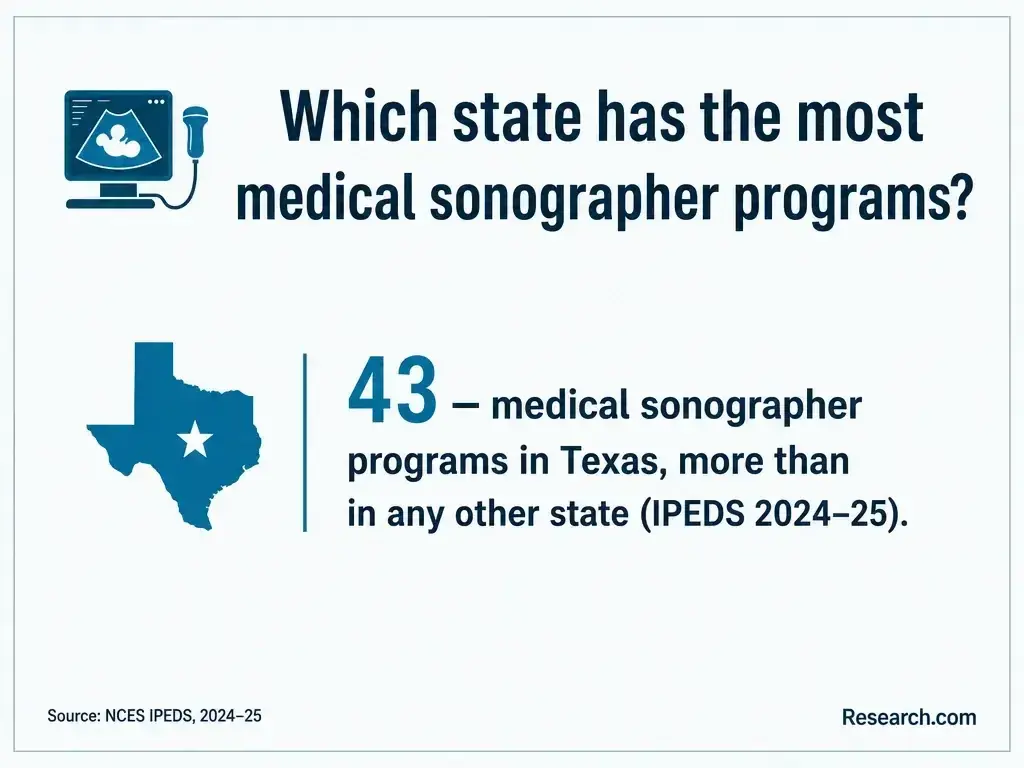
Texas does not issue a general occupational license specifically for diagnostic medical sonographers. That does not make credentials irrelevant: employers may require or prefer professional certification for the position and specialty. ARDMS certification has its own education, clinical, and examination prerequisites, separate from school admission or graduation.
Before choosing a program, check its current programmatic accreditation status with CAAHEP, verify the applicable ARDMS prerequisite directly with ARDMS, and read Beaumont-area job postings for the specialty credential requested. Institutional accreditation, state authorization to operate, programmatic accreditation, and individual certification answer different questions; none should be treated as a substitute for the others.
Start with the job you want, then work backward from its specialty and credential expectations. The affordability ranking can narrow a cost search, but it does not score clinical-site suitability or certification eligibility. These checks help identify a program that is both affordable and usable for your goal:
- Confirm the exact credential awarded, current programmatic accreditation status, and the certification prerequisite the program says graduates can pursue; verify that prerequisite with the certifier.
- Request the clinical schedule, placement process, supervised scanning requirements, and expected travel from Beaumont.
- Compare itemized total costs, available aid, likely borrowing, completion timing, and earnings you may give up while training.
- Ask for recent program completion, credential-exam, and placement results, including how each measure is defined.
A red flag is a provider that advertises online convenience or a low tuition figure but cannot explain where supervised patient scanning takes place. Likewise, do not choose a longer or more expensive pathway solely because of its credential name; compare what additional training and job access it actually offers. If you are exploring other trade school careers, compare their entry costs and required hands-on training before committing to sonography.
Entry-level opportunities depend on the examinations a graduate can perform and the credentials an employer requires. With experience and additional specialty qualifications, a sonographer may pursue broader imaging responsibilities, a specialty-focused role, clinical instruction, or a lead position. Those are possible progressions, not automatic outcomes of one program.
If a particular specialty is your goal, ask whether the program's clinical rotations provide relevant exposure and whether additional supervised experience or examinations will be needed afterward. A narrower certificate may fit an already qualified healthcare worker; someone new to patient care should check whether it actually accepts beginners and supplies the clinical preparation needed for employment.
The U.S. Bureau of Labor Statistics projects 13.9% national growth for diagnostic medical sonographers from 2025 to 2035. That signals demand across the occupation, but it does not forecast openings in Beaumont or guarantee a local job when a particular cohort graduates.
Test the local market while comparing programs: review current postings by specialty and shift, ask clinical coordinators where students rotate, and consider whether travel to a wider Southeast Texas job market is feasible. A program with accessible clinical experience may be more valuable to a Beaumont student than a cheaper option whose required placements are difficult to reach.
Most Affordable Diagnostic Medical Sonographer Schools & Training in Beaumont for 2027
Investing in training is a consequential decision, so Research.com designed this ranking to help readers compare reported costs and debt among relevant local programs. Programs are compared with others in the same occupation and geography; only programs with completions reported to IPEDS are included. An unlisted provider may still offer training - its absence is not a judgment about its quality or approval.
The most affordable ranking scores tuition, cost of attendance, median student debt, and federal loan default rate. Weights are distributed using an entropy-based method, which gives more weight to measures that differ more across included programs. Accreditation and other quality indicators do not enter this affordability score. Research.com's separate best programs methodology considers student outcomes; earnings and return on investment; costs and debt; and quality and recognition. In that methodology, occupation-relevant programmatic recognition receives 20%, institutional accreditation 10%, student support 10%, and the remaining 60% is distributed across outcomes, earnings, and costs using the entropy-based method.
The team used the following sources to check reported education data and relevant recognition information. Some cover other trades and should not be mistaken for sonography-specific approval:
- IPEDS database - reported program completions and institutional data.
- National Center for Education Statistics - federal education data and definitions.
- College Scorecard database - available cost, debt, and outcome measures.
- Peterson's database - supplementary institutional information.
- Commission on Accreditation of Allied Health Education Programs (CAAHEP) - relevant allied-health program accreditation information.
- Accrediting Bureau of Health Education Schools (ABHES) - health-education accreditation information.
- Commission on Dental Accreditation (CODA) - cross-occupation accreditation reference; not sonography accreditation.
- Dental Assisting National Board (DANB) - cross-occupation credential reference; not a sonography certifier.
- National Center for Construction Education and Research (NCCER) - cross-occupation training reference; not a sonography credentialing body.
- Apprenticeship.gov Partner Finder - information on registered apprenticeship sponsors.
The ranking gives readers a starting point for comparing affordability, not a substitute for checking the current program price, clinical placement, and certification pathway. See Research.com's methodology for more on how rankings are created.
# 2 position

Frequently asked questions about medical sonographer programs in Beaumont
Is the cheapest sonography program the best value?
Not necessarily. Compare total costs and debt alongside clinical access, completion timing, and the certification pathway. Low tuition offers limited value if you cannot complete required rotations.
Can I become a sonographer through a fully online program?
Coursework may be online, but scanning labs and supervised clinical examinations require in-person participation. Verify where those components occur and whether the complete pathway meets your intended certifier's prerequisites.
Does graduating automatically give me ARDMS certification?
No. ARDMS sets separate eligibility and examination requirements. Confirm the applicable prerequisite and examinations before enrolling.
Do I need to live near a clinical site?
You need reliable access to assigned labs and rotations. Ask for likely site locations, schedules, and travel expectations; a placement may not be available in your preferred neighborhood.
How should I compare a certificate with an associate-degree program?
Check who can enter each program, its supervised scanning experience, credential awarded, time and total cost, and the certification route it supports. A shorter certificate may be designed for applicants who already have relevant healthcare training.
- U.S. Bureau of Labor Statistics - Diagnostic Medical Sonographers and Cardiovascular Technologists and Technicians
Used to verify salary, employment outlook, and typical education requirements.
https://www.bls.gov/ooh/healthcare/diagnostic-medical-sonographers.htm - CAAHEP - Find an Accredited Program
Used to verify programmatic accreditation or industry recognition of programs.
https://www.caahep.org/students/find-an-accredited-program - ARDMS - Certification
Professional certification reference for graduates of this occupation.
https://www.ardms.org/ - Lamar Institute of Technology - official website
Official school website (programs, tuition, admissions).
https://www.lit.edu/