2027 Best AI Courses for Climate Tech Teams

Co-Founder and Chief Data Scientist
Climate tech teams face a growing demand to integrate advanced skills in artificial intelligence to tackle complex environmental challenges effectively. However, many professionals from unrelated fields struggle to find accredited, flexible programs that bridge this knowledge gap without requiring extensive prior experience. This skill shortage slows innovation in critical areas like energy optimization and environmental monitoring.
Addressing this need, the article explores leading AI courses tailored for climate tech professionals. It highlights accessible educational pathways designed to equip learners with essential AI competencies, enabling them to contribute meaningfully to sustainable technology development and environmental solutions.
Key Things You Should Know
- Climate tech teams increasingly rely on artificial intelligence courses emphasizing sustainable data modeling and energy optimization, with enrollment growing over 35% in 2025.
- Top programs integrate interdisciplinary training combining AI algorithms with environmental science to prepare professionals for real-world climate challenges.
- Certification in AI for climate tech can boost employment prospects by 40%, reflecting rising industry demand for specialized skills in mitigation and adaptation technologies.
Advance Your Career with AI Online Courses
Artificial Intelligence: Implications for Business Strategy
This program provides an introduction to Artificial Intelligence and their implications for business strategy. Earn an official digital certificate.

Oxford Artificial Intelligence Programme
Explore this Oxford Artificial Intelligence programme offered in a flexible learning environment and explore topics like machine learning, automation, and robotics.

Implementing Agentic AI: Building Your Organizational Playbook
This online MIT Agentic AI course offers a practical approach to deploying AI agents in your organization, including a custom playbook. 3 weeks, exclusive launch price.

AI Adoption: Driving Business Value and Impact
This online MIT AI Adoption: Driving Business Value and Impact offers practical frameworks to close the gap between AI potential and business reality.

Artificial Intelligence in Pharma and Biotech
Discover the applications and limitations of artificial intelligence in pharma and biotech with this MIT online short course.

What are the best AI courses for climate tech teams and who are they right for?
The best AI courses for climate tech teams emphasize practical skills in machine learning, data analysis, and environmental modeling tailored to sustainability challenges. Programs such as Stanford's "AI for Earth" and MIT's "Data Science for Environmental Applications" focus on applying AI to climate data, ecosystem analysis, and energy optimization.
These courses blend coding proficiency with domain expertise, critical for roles in climate risk assessment and renewable energy forecasting. The top artificial intelligence training for environmental professionals often highlights climate datasets, predictive modeling, and policy impact simulation, ideal for data scientists and engineers seeking applied techniques over theory.
Bootcamps like "AI Product Management for Climate Solutions" support teams deploying AI models in climate tech startups by addressing software integration, scalability, and ethical AI use. These courses suit project managers, climate entrepreneurs, and technical leads coordinating cross-functional AI initiatives. The demand for AI skills in climate tech is evident as startups attracted $68.8 billion in venture funding, with nearly 28% of climate equity capital dedicated to AI-enabled solutions.
Emerging professionals can also explore accelerated computer science programs to build foundational knowledge quickly. For those seeking efficient pathways, consider accelerated computer science programs that provide a strong technical base aligned with environmental applications. The best courses balance technical depth with climate-relevant expertise, equipping teams to harness AI for measurable climate impact.
Advance Your Career with AI Online Courses
Artificial Intelligence: Implications for Business Strategy
This program provides an introduction to Artificial Intelligence and their implications for business strategy. Earn an official digital certificate.
Oxford Artificial Intelligence Programme
Explore this Oxford Artificial Intelligence programme offered in a flexible learning environment and explore topics like machine learning, automation, and robotics.
Implementing Agentic AI: Building Your Organizational Playbook
This online MIT Agentic AI course offers a practical approach to deploying AI agents in your organization, including a custom playbook. 3 weeks, exclusive launch price.
How can AI skills specifically accelerate climate tech innovation and impact?
AI applications driving climate innovation play a pivotal role in enhancing data analysis and predictive modeling essential for environmental solutions. Teams skilled in AI improve energy efficiency by optimizing resources in real time, thus reducing carbon footprints in power grids and manufacturing. Machine learning algorithms, for example, boost the accuracy of climate models, enabling better forecasts of severe weather and natural disasters that support effective mitigation strategies.
AI-driven automation is transforming renewable energy by optimizing wind turbine placements and solar panel alignment, increasing energy output without new infrastructure. Experts trained in AI can develop tools that use satellite imagery to monitor deforestation and biodiversity loss, allowing quick detection of illegal activities and timely conservation efforts. These capabilities are central to AI skill development for climate tech impact.
Integration of diverse data sources like satellite, sensors, and IoT devices through AI forms comprehensive platforms for ecosystem monitoring and advanced environmental impact assessments. The adoption of AI in sustainability is rapidly increasing, with organizations using AI growing from 40% in 2023 to 61% in 2024. AI expertise is critical in optimizing energy grids, reducing emissions, and accelerating sustainable technology deployment.
Prospective learners should prioritize mastering machine learning, data engineering, and AI ethics as they apply to climate challenges. Gaining these skills facilitates transparent and efficient solutions that meet ethical and regulatory standards. Those seeking affordable education pathways may explore the cheapest online mechanical engineering degree, a potential stepping stone into these fields.
What types of AI training paths work best for climate tech teams at different stages?
Climate tech teams benefit greatly from customized artificial intelligence learning paths tailored to their project stage and technical skills. For beginners and early-stage startups, foundational courses focus on machine learning basics, data preprocessing, and domain-specific applications such as predictive maintenance and energy consumption forecasting. These practical examples help build skills without requiring deep prior knowledge.
Teams with intermediate AI experience should explore applied AI training that emphasizes real-world case studies on decarbonization and energy optimization. Courses covering reinforcement learning, edge AI, and time-series analysis prepare operators managing grid or building systems. Focus on algorithm deployment and integrating AI with existing infrastructure ensures effective implementation.
Advanced teams and research groups intent on innovation engage in deep-dive programs blending AI with climate science. Training topics include causal inference, explainable AI, and advanced optimization methods to develop novel models that reduce emissions and optimize demand response.
Industrial and building operators using AI-based energy optimization report 20-30% reductions in energy usage and emissions compared to conventional controls, highlighting the high impact of targeted AI training in real-world environments. Key factors in selecting courses include existing AI proficiency, project complexity, and desired impact. Certifications featuring hands-on labs and data challenges enhance learning outcomes.
Combining AI theory with climate tech case studies at any level maximizes practical value for climate tech professionals. Those seeking comprehensive education can consider the best online MS in data science programs, which often include these tailored AI training paths for climate tech professionals at beginner and advanced levels.
How do online, hybrid, and on-campus AI programs for climate tech compare?
Online AI programs provide unmatched flexibility and accessibility, making them ideal for climate tech professionals who need to balance work and study. These programs often emphasize practical skills such as AI-enhanced climate risk modeling, valuable for applications like sub-kilometer flood risk mapping in emerging markets, which can lower costs by up to 10× compared to traditional methods (World Bank, "AI for Climate and Disaster Risk," 2024). However, online formats may lack the collaborative, hands-on experiences found in other formats.
Hybrid programs combine online coursework with periodic on-campus sessions, offering a balance of flexibility and direct interaction. This approach benefits students who require remote learning but also gain from face-to-face mentorship, labs, and networking, all essential for complex topics like adaptation and resilience modeling. Hybrid formats often provide access to specialized climate datasets and advanced computing resources not easily available remotely, a key advantage for climate tech teams.
On-campus AI programs deliver immersive learning and strong peer engagement. Students enjoy full access to research labs, high-performance computing clusters, and interdisciplinary teams, critical for AI innovation in climate technology. These programs typically foster robust industry partnerships, supporting internships and project-based experiences focused on emerging market challenges. On-campus programs usually require relocation and a full-time commitment.
Choosing between these modes depends on professional circumstances and preferences:
- Online suits working professionals needing schedule flexibility and foundational AI skill-building.
- Hybrid offers structured networking and experiential learning benefits.
- On-campus is best for deep specialization, research, and hands-on climate tech innovation.
Prospective students seeking the best artificial intelligence course formats for climate technology professionals may also consider exploring programs such as the fastest cyber security degree offerings for related, flexible education pathways.
What should climate tech teams look for in an AI curriculum and course content?
Climate tech teams benefit significantly from AI curricula that blend technical expertise with real-world environmental applications. Training must cover large language models (LLMs) and multimodal AI systems designed for climate data, which can reduce time on ESG and climate reporting by 40%, according to the IBM Institute for Business Value. This efficiency lets specialists focus more on mitigation strategies.
Key skills include managing climate-specific datasets like satellite imagery, sensor data, and emissions tracking. AI integration with geographic information systems (GIS) and remote sensing is essential, alongside developing predictive models for climate risk and resource optimization under uncertainty.
Hands-on, project-based learning involving energy grid management, carbon footprint modeling, or deforestation tracking deepens understanding. Ethical AI practices, covering bias, transparency, and environmental impacts of AI, should also be emphasized.
Technical versatility across programming languages such as Python and R, along with frameworks like TensorFlow and PyTorch tailored to climate applications, is crucial. Additionally, knowledge of cloud computing and edge AI supports real-time environmental monitoring.
Ultimately, AI education empowers climate tech professionals to convert diverse climate data into actionable insights, helping organizations achieve evolving regulatory and sustainability goals with advanced AI tools.
Which U.S. accreditation standards and institutional credentials matter for AI climate programs?
U.S. accreditation standards significantly influence the quality and recognition of AI climate programs. Prospective students should prioritize programs accredited by regional bodies recognized by the U.S. Department of Education, such as the Middle States Commission on Higher Education or the Western Association of Schools and Colleges. These accreditations ensure that institutions follow rigorous academic and operational standards, guaranteeing your degree's validity in the job market.
Specialized accreditation from organizations like ABET (Accreditation Board for Engineering and Technology) is also important. ABET-accredited programs demonstrate comprehensive curricula that cover essential AI topics, including machine learning, data infrastructure, and ethics. Such credentials signal alignment with industry expectations in climate-related AI fields.
Institutional reputation and faculty expertise matter as well. Look for programs connected to universities or research centers focused on climate technology and AI innovation. These often include practical elements like MLOps, model governance, and sustainability-driven AI applications.
According to the McKinsey Global Survey on AI, organizations with mature MLOps are 2.6× more likely to deploy climate- and sustainability-related AI models at scale.
Additional factors to consider:
- Curricula that cover data governance and regulatory compliance
- Partnerships with industry or government entities for hands-on experience
- Career placement support in climate AI sectors
These program features provide strong operational frameworks and enhance your credentials for AI careers in climate technology.
What are typical admission requirements and prerequisites for AI courses focused on climate?
Admission to AI courses focused on climate usually requires a bachelor's degree in fields like computer science, environmental science, engineering, or data science. Foundational skills in programming languages, especially Python, and an understanding of machine learning concepts are often expected.
Proficiency in mathematics-particularly linear algebra, calculus, and statistics-is crucial as these support AI model development. Experience with data analysis frameworks such as TensorFlow or PyTorch can strengthen applications.
Prerequisites differ by course level. Introductory programs may only need basic coding skills and a general climate awareness. Advanced programs or certifications commonly require prior AI or machine learning coursework and domain expertise in climate science or environmental policy.
This interdisciplinary knowledge is valuable; studies from Climate Change AI show teams combining domain experts and AI specialists are over three times more likely to successfully deploy climate-related AI projects.
Applicants with interdisciplinary backgrounds, like environmental engineers with coding skills or data scientists knowledgeable about climate issues, are preferred. Many programs request portfolios or case studies demonstrating applied AI in climate contexts, alongside recommendation letters highlighting technical skills and dedication to climate solutions.
Working professionals might qualify for prerequisite waivers by demonstrating relevant experience or completing preparatory bootcamps. Early communication with program advisors helps clarify expectations and identify suitable preparatory resources for a smooth admission process.
How long do AI programs for climate tech usually take, and what do they cost?
AI programs for climate tech vary in length, typically running from 3 to 12 months based on their format and depth. Short certificate courses last 6 to 12 weeks and focus on foundational skills like machine learning, data analysis, and climate-specific applications.
More intensive bootcamps or professional certificates extend to 3-6 months, providing hands-on projects and sector-specific case studies. Advanced offerings from universities or specialized institutes often span 9 to 12 months, covering sustainable AI system design, environmental ethics, and low-carbon data infrastructure.
Costs range significantly, starting from $200 to $1,000 for entry-level online courses. Bootcamps and professional certificates typically range from $1,500 to $5,000. University-led and specialized programs may exceed $10,000, reflecting comprehensive curricula, mentorship, and career services. Additional expenses such as software and travel should also be considered, especially for hybrid formats.
Students often weigh time, cost, and curriculum depth when choosing programs. Those seeking quick entry into the climate tech workforce might select shorter certificates, while professionals targeting leadership roles should consider longer programs emphasizing ethical AI design.
Environmental impact is a vital concern. Training large AI models can emit up to 25 times more CO₂e than the annual emissions of an average passenger car (International Telecommunication Union AI for Good, "Environmental Efficiency of AI," 2024). Prioritizing energy-efficient model architectures and cloud providers using renewable energy helps reduce carbon footprints in climate-focused AI work.
What careers, roles, and advancement options can AI training open in climate tech?
AI training in climate tech opens varied career paths spanning research, development, and practical application. Roles include climate data scientists who build machine learning models for emissions forecasting and renewable energy optimization. Environmental machine learning engineers focus on designing algorithms that analyze satellite or IoT sensor data to monitor deforestation or pollution in real time. Experts in AI ethics and policy ensure that climate technologies align with sustainability objectives and regulatory requirements.
Career progression often moves professionals from technical duties to strategic leadership, such as AI project managers who lead climate-related AI initiatives. Many transition into sustainability consulting, helping organizations merge AI with environmental KPIs. Leadership roles like director of climate innovation blend AI proficiency with business skills to scale impactful solutions worldwide.
Hands-on skills gained through AI courses enable measurable impact. For instance, companies using AI with clear emissions and energy KPIs achieve twice the emissions reduction per dollar invested, according to research by Boston Consulting Group. Understanding how to develop and monitor these KPIs is essential for AI professionals dedicated to climate value.
Key learning questions include:
- How to create AI models that enhance energy efficiency?
- Which data sources most effectively predict climate risk?
- How to assess AI's environmental footprint
Training should include data analysis, model deployment, and project management tailored to climate challenges. Practical experience with renewable energy, carbon capture, or smart grid AI tools boosts employability.
Certifications in AI-driven climate impact measurement distinguish candidates. Opportunities exist in startups, NGOs, government agencies, and major energy companies integrating AI to advance sustainability. Building a portfolio with projects that reduce emissions or optimize resources supports long-term career growth in this expanding sector.
How can climate tech leaders choose and implement AI training that fits their team strategy?
Climate tech leaders must tailor AI training to their team's strategic objectives by pinpointing challenges where AI offers measurable benefits. Performing a skills gap analysis reveals current capabilities and identifies knowledge needed for projects such as emissions monitoring, energy optimization, or climate modeling. Customized training programs targeting these areas boost both relevance and engagement.
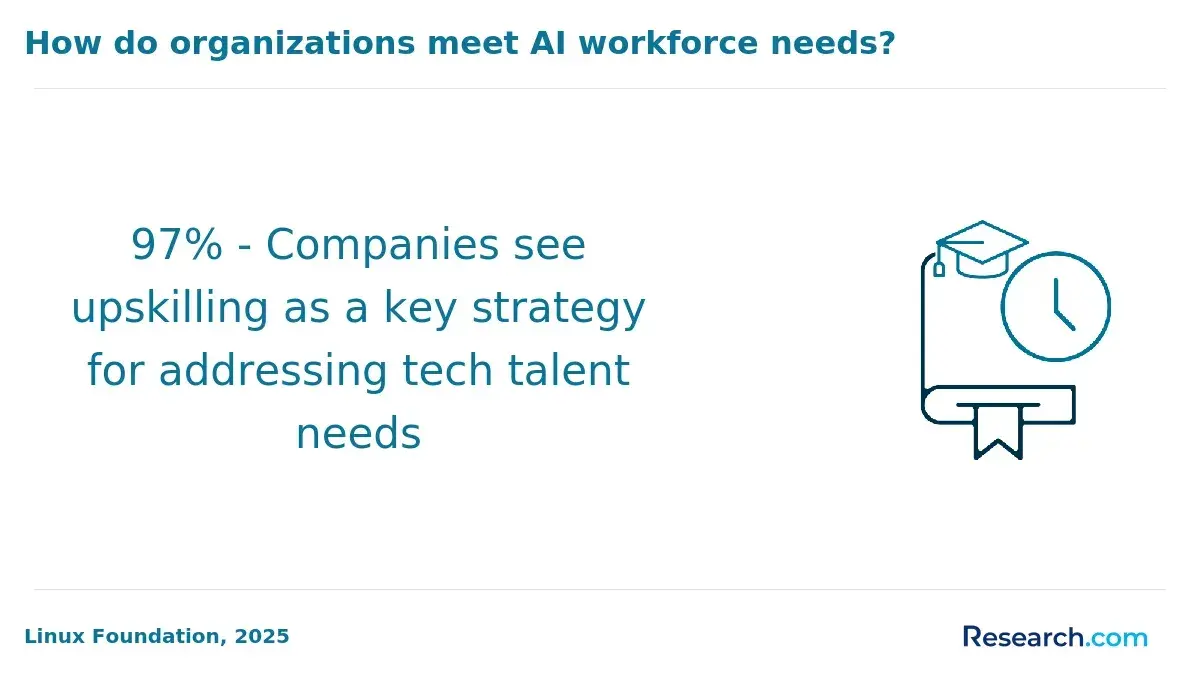
Ongoing, structured learning embedded in workflows outperforms one-off sessions. Organizations investing over 20 hours per employee annually in AI upskilling are 1.8× more likely to achieve significant business impact in sustainability efforts, based on Deloitte's "State of AI in the Enterprise." Such programs should involve continuous modules, hands-on projects, and expert mentorship access.
Prioritizing courses with practical applications-like deploying machine learning models for weather prediction or optimizing resource allocation-delivers direct operational improvements.
Key criteria for selecting AI training include:
- Alignment with climate tech goals
- Flexibility for varying expertise levels
- Incorporating real-world datasets
- Facilitating collaboration and peer learning
- Clear assessment metrics for progress
Successful implementation involves integrating AI training into project timelines and incentivizing participation with recognition or career pathways. Monitoring outcomes by linking project performance improvements to AI use ensures training meets both individual and organizational climate goals effectively.
Other Things You Should Know About Artificial Intelligence
In 2027, notable AI courses for climate tech teams include "AI for Climate Action" offered by Stanford University, "Machine Learning in Environmental Science" from MIT, and the "AI & Climate Change" course through Coursera. These programs focus on using AI to address environmental issues.
Ethical considerations in AI development for climate tech include ensuring transparency, avoiding bias in algorithms, and promoting equitable access to technology. It is vital to assess potential environmental impacts and avoid unintended consequences that could worsen climate-related issues. Responsible AI practices emphasize human oversight and accountability throughout deployment.
Yes, many artificial intelligence models, particularly those using machine learning, are designed to adapt as new data becomes available. Continuous learning methods allow AI to update its predictions in response to evolving climate conditions. This adaptability improves accuracy in applications such as weather forecasting and resource management.
Alongside artificial intelligence expertise, climate tech professionals benefit from skills in data science, programming languages like Python or R, and knowledge of environmental science. Familiarity with cloud computing and geospatial analysis tools also enhances the ability to implement AI solutions effectively. Strong interdisciplinary collaboration skills are important to integrate AI with climate research.
References
- Climate+Tech AI Think-Tank for Climate, Risk and Adaptation https://climateandtech.com/
- How much does AI really cost the planet? | MSMK University College https://msmk.university/how-much-does-ai-really-cost-the-planet/
- SITE Receives EQAC Accreditation — A Landmark Moment in Swiss Higher Education https://sitegeneva.com/tpost/e47n1h4ml1-site-receives-eqac-accreditation-a-landm
- Leading AI Change: Digital Transformation Success https://www.techclass.com/resources/learning-and-development-articles/ai-and-change-management-leading-teams-through-digital-transformation
- Generative AI for Climate Change in Financial Services Online Course - CFTE https://courses.cfte.education/generative-ai-in-climate-change-online-course/
- Guidance on the Responsible Use of Artificial Intelligence (AI) in Accredited Continuing Education (CE) - ACCME https://accme.org/resource/guidance-on-ai/
- How AI can help accelerate the pace of change https://www.ey.com/en_nl/insights/sustainability/how-can-ai-help-us-accelerate-the-pace-of-change-the-world-needs
- How AI Improves Employee Training: A Complete Guide https://itacit.com/blog/how-ai-improves-employee-training-a-practical-guide-for-hr-leaders/
- Artificial Intelligence – Driven Climate Change Prediction And Sustainability Analysis Using Hybrid Machine Learning Models https://www.ijsrtjournal.com/article/Artificial-Intelligence-%E2%80%93-Driven-Climate-Change-Prediction-And-Sustainability-Analysis-Using-Hybrid-Machine-Learning-Models
- AI for Earth and Environmental Sciences - application now open https://www.gu.se/en/earth-sciences/ai-for-earth-and-environmental-sciences-application-now-open