Rising Stars of Science World Ranking 2026 (5th edition)

Co-Founder and Chief Data Scientist
On October 15, 2026, Research.com released the 5th edition of the annual ranking of top rising stars in science. This report highlights exceptional early-career researchers who have made rapid and meaningful contributions across global scientific disciplines within their initial years of publishing. By spotlighting these emerging experts, the ranking maps key shifts in the international research frontier.
This report serves as a vital resource for academic institutions, funding agencies, and students seeking to identify leaders of tomorrow's scientific discovery. Readers can assess where pioneering breakthroughs are concentrating across global centers of learning. Furthermore, it helps emerging scholars gain valuable recognition for high-impact investigations that push modern technology and health forward.
For the 2026 edition, 279,971 scientist profiles were inspected across leading bibliometric providers, including OpenAlex, CrossRef, and other bibliometric databases. Every selected candidate represents an active scholar whose earliest published work appeared within the past 14 years. These rigorous standards ensure that the leaderboard strictly reflects dynamic researchers in the formative stages of their academic careers.
To qualify for evaluation, candidates met a minimum discipline H-index threshold of 34 alongside strong publication records. The final ranking considers each scholar's D-index score, their proportion of work contributed to the field, and notable awards. This balanced approach celebrates well-rounded academic excellence rather than raw publication volume alone.
Latest studies in science research
Recent medical investigations have revealed a hidden biological drainage route in the eye that could transform how doctors treat common causes of blindness. Scientists discovered tiny vessels beneath the retina, called the posterior ocular lymphatic outflow pathway, that channel waste away from light-sensing cells and into the body's immune network. Because conditions like macular degeneration affect approximately 2.5 million Canadians alone, strengthening this newly mapped cleanup route may prevent fluid buildup before it damages eyesight.
Another groundbreaking study demonstrated that worn joint tissue can be coaxed into healing itself without invasive surgery. Researchers discovered that shutting down a single enzyme that naturally doubles in older knee joints helped mice rebuild smooth, functional joint cushion rather than rough scar tissue. Laboratory trials using human tissue from joint surgeries also reacted positively, offering real hope for the 1 in 5 American adults currently living with painful joint wear.
The key findings from the rising stars of science ranking
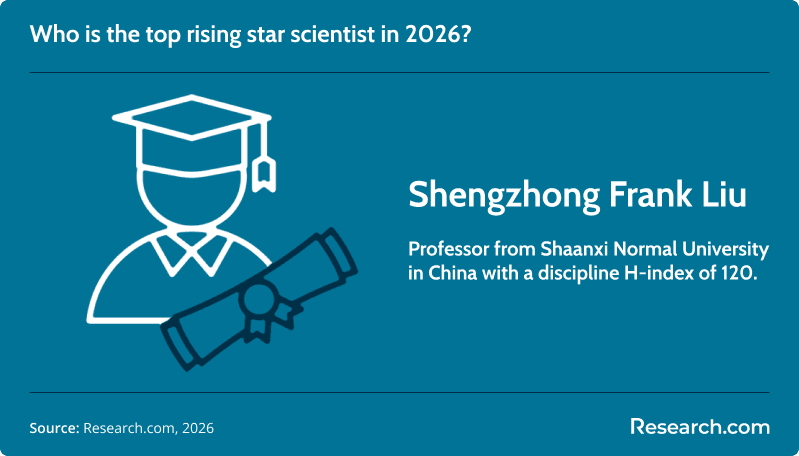
- Professor Shengzhong Frank Liu from Shaanxi Normal University in China ranks 1st globally with an H-index of 120, 38,739 citations, and 460 publications.
- China maintains the top spot worldwide with 243 ranked scientists, representing nearly 1 in 4 of all featured rising stars.
- Italy achieved the most notable progress year over year, adding 10 scientists to reach 36 scholars and rising to 6th place from 8th place in the previous report.
- Google (United States) takes 1st place among global institutions with 11 ranked scientists, edging past the Chinese Academy of Sciences (10 scholars).
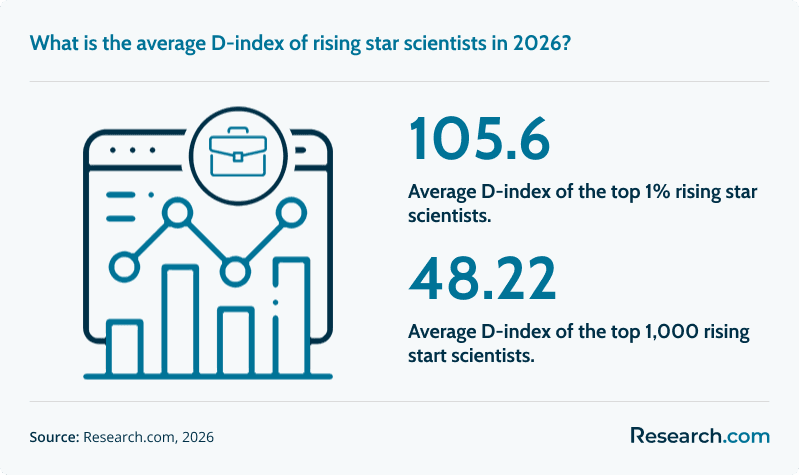
- The top 1% of scientists achieved an average H-index of 105.6, alongside 61,088.7 citations and 281.9 publications.
- Across the full leaderboard of 1,000 scholars, researchers maintained an average H-index of 48.22, 9,863.31 citations, and 149.2 publications.
- Over 41% of all recognized rising stars are based in institutions across China and the United States, cementing their joint leadership in early-career science.
RISING STARS OF SCIENCE RANKING
Countries with the highest number of leading scientists
China continues to hold the global lead with 243 scientists in the 2026 ranking, representing nearly a quarter of all featured scholars despite decreasing from 317 researchers in the previous report. The United States firmly retains 2nd place, expanding its representation to 170 rising stars compared to 162 in the prior edition. Together, these two research powerhouses account for over 41% of the world's most influential early-career scientific talent.
The United Kingdom advanced to 3rd place with 58 scholars, moving up from 4th place in the previous report when it registered 53 scientists. Conversely, Australia slid to 4th place with 50 researchers, moving down from 3rd place in the prior year's cohort of 54 scholars. Iran achieved notable upward momentum by securing 5th place with 42 scientists, climbing from a tie for 6th place in the previous ranking.
Italy recorded the strongest improvement among established nations by claiming 6th place with 36 scholars, rising from 8th place in the previous report where it had 26 researchers. Germany slid from 6th place to 7th place with 32 scientists, while India dropped from 5th place to 8th place with 28 scholars. Canada held steady in 9th place with 25 scientists, slightly increasing from its previous tally of 24.
Spain joined the leading tier in 10th place with 20 scholars, replacing Saudi Arabia which previously rounded out the top 10. This redistribution reflects broadening geographic diversity across European and Mediterranean research hubs.
Please note that the country associated with a scientist is based on the affiliated research institution according to OpenAlex and CrossRef, not on their actual nationality.
Institutions with the highest number of leading scientists
Google emerged as the world's leading research organization in the 2026 ranking, placing 1st globally with 11 affiliated scholars and rising from 4th place in the previous report. The Chinese Academy of Sciences moved down from 1st place in the previous report to 2nd place, housing 10 rising stars compared to 18 in the prior year. This transition marks the first time a private industrial research enterprise has outpaced traditional state academic institutions at the summit of the rising stars leaderboard.
Chinese universities continue to maintain substantial depth across the institutional rankings, occupying 7 of the top 10 positions worldwide. Zhejiang University and Peking University tied for 3rd place with 8 scientists each, with Peking University preserving its exact numerical output from the previous report. City University of Hong Kong followed closely with 7 scholars, adjusting downward after ranking among the top three organizations in the previous report with 10 researchers.
Italy's University of Naples Federico II demonstrated remarkable performance by tying for 5th place with 7 scholars, highlighting southern Europe's expanding footprint in cutting-edge science. Meanwhile, Tsinghua University and Hunan University tied for 7th place with 6 scholars each, with Hunan University dropping from 2nd place in the previous report where it fielded 11 scientists. Renowned international institutions, including ETH Zurich, University College London, and the National University of Singapore, also secured positions in the top tier with 6 scholars each.
Advancing science research through online universities
Modern research training is increasingly reinforced by digital learning platforms that expand access to advanced computational methods and specialized literature. Leading online universities provide flexible pathways for aspiring investigators to master data analytics, statistical modeling, and experimental methodologies while remaining actively embedded in global research teams. This technological evolution allows emerging scientists to collaborate across borders and acquire specialized technical skills without geographic constraints.
According to verified national data from the National Student Clearinghouse Research Center (NSCRC), graduate-level enrollment nationwide encompasses over 3.1 million students, with distance-enabled and hybrid delivery serving as essential vehicles for postbaccalaureate education. This sustained adoption demonstrates how online universities democratize rigorous academic training, equipping early-career researchers with the statistical toolkits needed for high-impact laboratory discovery. As digital learning tools continue to evolve, virtual graduate pathways will remain central to cultivating diverse scientific talent worldwide.
H-index ranking—leaders, averages, and distribution
World Ranking Leaders
The 2026 leaderboard of emerging science stars showcases the rapid ascent of top early-career researchers from across the globe. This year's top tier features prominent investigators driving breakthrough discoveries across materials chemistry, environmental engineering, and oncology.
Leading the world ranking for 2026 is Professor Shengzhong Frank Liu from Shaanxi Normal University in China. In this edition, Professor Liu holds an H-index of 120, backed by 38,739 citations and 460 publications.
Securing the 2nd spot globally is Professor Dieu Tien Bui from the University of South-Eastern Norway in Norway. He achieves an H-index of 116, amassing 33,642 citations and 296 publications.
The 3rd position on the global leaderboard is occupied by Professor Bach Xuan Tran from Vietnam National University, Hanoi, Vietnam. Holding an H-index of 113, Professor Tran has accumulated an extraordinary 189,855 citations across 377 publications.
Professor Yaoyu Zhou from Hunan Agricultural University in China ranks 4th worldwide with an H-index of 109 and 29,522 citations. Professor Zhou has contributed 301 published works to the field of chemical sciences.
Rounding out the top five is Professor Matthew D. Hellmann from Memorial Sloan Kettering Cancer Center in the United States, who ranks 5th globally with an H-index of 108. He has gathered 82,413 citations across 343 scientific publications.
Continental Leaders
Asia is spearheaded by Professor Shengzhong Frank Liu from Shaanxi Normal University in China, who commands the #1 spot globally with an H-index of 120. His pioneering work in advanced perovskite materials anchors the continent at the summit of the global ranking.
Europe is led by Professor Dieu Tien Bui from the University of South-Eastern Norway in Norway, holding 2nd place worldwide with an H-index of 116. His research in environmental geosciences and spatial intelligence reflects Europe's strong competitive footing.
North America is headed by Professor Matthew D. Hellmann from Memorial Sloan Kettering Cancer Center in the United States, who secures 5th place globally with an H-index of 108. His clinical investigations in cancer immunotherapy represent the top early-career benchmark on the continent.
Oceania is fronted by Professor Danial Jahed Armaghani from the University of Technology Sydney in Australia, placing 10th globally with an H-index of 91. He has accumulated 18,680 citations and 246 publications in engineering and technology.
Africa is represented by Professor Mahmoud A.O. Dawood from Kafrelsheikh University in Egypt, achieving 18th place worldwide with an H-index of 84. His foundational contributions to aquatic biosciences encompass 18,225 citations and 333 publications.
South America is led by Professor Dison S. P. Franco from the University of the Coast in Colombia, who ranks 345th globally with an H-index of 50. His environmental science research has generated 6,313 citations across 186 publications.
Averages and Distribution
In the 2026 world ranking, the top 1% of ranked rising stars achieved an average discipline H-index of 105.6, compared to an average of 48.22 across the entire cohort of 1,000 scholars. This substantial divide highlights the exponential research productivity separating top-tier pioneers from the broader field.
In terms of H-index distribution, 1 scientist placed in the 120–129 range, 2 reached the 110–119 tier, 4 registered in the 100–109 bracket, and 3 scored within the 90–99 range. An additional 23 scholars achieved an H-index between 80 and 89, while the remaining 967 researchers recorded an H-index below 80.
Regarding citations, the top 1% averaged 61,088.7 citations, substantially outpacing the overall list average of 9,863.31. The scholar with the highest citation total in the 2026 ranking is Professor Bach Xuan Tran of Vietnam with 189,855 citations, followed by Professor Jimmy Ba of Canada with 187,406 citations and Professor Fares Alahdab of the United States with 117,272 citations.
Regarding publications, the top 1% averaged 281.9 papers, nearly doubling the overall ranking average of 149.2 publications. The most prolific author in the cohort is Professor Paulo Eduardo Teodoro from Brazil with 610 publications, followed by Professor Miadreza Shafie-khah from Ireland with 555 publications and Professor Nitin Shivappa from the United States with 515 publications.
You can learn more about the methodology used to create this report here.
About Research.com
All research was coordinated by Imed Bouchrika, Ph.D., a computer scientist with a well-established record of collaboration on a number of international research projects with different partners from the academic community. His role was to make sure all data remained unbiased, accurate, and up-to-date.
Research.com is the number one research portal for science and educational rankings. Our mission is to make it easier for professors, research fellows, and students to progress with their research and find the top experts in a wide range of scientific disciplines. Research.com is also a leading educational platform that helps students find the best colleges, academic opportunities, and career paths.