
2027 What a Data Science Master's Really Costs When You Reduce Working Hours

Co-Founder and Chief Data Scientist
Reducing work hours for a data science master's can cost more than the tuition bill suggests. For working professionals, the decision turns on how much pay and employer support they would give up, how long that reduction would last, and whether the degree advances a realistic career goal. This guide shows you how to build a personal cost estimate and compare it with a schedule that lets you keep working.
Key Things You Should Know
- Calculate lost earnings from the hours you would actually give up, then add tuition, required fees, and any lost benefits; tuition alone is not the total cost.
- A lower-priced program may cost more overall if its schedule requires a larger or longer reduction in paid work.
- The Bureau of Labor Statistics reports a $120,230 median annual wage for data scientists in May 2025, but that occupational median is not a forecast of your post-degree pay or return on investment.
How much does a data science master's cost after reducing work hours?
Your personal cost is tuition and required fees + other study-related expenses + earnings and benefits forgone + financing costs − grants, scholarships, and employer support. The largest unknown may be the work schedule you can sustain. Two programs with similar tuition can have very different total costs if one lets you retain your hours and the other does not.
This table separates billed costs from costs created by a reduced schedule. It is a framework for comparing actual offers, not a published price estimate.
| Cost component | What belongs in the estimate |
| Academic charges | Tuition and mandatory program, university, or course fees |
| Additional cash expenses | Required materials, technology, and any travel or relocation |
| Work-related opportunity cost | Pay forgone during reduced hours and the value of benefits you actually lose |
| Financing | Interest and other borrowing costs under your anticipated repayment terms |
| Cost offsets | Confirmed grants, scholarships, and employer contributions |
Do not assume a listed price applies to your credit load or enrollment year. Request a written estimate of total credits, per-credit charges, mandatory fees, and likely annual price changes. If a different technical focus would meet your goal, budget-friendly ML master's programs under $20,000 can provide a comparison point - but compare complete costs and curricula, not advertised tuition alone.
What expenses should you include when calculating a data science master's cost?
Separate charges you must pay from costs that depend on your circumstances. Required expenses may include tuition, university fees, course fees, and specified software or equipment. Situational expenses may include childcare, commuting, campus visits, a computer upgrade, or additional living costs if you relocate. Ordinary living expenses count as an additional degree cost only to the extent that enrollment changes them.
Check when each expense occurs. An annual fee, for example, can recur if part-time study stretches across more academic years. Likewise, an employer benefit may depend on your course load, grades, or continued employment. Count assistance only after confirming its terms, and keep a separate cash-flow calendar so an eventual reimbursement does not obscure what you must pay upfront.
How much income could you lose while earning a data science master's?
For hourly work, estimate paid hours forgone each week × your hourly rate × weeks at the reduced schedule. For salaried work, use your employer's written pay adjustment rather than assuming that pay falls in exact proportion to hours. Make a separate estimate for any overtime, bonuses, retirement contributions, health coverage, or promotion opportunities that would genuinely change.
The comparison matters as much as the calculation: estimate lost pay for each feasible program schedule, including a slower option that preserves your hours. Do not count the same loss twice - for example, by adding a general "opportunity cost" on top of wages already forgone. Also distinguish a temporary pay cut during study from a permanent move into a lower-paid role; they create different financial risks.
Is an online or campus data science master's more affordable?
Neither format is automatically cheaper. Online study can eliminate a move and routine campus travel, but an online program with live classes or intensive group work may still force you to cut shifts. Campus study may offer a workable evening schedule, yet commuting and location-dependent charges can add costs. Compare the total academic price and the work hours each format lets you retain.
Ask whether classes are live or self-paced, when exams occur, whether attendance is required, and whether any campus visits are mandatory. If your target role is primarily in AI rather than broad data science, you can review online artificial intelligence degrees as another format-and-curriculum option; apply the same full-cost test.
How long does a data science master's take for working professionals?
Completion time depends on required credits, course availability, prerequisites, and how many courses you can take without reducing work further. A faster schedule may shorten the period of lost earnings but make the weekly workload unsustainable. A slower schedule may protect current pay while extending fees, borrowing, or the time before you can use the credential.
Before choosing a pace, map the actual course sequence against your busiest work periods. Confirm how often required courses run, whether summer enrollment is possible, and whether the program sets a completion deadline. Short-format online data science graduate programs are worth examining if time away from work drives your costs, but their advertised fastest pace may not fit your schedule.
What do you learn in a data science master's program?
Curricula commonly combine statistics, programming, data management, modeling, and applied projects, but the balance varies. That balance affects value when you are sacrificing income: pay for a curriculum that closes a skill gap relevant to your target role, not simply for a familiar degree title. Check course descriptions, prerequisites, and project requirements rather than relying on a topic mentioned in marketing copy.
If your goal involves production data pipelines or AI systems, verify that the program teaches those skills through substantial coursework or projects. AI master's options for building data infrastructure skills may be a closer fit than a program centered chiefly on analysis and modeling.
What are the admission requirements for a data science master's?
Requirements vary by school and can affect cost before enrollment begins. Review each program's current admissions page for its degree, quantitative, programming, test, and application requirements. If you need preparatory courses, ask whether they earn graduate credit or add time and expense without reducing the master's requirements.
Professional experience may strengthen an application or help with coursework, but do not assume it formally replaces a stated prerequisite. Resolve that question with the program before planning a work-hours reduction around a hoped-for start date.
How can you verify a data science master's program is accredited?
Confirm that the institution holds recognized institutional accreditation by checking the U.S. Department of Education's accreditation database or the Council for Higher Education Accreditation directory. Match the institution and campus or online division you are considering; do not rely solely on a program advertisement. A data science master's need not have a separate program-specific accreditation to be offered by an accredited institution.
Accreditation is a baseline check, not proof that the curriculum or schedule suits you. If you plan to study across state lines, also ask the school to confirm that it may enroll students where you live.
What careers and salaries can a data science master's lead to?
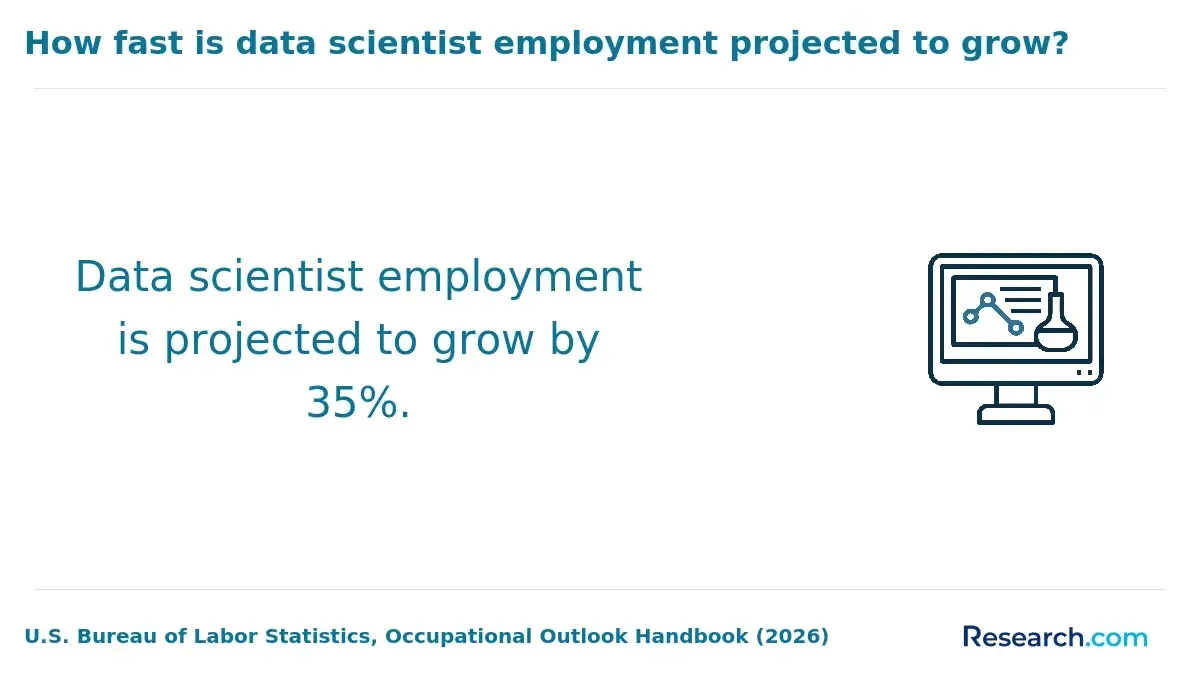
Depending on your experience and the curriculum, possible targets include data scientist, analyst, machine learning, or data engineering roles. The Bureau of Labor Statistics projects data scientist employment growth of 35% from 2025 to 2035. That indicates demand for the occupation overall, not the probability that a particular graduate will be hired.
For a financial decision, compare realistic roles against your current compensation, not just an occupational median. Consider your existing technical experience, location, portfolio, and the job requirements you actually see. A degree may help you qualify for a role, but any subsequent salary difference cannot automatically be attributed to the degree.
Is a data science master's worth the cost and reduced work schedule?
It may be worth it if the program teaches skills your target jobs require, you can absorb the temporary loss of pay, and the plausible career benefit justifies your full cost - not merely tuition. A lower-workload schedule is more suitable when it preserves income and benefits without delaying a necessary career change too much. Postpone or reconsider the degree if the plan depends on an unverified salary increase or employer reimbursement.
Make the decision with three scenarios: continuing to work at current hours, enrolling without cutting hours, and enrolling with the reduction you expect. Compare each scenario's cash needs during study, total cost, and career relevance. If an AI-focused credential might serve the same goal with a better schedule, compare AI degree pathways for your career before committing. The common mistake is to calculate whether you can afford admission, rather than whether you can afford the entire period of reduced earnings.
Other Things You Should Know About Data Science
Eligibility depends on the program, your enrollment status, and the specific aid. Ask the school's financial aid office how your planned course load affects each type of assistance before relying on it.
Do not assume they will. Deferment depends on the loan and qualifying enrollment status. Confirm your status with the school and your loan servicer before changing your work schedule.
Possibly. Employer policies may require continued employment or repayment under specified conditions. Obtain the written agreement and account for that risk if a career change is your goal.
Tax treatment depends on current law and your circumstances. Check current IRS guidance or consult a qualified tax professional; do not build a tax benefit into your budget before establishing eligibility.
References
- Pell Grant Enrollment Intensity and Cost of Attendance | ed.gov https://fsapartners.ed.gov/knowledge-center/fsa-handbook/2026-2027/vol7/ch3-pell-grant-enrollment-intensity-and-cost-attendance
- About the tool "Your Financial Path to Graduation" | consumerfinance.gov https://www.consumerfinance.gov/paying-for-college/your-financial-path-to-graduation/how-we-got-these-numbers/
- Delayed Time-to-Degree and Post-college Earnings - PMC https://pmc.ncbi.nlm.nih.gov/articles/PMC7875953/
- Federal Pell Grants | studentaid.gov https://studentaid.gov/understand-aid/types/grants/pell
- Employer-offered educational assistance programs can help pay for college | Internal Revenue Service https://www.irs.gov/newsroom/employer-offered-educational-assistance-programs-can-help-pay-for-college
- Data Science Program Costs - USC Rossier School of Education https://rossier.usc.edu/programs/masters/data-science-for-learning-applications/data-science-program-costs/
- How many credits do I need to be a full-time student? | cuny.edu https://help.bmcc.cuny.edu/37085/kb/article/101911/how-many-credits-do-i-need-to-be-a-fulltime-student
- Paying For Graduate School: 7 Funding Strategies | Northeastern University Graduate Programs https://graduate.northeastern.edu/knowledge-hub/paying-for-graduate-school/
- What Can You Do with a Master's Degree in Data Science? | UCLA MSOL Data Science https://www.msol.ucla.edu/data-science-engineering/articles/what-can-you-do-with-masters-degree-data-science/
- How Job Change Or Separation Affects Your Benefits | UA Human Resources https://hr.arizona.edu/employees/leaving-u/how-job-change-or-separation-affects-your-benefits


