2027 Well-Baby Nursery Nurse Orientation: Training, Competency Reviews, and Support to Compare
Audited and Verified:
Our Editorial and Data Verification Process
Research.com uses government datasets, official education statistics and primary institutional information to support its career and degree guides. Our review process checks factual accuracy, occupational definitions, source dates and the requirements associated with the credentials discussed.
How This Article Was Fact-Checked
Our editorial team verifies salary estimates, employment projections, education requirements and program information against original data providers and official organizations. Salary figures are checked against the relevant occupational definitions and reporting periods. Information about licensure, accreditation and required in-person training is reviewed separately.
Fact-checked and verified on:

Co-Founder and Chief Data Scientist
A well-baby nursery job offer can look attractive until you discover that "orientation" means a few shadow shifts - or that you may cover newborns and postpartum patients sooner than expected. For nursing students, new graduates, and RNs changing specialties, the important decision is whether the employer's training matches the assignment you will actually carry. This guide explains the RN pathway, common orientation content, observed competency reviews, and the support worth confirming before you accept a position or agree to practice independently.
Key Things You Should Know
- An active RN license is the usual starting credential; nursery-specific readiness is established through employer training and observed performance, not a degree or course title alone.
- Compare offers on three separate points: supervised progression, documented competency checks, and access to experienced help after orientation ends.
- Ask whether the assignment includes newborn-only care, couplet care, or attendance at deliveries; each can change the training, staffing, and escalation support you need.
What Does a Well-Baby Nursery Nurse Do?
A well-baby nursery nurse is an RN caring for newborns who do not require neonatal intensive care. Depending on the hospital, the nurse may work in a separate nursery, care for babies who room with their families, or take a mother-baby assignment. Typical responsibilities include newborn assessment, feeding and thermoregulation support, ordered screening and preventive care, documentation, family education, and prompt recognition of changes that require evaluation.
The assignment matters more than the job title. Ask whether nurses also care for postpartum patients, attend deliveries, or stabilize infants while a neonatal team responds. A newborn who needs a higher level of care is not simply a more demanding well-baby assignment; the nurse must recognize the concern, escalate it, and work within unit policy and personal competence.
For someone considering a faster entry into nursing, comparing accelerated LPN training schedules addresses a different license and scope. LPN/LVN responsibilities vary by state and employer; an LPN/LVN program does not qualify its graduate for an RN nursery position.
What Training Is Required for Well-Baby Nursery Nursing?
The usual foundation is graduation from a prelicensure nursing program, eligibility for the NCLEX-RN, and an active RN license issued by the appropriate state board. An ADN/ASN or BSN can provide the initial educational route, subject to the program's eligibility and an employer's hiring requirements. Graduation, exam eligibility, licensure, and readiness for a newborn assignment are separate milestones.
Employers then provide setting-specific training. A new graduate may need a structured transition-to-practice program and a longer supervised progression; an experienced RN moving from another specialty may need less general onboarding but substantial newborn-specific practice. Neither prior adult-care experience nor a classroom module establishes competence with a newborn population.
An RN-to-BSN program may serve an already-licensed nurse's academic goals. Even BSN completion programs using workplace-based projects should not be mistaken for a hospital's observed nursery skills validation. If you already hold an RN license, compare the employer's onboarding before paying for another degree solely to seek this role.
How Do You Become a Well-Baby Nursery Nurse?
For a nursing student or career changer, the practical sequence is to qualify for RN licensure, obtain the license, apply to employers willing to train nurses in newborn care, and complete supervised orientation. State board rules determine licensure; the hospital determines hiring and unit competency requirements.
Use these steps to distinguish a viable entry route from a job posting that assumes experience you do not yet have:
- Check your state board's RN licensure requirements and choose an eligible prelicensure program with supervised clinical education.
- Look for maternal-newborn clinical exposure, then document what you actually observed or performed without presenting student experience as independent practice.
- Ask recruiters whether new graduates are considered and whether the opening is for nursery-only, mother-baby, or a combined assignment.
- Request the orientation outline, evaluation method, expected progression, and escalation plan before accepting an offer.
If you already have a bachelor's degree outside nursing, online direct-entry MSN program comparisons may help you examine one initial-RN pathway. Confirm the specific program's state eligibility, required in-person clinical training, and licensure outcomes; an online label does not make newborn clinical preparation remote.
A meaningful competency review checks whether the nurse can perform and explain work safely in the intended assignment. Employers may use direct observation, case discussion, simulation, chart review, and preceptor feedback. A signed checklist is most useful when it records the expected standard, the method of evaluation, and any follow-up - not merely attendance at a class.
Reviews commonly examine newborn assessment and recognition of concerning changes; safe identification, medication and specimen workflows; feeding support and family teaching; infection prevention; accurate EHR documentation; handoffs; and timely escalation. The nurse should also know when to seek help rather than treating a successful simulation as authorization to manage every situation alone.
Ask who observes each skill and what happens if relevant cases do not arise during orientation. A supervisor may arrange additional observation or simulation, but the employer must decide what evidence is sufficient for its assignment. Admission to DNP programs with accessible admission requirements, like completion of any other academic program, does not replace that workplace determination.
Orientation should connect hospital policy to supervised newborn care and then to the assignment the nurse will carry. The sequence below is a comparison tool, not a universal schedule: hospitals differ in patient population, staffing, and which services nurses provide.
| Orientation component | What it should establish | What to verify |
| Unit and workflow introduction | Identification, documentation, screening, handoffs, equipment, and escalation routes | Whether workflows differ for nursery, rooming-in, and couplet assignments |
| Supervised patient care | Assessment, feeding support, family teaching, prioritization, and recognition of changes | How assignments progress and whether a consistent preceptor observes performance |
| Readiness review and follow-up | Documented strengths, remaining gaps, and a plan for the first independent assignments | Who authorizes the transition and what help remains available on each shift |
Request the policy for situations your unit handles infrequently, including how to summon neonatal or other urgent support. If orientation covers deliveries or postpartum patients, ask for the additional supervised experience and separate competencies tied to those duties. Even short online DNP completion pathways are academic study, not a substitute for this employer-specific progression.
An RN license is the central practice credential. Employers may also require or provide particular resuscitation training, newborn-care education, or competency validation based on the assignment. Check the job description and the employer's current policy rather than assuming every nursery requires the same course or credential.
After gaining relevant experience, an RN may consider a neonatal or maternal-newborn specialty certification if the awarding organization's current eligibility rules are met. Specialty certification can document professional knowledge, but it does not expand RN scope, guarantee a pay increase, or waive local orientation. Ask who pays for required training and whether completion is expected before hire or during onboarding.
A graduate credential for another role serves a different purpose. For example, comparing postgraduate FNP certificate schedules concerns advanced practice preparation, not a certification needed to work as a well-baby nursery RN.
For an aspiring nursery nurse, compare programs by whether they prepare you for initial RN licensure and provide approved, supervised clinical learning - not by the amount of coursework delivered online. Both online-supported and campus-based routes can require fixed-time labs, simulation, and in-person placements.
The format comparison is most useful when you include the time you must be physically available:
| Format | Potential advantage | Constraint to confirm |
| Online-supported prelicensure study | Some classroom work may be completed away from campus | Required labs, clinical sites, live sessions, travel, and state enrollment eligibility |
| Campus-based prelicensure study | Predictable access to on-site instruction and skills facilities | Commute, class timetable, and clinical shifts that may not follow class hours |
| Postlicensure online study | Can fit an existing RN's academic advancement goals | Does not provide initial RN licensure or replace nursery onboarding |
Online graduate specialties answer a different career question. Affordable online psychiatric nurse practitioner programs, for instance, are not an entry route into well-baby nursery RN practice. Before enrolling anywhere, obtain written answers about clinical placement responsibilities, required attendance, state eligibility, and total on-site commitments.
There is no nursery-specific nursing degree or single dependable price. An ADN/ASN or BSN is a common prelicensure route, and the time remaining depends on prerequisites, admission, course sequencing, clinical availability, and any credits the program actually applies. An RN changing specialties generally needs employer orientation rather than another prelicensure degree.
To compare costs, request each school's full estimate for tuition and fees, books and equipment, health and background requirements, clinical travel, and exam and licensure expenses. Add likely lost earnings or reduced work hours. For an employed RN, compare any tuition benefit with the cost and scheduling demands of a degree that may not be required for the nursery job.
Graduate study can be worthwhile for a separately defined advanced practice goal, but comparing lower-cost NP programs is not a necessary spending step for an RN nursery position. Price the shortest route that meets your actual license and career objective, not a higher credential by default.
Well-baby experience can support applications to mother-baby, postpartum, newborn education, and other roles involving families and infants. Moving into neonatal intensive care, labor and delivery, or a different specialty may still require substantial new orientation; employers will assess the patient population and skills you have actually managed. Precepting or unit education roles likewise depend on experience and employer expectations, not tenure alone.
If your goal is an advanced practice or unrelated specialty role, plan that transition separately. MSN-PMHNP program length comparisons, for example, address a different patient population and formal preparation; nursery employment does not waive that program's requirements. Ask prospective employers which experience they value and whether they offer a supervised transition rather than assuming a nursery title transfers directly.
What Are Well-Baby Nursery Nurse Salaries and Job Prospects?
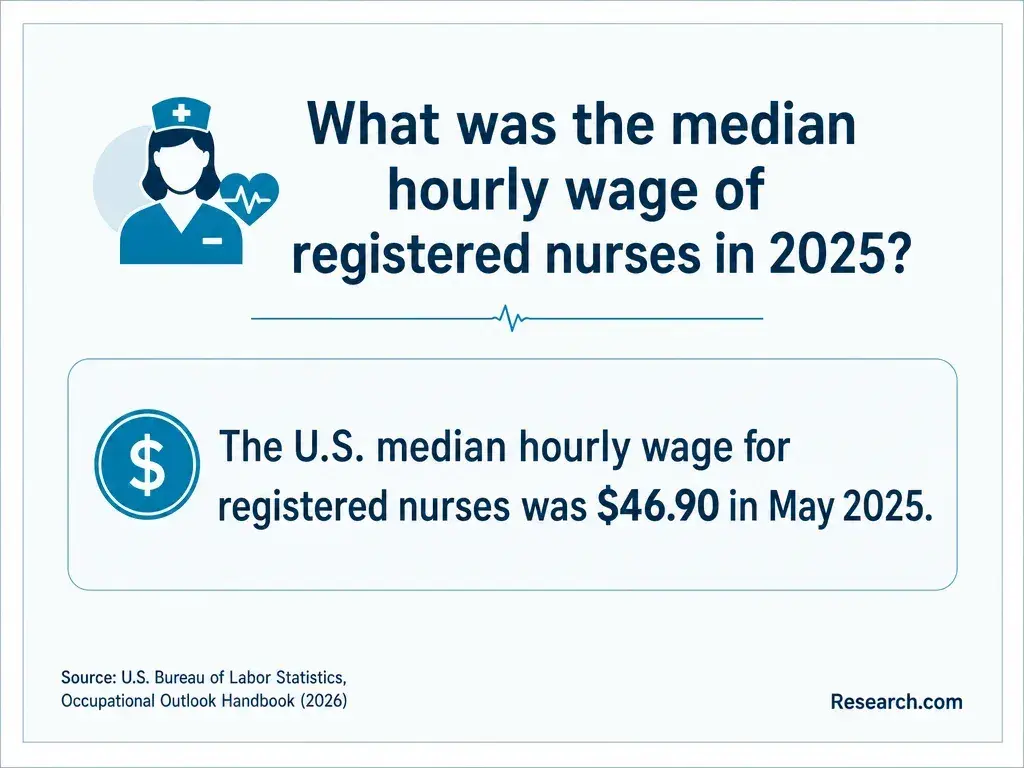
Well-baby nursery nurses are generally counted within the broader registered nurse occupation in U.S. Bureau of Labor Statistics wage and employment data. That makes RN data useful for understanding the overall market, but it does not establish a nursery-specific median, a new-graduate offer, or the number of local nursery openings. Pay also varies with region, employer, experience, shift differentials, and whether the role includes mother-baby duties.
Use the latest BLS Occupational Outlook Handbook RN wage and projection figures as broad context, then compare actual local postings and written offers for this assignment. Evaluate base pay alongside weekend and night requirements, orientation pay, staffing, benefits, and how soon independent assignments begin. A higher offer may be a poor trade if supervision or escalation support is inadequate.
Further education should have a clear purpose beyond an assumed salary gain. ADN-to-MSN bridge length and requirements may matter to an ADN-prepared RN pursuing a defined graduate role, but occupation-wide RN wages cannot predict whether that investment will pay off.
Other Things You Should Know About Nursing
Tell your preceptor and educator before the readiness review. Ask how the employer will provide supervised exposure or another acceptable assessment, and do not sign off a skill you have not demonstrated.
Yes. Describe the specific assignments or decisions for which you still need supervision and ask how additional shifts will be evaluated. Make the request before independent scheduling begins when possible.
Not automatically. A school must determine whether an experience meets its course, supervision, documentation, and site requirements. Employment and academic clinical credit are separate decisions.
Retain permitted records of your completed training and credentials, and describe your actual assignment and experience accurately. Do not take patient information or confidential employer materials; the next employer will set its own orientation and competency requirements.
- Assessment of clinical competence in... - PMC - NIH https://pmc.ncbi.nlm.nih.gov/articles/PMC7668267/
- HEALTHY NEWBORN CARE - Nursing Health Promotion - NCBI https://www.ncbi.nlm.nih.gov/books/NBK615345/
- Essential newborn care | who.int https://www.who.int/teams/maternal-newborn-child-adolescent-health-and-ageing/newborn-health/essential-newborn-care
- Top Tips to Prepare You to Precept a New Nurse Graduate | denvercollegeofnursing.edu https://www.denvercollegeofnursing.edu/blog/nursing/top-tips-to-prepare-you-to-precept-a-new-nurse-graduate.html
- "Development of an Evidence Based Orientation Model for the Newly Gradu" by Sandra L. Takach https://digitalcommons.otterbein.edu/stu_doc/175/
- Safe Practices | Baby-Friendly USA https://babyfriendlyusa.org/safe-practices/
- Rethinking Critical Care Orientation - AACN https://www.aacn.org/blog/rethinking-critical-care-orientation
- 5 Essentials of Nursing Orientation | HealthStream, Inc. https://www.healthstream.com/blog/five-essentials-of-nursing-orientation
- Components of an Effective Nurse Orientation Pathway | American Association of Critical-Care Nurses https://solutions.aacn.org/blog/components-of-an-effective-nurse-orientation-pathway