2027 Scientific Machine Learning in an Online Data Science Master's: Courses, Projects, and Program Selection

Co-Founder and Chief Data Scientist
Choosing an online data science master's for scientific machine learning requires more than finding "machine learning" in a course list. If you want to model physical, biological, or other scientific systems, you need the right mathematics, computational methods, and access to substantial projects.
This guide shows prospective students how to distinguish broad data science training from meaningful scientific machine learning depth - and decide whether an online program can support their goals.
Key Things You Should Know
- Look for numerical methods, scientific computing, and uncertainty-aware modeling alongside machine learning; a course title alone does not establish scientific machine learning depth.
- Prioritize a project that tests a model against scientific baselines, documents its limitations, and can be completed with the program's available data and computing support.
- The U.S. Bureau of Labor Statistics projects 35% growth in data scientist employment from 2025 to 2035, but that occupation-wide forecast does not measure demand for scientific machine learning specialists.
What is scientific machine learning in an online data science master's program?
Scientific machine learning, often shortened to SciML, uses machine learning to investigate systems governed or described by scientific knowledge. A model might learn from experimental observations while respecting a conservation law, approximate an expensive simulation, or estimate unknown parameters in a mathematical model. The defining challenge is not simply prediction: results must also make sense under scientific assumptions and measurement uncertainty.
In an online data science master's, SciML may appear across applied mathematics, computational science, statistics, and domain electives rather than as a named concentration. Common methods include surrogate models for simulations, neural operators, physics-informed neural networks, Bayesian inference, and hybrid models that combine learned components with conventional solvers. A general AI curriculum may emphasize other applications; if that is your broader aim, you can find an online AI degree program and compare its focus with SciML requirements.
What counts as depth? A passing mention establishes awareness; a course unit introduces a method; a dedicated course can develop its assumptions and implementation; advanced electives and a substantial project provide room to test it. Judge the work students actually do, not the sophistication of a course title.
Which courses cover scientific machine learning and advanced data science?
A strong pathway connects mathematical foundations to implementation and scientific evaluation. The table shows what to seek in course descriptions and assignments; programs may organize these subjects under different names.
| Course area | Relevant depth to look for | Why it matters for SciML |
| Mathematics and scientific computing | Linear algebra, differential equations, optimization, numerical methods, and simulation error | Supports models that interact with physical or computational systems |
| Statistics and uncertainty | Probabilistic modeling, measurement error, inference, and uncertainty quantification | Helps distinguish a reliable scientific finding from a confident prediction |
| Machine learning | Generalization, regularization, deep learning, and evaluation under distribution shift | Provides methods for learning from limited or changing observations |
| Domain or research electives | Work with scientific datasets, simulations, or a field-specific question | Connects technical methods to meaningful assumptions and constraints |
Preparation matters as much as elective choice. Students who need to rebuild calculus, linear algebra, probability, or Python skills should check whether foundation courses count toward the degree and whether they must be completed before advanced electives. For each promising course, request a current syllabus: evidence of coding assignments, numerical baselines, and model validation is more informative than a catalog description that merely names a technique.
What projects build practical scientific machine learning experience?
A useful SciML project poses a scientific question, identifies what is observed versus assumed, and compares a learned method with an appropriate statistical or numerical baseline. Its value comes from defensible evaluation, not from using the newest model architecture.
These project types can reveal whether a program provides enough technical scope for your interests:
- Simulation surrogate: Train a model to approximate an expensive simulator, then report accuracy, computational trade-offs, and where predictions fail outside the training conditions.
- Parameter estimation: Infer unknown model parameters from noisy observations, assess identifiability, and quantify uncertainty rather than reporting only a best-fit value.
- Hybrid physical model: Combine a conventional solver with a learned component and test whether the combination improves performance without violating relevant constraints.
Before enrolling, check whether students can obtain suitable data, computing resources, qualified supervision, and permission to pursue an independent topic. If a capstone is team-assigned or restricted to sponsor problems, an otherwise strong program may not let you build the SciML portfolio you want. Document code, data provenance, baselines, failure cases, and reproducibility; handle sensitive research data according to applicable agreements.
How do online and campus-based data science master's programs compare?
Delivery format does not determine technical rigor. The consequential difference for SciML is often access: an online student may have excellent remote coursework but less convenient access to a laboratory, specialized computing, or informal research collaboration. A campus student may gain those opportunities, but only if the particular program and faculty make them available.
Choose an online program when its advanced courses, remote computing arrangements, project supervision, and meeting times fit your work and research needs. Campus study may be more suitable if your intended work requires instruments, restricted data, or frequent in-person collaboration. In either format, verify whether research projects are open to master's students rather than assuming that a university's research activity automatically translates into student access.
What are the admission requirements for an online data science master's?
Requirements vary by institution. Applicants commonly need to demonstrate readiness for graduate quantitative work, but a particular major, course, test, or amount of professional experience should not be assumed to be universally required. Check each program's current admissions policy for its degree, transcript, programming, mathematics, and application-document rules.
For SciML, evidence of preparation may include graded work in calculus, linear algebra, probability, or programming, plus a project that explains a scientific question and its modeling assumptions. Self-study can close a knowledge gap, but it fulfills a formal prerequisite only if the program says it does. If application-writing requirements are a constraint, guidance on machine learning master's applications without essays can help you identify policies to verify directly before applying.
How long does an online data science master's take and cost?
Completion time depends on required credits, course availability, enrollment pace, and whether advanced electives or a project have prerequisites. A program advertised as flexible may still offer a crucial numerical methods course infrequently. Map the full sequence - not just the minimum possible duration - against the time you can devote each term. Readers comparing accelerated options can examine short-format online data science graduate programs, then check whether their schedules leave room for the SciML depth they need.
Compare costs using each school's current tuition and fee schedule. Include required fees, software or computing charges, materials, and any travel or on-campus attendance; account separately for financing costs and income you would forgo by reducing work. Ask whether employer assistance applies and whether a project needing substantial computing would create additional expense. Without a verified program-specific schedule, a quoted tuition figure would not be a dependable total-cost comparison.
How do accreditation standards affect online data science master's programs?
Institutional accreditation is an essential legitimacy check, but it does not certify that a program teaches SciML well. Verify the institution's current accreditation status through the accreditor or an official U.S. Department of Education resource, then separately evaluate curriculum and project access. Do not treat a platform partnership, ranking, or promotional badge as a substitute for institutional accreditation.
If you will study from another state, also confirm that the institution can enroll students where you reside and whether any required in-person activity is feasible. Accreditation, state authorization, and subject-matter depth answer different questions; a program should meet all three needs relevant to you.
What careers and salaries can scientific machine learning graduates expect?
SciML preparation can be relevant to data scientist, machine learning engineer, research software, or computational science work in organizations that use scientific observations or simulations. Job titles and required degrees vary considerably. Employers may value domain expertise and experience with numerical methods as much as a general machine learning credential.
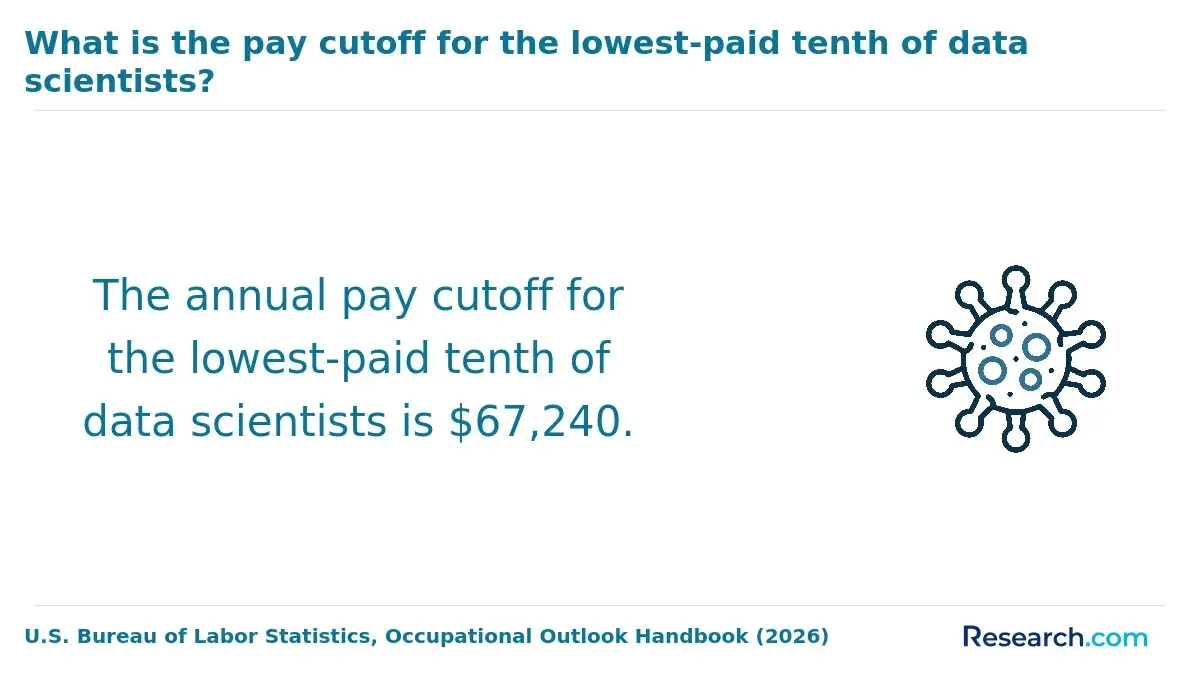
The U.S. Bureau of Labor Statistics reports a $120,230 median annual wage for data scientists in May 2025. This is a national occupational median - not a starting salary, a SciML-specific figure, or an outcome attributable to a master's degree. Use it as broad labor-market context while assessing roles by your prior experience, location, industry, and demonstrated projects. For a wider view of potential roles, explore online data science degrees for in-demand careers.
What is the job outlook for data science and machine learning careers?
The Bureau of Labor Statistics projects 35% employment growth for U.S. data scientists from 2025 to 2035, much faster than the average for all occupations. That projection supports broad interest in data science skills, but it neither isolates scientific machine learning jobs nor guarantees that a graduate will secure one.
For a SciML-focused search, examine actual postings in your target domain. Check whether they ask for scientific computing, simulation, uncertainty quantification, or a particular research background. AI tools can change how teams build models, making evidence of validation and domain judgment especially useful; the occupational growth figure alone cannot tell you which specialized methods an employer will require.
How do you choose a reputable online data science master's program?
Shortlist programs by the work you want to do, then compare evidence using the same criteria. If your goal is scientific modeling, a general AI program may be a better fit only when its electives and projects support that goal; advice on how to evaluate AI degrees for career fit can help frame that alternative.
Use these checks before committing to a program:
- Trace the course sequence: Confirm that you can reach advanced numerical, statistical, and machine learning work within your planned pace.
- Inspect project evidence: Ask for a current capstone policy, examples of permitted topics, and the process for finding a qualified supervisor.
- Verify delivery and resources: Check live-session requirements, elective availability, remote computing access, and any necessary campus visits.
- Confirm legitimacy and total cost: Verify accreditation and enrollment eligibility, then calculate tuition plus required and project-related expenses.
- Test career fit: Compare the curriculum with job postings in your intended scientific domain rather than relying on a broad placement claim.
A common mistake is to choose the program with the most AI-branded electives while overlooking numerical methods or research access. Another is to assume that every capstone can be tailored to a scientific problem. Request written clarification when a feature is decisive and not clearly stated in current program materials.
Other Things You Should Know About Data Science
Not always. Some projects can be completed with modest computing resources; large neural models or extensive simulation experiments may need more. Estimate the workload for your proposed project and ask what computing the program provides.
No. They are one approach to combining learned models with physical constraints. Whether they are useful depends on the problem, available observations, and performance against established numerical methods.
Possibly, but publication depends on the quality of the work and any university, sponsor, data-use, or intellectual-property restrictions. Clarify those conditions before using a proprietary dataset or sponsored research question.
Not universally, but research experience and strong academic references can matter. If doctoral study is a serious possibility, ask whether the online master's offers a supervised thesis or another route to sustained research work.
References
- From PINNs to PIKANs: recent advances in physics-informed machine learning - PMC https://pmc.ncbi.nlm.nih.gov/articles/PMC13290273/
- MS in Data Science | UConn | Online & On-Campus Programs | Master of Science in Data Science | University of Connecticut https://masters.datascience.uconn.edu/
- The Capstone Project | Master of Molecular Science and Software Engineering https://msse.berkeley.edu/capstone/
- Computational & Data Science | The University of Utah https://psm.utah.edu/degree-programs/comp-data-sci.php
- Costs | MIT Course Catalog https://catalog.mit.edu/mit/graduate-education/costs/
- M.S. in Data Science, Online | virginia.edu https://datascience.virginia.edu/degrees/msds-online
- Integrating Scientific Knowledge with Machine Learning for Engineering and Environmental Systems | ACM Computing Surveys https://dl.acm.org/doi/10.1145/3514228
- Cost: New and Current Graduate & Professional Students | University of Arizona Office of Scholarships & Financial Aid https://financialaid.arizona.edu/cost/graduate-professional
- What Are Physics-Informed Neural Networks (PINNs)? | mathworks.com https://www.mathworks.com/discovery/physics-informed-neural-networks.html
- Understanding Physics-Informed Neural Networks | mdpi.com https://www.mdpi.com/2673-2688/5/3/74