2027 Reliability Analytics in an Online Data Science Master's: Courses, Projects, and Program Selection

Co-Founder and Chief Data Scientist
Reliability analytics is rarely the name of an online master's degree. If you want to predict equipment failures, analyze product defects, or measure software service reliability, you will usually need to find that training within a data science, statistics, or engineering program. This guide shows you which courses and projects provide meaningful preparation - and how to distinguish a program with real reliability depth from one that merely mentions the topic.
Key Things You Should Know
- Look for statistics and time-to-event methods alongside data engineering and a project using failures, defects, maintenance records, or service incidents. A course title alone does not establish depth.
- Compare online programs by access to relevant electives, usable project data, faculty supervision, and total cost - not by the degree title alone.
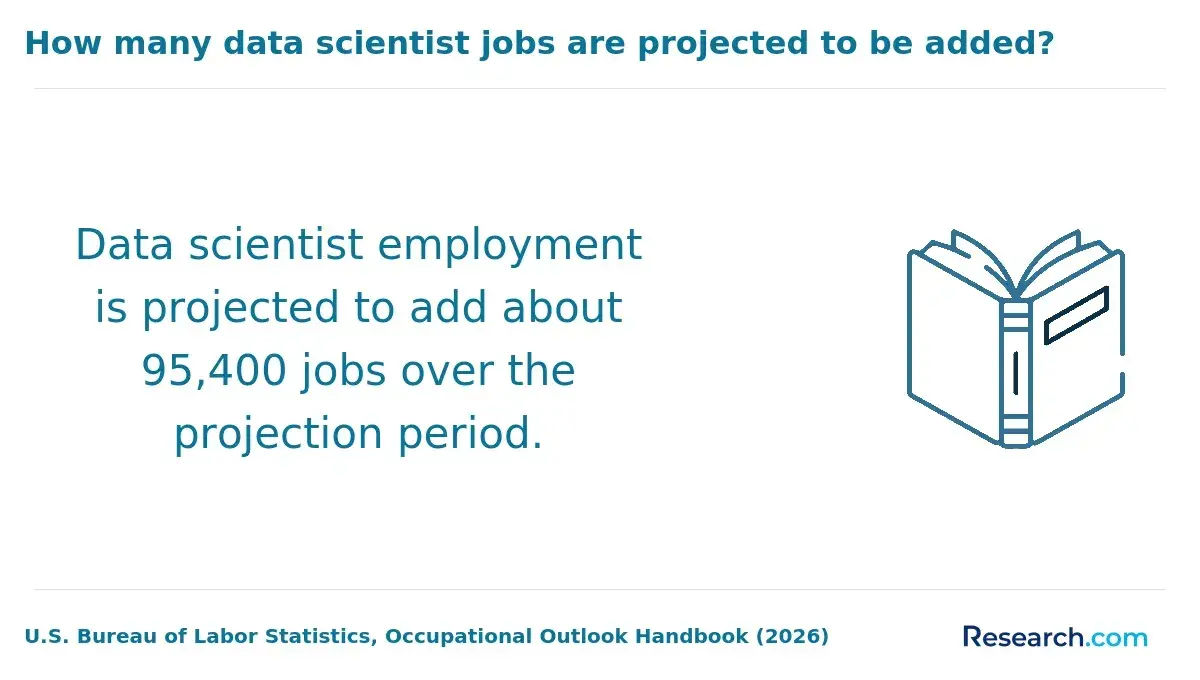
- The U.S. Bureau of Labor Statistics projects 35% employment growth for data scientists from 2025 to 2035, but that occupation-wide forecast does not predict openings specifically in reliability analytics.
What is reliability analytics in an online data science master's program?
Reliability analytics uses data to understand when and why a product, machine, process, or software service stops meeting an expected standard. The practical questions differ by setting: How long until a component fails? Which maintenance action reduces unplanned downtime? Are defects increasing after a manufacturing change? Is a software service meeting its availability target?
In a data science master's, this work may appear under survival analysis, quality engineering, industrial analytics, predictive maintenance, operations research, or time-series modeling rather than "reliability analytics." Students need statistical judgment as well as coding: a model that predicts failure accurately in a classroom dataset may be unusable if it relies on information that would arrive only after the failure.
AI can help classify incident reports or detect unusual sensor behavior, but automating a maintenance or safety decision introduces questions about oversight and error costs. Students targeting that kind of work may also examine AI governance study at master's level; it complements, rather than replaces, reliability methods.
What courses do online reliability analytics master's programs typically include?
There is no standard reliability analytics master's curriculum. Relevant training is more often assembled from core data science courses, technical electives, and an applied project. The distinction to check is whether students can use reliability methods, not simply encounter the term in a lecture.
The following course areas show what to look for in a catalog and what each contributes to reliability work.
| Course area | Reliability application | Evidence of useful depth |
| Probability and statistical inference | Quantifies uncertainty in failure rates and comparisons | Coverage of estimation, uncertainty intervals, and assumptions |
| Survival analysis or reliability engineering | Models time to failure when some units have not yet failed | Censoring, hazard or survival functions, and model validation |
| Time series and machine learning | Analyzes sensor streams, degradation, or incident patterns | Temporal validation and evaluation of rare events |
| Data engineering | Combines operational logs, maintenance records, and asset histories | Work with messy timestamps, identifiers, and missing data |
| Optimization or decision analytics | Connects predictions to inspections, maintenance, or staffing | Explicit treatment of intervention costs and constraints |
A passing mention of predictive maintenance is weaker evidence than a graded unit; a dedicated elective is stronger still. The best evidence is a substantial project in which students define a failure, handle incomplete observations, and explain a decision. If the catalog is vague, request a current syllabus and ask whether the relevant electives are available to online students when they need them.
What projects prepare students for reliability analytics careers?
A strong project starts with a decision someone could make differently - not just a model to train. Students might estimate component life to inform inspection intervals, identify recurring causes of service incidents, or forecast which assets warrant review. Public data can support a portfolio project, but its limitations should be stated rather than treated as representative of an employer's operations.
For a capstone or substantial course project, look for these features:
- A precise outcome: Define what counts as a failure or incident, when observation begins, and whether an asset that has not failed is censored rather than labeled permanently healthy.
- Data available at decision time: Exclude post-failure repairs, investigation notes, and other variables that would leak the answer into a prediction.
- An appropriate baseline and evaluation: Compare the proposed method with a simple maintenance rule or statistical baseline; use time-aware testing when future performance is the goal.
- An operational recommendation: Explain false-alarm costs, missed failures, and how a person would review or act on the result.
- Reproducibility and permissions: Document cleaning and assumptions, and obtain approval before using or publishing employer data.
Choose a program that permits domain-specific capstones and offers feedback on project design. A polished dashboard is less persuasive than an honest analysis of censoring, data quality, and whether the proposed action would have been feasible.
How do online and campus-based data science master's programs compare?
Delivery format does not, by itself, establish technical rigor. For reliability analytics, the consequential differences are access to relevant electives, operational datasets, project supervision, and the ability to collaborate with domain experts.
Online study may suit someone who can apply coursework to an existing reliability, manufacturing, or software-operations job. Campus study may be preferable when a prospective student needs regular access to a laboratory, equipment, or in-person research group. In either format, confirm whether the intended project requires physical access, whether courses meet live, and whether online students receive the same elective and advising options.
If the primary goal is general AI development rather than failure analysis, it may be useful to explore lower-cost online AI programs. A cheaper AI degree is not automatically a substitute for one that teaches survival analysis or reliability engineering.
What accreditation should an online data science master's program have?
Verify that the degree-granting institution holds recognized institutional accreditation and that the online degree is offered by that institution. Check the institution's status with its accreditor or the U.S. Department of Education rather than relying on a marketing badge. Program-specific accreditation may matter for certain engineering pathways, but do not assume every data science degree needs it or that it confers a professional license.
Accreditation is a threshold check, not proof that a curriculum teaches reliability analytics. Also confirm that the school can enroll students in your state and whether any required in-person activities affect your ability to complete the program.
What are the admission requirements for an online reliability analytics master's?
Requirements vary because applicants usually enter a broader data science, statistics, or engineering degree. Programs may evaluate prior study in programming, calculus, linear algebra, and statistics, along with a résumé, recommendations, or an essay. A mechanical engineering applicant may already understand failure mechanisms but need more coding; a software applicant may need more statistical inference or physical-asset context. Neither background automatically qualifies or disqualifies someone.
Before applying, compare your transcript with the program's stated prerequisites and ask admissions staff whether professional work or noncredit study can satisfy any formal requirement. Self-study may improve readiness without fulfilling a required course. Essay rules also differ: application essay policies for online machine learning master's degrees illustrate why applicants should check each current application rather than assume a common rule.
How long does an online reliability analytics master's take and cost?
There is no reliable single duration or price for a "reliability analytics master's": credit requirements, tuition structures, elective schedules, and enrollment pace vary by program. Obtain the current degree plan and fee schedule before comparing offers. A relevant elective offered infrequently can affect completion time even when the advertised program length looks convenient.
For an apples-to-apples cost comparison, ask each school for the following amounts and conditions:
- Required credits multiplied by the applicable tuition rate, including any rate that differs by residency or enrollment status.
- Mandatory online, technology, and program fees, plus any required software or materials.
- Travel or time away from work for residencies, exams, or project requirements, if applicable.
- The effect of part-time pacing, tuition changes, employer assistance, scholarships, and borrowing on your actual out-of-pocket cost.
A lower tuition quote may not mean a lower total cost. Compare funding terms as carefully as sticker prices; how to fund a data science master's provides a starting point for examining aid and payment options.
What careers can reliability analytics graduates pursue?
Relevant roles include reliability analyst, predictive-maintenance analyst, quality or manufacturing data scientist, operations researcher, and data scientist working with service incidents. Software reliability work may sit within site reliability engineering, where analytics is combined with systems operations. Job titles are inconsistent, so examine responsibilities rather than searching only for "reliability analytics."
Match your target role to the program's evidence: asset-focused positions benefit from maintenance and engineering context; product-quality roles need defect and process analysis; service-reliability roles need experience with logs, incidents, and operational metrics. A master's can build those skills, but some positions also require domain experience that coursework alone cannot supply.
What salaries and job outlook can reliability analytics professionals expect?
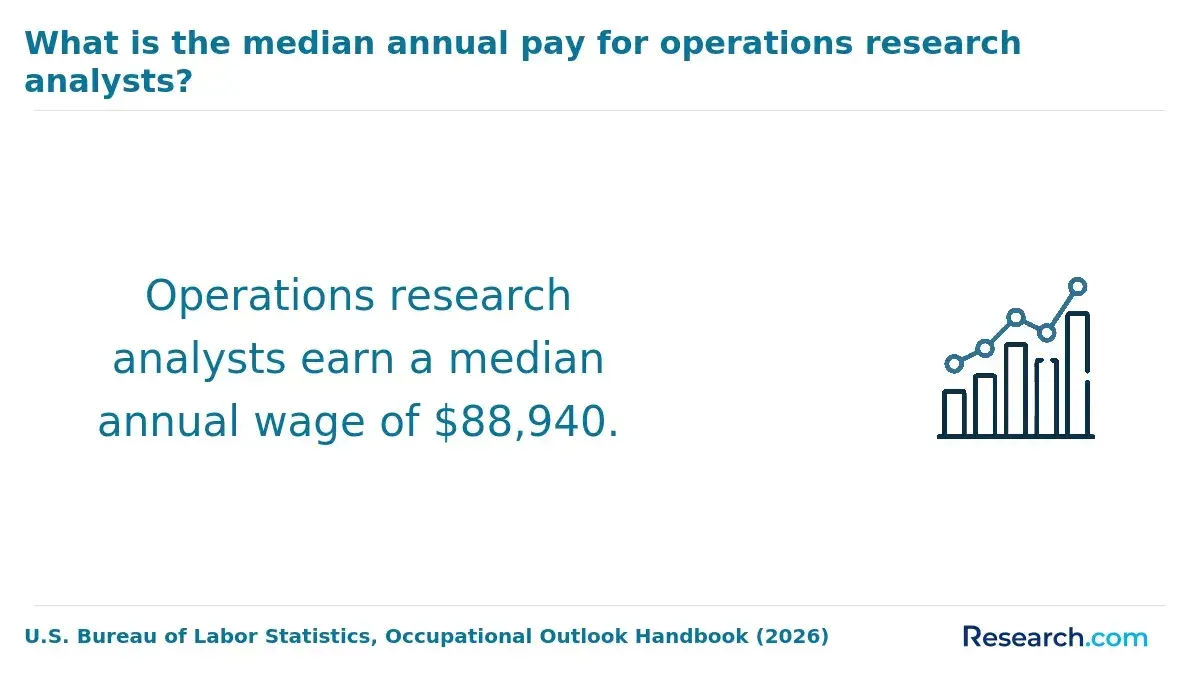
The U.S. Bureau of Labor Statistics reports a $120,230 median annual wage for data scientists in May 2025. That is an occupation-wide benchmark, not a verified salary for reliability specialists or a prediction of what a new graduate will earn. The fit is closest for roles classified as data scientists; reliability engineering and software-operations positions may fall under different occupations.
Use occupation data to understand the broader market, then examine job postings for your intended industry, location, and experience level. When a school publishes graduate salaries, check who responded, whether they were already employed, and whether the figure measures salary level or an increase. Neither a national median nor an alumni figure establishes a return on your tuition.
How can you choose a reputable online reliability analytics master's program?
Start with the work you want to do, then test each program against evidence you can verify. A program with a strong general machine-learning reputation may still be a poor fit if online students cannot take its reliability-relevant electives or complete a suitable project.
Use these questions to narrow your shortlist and resolve gaps before paying an enrollment deposit:
- Check recognition and access: Verify institutional accreditation, eligibility to enroll from your state, and access to the courses listed in the current catalog.
- Test technical depth: Read syllabi for statistics, censoring or time-to-event analysis, temporal validation, and decision-making under failure risk.
- Check the project pathway: Ask whether a reliability-focused capstone is permitted, who supervises it, and how students obtain usable data.
- Compare practical fit: Request a realistic course sequence, live-meeting requirements, and a total-cost estimate using the same assumptions across schools.
- Assess outcomes cautiously: Ask for career-support details and the methodology behind any published employment claims; do not treat a ranking or salary headline as proof of fit.
Choose the program whose verified coursework and project access match your target role at a cost and pace you can manage. If your interest is principally AI rather than reliability methods, online AI master's programs for cost-conscious students offer a different comparison set - but check their curricula before treating them as equivalent.
Other Things You Should Know About Data Science
Not for every analytics role. Licensure requirements depend on the duties, employer, and state; work involving regulated engineering practice may have different rules. Check the requirements for the position you want rather than assuming the degree grants a license.
Only with appropriate permission. If operational data or incident details are confidential, publish an approved, anonymized summary or demonstrate the method using data you are authorized to share.
They can document familiarity with a particular platform, but they may not cover statistical modeling, study design, and evaluation at graduate depth. Their value depends on the tools and qualifications in your target job postings.
Not always, but research experience and strong academic recommendations can matter. If doctoral study is a serious possibility, ask whether online students can undertake faculty-supervised research rather than assuming a course-only capstone serves the same purpose.
References
- Survival Analysis and Interpretation of Time-to-Event Data - PMC https://pmc.ncbi.nlm.nih.gov/articles/PMC6110618/
- MS in Reliability and Maintainability Engineering https://rme.utk.edu/masters/
- Master's in Data Science | utexas.edu https://cdso.utexas.edu/msds
- Systematic review of predictive maintenance practices in the manufacturing sector - ScienceDirect https://www.sciencedirect.com/science/article/pii/S2667305325000274
- Reliability Engineering | MSOL - UCLA https://www.msol.ucla.edu/reliability-engineering/
- Online MS in Data Science | Master's Program | Hopkins EP https://ep.jhu.edu/programs/data-science/
- Reliability Engineering | umd.edu https://mage.umd.edu/programs/reliability-engineering
- Types of Data Analytics in Engineering | Interdisciplinary Professional Programs https://interpro.wisc.edu/types-of-data-analytics-in-engineering/
- Time-To-Event (TTE) Data Analysis | Columbia University Mailman School of Public Health https://www.publichealth.columbia.edu/research/population-health-methods/time-event-data-analysis
- Prerequisites | Master of Science in Analytics https://analytics.ncsu.edu/admissions/prerequisites/