2027 Radiation Oncology Nurse Orientation: Training, Competency Reviews, and Support to Compare
Audited and Verified:
Our Editorial and Data Verification Process
Research.com uses government datasets, official education statistics and primary institutional information to support its career and degree guides. Our review process checks factual accuracy, occupational definitions, source dates and the requirements associated with the credentials discussed.
How This Article Was Fact-Checked
Our editorial team verifies salary estimates, employment projections, education requirements and program information against original data providers and official organizations. Salary figures are checked against the relevant occupational definitions and reporting periods. Information about licensure, accreditation and required in-person training is reviewed separately.
Fact-checked and verified on:

Co-Founder and Chief Data Scientist
A radiation oncology RN may bring strong assessment and patient-education skills to a new job yet still need supervised preparation for treatment workflows, symptom escalation, and the department's safety procedures. For new graduates and nurses changing specialties, the quality of orientation can matter more than its advertised length. This guide explains what training and competency reviews should cover, how to compare support across employers, and when additional education or certification is - and is not - worth pursuing.
Key Things You Should Know
- An active RN license is the entry credential; a nursing degree or oncology certificate does not replace employer-specific radiation oncology orientation.
- Compare three forms of readiness evidence: supervised clinical work, observed skills or scenarios, and documented feedback with a plan for remaining gaps.
- There is no single national orientation length or price. Ask how workload and supervision change before accepting an independent assignment.
What Is Radiation Oncology Nurse Orientation and Why Does It Matter?
Radiation oncology nurse orientation is an employer-run transition into caring for people receiving radiation treatment. It connects general RN practice with the department's patient population, equipment-adjacent workflows, documentation, and escalation procedures. Depending on the service, nurses may assess symptoms, teach patients and families, coordinate care, support procedures, and respond to urgent concerns; radiation therapists and other team members have distinct responsibilities.
Orientation matters because recognizing a concern in a classroom is different from managing it within a busy clinic. An experienced RN's transferable skills can shorten some learning steps, but experience alone does not establish competence in an unfamiliar service. Likewise, an RN considering BSN completion options for experienced RNs should treat degree completion and specialty onboarding as separate decisions.
What Training Do Radiation Oncology Nurses Need Before Independent Practice?
Before taking an independent assignment, a nurse needs an active license appropriate to the job, training on the employer's policies, and demonstrated competence for the duties assigned. Preparation should address the treatments and patient groups actually served - for example, external-beam visits, brachytherapy support, pediatric care, or concurrent systemic therapy where applicable. Training in one service should not be presumed to cover another.
Ask whether a named preceptor will supervise assessments, patient teaching, documentation, and escalation until the nurse can perform them reliably. A sound progression moves from observation to supervised care and then to an appropriately supported workload. Classroom modules and simulation can prepare a nurse for this work, but neither substitutes for observed performance with patients. Even short online DNP completion pathways would not replace local training for a new radiation oncology assignment.
How Do Competency Reviews Evaluate Radiation Oncology Nursing Skills?
A competency review checks whether a nurse can perform defined work safely in the intended setting. Employers may combine direct observation, case discussion, simulation, chart review, and feedback from a preceptor. A signed checklist is useful only if it identifies the skill, the assessment method, the reviewer, and what happens when performance needs improvement.
Ask to see the role's competency criteria before orientation begins. Strong reviews assess clinical judgment as well as task completion: whether the nurse identifies a concerning change, communicates it through the right channel, documents accurately, and recognizes when to seek help. Reviews should recur when responsibilities or procedures change, not end permanently on the first independent day. These workplace assessments serve a different purpose from comparing DNP admission criteria, which measure eligibility for further study rather than readiness for a specific patient-care assignment.
Content varies by department, but the most useful comparison is whether orientation covers the actual work the new hire will perform. The following areas give applicants a practical way to examine an orientation plan.
- Care pathway: consultation, treatment planning, treatment visits, follow-up, referrals, and the RN's role at each point.
- Assessment and teaching: expected effects, symptom reporting, self-care instructions, accessibility needs, and when to escalate.
- Local safety procedures: infection prevention, emergency response, medication practices, and radiation precautions relevant to the assignment.
- Team workflow: handoffs with radiation oncologists, therapists, dosimetrists, physicists, social workers, and other clinicians.
- Documentation and support: EHR use, approved patient materials, preceptor meetings, feedback, and access to help after orientation.
Ask for an example of how the plan adapts when a nurse has limited exposure to a procedure or patient group. An RN who later considers master's nursing study after an ADN should still expect the employer to validate the clinical competencies of this role.
An ADN or BSN prelicensure pathway can provide foundational nursing preparation and a route toward RN exam eligibility, subject to the program and state board's requirements. Graduation alone does not grant an RN license. Radiation oncology specialization usually develops through employment, supervised orientation, and continuing education rather than a required radiation-oncology-specific nursing degree.
For someone with a prior non-nursing bachelor's degree, an accelerated BSN may be an option if prerequisites and clinical scheduling are feasible; accelerated BSN programs with accessible admissions still require scrutiny of licensure eligibility and in-person clinical requirements. An already-licensed RN generally does not need an MSN or DNP merely to enter radiation oncology nursing. Graduate study makes more sense when its specific track supports a separate goal, such as education, leadership, or an advanced practice role.
There is no single required "radiation oncology nursing program" admission process. A prospective RN applies to a prelicensure nursing program, whose requirements may include science prerequisites, minimum grades, an entrance assessment, and clinical-placement checks. The school determines admission; the state board determines licensure eligibility. Applicants should confirm both before enrolling.
Admission assessments differ by school. Nursing schools with alternative admission assessments may be worth comparing, but the absence of TEAS or HESI does not remove other selection requirements. An RN seeking a specialty job instead faces employer hiring criteria, which may include prior oncology or ambulatory experience; ask whether the employer offers a structured pathway for nurses without it.
For a future radiation oncology RN, the decisive format question is where supervised nursing skills and clinical practice occur - not whether lectures are online. Prelicensure programs may deliver some coursework remotely, but applicants must verify labs, simulation, placements, campus visits, and the program's eligibility in their state. Online delivery is not a promise of flexible clinical hours.
Postlicensure degrees can offer more remote coursework, yet they do not replace hands-on specialty orientation. For an experienced nurse weighing a leadership goal, systems-focused DNP study options address a different objective from learning a radiation clinic's direct-care workflows. Compare the program's actual on-site commitments with work and caregiving obligations before committing.
There is no universal number of orientation weeks, and an employer's calendar alone says little about readiness. A new graduate, an experienced oncology RN, and an RN new to ambulatory care may need different amounts of supervised practice. Compare the planned schedule, protected preceptor time, expected patient load at each stage, and the process for extending orientation if competencies remain unmet.
For a licensed RN, employer orientation and targeted continuing education may be more direct than another degree. Before accepting a job, ask whether required courses occur on paid time, who pays for travel or exams, and whether training carries a repayment agreement. If a separate master's degree supports a longer-term goal, budget planning for BSN-to-MSN study should include fees, clinical or campus travel, and time away from work - not just tuition.
The Oncology Nursing Certification Corporation's Oncology Certified Nurse (OCN) credential is a specialty option for eligible RNs. Certification eligibility and renewal rules are set by the certifying organization, so verify its current practice, education, examination, and fee requirements before planning an application. Employers may also require training or competency validation for particular procedures. Neither OCN nor an employer-issued course certificate replaces RN licensure or local orientation.
Choose a credential based on the role you actually want. For example, family NP certificate options for MSN-prepared nurses concern advanced practice preparation, not certification for an RN radiation oncology position. Do not pay for a credential on the assumption that it will expand your legal scope or guarantee a raise.
What Jobs, Salaries, and Outlook Can Radiation Oncology Nurses Expect?
Radiation oncology RNs work in settings such as hospital cancer programs and outpatient radiation centers. Duties and schedules depend on the service: a treatment clinic may differ substantially from a procedural service. In an interview, compare the patient population, staffing, coverage during absences, escalation access, and support after orientation - not just the job title.
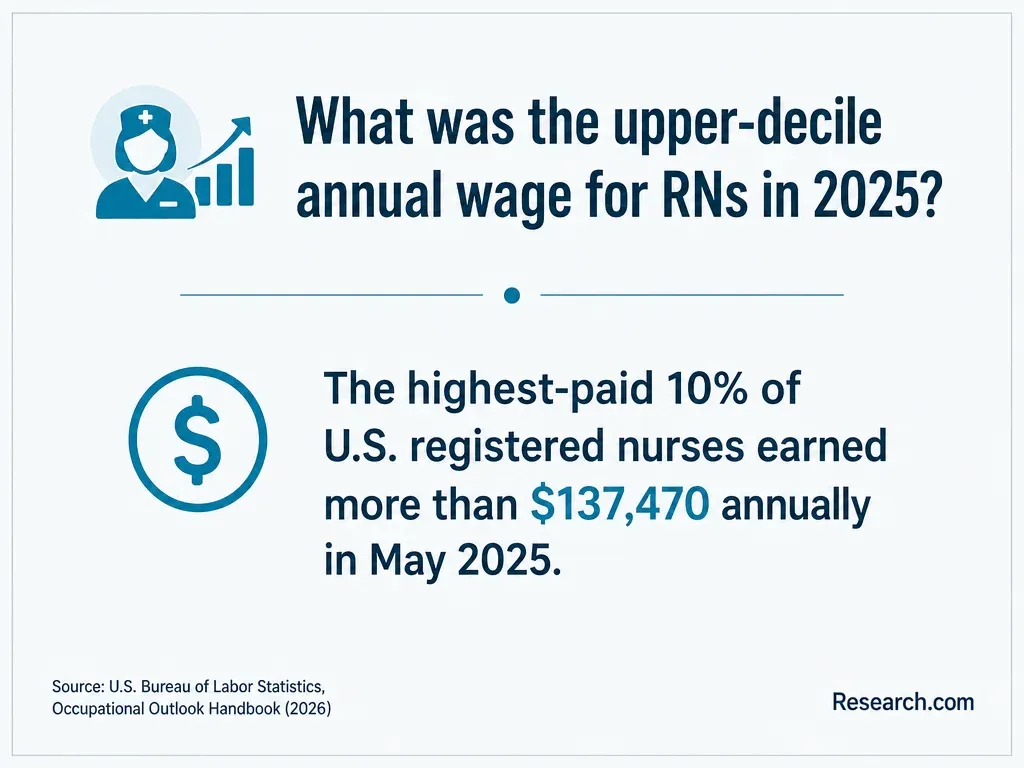
The U.S. Bureau of Labor Statistics reports wages and projected employment for registered nurses as an occupation, not a separate radiation oncology RN category. Its RN figures can provide broad context, but they cannot predict a specialty offer; location, employer, experience, and schedule matter. A nurse contemplating another career direction may compare MSN-PMHNP program length comparisons, but that is an advanced practice pathway with different preparation and authorization requirements, not a shortcut into radiation oncology nursing.
Other Things You Should Know About Nursing
Exposure depends on assigned duties and the service's procedures. Ask the employer which radiation-safety rules, monitoring, and training apply to the specific RN position rather than assuming every clinic role has the same exposure.
Pregnancy does not, by itself, answer whether a particular assignment is appropriate. Discuss the duties and applicable safety policies with the employer's radiation-safety and occupational-health teams; seek individualized advice through the appropriate clinical channels.
They may do so when the employer's role, protocols, and applicable licensing rules permit it. Remote work still requires sound assessment, documentation, privacy practices, and a clear escalation route.
Ask the educator or manager to document what has been completed, identify the remaining competencies, and arrange supervised opportunities or other approved assessments. A missed case should not be treated as demonstrated competence.
- Competency in nursing practice: a concept analysis - PMC - NIH https://pmc.ncbi.nlm.nih.gov/articles/PMC10255110/
- Standards & Guidelines | azbn.gov https://azbn.gov/standards-guidelines
- Full article: Role of nurses in the assessment and management of chemotherapy-related side effects in cancer patients https://www.tandfonline.com/doi/full/10.2147/NRR.S41845
- Pilot Curriculum for Continued Professional Development of Radiation Oncology Nurses - Advances in Radiation Oncology https://www.advancesradonc.org/article/S2452-1094(23)00200-2/fulltext
- The Intersection of Radiation and Medical Oncology Nursing | Oncology Nursing Society https://www.ons.org/publications-research/voice/news-views/06-2018/intersection-radiation-and-medical-oncology-nursing
- Treatment Team | rtanswers.org https://www.rtanswers.org/cancer-types/breast-cancer/breast-cancer/initial-referral/treatment-team
- A Syllabus for the Education and Training of Radiation Oncology Nurses | IAEA http://www.iaea.org/publications/7757/a-syllabus-for-the-education-and-training-of-radiation-oncology-nurses
- How to Know When a Nurse Is Ready for Independent Practice - Creative Health Care Insight https://www.mychci.com/blog/how-to-know-when-a-nurse-is-ready-for-independent-practice/
- Components of an Effective Nurse Orientation Pathway | American Association of Critical-Care Nurses https://solutions.aacn.org/blog/components-of-an-effective-nurse-orientation-pathway
- ACCC | Oncology Nursing https://www.accc-cancer.org/education-and-resources/practice-management-operations/fundamentals/oncology-services/oncology-nursing