2027 Public Health BS Transfer Planning With Quarter-System Credits

Co-Founder and Chief Data Scientist
Quarter-system credits can look plentiful on a transcript yet leave important public health BS requirements unfinished. If you are transferring or returning to college, the decision is not simply whether a university accepts your credits; it is whether those credits satisfy the right requirements in time for you to graduate.
This guide explains conversion, course equivalencies, admission, accreditation, scheduling, and cost. Use it to compare programs by the degree you would still need to complete, not by the transfer-credit total advertised before an official evaluation.
Key Things You Should Know
- For a semester-based school, quarter credits generally convert at a two-thirds ratio: 5 quarter credits equal about 3.33 semester credits before the school applies its own evaluation rules. Accepted credits may count only as electives.
- Request a written degree audit showing general education, public health major, prerequisite, and residency requirements separately.
- Compare the remaining required courses and when they are offered, not just the number of credits accepted, before estimating graduation time or cost.
What Is a Public Health BS Transfer Program With Quarter-System Credits?
It is a bachelor of science in public health pathway that evaluates prior coursework recorded in quarter credits. The receiving university may itself use quarters or may convert those credits to semester units. "Degree completion" describes the student's goal, but it does not necessarily mean every previously earned credit will apply to the BS.
Check the exact award: a public health BS, a health education degree, and an applied-science bachelor's can have different science, statistics, and general-education requirements.
An associate degree may simplify transfer under a specific agreement, while courses from an applied associate degree, military learning, or competency-based study may receive a different review.
If price is a major constraint, cost-conscious online public health undergraduate study can provide options to investigate, but the least expensive advertised tuition may not produce the least expensive remaining degree.
How Do Quarter Credits Convert to Semester Credits for Public Health Degree Transfers?
The standard arithmetic is quarter credits × 2 ÷ 3 = semester credits. For example, a 5-quarter-credit course converts to approximately 3.33 semester credits. This describes credit volume, not course equivalence: the receiving school must still decide whether that course meets a particular requirement.
That distinction matters when a semester-based program requires a specific statistics course or a science course with a laboratory. A converted course can carry sufficient credit but lack required content; a course with appropriate content may still need departmental approval because its lab or credit value differs.
Ask how the registrar rounds converted credits and whether the public health department accepts the course for the major. Keep syllabi and lab descriptions for any course whose title does not make its content clear.
Do not assume this undergraduate conversion settles future graduate prerequisites. If graduate study is a later goal, comparing flexible public health master's entry routes is a separate exercise; each graduate program decides which prior courses meet its own requirements.
What Transfer Requirements Apply to Public Health BS Degree-Completion Programs?
Five decisions can affect the same transcript: admission to the university, admission to the public health major, acceptance of transfer credit, application of that credit to degree requirements, and final graduation eligibility. A favorable decision at one stage does not settle the others.
The following checks help expose lost credits and scheduling delays before you commit:
- Request an official, program-specific degree audit that separates general education, prerequisites, major courses, free electives, and credits still required at the university.
- Compare descriptions and syllabi for statistics, biology or other sciences, labs, and introductory public health courses; request written substitutions where appropriate.
- Check minimum grades, course recency policies, repeat-course rules, and whether an associate-degree transfer agreement applies to your exact credential.
- Ask when required upper-division courses and any internship or capstone are offered, then map prerequisites backward from those courses.
- Confirm the appeal route for disputed equivalencies and obtain the revised audit after any approval.
The registrar or transfer-credit office normally records accepted credits; the public health department or designated academic authority determines many major equivalencies.
Follow the receiving school's stated approval process rather than relying on an informal estimate. Exploring less selective MPH study pathways is not a substitute for completing a bachelor's degree when a future graduate program requires one.
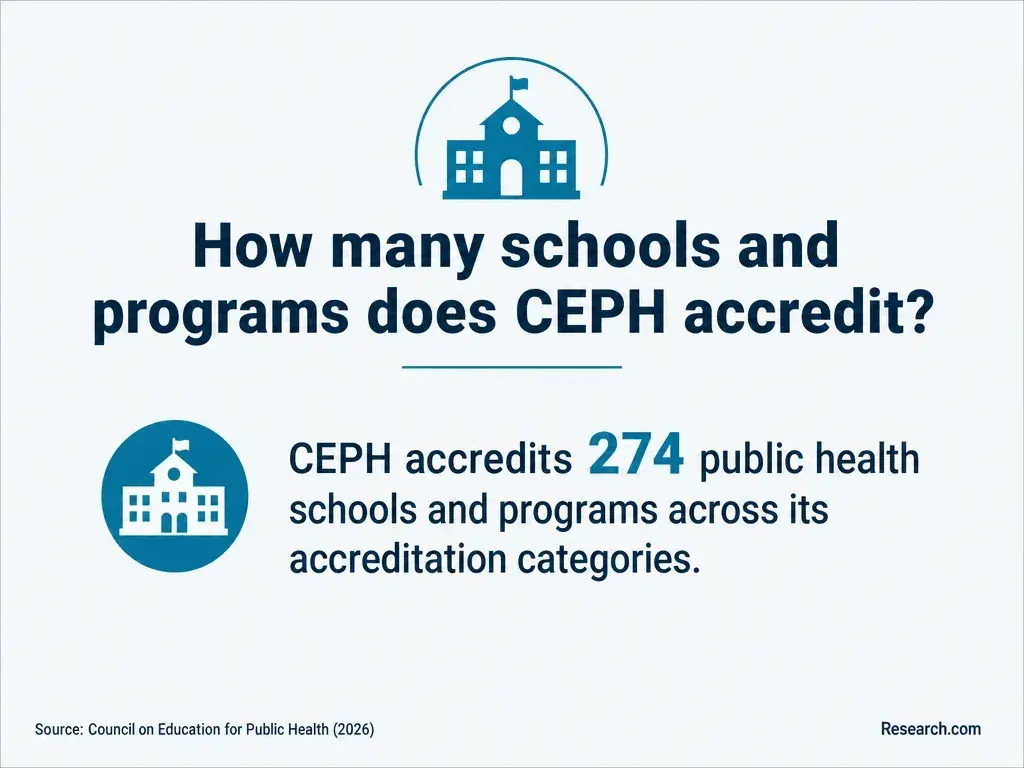
CEPH accreditation can matter if you want external review of public health educational standards or expect to pursue opportunities that specify study at a CEPH-accredited school or program.
Check CEPH's current listing for the exact accredited school, unit, or standalone program and confirm whether the bachelor's degree you would enter is within its scope. A university's institutional accreditation and its public health-specific CEPH status answer different questions.
Accreditation does not tell you whether your statistics course transfers, whether a capstone is offered next term, or whether a particular employer will hire you. Verify institutional accreditation, the degree's CEPH coverage where relevant, and the written degree audit independently.
The same scope check matters if you later consider graduate education; reviewing public health doctoral degree choices should not lead you to assume that one institution-wide label covers every degree it offers.
A public health BS commonly brings together population health, epidemiology, introductory biostatistics, health behavior, environmental health, health policy, and program planning or evaluation.
Programs differ in science depth, methods requirements, electives, and whether students complete an internship, community project, or capstone. The catalog for your entry term - not a general description of the field - controls the actual sequence.
For a quarter-system transfer, the key curriculum question is which courses must be taken in sequence at the receiving school. An accepted introductory course might not replace its upper-division counterpart; a statistics prerequisite may have to be completed before epidemiology.
Ask the department to identify courses available only in particular terms and whether prior community or healthcare experience can satisfy any requirement. Do not assume experience replaces assessed fieldwork.
If your target role eventually requires deeper graduate-level training, compare that additional curriculum and its price separately. A list of low-cost public health master's degrees cannot establish that a bachelor's course will meet a graduate prerequisite or that graduate study is necessary for your first job.
Neither format consistently wins on transfer efficiency. An online BS may reduce commuting, but required live meetings, group projects, proctored assessments, and local fieldwork can limit flexibility.
Campus study may make advising, labs, and community placements easier to access, yet travel and fixed class times can delay completion for a working student.
Compare the formats using the remaining courses on your audit. Ask whether required courses run online every term, whether an online student can complete a lab or internship locally, and who arranges or approves a field site.
A format comparison at the master's level, such as comparing lower-tuition MPH programs, should not be treated as evidence that an undergraduate program uses the same scheduling or fieldwork model.
Universities may set transfer-entry rules, while a public health major may have a separate application, prerequisite courses, grade standards, or limited entry points. Published minimums establish eligibility, not guaranteed admission or guaranteed placement in required courses. Check both sets of rules for the term you intend to enter.
Prepare official transcripts from every college attended and retain syllabi for courses likely to need equivalency review. Applicants with military learning, competency-based credits, or international study should ask what documentation and evaluation the receiving institution requires.
If you have been away from school, also ask how the university treats older science or statistics coursework and whether an admission decision can precede a final major audit.
Do not borrow requirements from a different degree level: online public health master's no-letter application paths, for example, say nothing about whether a particular BS transfer application requires recommendations or other materials.
The useful estimate begins after a written audit. Remaining credits alone cannot establish a graduation date: a prerequisite offered after the course it unlocks, a required residency minimum, or an internship with a separate approval cycle can extend the schedule. Ask an advisor for a term-by-term plan that reflects actual course availability and your realistic enrollment load.
Build a cost estimate from the tuition and mandatory fees charged for those planned terms, then add books, lab or technology charges, travel, and potential unpaid fieldwork costs.
Check whether your enrollment pace affects aid eligibility and whether remaining eligibility, satisfactory academic progress rules, or repeated coursework changes the plan.
Compare schools on estimated cost to finish, not cost per credit in isolation; neither transfer savings nor an aid award should be assumed before the relevant offices confirm them.
If doctoral study is a distant possibility, treat epidemiology doctorate scholarships and grants as a separate future financing question, not a reason to take on more undergraduate cost now.
A public health BS can support applications for roles such as community health worker, program assistant, outreach coordinator, or health education specialist, depending on the employer's requirements and your experience.
These jobs differ: outreach and community health work emphasize relationships and service navigation, while program support may involve scheduling, reporting, basic data handling, and evaluation assistance. An internship or supervised project can help demonstrate those skills.
Salary comparisons require an occupation and location, not a degree label. The US Bureau of Labor Statistics publishes occupation-wide wage data for roles such as community health worker and health education specialist; those figures include workers with different credentials and experience and are not starting salaries promised to BS graduates.
Compare local postings' pay and entry requirements before deciding what you can afford to spend on completion. Comparing earnings across MPH career paths addresses a different degree level and should not be used to forecast a bachelor's-level offer.
Do Public Health Graduates Need Licenses or Professional Certifications?
A general public health BS does not itself confer a clinical license or automatic professional certification. Whether you need a credential depends on the job, employer, and state.
For example, a clinical position has profession-specific licensing rules; some community health worker positions have state-specific training or certification expectations. Check the requirements in actual job postings and with the responsible state authority before selecting courses for a credential goal.
Credentials such as CHES or CPH have their own eligibility and examination rules. If one matters to you, confirm the certifying organization's current criteria and whether your exact degree and coursework qualify; do not infer eligibility from the words "public health" in a program name.
Likewise, cost-conscious public health doctoral advancement is a separate education decision, not a replacement for a license or job-specific certification.
Other Things You Should Know About Public Health
Not necessarily. Universities may use prior grades for admission while calculating the institutional GPA from courses taken after enrollment. Ask how transfer grades affect major admission, honors, and graduation rules separately.
Possibly, but enrollment may leave you uncertain about prerequisites and the courses you still owe. Ask whether the appeal must be resolved before you register for the affected course.
Yes. A syllabus can document topics, assignments, contact hours, and lab work when a course title alone is insufficient for an equivalency review.
Send the required official transcript from each institution. The receiving school evaluates the records under its policies; credits from different schools are not automatically combined to satisfy a single course requirement.
- Quarter Credit Conversion to U-M Credit - TeamDynamix | CAI Client Portal https://teamdynamix.umich.edu/TDClient/154/Portal/KB/Article/7925/Quarter-Credit-Conversion-to-U-M-Credit
- Public Health for Transfer Students (Direct Admit to EJBSPPP) | rutgers.edu https://catalogs.rutgers.edu/generated/nb-ug_1315/pg1280.html
- Pursue Your BS in Public Health Online with South University https://www.southuniversity.edu/online/degrees-programs/public-health/public-health-bs
- Second Degree Transfer - NYU Rory Meyers College of Nursing https://nursing.nyu.edu/academics/undergraduate/second-degree-transfer
- Prerequisites | University of Michigan School of Public Health https://sph.umich.edu/undergrad/apply/prerequisites.html
- Transfer Credit for MPH and MHA | The University of Oklahoma Health Sciences Course Catalog https://catalog.ouhsc.edu/public-health/bulletin/academic-information/transfer-credit-mph-mha/
- BSPH Degree Requirements - Public Health https://cosspp.fsu.edu/publichealth/bachelors-degree-requirements/
- Public Health Majors | | University of South Carolina https://cms.sc.edu/about/offices_and_divisions/undergraduate_admissions/apply/for_transfers/credits_from_sc_technical_colleges/course_equivalents_by_major/public_health.php
- Public Health (PUBH) | The George Washington University Bulletin https://bulletin.gwu.edu/courses/pubh/