
2027 Online Data Science Master's for Education Researchers: A Career Transition Guide

Co-Founder and Chief Data Scientist
Education researchers often bring strong study-design and statistical skills to a data science career transition, but may need more experience with programming, data engineering, and production workflows. An online master's can help close those gaps while you keep working - if its curriculum matches the role you want and its total cost is justified. This guide helps you assess what you already know, identify realistic target jobs, and decide whether a degree or a smaller credential is the better next step.
Key Things You Should Know
- Start with your target role: education analytics may build on existing research skills, while general data scientist roles may require substantially more coding and data-engineering practice.
- A master's is not automatically necessary. Compare the program's projects and technical depth with the gaps you cannot address through work experience or shorter study.
- The U.S. Bureau of Labor Statistics projects 35% employment growth for data scientists from 2025 to 2035, but that occupation-wide forecast does not predict openings for education researchers or outcomes from a particular degree.
What Is an Online Data Science Master's for Education Researchers?
It is usually a general data science master's completed primarily online, not a separate credential reserved for education researchers. Its value in this transition depends on whether you can apply technical coursework to education questions: student outcomes, program evaluation, learning platforms, or institutional operations.
Research experience transfers most directly to defining questions, assessing data quality, choosing defensible measures, and explaining uncertainty. The degree should add capabilities you cannot already demonstrate - often substantial programming, database work, machine learning, and reproducible software practices. If your goal is mainly reporting or institutional research, choosing a data analytics master's degree may be worth considering alongside data science programs.
Why Should Education Researchers Earn a Data Science Master's Degree?
Consider the degree when your intended jobs call for technical work beyond your current research toolkit and you want structured practice, feedback, and a substantial project. Your domain expertise remains useful: a predictive model is less valuable if its outcome measure is misleading, its comparison groups are inappropriate, or its results cannot inform an education decision.
A master's is less compelling if you can already code, manage data, and demonstrate relevant projects, or if the jobs you want chiefly require evaluation design rather than new technical depth. For researchers drawn specifically to building AI systems, comparing AI degree pathways for your career can clarify whether a broader data science curriculum or an AI-focused one better addresses the missing skills. Neither credential replaces evidence that you can do the work.
What Careers Can Education Researchers Pursue With a Data Science Master's?
The closest transitions usually preserve some connection to education data or research. This comparison separates roles by the work they emphasize; job titles and requirements vary by employer.
| Potential role | Typical focus | Likely transition challenge |
| Institutional research or education data analyst | Reporting, cohort analysis, and decision support | Demonstrating efficient SQL and reliable reporting workflows |
| Education or learning analytics scientist | Analyzing learner behavior and evaluating interventions | Working with complex event data and explaining model limitations |
| Data scientist outside education | Building and evaluating models for other organizational problems | Proving technical range beyond education-specific projects |
| Research or evaluation scientist with advanced analytics | Study design, causal questions, and applied statistical analysis | Showing why additional data science methods improve the research |
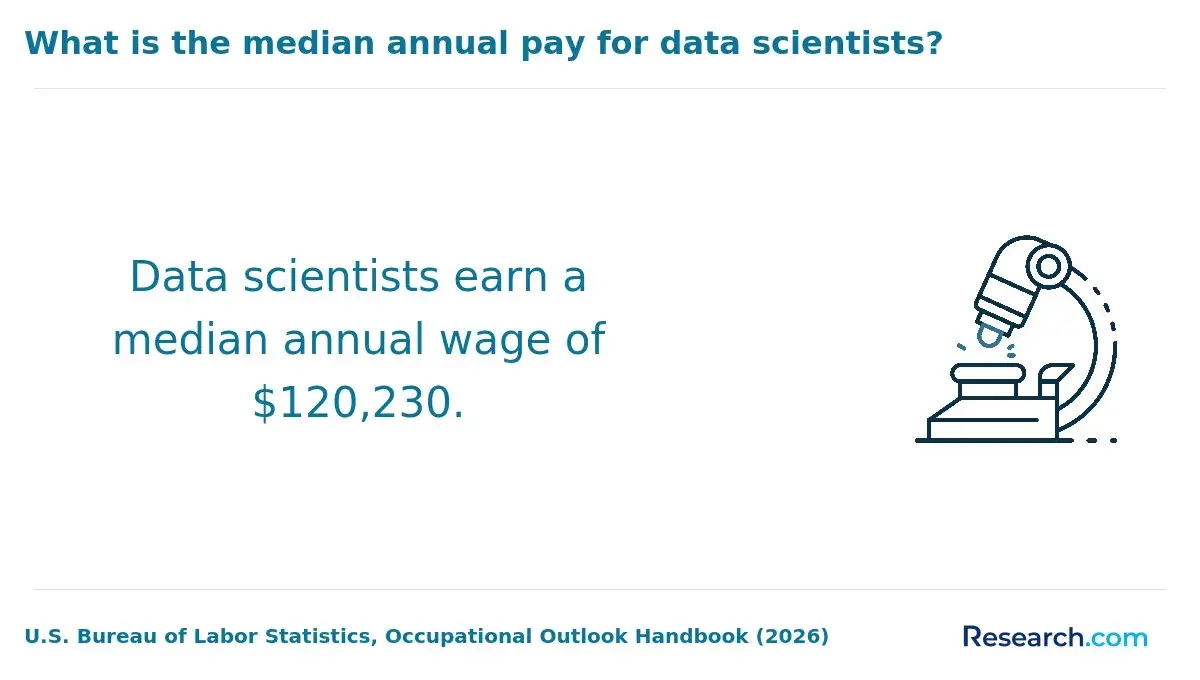
The Bureau of Labor Statistics reports a $120,230 median annual wage for U.S. data scientists in May 2025. That figure describes an occupation across industries and experience levels - not the pay an education researcher can expect after graduating. Compare actual job postings and compensation for your target role and location before using salary to justify tuition.
To make a transition credible, build a portfolio project that starts with an education decision, documents data limitations, compares a simple baseline with a more advanced method, and explains results to a nontechnical stakeholder. A polished analysis can be more persuasive for an adjacent education role than an unrelated model built solely to display an algorithm.
What Do Online Data Science Master's Programs Teach?
Course labels differ, but a useful transition curriculum combines statistical reasoning with Python or another programming language, SQL, data management, model evaluation, and communication. Education researchers may already know parts of the statistics; they should inspect assignments and prerequisites rather than assume every required course adds new depth.
Pay particular attention to how students obtain, join, document, and maintain data before modeling it. An elective that merely mentions pipelines is different from a project that requires students to build one. If that gap is central to your target job, examine AI and data engineering graduate study options as a curriculum comparison - not as a substitute for checking each program's actual course requirements.
For education-focused work, seek opportunities to examine missing data, measurement quality, group-level performance, and the consequences of a wrong prediction. Ask whether a capstone can use an approved education dataset and whether faculty can supervise an evaluation question as well as a modeling question. Do not assume a course title or a published project description guarantees that option.
What Are the Admission Requirements for an Online Data Science Master's?
Requirements vary by program. Applicants commonly need to document prior higher education and may be asked to show preparation in mathematics, statistics, or programming; a research background alone neither guarantees eligibility nor rules it out. Read the current admissions page for each program and distinguish a formal prerequisite from a skill the school merely recommends.
If your research work involved statistical software but little general-purpose coding, prepare a small Python and SQL project before applying. If your mathematics is rusty, review the topics named in the program's prerequisites. Self-study can improve readiness, but it does not necessarily satisfy a required for-credit course. Ask admissions staff how they assess professional experience, prerequisite coursework, and any permitted preparation before enrollment.
How Long Does an Online Data Science Master's Take and Cost?
Completion time depends on required credits, course sequencing, enrollment pace, and whether key courses run every term. Published tuition may exclude mandatory fees, software or equipment, and any travel requirement. Without a program-specific fee schedule, a reliable total - or a universal completion time - cannot be stated.
Build a comparable estimate for each school using its current tuition and fee schedule: required credits multiplied by the applicable tuition rate, plus mandatory charges and likely materials or travel. Then check whether taking fewer courses per term changes fees or delays a required sequence. If affordability is decisive, ML master's degrees with tuition and fees below $20,000 provide an alternative price point to investigate, but confirm current charges and curriculum fit directly with any school you consider.
For a working researcher, the opportunity cost of reduced hours or an extended job search can matter as much as the bill. Employer tuition assistance and eligible financial aid may reduce upfront pressure, but neither establishes that the degree will produce a salary increase.
How Do Online and Campus Data Science Master's Programs Compare?
Online study can let you retain an education research job and apply new methods at work. Campus study may offer easier access to in-person collaborators or local recruiting. Neither format establishes technical depth or career support on its own; those depend on the particular program.
Compare live-session times, group-project expectations, instructor access, career services, and any required campus visits. Also check whether the advertised pace is feasible at your intended course load. If you are weighing a more specialized AI route, comparing AI master's programs by duration can help frame the scheduling trade-off, though a faster path is not necessarily the better fit for someone building foundational coding skills.
How Can You Verify Data Science Program Accreditation?
Confirm the institution's current accreditation through the accreditor and the U.S. Department of Education's recognized-accreditor information; do not rely solely on a promotional claim. Institutional accreditation is distinct from approval of a particular data science curriculum, so ask what any additional program-level claim covers.
If you will study from another state, also verify that the institution can enroll students where you live and that any planned internship or field activity is permitted there. Accreditation, state authorization, and professional licensure address different questions; one does not automatically establish the others.
Do Education Researchers Need Licenses or Certifications in Data Science?
Data science roles generally are not entered through a single occupational license. Employers may nevertheless prefer evidence of particular tools, and a certificate can help document a narrow skill. Check job descriptions for your intended role before paying for an optional credential; a certificate is not a substitute for showing how you applied the skill.
If you continue work in a regulated education setting, follow your employer's data-access and research-review rules. A data science degree does not grant permission to use identifiable student records in coursework, a capstone, or a public portfolio.
How Can You Choose the Best Online Data Science Master's Program?
Choose for the transition you intend to make, not for a ranking or degree title alone. The strongest fit addresses your documented technical gaps while letting you produce work that target employers can assess.
Use this short checklist to compare finalists on evidence you can verify rather than on marketing descriptions:
- Collect target job postings and identify the recurring skills you cannot yet demonstrate.
- Match those gaps to required courses and assess projects or syllabi for genuine practice, not just topic names.
- Confirm whether you can complete an approved education-focused project and receive relevant supervision.
- Compare full estimated cost, realistic part-time sequencing, and the support available to online students.
- Request career-outcome information for comparable students, including how the school defines and measures outcomes; treat unpublished or incomplete results cautiously.
If your main gap is SQL and reporting, a narrower course of study may be sufficient. If you need sustained practice across programming, modeling, and data systems - and can afford the time and cost - a well-matched master's is easier to justify. Avoid the common mistake of choosing an advanced-sounding program whose required work does not resemble the jobs you want.
Other Things You Should Know About Data Science
Yes. Interviews and field observations can help identify meaningful questions and interpret results. Present qualitative methods as a complement to, rather than proof of, your technical data science skills.
Do not publish restricted or identifiable records without the appropriate permission. If your work data cannot be shared, use an approved public dataset or create a separate demonstration and explain what it does - and does not - represent.
It can demonstrate question formulation and analysis. For a technical hiring audience, add a clear description of your own contribution, methods, code if shareable, and how someone could reproduce or assess the work.
Connect a specific research problem you have handled to the technical methods you learned and the decisions your analysis supported. Be candid about skills you are still developing rather than presenting domain experience as a replacement for them.
References
- A review of learning analytics opportunities and challenges for K-12 education - PMC https://pmc.ncbi.nlm.nih.gov/articles/PMC10881331/
- Cost of Attendance (Budget) | 2025-2026 Federal Student Aid Handbook https://fsapartners.ed.gov/knowledge-center/fsa-handbook/2025-2026/vol3/ch2-cost-attendance-budget
- Master of Science in Statistics | Georgia Tech Catalog https://catalog.gatech.edu/programs/statistics-ms/
- Data Science | Academic Catalog | The University of Chicago http://collegecatalog.uchicago.edu/thecollege/datascience/
- MS Admissions FAQ | Department of Statistics https://statistics.stanford.edu/msadmissions/ms-admissions-faq
- What is Data Science? | UC Berkeley School of Information's Online Master's Programs https://ischoolonline.berkeley.edu/data-science/what-is-data-science/
- Digital tools for real-time data collection in education | Brookings https://www.brookings.edu/articles/digital-tools-for-real-time-data-collection-in-education/
- Prerequisites for Statistics Graduate Program | oregonstate.edu https://stat.oregonstate.edu/prospectives/statistics-ms-and-phd/prerequisites
- What's the Difference Between Asynchronous and Synchronous Learning? | Ohio State Online https://online.osu.edu/content-hub/blogs/whats-the-difference-between-asynchronous-and-synchronous-learning/
- Online Master of Education in Measurement, Evaluation, Statistics & Assessment | Online MESA https://mesaonline.ec.uic.edu/programs/master-education-measurement-evaluation-statistics-assessment/


