2027 Online Data Science Master's After a Bachelor's in Psychology: Prerequisites and Program Fit

Co-Founder and Chief Data Scientist
A psychology bachelor's can be a starting point for an online data science master's, but research experience alone may not satisfy a program's math and programming expectations. The decision is whether your transcript and skills match a particular program, or whether you need preparation first.
This guide helps psychology graduates identify transferable strengths, check prerequisites, and choose a program with the right technical depth for their goals.
Key Things You Should Know
- A psychology degree does not automatically qualify or disqualify you; compare each program's stated requirements with your courses in statistics, mathematics, and programming.
- Research methods and statistical reasoning can transfer well, but many applicants will need stronger evidence of coding, linear algebra, calculus, or database skills.
- The U.S. Bureau of Labor Statistics projects 35% employment growth for data scientists from 2025 to 2035; that outlook describes an occupation, not the placement prospects of any master's program.
Can you earn an online data science master's after a bachelor's in psychology?
Yes. A psychology graduate can pursue an online data science master's when they meet the chosen program's admissions requirements.
Some programs consider applicants from varied academic backgrounds; others expect substantial prior coursework in computing and mathematics. The degree title on your transcript matters less than the preparation you can demonstrate.
Psychology training may be especially useful if you have designed studies, evaluated evidence, worked with survey data, or interpreted statistical results.
Those experiences can inform work involving human behavior, such as product research or health analytics. They do not, by themselves, establish readiness to write production-quality code or study machine learning at graduate level.
Choose data science when you want a broad foundation in data preparation, statistical modeling, and computing. If your goal is specifically to build AI systems, compare that curriculum with economical online artificial intelligence degrees; the less expensive option is not necessarily the better fit if it omits methods you need.
What prerequisites do psychology graduates need for an online data science master's?
Prerequisites vary by program. Psychology graduates may already have meaningful preparation in research design and introductory statistics, particularly if they completed quantitative projects. The most important gaps to check are usually programming, mathematical foundations, and hands-on work with data.
This comparison separates potentially transferable preparation from topics that may need additional study; it does not describe universal admissions requirements:
| Area | Preparation a psychology graduate may have | Preparation a technical program may expect |
| Statistics | Hypothesis testing, regression, and study design | Probability and more advanced statistical modeling |
| Mathematics | Quantitative reasoning, depending on coursework | Calculus and linear algebra |
| Computing | Analysis in statistical software or spreadsheets | Programming, databases, and reproducible workflows |
| Research | Measurement, bias assessment, and interpretation | Application of those skills to larger or less structured datasets |
Start by matching your transcript against each program's published prerequisites, including required course content rather than course names alone. If a requirement is unclear, send admissions staff the syllabus and ask whether it satisfies that requirement.
A coding project, relevant job experience, or self-study can demonstrate readiness, but none should be assumed to replace a formally required course without written confirmation.
If you need preparation, prioritize the specific gap: a for-credit prerequisite where the school requires one, and practice projects where you need stronger evidence of applied skill. Avoid paying for a full master's before confirming whether its first technical courses assume knowledge you have not yet acquired.
How can you choose an accredited online data science master's program?
Verify the institution's accreditation through the accreditor and the U.S. Department of Education's recognized-accreditor information; do not assume that a ranking or an "accredited" marketing statement establishes the status of the institution or a particular offering.
Also confirm that the university can enroll students residing in your state. Institutional accreditation, state authorization, and the academic fit of a data science curriculum answer different questions.
For a psychology graduate, fit depends on the program's actual entry point. Read prerequisite policies alongside required course descriptions: an introductory programming course intended for experienced coders is not a bridge course. Compare the depth of statistics, computing, and projects, and ask what support is available before and during the first technical term.
Before applying, request answers to these questions so you can compare programs on the same basis:
- Which prerequisites must be completed for admission, and which can be completed after admission?
- Can an advisor review my psychology statistics and research-methods syllabi for equivalency?
- What programming and math skills do the first required courses assume?
- Can online students complete projects using an approved dataset relevant to their career goal?
What do online data science master's programs teach?
Curricula differ, but a suitable program should connect statistical reasoning with practical computing: collecting and cleaning data, working with databases, building and evaluating models, and communicating findings.
A psychology graduate may recognize concepts such as measurement error or confounding while encountering unfamiliar requirements in software development or scalable data processing.
Look beyond a course title that mentions machine learning. Review assignments or course descriptions for evidence that students select evaluation measures, avoid data leakage, explain model limitations, and complete substantial projects.
If you want roles that build data pipelines rather than primarily analyze datasets, compare the required engineering work with data engineering learning paths within AI graduate programs.
A strong psychology-to-data-science project could examine a behavioral question using appropriately obtained data, document cleaning decisions, compare a simple baseline with a more complex model, and explain what the results cannot establish. That work shows both transferable domain judgment and newly acquired technical skill.
How do online and campus-based data science master's programs compare?
Delivery mode alone does not indicate academic depth. An online program may make continued employment possible, while a campus-based program may offer easier access to in-person activities.
The consequential differences are scheduling, interaction, project support, and whether either format provides the resources you need to close a technical gap.
Check whether "online" includes live classes, timed exams, team meetings, or campus visits, and whether those obligations fit your time zone and work schedule.
Ask how students get help with programming and mathematics when they are stuck. For more scheduling-focused comparisons, see data science master's study options for the workforce.
Choose online study if its schedule and support let you practice consistently; choose campus-based study if access to in-person instruction or resources would materially improve your learning. Neither format compensates for prerequisites you have not met.
What are the admission requirements for online data science master's programs?
Expect requirements to differ across universities. Applications commonly call for an academic transcript and evidence that the applicant can handle graduate study; a program may also request a résumé, statement, recommendations, test scores, or specified prerequisite courses. Use the current admissions page for each program rather than treating any one school's checklist as universal.
In your statement, make a specific case for the transition: identify the quantitative work you completed in psychology, the technical work you have completed since, and the problems you want to solve. Describe your own contribution to research or analysis rather than presenting participation in a group project as proof of independent programming ability.
If your record is uneven, ask whether the program accepts later coursework as evidence of readiness and how it assesses applicants with non-computing degrees. That answer is more useful than assuming either that your psychology degree is a disadvantage or that research experience waives technical requirements.
How long do online data science master's programs take and cost?
Completion time depends on required credits, course sequencing, enrollment pace, and whether you must finish prerequisites before starting. Do not compare advertised minimum completion times unless you could realistically follow the schedule used to calculate them. Ask for a course-by-course plan based on your preparation and intended pace.
Calculate the price of each option from its current tuition schedule and degree requirements, then add mandatory fees, materials or software, any required travel, and prerequisite coursework.
Confirm whether tuition differs by residency or enrollment status and whether the program is eligible for the financial aid you intend to use. Employer assistance or scholarships may lower your out-of-pocket cost, but eligibility and conditions vary.
A lower-priced alternative can be worthwhile if its curriculum matches your goal. For example, compare graduate machine learning programs under the $20,000 threshold with data science programs using the same definition of total required tuition and fees. Then check whether the narrower degree leaves out statistics, data engineering, or applied work you need. Avoid choosing from a tuition headline alone.
What careers can you pursue after an online data science master's?
Possible targets include data scientist, data analyst, research analyst, and roles focused on product or health data. Fit depends on your technical experience as well as the degree.
Psychology graduates may bring useful expertise in behavioral measurement, study design, and interpreting results for people who will act on them; they still need to demonstrate the computing skills required by the role.
The Bureau of Labor Statistics projects 35% growth in U.S. data scientist employment from 2025 to 2035. That signals demand across the occupation, not guaranteed openings for new graduates or equal demand for every specialty.
If you have limited coding experience, an analytically focused role that uses your research background may be a more realistic first target than one centered on building complex systems.
Use job postings for your target role to check which tools and methods recur, then choose projects that demonstrate those abilities. A master's may help you gain them, but it is not automatically necessary for every analyst position or sufficient on its own for every data scientist position.
How much can data science master's graduates earn?
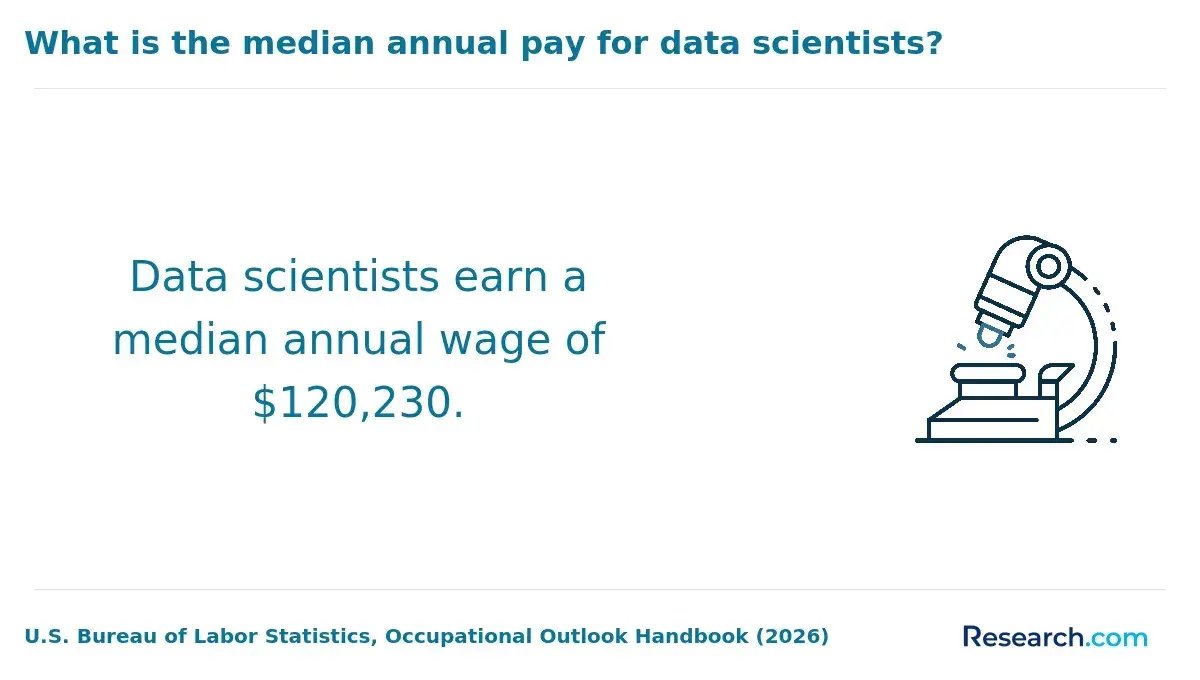
The Bureau of Labor Statistics reports a median annual wage of $120,230 for U.S. data scientists in May 2025. That is an occupational median, not a starting salary or a verified outcome for online master's graduates. Pay can differ with experience, responsibilities, location, and industry; data science compensation trends by industry can provide context when comparing target fields.
For a personal return-on-investment estimate, compare realistic roles you could pursue with and without the degree. Account for tuition, fees, financing, and any work you would forgo.
If a school publishes graduate salaries, check who responded, their prior experience, and whether the figure measures salary level or a change in pay. Neither an occupational median nor a school average shows what the degree caused an individual to earn.
What certifications and professional standards matter in data science?
Data science is not generally a licensed profession in the way clinical psychology is. A technical certificate can document study in a tool or platform, but it should supplement, not replace, evidence that you can formulate a question, analyze data reproducibly, and explain a model's limitations. Check target job postings before paying for a credential that employers may not request.
Professional practice matters especially when behavioral data involves people. Look for instruction in privacy, responsible data use, evaluation bias, and clear reporting of uncertainty.
If you plan to work with health information or human-subject research, confirm which institutional approvals and workplace rules apply to the specific project. Do not assume permission to analyze a dataset extends to publishing it in a portfolio.
Other Things You Should Know About Data Science
Not necessarily. If a master's program accepts applicants with your academic background, targeted for-credit prerequisites may be enough. Ask the program what must appear on your transcript before committing to another full degree.
It can demonstrate skill in defining questions, handling sensitive information, and interpreting evidence. Explain those contributions clearly, while showing quantitative and programming preparation separately if the program requires it.
Only if the applicable consent, institutional approvals, and data-use rules permit that use. When permission is uncertain, use an authorized public or synthetic dataset instead.
A thesis may offer useful research experience, but doctoral programs set their own expectations. Compare the research opportunities in each master's option with the admissions criteria of doctoral programs you might eventually pursue.
References
- Accreditation in the U.S. | ed.gov http://www.ed.gov/laws-and-policy/higher-education-laws-and-policy/college-accreditation/accreditation-in-the-us
- Understanding U.S. Accreditation | EducationUSA https://educationusa.state.gov/understanding-us-accreditation
- What preparations do I need for graduate education? | Statistics & Data Science Graduate Interdisciplinary Program https://stat.arizona.edu/what-preparations-do-i-need-graduate-education
- Ch 2: Psychological Research Methods | Psychological Science: Understanding Human Behavior https://openbooks.library.baylor.edu/psychscience/chapter/research-methods/
- Programs | ucsd.edu https://hsdsc.ucsd.edu/programs/index.html
- MS Admissions FAQ | Department of Statistics https://statistics.stanford.edu/msadmissions/ms-admissions-faq
- Curriculum - MU Institute for Data Science and Informatics https://muidsi.missouri.edu/academic-programs/m-s-data-science-and-analytics-program/masters/curriculum/
- Alumni Perspective: Do I Need a Master's Degree for Data Science? - School of Data Science https://datascience.virginia.edu/news/alumni-perspective-do-i-need-masters-degree-data-science
- What You Can Do with a Master's in Data Science and Artificial Intelligence | Harvard Extension School https://extension.harvard.edu/blog/what-you-can-do-with-a-masters-in-data-science-and-artificial-intelligence/
- Master of Science (M.S.) in Applied Data Science - UGA Online https://online.uga.edu/degrees-certificates/master-of-science-in-applied-data-science/