2027 Online Child Development Degree Programs With No Letters of Recommendation Required

Co-Founder and Chief Data Scientist
Applying to college can stall when applicants cannot access professors or supervisors for recommendation letters. Online child development degrees with no recommendation requirement can offer a more accessible route for working adults, career changers, and students returning after time away.
The U.S. Bureau of Labor Statistics reports a 2024 median annual wage of $37,120 for preschool teachers, illustrating the career relevance of early childhood preparation. This guide explains how streamlined admissions work, what schools review instead, and how to choose a credible program aligned with your goals.
Key Things You Should Know
- "No letters of recommendation required" means the published application for the specific online child development program does not require references; it does not mean transcripts, minimum GPA rules, placement requirements, or background checks are waived.
- Legitimate no-recommendation options exist at associate and bachelor's levels, but applicants should confirm institutional accreditation, field-placement arrangements, state educator requirements, total tuition, and whether the program leads to their intended role.
- For career context, preschool teachers had a 2024 median annual wage of $37,120, but pay, licensing requirements, and hiring standards vary substantially by employer, state, setting, degree level, and credential.
Which Online Child Development Degree Programs Require No Letters of Recommendation?
Online child development degrees are most commonly offered as associate degrees, bachelor's degrees, early childhood education degrees, and closely related programs in human development or family studies. Schools may use slightly different names for similar curricula, so search both "child development" and "early childhood education" when comparing options.
A program qualifies only when its current, program-specific admissions page states that recommendation letters are not required. Some institutions use streamlined admissions for undergraduate applicants while requiring recommendations for graduate education, scholarships, honors tracks, or educator-preparation cohorts. Others make letters optional, which is different from not requiring them.
The following program categories are the most likely places to find no-recommendation admissions, although applicants must verify the current policy directly with each school before submitting an application.
| Program type | Typical credential | Common admission model | Best fit |
| Online child development associate degree | Associate of Arts or Associate of Science | Application, high school transcript or GED, and placement information; recommendations often not requested | Students seeking entry-level preparation, transfer options, or a faster first credential |
| Online early childhood education bachelor's degree | BA or BS | Application and transcripts; some programs request an essay or resume instead of references | Working professionals seeking broader developmental, curriculum, and family-engagement preparation |
| Degree-completion program | Bachelor's completion degree | Transfer-credit review, prior-college transcripts, and minimum cumulative GPA | Applicants with an associate degree or substantial prior coursework |
| Human development or family studies program | BA or BS | Standard undergraduate application and academic records, often without recommendations | Students interested in youth services, family support, research, or non-teaching roles |
Use an institution's application checklist rather than a general admissions page. Ask an admissions representative to confirm in writing whether letters are required for your exact degree, start term, campus designation, and residency status. This protects against a common error: applying based on an outdated online listing or an institution-wide policy that does not apply to a specialized track.
What Are the Admission Requirements for Online Child Development Degree Programs With No Recommendation Letters?
Most undergraduate online child development programs replace recommendation letters with documentation that establishes academic readiness and identity. Requirements vary, but a streamlined application still gives the school enough information to determine whether you can begin college-level coursework and meet any practicum expectations.
Applicants commonly need the following materials. Checking them early is useful because transcript retrieval and transfer evaluations can take longer than completing the online application.
- A completed application and application fee, if the school charges one
- Official high school transcript, GED record, or prior-college transcripts
- Minimum GPA evidence when the program has an academic threshold
- Proof of English proficiency for applicants required to provide it
- A personal statement, short-answer response, or resume when the program uses holistic review
- Transfer-credit information, including course descriptions when requested
- Background-clearance, fingerprinting, immunization, or field-placement documentation after admission when a practicum involves children
Standardized tests are increasingly uncommon in undergraduate online admissions, but schools can still use placement assessments or require prerequisite coursework in English, math, or child development. A teaching-licensure pathway may also impose additional requirements beyond general university admission. An online child development degree is not automatically an online teacher-licensure program.
Students considering a move into a clinical care field should not assume that simplified admissions transfer across disciplines. For example, ASN programs online typically have separate science prerequisites, clinical placement requirements, and regulatory expectations.
Are Online Child Development Programs With No Letters of Recommendation Easier to Get Into?
Not necessarily. Removing recommendation letters reduces an administrative barrier; it does not automatically lower academic standards, create open admission, or guarantee acceptance. Schools can still assess GPA, completed prerequisites, writing readiness, transfer performance, available practicum capacity, and compliance with field-placement requirements.
Programs are often more accessible for applicants who have been out of school, work independently, or do not have recent academic references. That accessibility can be especially valuable for childcare professionals who have relevant experience but cannot reasonably ask a former instructor for a letter. However, selective cohorts and state-approved educator-preparation pathways may remain competitive even when letters are not part of the file.
This comparison separates a simpler application process from a less demanding academic program.
| Admissions feature | What it may indicate | What it does not indicate |
| No recommendation letters | The program relies on other evidence of readiness | Automatic admission or lower-quality instruction |
| Published minimum GPA | A baseline academic standard is stated | That every applicant above the threshold will be admitted |
| Open or rolling application periods | Flexible timing for applicants | That courses, aid, or practicum placements are always available |
| Required practicum clearance | Students will need to meet field-site rules | Guaranteed placement in a preferred school or childcare center |
Choose based on fit, not perceived ease. Applicants interested in administrative roles across care organizations may also compare child-focused education with the best schools for healthcare administration online, but healthcare administration prepares for a different employer environment and does not substitute for early childhood training.
What Do Online Child Development Programs Evaluate Instead of Letters of Recommendation?
Without recommendation letters, admissions teams generally rely more heavily on verifiable records and direct applicant materials. For undergraduate programs, the strongest indicators are usually prior academic performance and evidence that the applicant can complete online coursework consistently.
The table below shows how common substitute materials function in an application. It can help you focus preparation on the documents that are actually required instead of spending time seeking unnecessary references.
| Material | What the school may assess | How to strengthen it |
| Academic transcripts | GPA, course rigor, prerequisite completion, and academic trends | Submit every required transcript promptly and explain significant gaps only when the application provides space |
| Personal statement | Motivation, communication, career direction, and understanding of the field | Connect your goals to child development, family engagement, learning environments, or a specific role |
| Resume | Childcare, teaching-assistant, youth-program, volunteer, or supervisory experience | Describe responsibilities, age groups served, training, and measurable scope without overstating duties |
| Prerequisite record | Readiness for college writing, math, psychology, or education coursework | Ask whether equivalent transfer courses satisfy requirements before enrolling |
| Interview or short responses | Professional communication and alignment with program expectations | Prepare concrete examples of reliability, ethical conduct, and working with children or families |
Applicants should be candid about experience. A resume can demonstrate relevant work, but it should not imply licensure, classroom authority, or supervised teaching hours that were not earned. If your GPA is below a program's standard, ask whether conditional admission, prerequisite completion, or an academic explanation is available rather than assuming a no-letter policy overrides the requirement.
How Can You Tell if an Online Child Development Degree With No Recommendation Requirement Is Accredited and Legitimate?
Accreditation is more important than the presence or absence of recommendation letters. Institutional accreditation evaluates the college or university as a whole and is central to federal aid eligibility and credit transfer. Programmatic recognition can add value in some early childhood pathways, but the appropriate standard depends on whether you seek childcare employment, Head Start-related work, a teaching credential, or a public-school license.
Before applying, use these steps to verify a program and avoid enrollment mistakes.
- Confirm that the institution holds recognized institutional accreditation and verify the accreditor through the U.S. Department of Education or Council for Higher Education Accreditation database.
- Read the degree page and catalog to confirm that the credential is a degree, not merely a noncredit certificate or enrollment-preparation course.
- Ask whether the online program uses the same accreditation and transcript as the institution's campus-based version.
- Determine whether the curriculum includes supervised field experience, observation hours, or student teaching and whether the school can arrange placements in your state.
- Contact your state education agency or intended employer if your target role requires licensure, a permit, or a specific early childhood credential.
- Request the full tuition schedule, refund policy, transfer policy, and graduation requirements before paying a deposit.
Red flags include pressure to enroll immediately, vague statements about accreditation, unclear total charges, promises of licensure without naming the state, and refusal to explain how practicum placements work. Employers generally focus on the degree, institution, relevant training, experience, and any required credential - not whether references were requested during admission.
How Much Do Online Child Development Degree Programs With No Letters of Recommendation Cost?
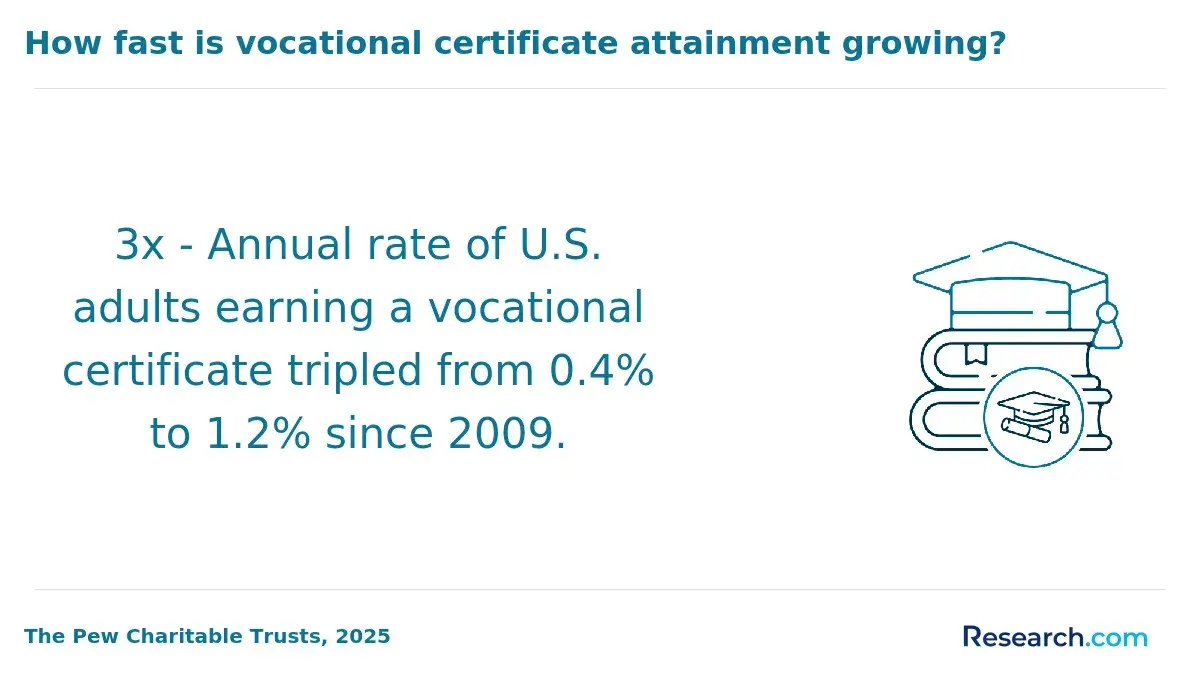
No-recommendation admissions do not determine price. Tuition depends mainly on institution type, residency rules, credit load, transfer credits, fees, and whether required practicum courses create travel, background-check, or materials costs. Compare the net cost of completing the degree, not only the advertised cost per credit.
The National Center for Education Statistics reported average published tuition and fees for full-time undergraduates in 2023-24 at $9,800 for public four-year institutions and $40,700 for private nonprofit four-year institutions. Those figures are broad institutional averages rather than online child development program prices, but they show why institution type and aid eligibility matter.
This cost framework identifies the charges applicants should request in writing before making a decision.
| Cost component | Why it matters | Question to ask |
| Tuition per credit | Determines the basic price of coursework | Is the rate fixed for online students, and does it change by residency? |
| Required credits after transfer | Has the largest effect on total tuition | How many of my credits are accepted toward major and general-education requirements? |
| Mandatory fees | May include technology, graduation, learning-platform, or distance-learning charges | Which fees are charged every term, and which are one-time charges? |
| Practicum expenses | Can include transportation, clearances, insurance, testing, or supplies | What costs are associated with field placement in my state? |
| Books and course materials | May vary by course and format | Are digital materials included, optional, or billed separately? |
A lower tuition rate is not always the lower total cost if few transfer credits apply or if the program requires extra courses. For perspective when considering a different care-sector route, a 6 month LPN program online has different clinical, licensing, and cost considerations than a child development degree and should be evaluated as a separate career decision.
Can You Get Financial Aid for an Online Child Development Degree With Streamlined Admissions?
Yes. A school's choice not to require recommendation letters generally does not affect eligibility for federal student aid. Eligibility depends on factors such as enrollment in an eligible program at a qualifying institution, satisfactory academic progress, citizenship or eligible noncitizen status, and the information submitted through the Free Application for Federal Student Aid.
Complete the FAFSA early and compare each institution's aid offer after admission. Grants, scholarships, work-study availability, employer tuition assistance, and federal loans can differ considerably between schools. Aid may also change if you attend part time, repeat courses, withdraw, or transfer credits that reduce the number of credits needed for graduation.
Before accepting loans, ask the financial aid office for a program-specific estimate showing tuition, fees, expected aid, borrowing options, and the academic year used for the calculation. Working in early childhood education can also make you eligible for local workforce scholarships or employer support, but those opportunities are location-specific and should not be assumed.
Students comparing care-sector careers should keep aid rules separate from program fit. Advanced clinical paths such as DNP programs online generally require prior nursing education and licensure, unlike entry-level child development degrees.
How Long Does an Online Child Development Degree With No Letters of Recommendation Take to Complete?
Completion time depends on credential level, transfer credit, course sequencing, part-time enrollment, and practicum availability - not on whether the application requires references. An associate degree commonly requires about two years of full-time study, while a bachelor's degree commonly requires about four years from the beginning. Transfer students may finish sooner if prior coursework applies to both general education and major requirements.
Online delivery can add scheduling flexibility, but it does not always mean self-paced study. Many programs use weekly deadlines, group discussions, fixed term dates, and locally completed observation or practicum experiences. Students with employment or caregiving responsibilities should ask how often classes meet synchronously and whether field hours must occur during business or school-day hours.
Use the program's published degree map to identify bottleneck courses, especially child assessment, curriculum, research methods, and capstone or practicum requirements. An accelerated schedule can be workable for students with substantial time available, but it may be a poor fit when required fieldwork conflicts with work schedules. Degree timelines should not be compared directly with professional nursing pathways; a nursing doctorate has different entry requirements and sequencing.
Can You Transfer Credits Into an Online Child Development Degree Program With No Recommendation Letters?
In many cases, yes. Transfer review is separate from the recommendation-letter policy. Colleges may accept prior general education, early childhood education, psychology, sociology, and developmental coursework, but they decide equivalencies individually and may limit how old a course can be or how many credits can transfer.
Send official transcripts as early as possible and request a written transfer evaluation before committing. Ask whether credits count toward the major, general education, electives, or only total credits; these categories can affect how many classes remain. Students with a Child Development Associate credential, military training, employer training, or prior learning should ask whether the school offers a formal credit-review process, but should not assume credit will be awarded.
Transfer-friendly programs can reduce time and cost, yet the cheapest path is not always the one accepting the most credits. A course must support your target role and meet any state or employer requirements. This is particularly important for students seeking teacher licensure, because educator-preparation standards may require specific coursework and supervised experiences regardless of prior credits.
How Should You Compare Online Child Development Degree Programs That Do Not Require Letters of Recommendation?
Compare programs after confirming that letters are truly not required for your application type. The best option is the one that meets your career goal, works in your state, fits your budget, and provides a realistic path through fieldwork - not simply the one with the fewest application documents.
Use these comparison questions when speaking with admissions, financial aid, and program representatives.
- Does the published checklist for my exact online program and start date explicitly say that recommendation letters are not required?
- What GPA, prerequisite, essay, resume, interview, or placement requirements remain?
- Is the institution accredited, and does the degree meet the educational expectations for my intended job or state credential?
- Can I complete all required observations, practicum hours, or student teaching in my state and near my home?
- What is the estimated total cost after accepted transfer credits, mandatory fees, books, and field-placement expenses?
- How many credits will transfer, and which required courses will I still need to take?
- What support is available for online students, including tutoring, career advising, technology assistance, and practicum coordination?
- What roles do the curriculum and degree prepare me for, and which roles require additional state licensure or credentials?
Avoid choosing solely by admission convenience, accepting verbal promises without written confirmation, or overlooking state rules. Child development can lead toward childcare administration, family services, early intervention support, youth programming, and early learning settings, but public-school teaching commonly requires a state-approved educator-preparation route and licensure.
If your interests extend from child and family services into organizational leadership, a masters degree in healthcare management is a distinct later-stage option for qualified students; it is not a substitute for child development preparation or educator licensing.
Other Things You Should Know About Child Development
Often, yes. Online coursework can fit around employment, and current work may help you connect theory to practice. However, practicum or observation requirements may need supervisor approval, specific age groups, scheduled hours, and clearance documentation. Confirm whether your workplace can serve as a placement before relying on it.
Not automatically. Public-school teaching usually requires a state-approved educator-preparation program, supervised student teaching, examinations, and a state license. Review the program's licensure disclosure for your state and contact the relevant state education agency before enrolling.
No. The CDA is a professional credential focused on early childhood education practice, while an associate or bachelor's degree is an academic credential awarded by a college or university. Either may be useful depending on the employer and role, and some students pursue both.
Useful skills include observing developmental progress, communicating with families, planning age-appropriate learning activities, maintaining safe environments, documenting information accurately, collaborating with colleagues, and understanding ethical and cultural considerations. Specific roles may also require first aid, mandated-reporter training, or state-specific credentials.
References
- Early Childhood Education Online Completion, B.S. https://vermontstate.edu/academic-programs/early-childhood-education-online-completion-bs/
- DAP: Observing, Documenting, and Assessing Children's Development and Learning | NAEYC https://www.naeyc.org/resources/position-statements/dap/assessing-development
- 2025 Most Affordable Online Master's Degrees in Child Development https://www.onlineu.com/most-affordable-colleges/child-development-masters-degrees
- Does the Letter of Recommendation Still Matter in College Admissions? https://www.saraharberson.com/blog/letter-of-recommendation-still-matter-college-admissions
- ECECD Scholarship Information - Scholarship and Pay Incentive Programs https://ececdscholarship.org/scholarship-information/
- Rating Resources - Parent Aware https://www.parentaware.org/programs/rating-resources/
- TEACH NC Eligibility | Early Years, Inc https://www.earlyyearsnc.org/program/teach-nc/teach-nc-eligibility
- How to Get Your Child Development Associate (CDA) Certification Without Breaking the Bank - post https://www.childcareed.com/a/how-to-get-your-child-development-associate-cda-certification-without-breaking-the-bank.html
- Best Online EdD Programs with No GRE Requirement https://www.phds.me/online-programs/education-doctorate-edd/no-gre-required/
- Erikson Admissions Requirements | Erikson Institute Admissions https://www.erikson.edu/admissions/requirements/