
2027 Online BA in Psychology - Mental Health for Preschool Teachers: Compare Transferable Skills and Degree Requirements

Co-Founder and Chief Data Scientist
Preschool teachers already support young children through separation, conflict, frustration, and change. An online BA in psychology can deepen their understanding of development and behavior, but it may not be the most direct way to improve classroom practice - or qualify them for a mental health job.
This guide compares the skills teachers bring, the coursework and scheduling they would need, and the career boundaries of a psychology degree. Use it to decide whether a BA, targeted professional development, or a different credential fits your goal.
Key Things You Should Know
- Preschool teaching builds observation, communication, and family-partnership skills; psychology adds research literacy and a framework for interpreting behavior without diagnosing children.
- Many bachelor's degrees require about 120 semester credits, but accepted transfer credits may not satisfy psychology-major requirements. Request a written degree audit before estimating time or cost.
- A psychology BA does not authorize therapy or diagnosis. If your aim is classroom support, targeted training may be more direct; a licensed mental health role requires a separate, qualifying pathway.
What Is an Online BA in Psychology for Preschool Teachers?
An online BA in psychology is a bachelor's degree covering psychological science, research methods, and behavior. It is not usually a preschool-teacher credential or a clinical qualification. For a teacher, its value is the chance to connect daily observations of children with evidence about development, learning, relationships, and stress.
Check the official degree title before relying on a program's marketing language. A general psychology BA with child-development electives differs from a formally named concentration in mental health. Neither automatically includes early-childhood fieldwork. If substance-use prevention or recovery services - not preschool practice - is your intended direction, compare addiction psychology degree options for undergraduate students against a general psychology curriculum.
For teachers who primarily want better strategies in their current classroom, employer training in developmentally appropriate practice, family engagement, and referral procedures may be faster and less expensive than another degree.
How Can Psychology Skills Support Preschool Teachers' Mental Health Work?
In a preschool, "mental health work" generally means fostering supportive relationships, noticing concerns, communicating respectfully with families, and following the center's referral and safeguarding procedures - not assessing or treating a disorder. Psychology study can help a teacher distinguish an observation, such as a child avoiding group activities, from an unsupported explanation for that behavior.
The comparison below shows where teaching experience and academic study complement each other. It also identifies the boundary that matters when working with young children.
| Classroom experience | Psychology skill to develop | Appropriate application |
| Observing play and interactions | Developmental knowledge and careful documentation | Record specific patterns and discuss concerns through approved channels, without diagnosing. |
| Helping children manage conflict | Understanding learning, emotion, and social context | Use developmentally appropriate supports consistent with center policy. |
| Speaking with caregivers | Research literacy and culturally responsive communication | Share observations without overstating what a behavior means. |
These skills can transfer to family-support and community-service work, but the setting changes the required preparation. Teachers considering substance-use services, for example, can explore career progression in addiction recovery; preschool experience alone does not establish eligibility for recovery or counseling credentials.
What Degree Requirements Apply to Online Psychology Bachelor's Programs?
A typical bachelor's plan combines general education, psychology-major courses, electives, and a minimum amount of coursework completed through the degree-granting institution. Many programs are designed around approximately 120 semester credits, but graduation depends on meeting each requirement - not merely reaching a credit total.
For a returning teacher, the decisive question is where prior coursework applies. An early-childhood education course might transfer as an elective but not replace developmental psychology; a statistics course might need departmental review for major equivalency. Associate degrees, workplace training, and professional credentials are evaluated under different institutional policies.
Send transcripts to prospective schools and request an official or written preliminary audit showing general education, major, prerequisite, elective, and residency requirements separately. A psychology transfer credit acceptance guide can help you frame questions, but only the institution can approve how your credits count toward its degree.
Online delivery may remove a commute without removing scheduled obligations. An asynchronous course can still have weekly deadlines and group assignments; another program may require live discussions, proctored exams, campus visits, or an approved local placement. Campus study offers in-person access to classmates and faculty but can be harder to fit around classroom hours.
Ask each program which required courses run asynchronously, when live sessions meet, how frequently courses are offered, and whether research or experiential learning can be completed near home. A teacher working a fixed school-day schedule should obtain these answers for required courses, not just introductory ones.
Delivery format matters even more if the BA is preparation for a later professional degree. Compare the attendance and placement obligations of accredited counseling study with accelerated schedules separately; an online psychology BA does not make a subsequent counseling program fully remote or schedule-flexible.
Look for introductory psychology, developmental psychology, statistics, research methods, and coursework on learning, social behavior, and psychological disorders. The last subject teaches academic knowledge about conditions; it does not train undergraduates to diagnose them. BA programs vary in science requirements and in whether a capstone, internship, or formal concentration is available.
For preschool practice, prioritize child development, learning, family and cultural context, and methods courses that teach you to evaluate evidence. A useful capstone might be a literature-based review of classroom supports, if the program permits it. Collecting information about children or families for a project requires center authorization and attention to privacy, consent, and any applicable university review process.
Course labels can also signal a different career direction. Before choosing forensic electives because they sound relevant to children's welfare, compare their actual subject matter and degree requirements with forensic psychology program costs and entry requirements. Forensic study is not a substitute for early-childhood or clinical preparation.
First-year applicants generally need to document secondary-school completion; transfer applicants typically submit college transcripts. Schools may have separate rules for admission to the institution and declaration of the psychology major. Published GPA thresholds, prerequisite courses, and application materials vary, so check the requirements for your intended entry term.
If you have college credit, ask admissions how to apply, then ask the registrar or academic department who evaluates course equivalencies. Keep syllabi for statistics, psychology, and education courses in case reviewers request them. Admission does not mean those courses satisfy major requirements.
If you are choosing between psychology and another specialization, compare admission with the full route to graduation. Published forensic psychology undergraduate graduation timelines, for example, should not be treated as your personal completion estimate until a school evaluates your credits and required course sequence.
Time depends on applied transfer credit, course sequencing, and how many courses you can sustain while teaching. At a school requiring 120 credits, an audit showing 60 credits applied to the degree would leave 60 credits - not necessarily a predictable number of terms. Required courses offered infrequently can extend the schedule.
Compare schools using the remaining required credits multiplied by the applicable tuition rate, then add mandatory fees, materials, technology, travel, and any placement costs. Ask whether your employer offers education assistance and whether your planned enrollment meets financial-aid conditions. Do not compare advertised per-credit prices without comparing how many credits each school says you still need.
Budget for graduate education only if it serves a defined goal. One-year forensic psychology graduate tuition comparisons illustrate a different specialty and should not be added to a preschool-focused plan merely because a short program is available.
The most immediate application may be staying in early childhood education with stronger skills in observation, family communication, and evidence-informed support. Whether a BA changes a teacher's job classification or pay depends on the employer and applicable state requirements. The degree may also support applications for nonclinical family-support, human-services, program-coordination, or research-support positions, depending on the job description and the applicant's experience.
For a transition, match your existing work to actual vacancies: document family partnerships, referral coordination, staff training, data handling, or supervised projects you have performed. Then identify missing qualifications, such as case-management experience or a required state credential. A degree broadens academic preparation; it does not replace role-specific hiring requirements.
A later nonclinical psychology master's may suit a research or specialized program role, but it is not an automatic promotion step or therapy credential. Compare the purpose and workload of psychology master's programs with intensive pacing only after identifying a target job that values that training.
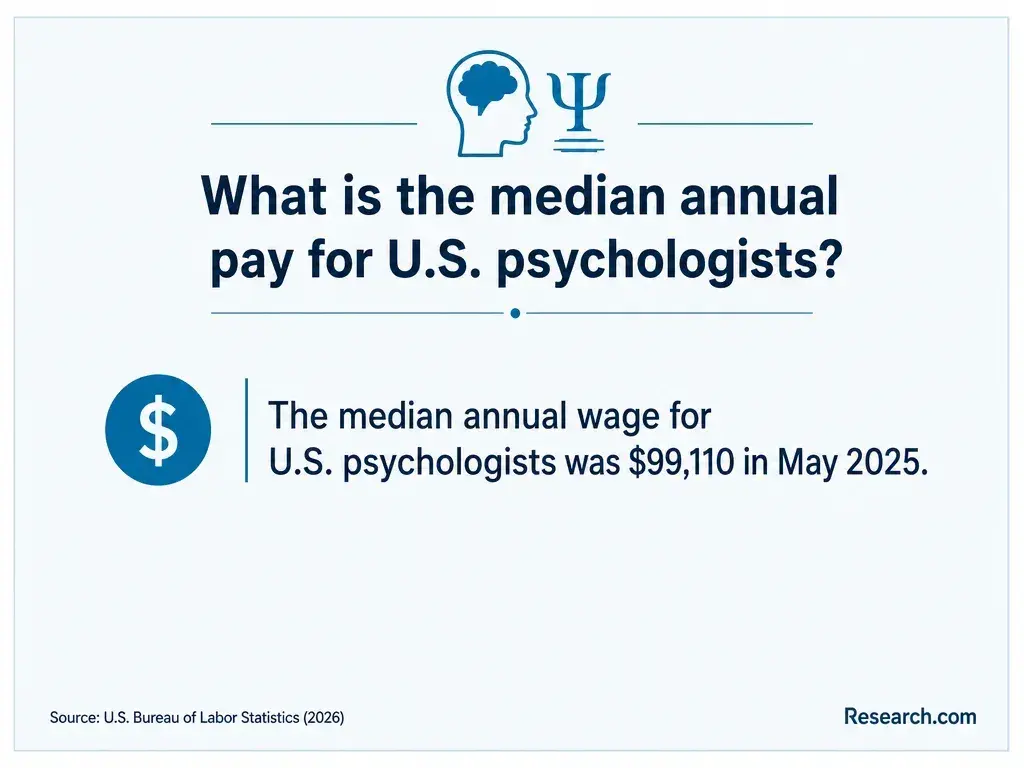
There is no reliable single salary or growth rate for "psychology BA graduates." Pay depends on the occupation, location, employer, experience, and any required credential. The US Bureau of Labor Statistics Occupational Outlook Handbook reports occupation-wide wages and projections - not outcomes attributable to a psychology major. Compare its entries for the specific jobs on your shortlist, such as preschool teacher and social and human service assistant, using the published wage year and projection period.
For a working teacher, the useful financial comparison is between the pay and advancement rules of the current employer and the requirements of a realistic next role. If the actual aim is licensed counseling, include the cost and time of qualifying graduate study and supervised experience. Shorter online counseling master's financial comparisons can inform that separate calculation, but occupational median wages are not promised earnings for graduates.
Does a Psychology BA Qualify Graduates for Mental Health Licensure?
No. A psychology BA alone does not authorize psychotherapy, diagnosis, independent psychological assessment, or use of a protected licensed-professional title. Studying mental health - or supporting a child and family within a teacher's role - is different from delivering clinical treatment.
If your goal is to become a licensed counselor, clinical social worker, school psychologist, or psychologist, identify the exact profession and state first. Each has its own qualifying education and, where applicable, supervised practice and examination rules. A general psychology BA can be useful preparation, but it may not be required; a nonclinical psychology master's is not interchangeable with a qualifying professional program.
For prospective counselors, compare state-board educational rules with actual program details before considering tuition-conscious mental health counseling degree choices. Verify the relevant accreditation's scope and the program's licensure disclosures for the state where you intend to practice. If your goal remains classroom support, targeted training and established referral partnerships may be a better next step than a clinical pathway.
Other Things You Should Know About Psychology
Possibly, but not automatically. Ask the psychology department whether your workplace and proposed duties meet its internship objectives, supervision rules, and approval process before enrolling.
Do not assume so. Your state credentialing agency and employer determine which degree courses or professional-development activities count toward renewal.
No. Targeted training may help with recognizing concerns and following support or referral procedures, but it does not award a BA or authorize clinical care. It may be the more practical choice if those are your immediate goals.
Ask whether the degree changes eligibility for a specific role or pay category, whether tuition assistance is available, and whether required coursework or placements can fit your work schedule.
- Requirements Related to the Practice of Counseling - NCBI https://www.ncbi.nlm.nih.gov/books/NBK259170/
- Frequently Asked Questions - California Board of Psychology https://www.psychology.ca.gov/licensees/faq.shtml
- Education Requirements for Center-based Preschool Teachers | HeadStart.gov https://headstart.gov/publication/education-requirements-center-based-preschool-teachers
- What Degree Do I Need to Become a Counselor or Therapist? | Palo Alto University https://paloaltou.edu/resources/blog/what-degree-do-i-need-become-counselor-or-therapist
- School of Education & Human Sciences Early Childhood Unified Practicum Student Teaching Handbook | ku.edu https://soehs.ku.edu/school-education-human-sciences-early-childhood-unified-practicum-student-teaching-handbook
- Test, Prior Learning and Transfer Credit - UNT Catalog https://catalog.unt.edu/content.php
- Bachelor of Arts in Psychology - Texas State's online programs https://online.txst.edu/degrees/undergraduate/ba-psychology/
- Developmental Psychology Career Advising - Queens College | The Center for Excellence in Teaching, Learning & Leadership https://www.qc.cuny.edu/academics/psychology/career-advising-developmental-psychology/
- How to Become a Preschool Teacher | ASU Online https://asuonline.asu.edu/newsroom/online-learning-tips/look-your-career-preschool-teacher/
- Online Psychology Degree | LSU Online https://online.lsu.edu/online-degree-programs/undergraduate/bachelor-science-psychology/


