2027 Online BA in Psychology - Mental Health: Choosing a Degree for Mental Health Support in Senior Services
Audited and Verified:
Our Editorial and Data Verification Process
Research.com uses government datasets, official education statistics and primary institutional information to support its career and degree guides. Our review process checks factual accuracy, occupational definitions, source dates and the requirements associated with the credentials discussed.
How This Article Was Fact-Checked
Our editorial team verifies salary estimates, employment projections, education requirements and program information against original data providers and official organizations. Salary figures are checked against the relevant occupational definitions and reporting periods. Information about licensure, accreditation and required in-person training is reviewed separately.
Fact-checked and verified on:

Co-Founder and Chief Data Scientist
Supporting older adults through isolation, grief, cognitive change, and access to services takes more than an interest in mental health. It takes appropriate training, clear professional boundaries, and experience working with seniors.
If you are considering an online psychology BA, this guide will help you judge whether its courses and practical opportunities fit a senior-services role - or whether a more direct credential would serve you better. It also explains what to check before enrolling, from local placements and transfer credit to costs and the qualifications required for clinical work.
Key Things You Should Know
- An online psychology BA can prepare you for nonclinical senior-services support, but it does not qualify you to diagnose conditions or provide psychotherapy.
- Prioritize lifespan development, aging, research literacy, and an approved opportunity to work with older adults; online coursework alone cannot demonstrate client-facing readiness.
- A bachelor's degree commonly requires about 120 credits, but your remaining time and cost depend on accepted credits, required courses, enrollment pace, and placement expenses.
What is an online bachelor's degree in psychology for mental health support?
It is an undergraduate psychology degree delivered primarily online that you can shape toward understanding older adults' behavior, mental health needs, and service systems. The credential may be a general psychology BA with relevant electives; a "mental health" concentration exists only if the school formally designates one. Neither version is a clinical qualification.
In senior services, mental health support may mean listening respectfully, documenting concerns within your role, connecting someone with community resources, and referring possible depression, substance use, or safety concerns to qualified staff. It does not mean independently determining a diagnosis or treatment plan. If recovery services interest you, compare career choices across recovery service settings before assuming the same preparation fits every population or job.
What careers can an online psychology degree prepare you for in senior services?
Start with the work you already know. Experience in caregiving, activities, community outreach, or administration may help you enter a senior-services role; psychology study can add developmental knowledge and stronger communication and evaluation skills. The following distinctions matter more than a job title alone.
This comparison shows where a BA may be useful and where an employer or regulator may expect a different qualification.
| Potential role | Typical contribution | Qualification to check |
| Senior-services program assistant | Organizes activities, outreach, and referrals | Employer requirements and experience with older adults |
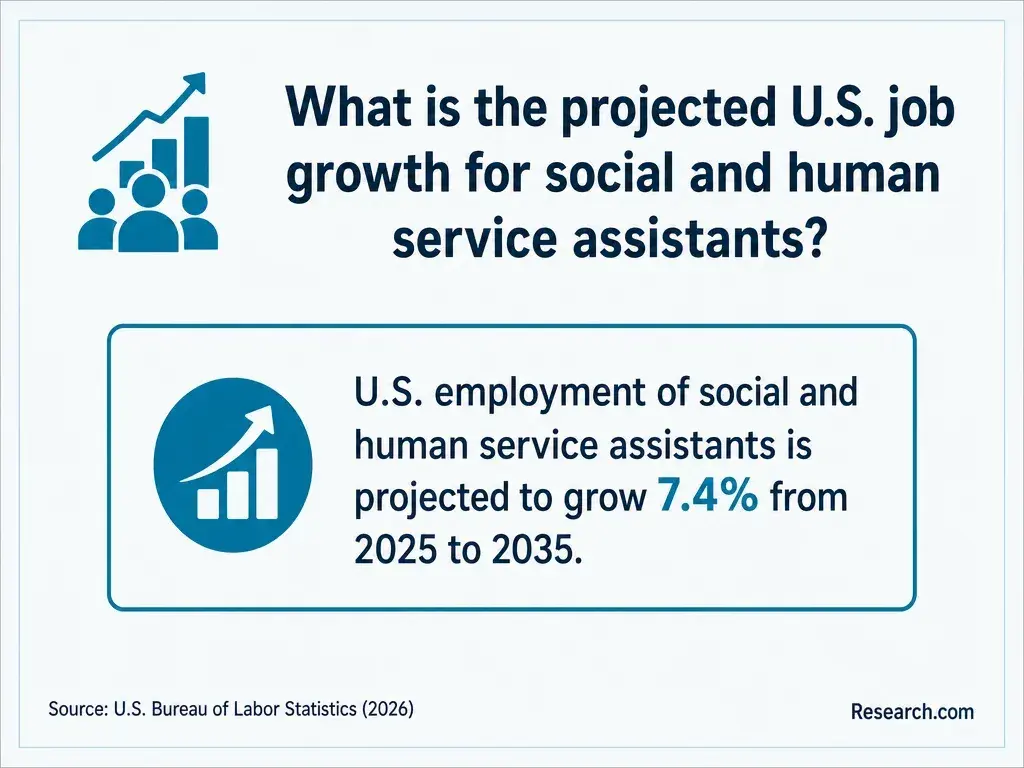
| Social and human service assistant | Helps clients access benefits and services under supervision | Agency requirements, training, and documentation duties |
| Care or intake coordinator | Tracks requests and connects clients with appropriate staff | Whether the position requires a clinical license or specific health credential |
| Licensed mental health professional | Provides services within a regulated clinical scope | Qualifying professional education, supervised experience, and state licensure |
If your target is justice-system work rather than aging services, intensive forensic psychology master's admissions and study plans address a different specialization. Do not choose that route simply to qualify for senior-services support work. For the latter, ask local employers which duties are open to BA graduates and which require prior care-coordination experience or another credential.
Does a psychology bachelor's degree qualify you for mental health licensure?
A psychology BA, including one labeled mental health, does not by itself authorize psychotherapy, diagnosis, independent psychological assessment, or use of a protected clinical title. Counseling, clinical social work, and psychology follow distinct education, supervision, examination, and state-licensing rules. Even nonclinical job titles can carry employer-specific limits.
If your goal is to provide therapy to older adults, identify the exact license you want and check your state board's educational rules before selecting a graduate program. Comparing lower-cost accredited counseling degree pathways may be more useful than choosing a psychology BA for its mental health label. If you want outreach, referrals, or program support instead, you may not need a clinical graduate degree.
First, verify the institution's current accreditation with its recognized institutional accreditor. Do not look for APA accreditation of a general psychology BA: APA's program accreditation does not cover ordinary undergraduate psychology majors. Then evaluate whether the particular program supports your senior-services goal.
Ask for the degree requirements and a written explanation of these practical details:
- Which aging, lifespan, mental health, research, and community-service courses are actually available online, and how often are they offered?
- Are live meetings, campus visits, internships, or capstones required, and who approves a local senior-services site?
- What supervision, accessibility support, career advising, and leave or part-time options are available?
- What do published completion and career outcomes measure, and how many students are represented?
If you have previous college coursework, request a degree audit - not just a count of accepted credits. Guidance on transferring college credits into a psychology degree can help you ask whether statistics, methods, general education, and major requirements are satisfied. The receiving institution makes the final decision.
Requirements vary, but a useful BA combines psychological science with evidence-based writing, statistics, and research methods. For senior services, prioritize lifespan or adult development; cognition and memory; social and cultural psychology; health or abnormal psychology; and ethics. These subjects help you understand aging without treating normal age-related variation as a disorder.
Compare the course list with an actual senior-services job description. A course about depression explains concepts; it does not teach you to diagnose it. A methods course can help you evaluate whether a program appears useful, while a supervised, nonclinical project can show that you can communicate with participants and protect private information.
If your intended role specifically involves substance-use services, compare the psychology curriculum with substance abuse counseling bachelor's affordability and duration. Check your state's credential rules separately: neither degree title establishes permission to counsel independently.
Online delivery can support rigorous reading, research methods, discussion, and feedback. Format alone, however, does not establish equivalent learning or career preparation. For this goal, the decisive question is whether you can practice respectful communication and referral skills with appropriate supervision, whether in a local placement, your current workplace with school approval, or another structured experience.
Compare actual schedules rather than assuming "online" means asynchronous. Live classes, group projects, and site hours can conflict with employment or caregiving. Ask how students secure placements, what happens if a site falls through, and whether faculty assess applied work. The same caution applies if you later consider condensed online psychology master's study: speed and delivery format do not establish clinical eligibility or the quality of supervised experience.
Schools generally ask first-time applicants for secondary-school records and transfer applicants for college transcripts, but GPA thresholds, application materials, and admission to the major differ. Some programs admit students directly to psychology; others require introductory or methods coursework before declaring the major. Request the requirements for your entry term.
Returning students should submit transcripts early and ask which previous courses apply to the degree. If you already work in a nonprofit or care setting, ask whether prior learning can earn credit and whether your job could qualify for an approved placement; neither happens automatically. If addiction-focused education is a better match, investigate scholarship options for online addiction counseling undergraduates alongside that program's actual admissions and aid rules.
A bachelor's degree commonly totals about 120 credits; full-time students often plan around four academic years from the beginning. A transfer student's timeline depends on the school's written evaluation, course sequence, residency requirement, and how many credits remain. Part-time enrollment can make study more manageable but extends the calendar.
For a realistic cost comparison, multiply remaining required credits by the applicable tuition rate, then add mandatory fees, books, technology, and any placement travel or lost work time. Ask about aid eligibility at your intended course load and whether employer tuition assistance applies. Do not compare advertised per-credit prices without first comparing remaining degree requirements. If pace is your main constraint, review shorter routes to an online psychology major, then confirm whether their schedules and required experiences are feasible for you.
There is no single salary for psychology BA graduates in senior services. Pay follows the occupation, location, employer, experience, and required credential - not the name of the major. For a support role, consult the U.S. Bureau of Labor Statistics wage data for the closest matching occupation, such as social and human service assistant, then compare local postings for the actual senior-services duties. An occupation-wide median is not a starting-salary offer or a graduate outcome.
Be particularly careful when comparing fields. Pay comparisons across forensic psychology-related careers describe different roles and qualifications; they cannot estimate what a senior-services coordinator will earn. If you already have relevant experience, ask employers whether the BA changes your eligibility or pay grade before taking on education costs.
What is the job outlook for psychology careers serving older adults?
An aging population creates reasons for agencies to plan services, but it does not guarantee openings for psychology majors. The U.S. Bureau of Labor Statistics publishes projections by occupation, not by undergraduate major or client age. Use the projection for the job you intend to seek, then check local senior centers, community agencies, and health systems for openings and credential requirements.
Your next step depends on your target duties. For nonclinical support, build evidence through supervised service, accurate documentation, accessible communication, and knowledge of referral pathways. For psychotherapy, compare qualifying professional programs; comparing fast-track mental health counseling master's formats is useful only after verifying that a specific program meets the educational rules of the state where you intend to practice. A faster degree is not a substitute for required supervised training.
Other Things You Should Know About Psychology
Yes, if it helps you understand the setting and the responsibilities you enjoy. Ask about training, supervision, privacy rules, and whether volunteers may assist with referrals; volunteering does not itself confer a clinical credential.
Possibly. Obtain your program's approval and your employer's permission before proposing tasks or using workplace information. Do not include identifiable client details in coursework or a portfolio without appropriate authorization.
It may be if your goal is a social-work career or eventual clinical social-work licensure. Compare the specific BSW or MSW pathway and state rules with the broader psychological-science focus of a psychology BA.
Ask your employer which gaps matter most. Training in aging, accessibility, referral procedures, or crisis-response boundaries may be more direct and less costly than another degree if no target position requires one.
- Mental health of older adults | who.int https://www.who.int/news-room/fact-sheets/detail/mental-health-of-older-adults
- Requirements Related to the Practice of Counseling - NCBI https://www.ncbi.nlm.nih.gov/books/NBK259170/
- Cost of Attendance (Budget) | 2025-2026 Federal Student Aid Handbook https://fsapartners.ed.gov/knowledge-center/fsa-handbook/2025-2026/vol3/ch2-cost-attendance-budget
- Accreditation in the U.S. | ed.gov http://www.ed.gov/laws-and-policy/higher-education-laws-and-policy/college-accreditation/accreditation-in-the-us
- Evidence-Based Practices Resource Center | samhsa.gov https://www.samhsa.gov/libraries/evidence-based-practices-resource-center
- Can I Become a Counselor With a Bachelor's Degree? | George Fox University https://www.georgefox.edu/counseling-programs/articles/without-bachelors.html
- How Do Transfer Credits Work When You Go Back to School? | Whitworth Online https://online.whitworth.edu/news-articles/how-do-transfer-credits-work-when-you-go-back-to-school/
- Online Mental Health Concentration | SNHU https://www.snhu.edu/online-degrees/bachelors/ba-in-psychology/mental-health
- Pursuing a Career in Clinical or Counseling Psychology | apa.org https://www.apa.org/education-career/guide/subfields/clinical/education-training
- Community Mental Health, BA Online | New England College https://www.nec.edu/programs/community-mental-health-b-a