2027 MLIS Programs With Short Intensive Terms Instead of Weekly Courses

Co-Founder and Chief Data Scientist
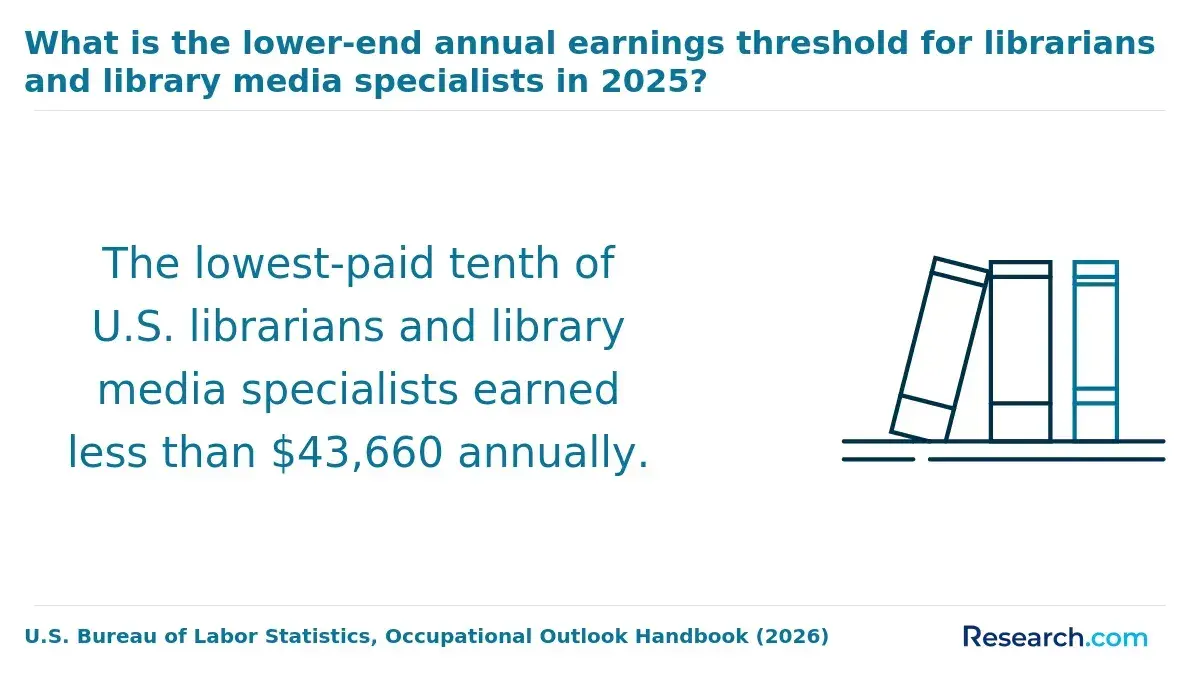
A short-term MLIS can look easier to fit around work than a semester of weekly courses, but a compressed calendar may demand more time each day. That distinction matters when choosing a degree for a profession in which librarians and media collections specialists had a median annual salary of $68,270 in May 2025, according to the U.S. Bureau of Labor Statistics (BLS).
This guide helps prospective students distinguish genuine intensive terms from ordinary online flexibility, compare accreditation and costs, and identify the schedule they can realistically complete.
Key Things You Should Know
- "Intensive" may mean shorter courses, one course at a time, or a faster degree; confirm the term calendar, weekly workload, and required course sequence separately.
- Check the specific master's program in the ALA accreditation directory. Institutional accreditation alone does not establish ALA accreditation, and neither establishes a particular course schedule.
- Compare total credits, fees, and time away from work - not just tuition per credit. BLS projects 2.6% employment growth for librarians and media collections specialists from 2025 to 2035; a faster degree does not change that broader outlook.
What are MLIS programs with short intensive terms instead of weekly courses?
These are library and information science master's programs that deliver some or all coursework in compressed blocks rather than spreading each course across a conventional semester. A block might concentrate reading, discussions, assignments, and meetings into a shorter period. Another program might offer one course at a time but still take about as long to finish as a conventional degree. The label "accelerated" does not resolve that difference.
Ask for a sample calendar showing when each required course starts and ends, whether blocks overlap, and whether live meetings occur at fixed times. Asynchronous access can make an online MLIS while working full time more manageable, but it does not make deadlines or intensive weekly workloads disappear. Also distinguish an MLIS from an MLS, a Master of Science in Library Science, or a Master of Information: degree names vary, so check the specific program and curriculum rather than relying on the acronym.
How do intensive-term MLIS programs compare with traditional weekly-course formats?
The main trade-off is workload concentration, not necessarily the amount of work. This comparison shows what each calendar can mean for a student balancing employment, caregiving, or a practicum.
| Feature | Short intensive terms | Traditional weekly courses |
| Course pace | Material and deadlines are concentrated into shorter blocks. | Work is distributed across a longer term. |
| Concurrent courses | May allow fewer courses at once; confirm whether blocks overlap. | Students may take several courses simultaneously. |
| Schedule risk | Missing a short block or a prerequisite can delay the next course. | A longer term may provide more time to recover from a disrupted week. |
| Applied work | A practicum or group project may not fit the same block pattern. | Applied work may be easier to spread across a term. |
A compressed course can suit someone who prefers focused study and can protect substantial time during each block. A weekly course may suit someone whose available hours are limited but predictable. When comparing library science degree semesters, request a term-by-term plan for your intended enrollment load; a short course does not automatically mean an earlier graduation date.
Which accredited MLIS programs offer accelerated online or campus-based study?
There is no responsible fixed list based on a school's "accelerated" label alone: accreditation status, course calendars, and available starts must be checked for the particular program and entry term. The American Library Association (ALA) accredits eligible library and information studies master's programs, not every degree offered by an accredited university. Its directory is the starting point for checking the specific program; the university's current catalog and schedule establish how that program is delivered.
For each prospective online, hybrid, or campus-based program, request evidence of these three distinct features before comparing schools:
- Calendar: Published block lengths, start dates, overlapping courses, live sessions, and any campus attendance.
- Completion path: A course sequence showing prerequisites, elective availability, practicum timing, and the earliest feasible finish for your enrollment load.
- Credential: The exact master's degree awarded and its current ALA accreditation status, plus any separate school-librarian preparation pathway you need.
An ALA-accredited program may offer a fast full-time route without offering intensive blocks. Conversely, short blocks do not establish ALA accreditation. Ask an adviser to put a realistic schedule in writing, especially if a required course is offered only at particular times.
What does the curriculum cover in an intensive-term MLIS program?
Term length changes the pace, not the professional skills a program needs to teach. Common areas to examine include information organization and metadata, reference and information literacy, collection development, research methods, management, and the ethical provision of accessible services. Individual curricula differ, so use the required-course list - not a program's marketing description - to see what every student studies.
Electives and applied work matter when you have a specific destination. A prospective digital collections librarian might seek metadata and digital preservation coursework plus a project describing or organizing a collection. Someone interested in academic libraries might prioritize research support and information literacy. A catalog listing an elective does not show that it will run during your intensive-term sequence, and a relevant elective is not necessarily a formal concentration. Ask when it is next scheduled and whether an internship can be completed at a suitable local or remote site.
What are the admission requirements for intensive-term MLIS programs?
Requirements depend on the institution, not on whether courses use short terms. Applicants generally need to review the program's published rules for a bachelor's degree, transcripts, application materials, recommendations, and any stated academic or language requirements. Do not assume library employment substitutes for a required degree, or that an application deadline for a conventional term also applies to every block start.
If you work full time, ask admissions and the program adviser separate questions: whether your academic record meets entry requirements, and whether the first available course sequence fits your working hours. An applicant with substantial library experience can use a statement of purpose to explain relevant service or technical skills, but should still verify eligibility under the written admissions policy.
How long do intensive-term MLIS programs take to complete?
There is no single reliable completion time for this format. The relevant calculation is the number of required credits and courses, how often each prerequisite is offered, how many blocks you can take while working, and when any practicum or capstone can be completed. A compressed course may shorten the time spent on that course without shortening the entire degree.
Build two timelines with an adviser: one for the workload you can sustain and one for the program's fastest published path. If you hope to accelerate an MLIS with transfer credits, obtain a written evaluation of eligible graduate-level credits and confirm how they apply to requirements. An accepted credit does not necessarily remove a prerequisite or a scheduling bottleneck.
How much do intensive-term MLIS programs cost?
Without a current, program-specific tuition schedule, no single price is reliable. Calculate tuition using the rate that applies to your residency and enrollment status, then add required fees and expenses. The table separates charges that are easy to overlook when a short calendar makes a degree appear cheaper.
| Cost component | What to verify |
| Tuition | Applicable rate per credit or term and the credits required for the degree. |
| Mandatory fees | University, program, and technology charges and how often they recur. |
| Course materials | Books, software, and equipment required for intensive blocks. |
| Applied or in-person work | Travel, campus visits, or practicum-related expenses, if applicable. |
| Scheduling changes | Extra terms or charges if a required course is missed or postponed. |
For a low cost online library science degree, compare the estimated cost to finish rather than advertised tuition alone. Ask the financial aid office how your actual block enrollment affects aid eligibility and disbursement; do not assume every short block qualifies in the same way as a conventional semester. Employer reimbursement or scholarships can lower personal out-of-pocket cost if awarded, while borrowing changes when and how you pay - not the underlying price. Weigh those costs against your current earnings and the positions you intend to pursue, rather than assuming faster completion produces a financial return.
What careers can an intensive-term MLIS degree prepare you for?
The calendar itself is not a career specialization. An appropriately accredited LIS master's program can support applications for professional roles in public, academic, government, or special libraries, depending on the employer and the applicant's experience. Librarians may help patrons find information, teach research skills, manage collections, or oversee services. Relevant electives and applied projects can also support work in archives, metadata, digital collections, or scholarly communication, where qualifications vary by job.
Choose experience that demonstrates the work you want to do: a reference-service project for public-facing roles, a documented metadata project for digital collections, or supervised archival description for archives positions. Check postings before deciding that an MLIS is necessary. Some information-management roles accept other degrees or substantial technical experience, while paraprofessional library technician roles have different typical qualifications. Understanding library degree career barriers can help you decide whether the master's credential, targeted experience, or another pathway best addresses the jobs you want.
What salaries and job outlook can MLIS graduates expect?
BLS figures describe U.S. occupations, not the earnings or placement results of intensive-term MLIS graduates. The following figures provide context for three related roles; qualifications and duties differ across them.
| BLS occupation | Median annual salary, May 2025 | Projected employment change, 2025-2035 |
| Librarians and media collections specialists | $68,270 | +2.6% |
| Archivists | $64,550 | +3.4% |
| Library technicians | $44,580 | −6.4% |
The librarian median is a useful benchmark, not an expected starting salary: location, employer, role, and experience affect offers. Projected growth likewise does not measure how easily a particular graduate will find work. Compare local job postings and their credential requirements with the full cost of your intended program before using salary data to judge whether an intensive schedule is worth it.
Do intensive-term MLIS graduates need librarian certification or licensure?
There is no universal U.S. librarian license conferred by completing an MLIS. Requirements depend on the role and jurisdiction. Public librarian positions may have state or local credential rules, while school librarian positions commonly involve state educator certification, licensure, or endorsement requirements that are separate from ALA program accreditation.
If you want to work in a school, check your state education authority's requirements and ask the university whether its specific pathway prepares students for that state's credential, including any fieldwork or examinations. An online or accelerated MLIS does not automatically qualify you everywhere. Specialized employers, including law and medical libraries, may prefer subject knowledge or additional training; such preferences should not be mistaken for a universal legal requirement.
Other Things You Should Know About Library Science
Possibly, but a break can affect course sequencing or your status as an enrolled student. Ask the program about leave policies and the next available start for any course you would miss.
Students can ask the university's accessibility office how approved accommodations work with compressed deadlines and any live sessions. Make that inquiry before enrollment so the practical arrangements are clear.
That depends on the course design. Ask whether collaboration, faculty office hours, student groups, and professional events are available across terms rather than assuming a short course limits contact.
Review the program's current technology requirements, including internet access, software, and any tools used for live meetings or assignments. Confirm that you can use them during the hours your courses require.
References
- Recommended Course Sequence | Texas Higher Education Coordinating Board https://www.highered.texas.gov/data-submission-reporting/recommended-course-sequence/
- Semester Course Load and Student Performance - PMC - NIH https://pmc.ncbi.nlm.nih.gov/articles/PMC7568764/
- Fast Facts: Tuition costs of colleges and universities (76) | ed.gov https://nces.ed.gov/fastfacts/display.asp
- Academic Years, Academic Calendars, Payment Periods, and Disbursements | 2025-2026 Federal Student Aid Handbook https://fsapartners.ed.gov/knowledge-center/fsa-handbook/2025-2026/vol3/ch1-academic-years-academic-calendars-payment-periods-and-disbursements
- Chapter 3 - Courses and Enrollment, Full Course of Study, and Reduced Course Load | USCIS https://www.uscis.gov/policy-manual/volume-2-part-f-chapter-3
- MLIS Curriculum, Specialties & Courses | University of Arizona College of Information Science https://infosci.arizona.edu/ma-library-information-science/curriculum-specialties-courses
- 4.1.21 Instructional Modalities and Distance Education | Illinois State https://policy.illinoisstate.edu/academic/4-1-21
- Course Modes & Definitions - Office of the University Registrar https://registrar.washington.edu/classrooms/course-modes/
- Teaching an Intensive Three-Week Course - IU Blogs https://blogs.iu.edu/citl/2020/10/12/three-week-course/
- Introducing new 8-week sessions starting Fall 2022 | Fletcher Technical Community College https://www.fletcher.edu/news/1750732/introducing-new-8-week-sessions-starting-fall-2022