
2027 MLIS Programs for School Library Reading Intervention Support

Co-Founder and Chief Data Scientist
Choosing an MLIS for school library reading support means looking beyond a program's degree title: the coursework must fit the work, and the credential must fit the state where you hope to teach. The U.S. Bureau of Labor Statistics reports a May 2025 median annual salary of $68,270 for librarians and media collections specialists, a broad occupation that includes more than school librarians.
This guide helps prospective students compare preparation, licensure, format, and cost so they can choose a realistic route into school-based reading support.
Key Things You Should Know
- Look for a school library preparation pathway with literacy coursework and supervised experience; a general MLIS or a single relevant elective may not meet school credential requirements.
- Check both the master's program's accreditation and the education agency's rules in the state where you intend to work. Neither substitutes for the other.
- BLS projects 2.6% employment growth for librarians and media collections specialists from 2025 to 2035. That broad forecast is useful context, not a prediction of school library openings in your district.
What are MLIS programs for school library reading intervention support?
These are library and information science master's programs that can prepare a student to support literacy in a K-12 school library. An MLIS, MLS, or differently named LIS master's degree may provide the foundation; what matters is the documented school library pathway, its curriculum, and whether it meets the student's intended state credential requirements. "Reading intervention support" is not necessarily the name of a formal concentration.
In practice, a school librarian might help teachers locate accessible texts, match students with engaging books, teach research and information skills, and reinforce a school's literacy goals. That differs from independently diagnosing reading disabilities or delivering specialized interventions reserved for appropriately qualified educators. When comparing programs, ask how students learn to collaborate with classroom teachers and reading specialists, rather than assuming a school library track includes clinical or specialist-level reading instruction.
Which accreditation should school library MLIS programs have?
First, check the specific master's program in the American Library Association's current directory of accredited programs. A university's institutional accreditation does not, by itself, mean its MLIS is ALA-accredited. Conversely, ALA accreditation does not establish that a school library pathway meets any particular state's educator credential rules.
Next, check the state education agency's requirements for the credential you need, including any rules about an approved educator preparation program, prior teaching credentials, examinations, and supervised school experience. Ask the university to identify the states for which its current pathway is designed and to explain how it supports applicants seeking credentials elsewhere. Get the answer for your specific degree and delivery format: accreditation alone does not verify an elective, practicum placement, or online option.
What degree pathways lead to school library reading intervention careers?
The right pathway depends on whether your goal is a school librarian position or a role primarily responsible for direct reading intervention. The comparison below separates those objectives so you can investigate the appropriate credential before enrolling.
| Pathway | Best fit | Key limitation to check |
| LIS master's with a documented school library pathway | Applicants seeking school librarian or library media specialist roles with literacy responsibilities | Whether the pathway meets the intended state's educator credential rules |
| General LIS master's plus relevant electives | Applicants seeking broader librarianship options while developing literacy-related skills | Electives alone may not qualify a graduate for a school librarian credential |
| Education degree or approved reading specialist pathway | Educators whose primary goal is to provide specialized reading instruction | It may not prepare or qualify them for a school librarian position |
A current teacher may also want to ask whether an approved endorsement or other state-recognized route fits their existing credentials. Do not assume that an MLIS is either required for every literacy role or sufficient for every school library job.
How do online and campus-based MLIS programs compare?
Online study can reduce routine travel, but it does not necessarily remove scheduled classes or in-person school experience. Campus study may make local partnerships easier to access, while still requiring a placement that meets the program's and state's rules. Neither format is inherently the stronger route to certification.
Before choosing, request the current course rotation and ask which classes meet live, whether any campus visits are required, who arranges school placements, and whether a placement near your home is permitted. A working educator should check whether required field hours fit the school day; an accelerated schedule is only useful if required courses and practica are available in the necessary sequence. Guidance on an intensive library science graduate program can help frame that scheduling trade-off, but the university must confirm its current timetable.
What coursework prepares MLIS students for reading intervention?
Prioritize a combination of school librarianship, children's or young adult literature, collection development, instructional design, and collaboration with educators. Courses on accessible resources and evaluating information can strengthen that preparation. For direct reading intervention work, determine whether separate education coursework or a reading specialist credential is required for the role you want.
A course title is not proof of a formal concentration, and a catalog listing does not mean the course runs every term. Ask which courses are required, which are electives, and when each is expected to be offered. Applied work matters too: a supervised school placement or project developed with a teacher can show how you select texts, design a learning activity, and adapt it to student needs. Students considering a user services library science focus should compare those opportunities with the school-specific preparation their target position requires.
What are the admission requirements for school library MLIS programs?
Applicants should expect to document a completed bachelor's degree and submit the materials specified by each graduate program, which may include transcripts, a statement of purpose, recommendations, or a résumé. A school library pathway may have additional educator-preparation eligibility rules. Check the current admissions page for both the degree and the pathway; professional experience should not be assumed to replace a published academic requirement.
If you already teach, ask whether your credential or school experience changes the required fieldwork or eligibility review. If you do not hold a teaching credential, ask whether the pathway admits you and what steps remain before state certification. Request an individual review when your academic or credential history does not fit the published route.
Admission and affordability are separate decisions. Applicants comparing library science masters funding for adults should confirm award eligibility, renewal conditions, and application deadlines with each school rather than treating a listed opportunity as guaranteed funding.
How long do MLIS programs cost and take to complete?
Completion time depends on required credits, enrollment pace, course sequencing, and any school-based fieldwork. A program's advertised fastest completion time may not apply to a part-time student or to someone waiting for a required placement. Ask for a term-by-term plan based on your intended start date and workload.
For a comparable cost estimate, multiply the tuition charged per credit by the credits you must complete, then add required fees and likely expenses for materials, travel, and placements. Check residency and online tuition rules rather than assuming one published rate applies to everyone. Compare the resulting gross cost with confirmed grants or employer support; borrowing changes when you pay, not the underlying program cost. An affordable MLIS for working professionals should also be feasible to finish on your schedule.
Before committing, ask the financial aid office which aid you qualify for in your enrollment period and what happens if you attend part time. Weigh any expected career benefit against your current earnings and borrowing needs; a general occupational salary is not a reliable personal payback calculation.
What licenses and certifications do school library professionals need?
Requirements depend on the state and the position. Public school librarian roles may require an educator license, a school library endorsement, certification through an approved preparation route, or a combination of state-specified steps. Private school requirements and job descriptions may differ. Verify the current rules with the education agency in the state where you intend to work and compare them with actual employer postings.
Ask the preparation program for a written explanation of its credential pathway, including examinations, prior teaching requirements, and field experience. If you plan to study online from another state, ask about your home state specifically. An ALA-accredited degree is valuable to assess, but it is not a portable school librarian license; an optional professional certificate likewise should not be mistaken for a legally required state credential.
What careers can graduates pursue in school library reading support?
The clearest match is school librarian or library media specialist, a role combining resource selection, instruction, access to information, and collaboration with teachers. Responsibilities for literacy support vary by school and district. Related work may include youth services in a public library or educational resource support, but those employers may apply different degree and experience requirements. A reading specialist position follows its own educator-credential pathway and should not be treated as an automatic MLIS outcome.
For school library applications, useful evidence might include a lesson developed with a teacher, a rationale for an inclusive reading collection, or a reflection on supervised work with students. Protect student identities in any portfolio. Reviewing broader online library degree outcomes may help you consider alternative settings, but ask each program for school-specific placement and career information before drawing conclusions about your prospects.
What are the salary and job outlook for school library professionals?
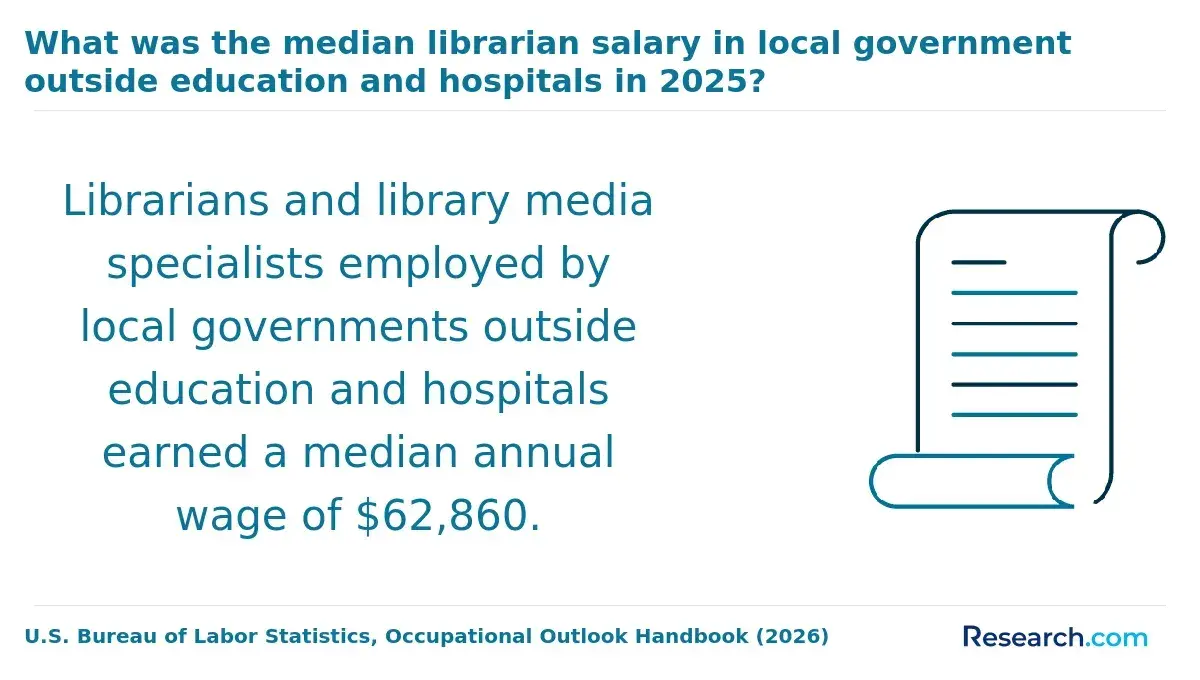
The BLS reports a May 2025 median annual salary of $68,270 for librarians and media collections specialists and projects 2.6% employment growth from 2025 to 2035. These figures describe a broad occupation, not school librarians alone; they cannot establish a starting salary, a district pay scale, or an individual graduate's employment prospects.
For a decision closer to home, review posted school librarian jobs in the districts where you could work. Compare their credential requirements, salary schedules, contract length, and stated literacy responsibilities. That local evidence is more useful for judging whether a particular degree's cost fits your career plans.
Other Things You Should Know About Library Science
No. A school librarian can help students access appropriate materials and collaborate with qualified educators, but a library degree alone does not authorize a diagnosis.
It can offer materials in students' languages and at varied reading levels, then work with teachers and families to identify resources students can use and enjoy.
Follow the school's privacy rules and share only information needed for an authorized educational purpose. Discuss data practices with a supervisor rather than assuming all circulation records should be accessible.
Agree on a modest goal with the collaborating teacher, such as increased access to suitable books, and review appropriate feedback or participation evidence. Do not present library activity alone as proof of improved reading proficiency.
References
- Student Services Certificates | Texas Education Agency https://tea.texas.gov/educators/certification/additional-certifications/student-services-certificates
- 8VAC20-23-420. Library media preK-12. | virginia.gov https://law.lis.virginia.gov/admincode/title8/agency20/chapter23/section420/
- Teacher Librarian Services Credential (CL-562) | Commission https://www.ctc.ca.gov/credentials/leaflets/cl-562/
- FERPA | Protecting Student Privacy - Department of Education https://studentprivacy.ed.gov/ferpa
- School Library and Media Center Placement | michigan.gov https://www.michigan.gov/mde/services/ed-serv/ed-cert/permits-placement/courses-that-can-be-taught/library-media
- Library and Information Science (MLIS) | missouri.edu https://cehd.missouri.edu/degree/library-science-mlis-certification/
- Master's in Library and Information Science | UNC Greensboro https://www.uncg.edu/degrees/library-and-information-science-m-l-i-s-school-library-media-coordinator-concentration/
- MLIS Online - School Librarianship - ODUGlobal https://online.odu.edu/academics/programs/library-information-studies-school-librarian
- Library Education & Licensing | American Library Association https://www.ala.org/aasl/about/ed/recruit/license
- Effective Reading Instruction for Students with Dyslexia | dyslexiaida.org https://dyslexiaida.org/effective-reading-instruction-for-students-with-dyslexia/


