
2027 MLIS Programs for Institutional Archives and Compliance Records

Co-Founder and Chief Data Scientist
Choosing an MLIS for archives or compliance records means looking beyond the degree title: archival description and legally defensible records retention call for different preparation. The U.S. Bureau of Labor Statistics reports a May 2025 median annual wage of $64,550 for archivists, but that figure does not describe every records-management job.
This guide helps prospective students compare curricula, applied experience, accreditation, costs, and career paths so they can choose a program - or an alternative credential - that fits the work they want to do.
Key Things You Should Know
- Look for evidence of both archival practice and records governance; a relevant elective is not proof of a formal concentration.
- Confirm accreditation for the specific master's program, then check when essential electives run and whether you can complete relevant fieldwork.
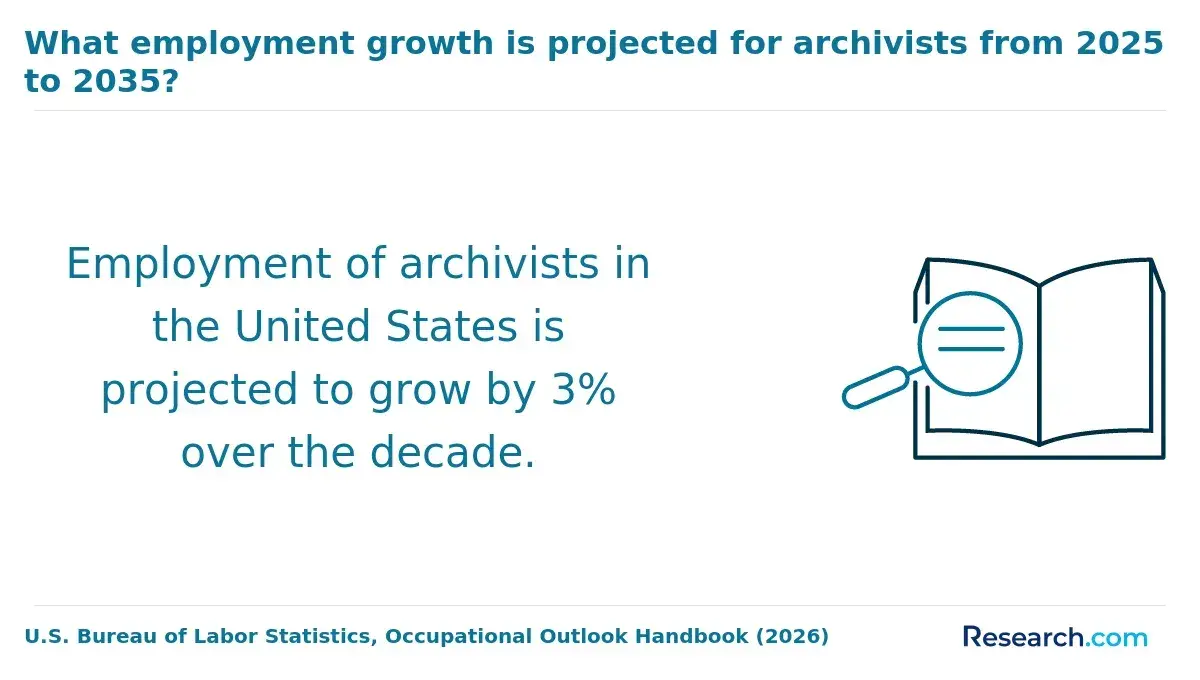
- Archivist employment is projected to grow 3.4% from 2025 to 2035; that occupational projection is not a placement rate for MLIS graduates.
What are MLIS programs for institutional archives and compliance records?
These are library and information science master's programs that students can use to prepare for two related functions. Institutional archives preserve records with enduring historical or administrative value, such as university records, organizational photographs, and born-digital files. Compliance records management governs how records are classified, retained, protected, retrieved, and disposed of under applicable policies and legal requirements.
The two functions overlap when an organization decides which records to keep permanently and which to dispose of after an authorized retention period. They are not interchangeable: an archives-focused curriculum may emphasize appraisal, arrangement, and description, while a records-governance curriculum may emphasize retention schedules, privacy, and defensible disposition.
Schools may award an MLIS, MLS, Master of Information, or another LIS degree. Do not assume a degree bearing any of those names offers a formal archives or records-management concentration. Compare the published curriculum and available applied work, not just the credential's label.
Which accreditation should archives and records management MLIS programs have?
For a U.S. library and information science master's, check whether the specific graduate program appears in the American Library Association's current directory of accredited programs. An institution's accreditation is separate and does not establish ALA accreditation for its MLIS. Conversely, ALA accreditation does not verify that an archives elective, internship, or online format is available.
Accreditation can matter when employers request an ALA-accredited degree, particularly for professional librarian positions. Archives and records-management employers may instead accept several graduate-degree fields and weigh relevant experience heavily. Read job postings in your intended setting before treating any one credential as universally required.
For a sound comparison, verify program accreditation in the directory, then ask the department which specialization requirements are formally documented, when the courses you need are next scheduled, and whether field placements are available in your area. That separates an accredited degree from the specialized preparation you actually need.
What careers can an archives and compliance records MLIS prepare you for?
An MLIS can support work in universities, government agencies, corporations, nonprofits, and cultural institutions. Job titles vary, so compare duties and required qualifications rather than searching only for "archivist." The distinctions below show where archival training and records-governance experience carry different weight.
| Role | Typical work | What to check in job postings |
| Institutional archivist | Appraises collections, prepares finding aids, manages access, and supports preservation. | Archives coursework, processing experience, and digital-collections skills. |
| Records manager | Develops retention processes, coordinates disposition, and helps staff follow records policies. | Governance experience, knowledge of applicable requirements, and accepted degree fields. |
| Digital archivist | Ingests, describes, preserves, and provides access to born-digital materials. | Hands-on digital preservation and metadata experience. |
| Information governance analyst | Helps organizations classify, protect, locate, and manage information across systems. | Privacy, technology, compliance, or business experience that may substitute for an MLIS. |
For an entry-level portfolio, a documented processing project or sample retention analysis can be more persuasive than a course title alone. Students aiming primarily at corporate compliance should also compare information-governance certificates, employer training, and degrees in law, business, or information systems. A career focused library information degree makes the most sense when its required and available coursework matches the jobs you plan to seek.
What do MLIS programs teach about archives and compliance records?
Relevant study typically combines LIS foundations with selected archives, technology, and governance coursework. An archives course may cover appraisal, deciding what has lasting value, and arrangement and description, which organize materials and make them discoverable through tools such as finding aids. Digital archives work adds metadata, file assessment, storage planning, and preservation workflows.
Records-management preparation should address how records are identified, assigned retention periods, protected during a legal hold, and disposed of when authorized. Because retention obligations depend on the organization and jurisdiction, a course should teach students how to investigate applicable requirements, not claim to supply a universal schedule.
Look for an applied assignment that produces a defensible work sample: for example, a finding aid with a documented appraisal rationale, or a proposed retention workflow reviewed against a real organization's policies. Compare learning outcomes and assessments, not just catalog descriptions; guidance on competency based MLIS outcomes can help frame that review. Before enrolling, confirm which relevant courses are required, which are electives, and how often the electives are offered.
Are online MLIS programs effective for archives and records management?
They can be, provided the program gives students access to specialized instruction, usable feedback, and meaningful practice. Online coursework is well suited to activities such as drafting metadata, evaluating retention policies, and documenting digital-preservation decisions. Physical collections work, restricted records, and some institutional systems may require supervised on-site access.
Do not assume "online" means every class is asynchronous or every internship can be remote. Ask whether archives electives have live meeting times, whether required courses run during terms you can attend, and who arranges or approves placements. Working adults comparing library masters weekend and online options should check actual course schedules and travel requirements rather than relying on a program-wide format label.
If local archives cannot host a placement, ask whether an approved digital collections, records office, or employer-based project can meet the learning requirement. Obtain the program's answer before counting on that arrangement.
What are the admission requirements for archives-focused MLIS programs?
Applicants generally need a completed bachelor's degree and must meet the individual program's graduate admission requirements. Schools may request transcripts, a statement of purpose, recommendations, a résumé, or other materials; testing policies and prerequisites vary. An archives-focused applicant should use the statement to connect their experience or interests to specific, verified elements of the curriculum.
Prior library employment is not necessarily required. Experience with digitization, administrative records, research collections, privacy-sensitive information, or organizational policy can also inform an application. If your academic record or prior credentials are unusual, request an individual review rather than assuming professional experience replaces a published admission requirement.
Ask admissions and the academic department separate questions: admissions can clarify eligibility and document rules, while faculty or program advisers can explain whether your intended courses and placements are realistically accessible.
How long do archives and compliance records MLIS programs take?
Completion time depends on required credits, enrollment pace, course sequencing, and any practicum or capstone. Full-time students may finish in roughly two years, while part-time students often need longer; neither timeline should be assumed for a particular program.
Specialization can affect the schedule more than the degree's advertised minimum. If a needed archives elective runs infrequently, or fieldwork requires approval before enrollment, a fast general MLIS route may not be the fastest route to your career goal. When assessing how many years for library science degree, map the required courses and target electives across actual upcoming terms, including any prerequisites.
How much do archives and compliance records MLIS programs cost?
There is no single reliable price for this specialization. To compare programs, multiply each school's published tuition per credit by the credits required for its degree, then add mandatory fees. Use the tuition schedule that applies to your residency, delivery format, and enrollment period; online enrollment does not automatically confer an in-state rate.
The following cost categories matter because two programs with similar tuition can produce different total expenses.
- Mandatory university and program fees, books, software, and equipment.
- Travel or lost work time for campus visits, fieldwork, or supervised projects.
- Extra terms or credits needed because of elective sequencing or specialization requirements.
Compare that gross cost with any confirmed scholarship or employer support to estimate your out-of-pocket expense. If you expect to borrow, ask the financial aid office which federal aid rules and loan limits apply to your enrollment period; financing does not reduce the program's price. A library science program cost comparison is a starting point, but confirm current rates and fees directly before deciding. Weigh the resulting cost against jobs you could realistically pursue and your current earnings, not an assumed salary increase.
What salaries and job outlook can MLIS archives graduates expect?
The Bureau of Labor Statistics reports a May 2025 median annual wage of $64,550 for archivists and projects 3.4% employment growth for the occupation from 2025 to 2035. A median describes workers across career stages and employers; it is neither a starting salary nor an outcome reported for a particular MLIS program.
Records managers and information-governance staff may be classified under different occupations, so the archivist figure should not be applied to every compliance role. Location, sector, responsibility, and prior experience also affect job offers. For a more useful personal estimate, compare current postings in your target region with their stated degree requirements and salary ranges, then consider whether a program's applied training would help you qualify.
Do archivists and records managers need certification or licensure?
There is no single U.S. license required for all archivists or records managers. Employers may value optional professional credentials, such as the Academy of Certified Archivists' Certified Archivist credential or the Institute of Certified Records Managers' Certified Records Manager credential, but eligibility and examination requirements are separate from earning an MLIS.
Check the qualifications in the jobs you want before paying for an additional credential. For a student with limited experience, supervised projects and demonstrable skills may be the more immediate priority; an experienced practitioner may find certification more relevant for advancement. Neither an MLIS nor a professional certification authorizes someone to provide legal advice about an organization's retention obligations.
Other Things You Should Know About Library Science
A finding aid describes archival materials so people can locate and understand them. A retention schedule specifies how long categories of records must be kept and what happens when that period ends.
Only with appropriate authorization. Use public, redacted, or simulated materials when records contain personal, confidential, or legally restricted information, and follow your employer's policies.
No. Scanning or converting creates a digital copy; digital preservation also addresses file integrity, documentation, storage, access, and ongoing management.
Not for every role. Familiarity with file formats, metadata, spreadsheets, and preservation workflows is broadly useful; coding becomes more valuable when a position involves automation or large-scale digital collections.
References
- Internships | Mississippi Department of Archives & History http://www.mdah.ms.gov/careers-volunteering/internships
- Summary of the HIPAA Privacy Rule | hhs.gov https://www.hhs.gov/hipaa/for-professionals/privacy/laws-regulations/index.html
- Certification of Training in Federal Records Management | National Archives https://www.archives.gov/records-mgmt/initiatives/certification-of-training.html
- Junior Fellows Program | loc.gov https://www.loc.gov/item/internships/junior-fellows-program/
- Privacy Laws, Policies and Guidance - Commerce.gov https://www.commerce.gov/opog/privacy/privacy-laws-policies-and-guidance
- SANC Paid Internships | ncdcr.gov https://archives.ncdcr.gov/support/volunteer-and-internship-opportunities/sanc-paid-internships
- Records Management Specialization | St. John's University Programs https://online.stjohns.edu/online-programs/mslis/records-management-specialization
- About this course - Archival Appraisal, Arrangement, and Access https://lbsci730.commons.gc.cuny.edu/about/
- Graduate Certificate in Archival Administration | Wayne State University https://sis.wayne.edu/certificates/archival-administration
- Records Management Primary Roles, Responsibilities, and Procedures | Records Management https://records.arizona.edu/roles-responsibilities-procedures


