
2027 MLIS Programs for Information Policy Analysts

Co-Founder and Chief Data Scientist
Choosing an MLIS for information policy work means looking beyond a program's name. Privacy, public access, records retention, and responsible AI require both policy judgment and an understanding of how information systems work. For context, the U.S. Bureau of Labor Statistics reports a May 2025 median annual salary of $68,270 for librarians and media collections specialists - but that broad occupation is not a salary measure for policy analysts. This guide helps prospective students identify relevant training, compare costs and formats, and decide whether an MLIS fits their intended role.
Key Things You Should Know
- Look for documented coursework in information policy, privacy, law, and information governance; a related elective is not proof of a formal policy concentration.
- Check ALA accreditation at the program level if you want to preserve eligibility for librarian roles that prefer or require an accredited master's degree.
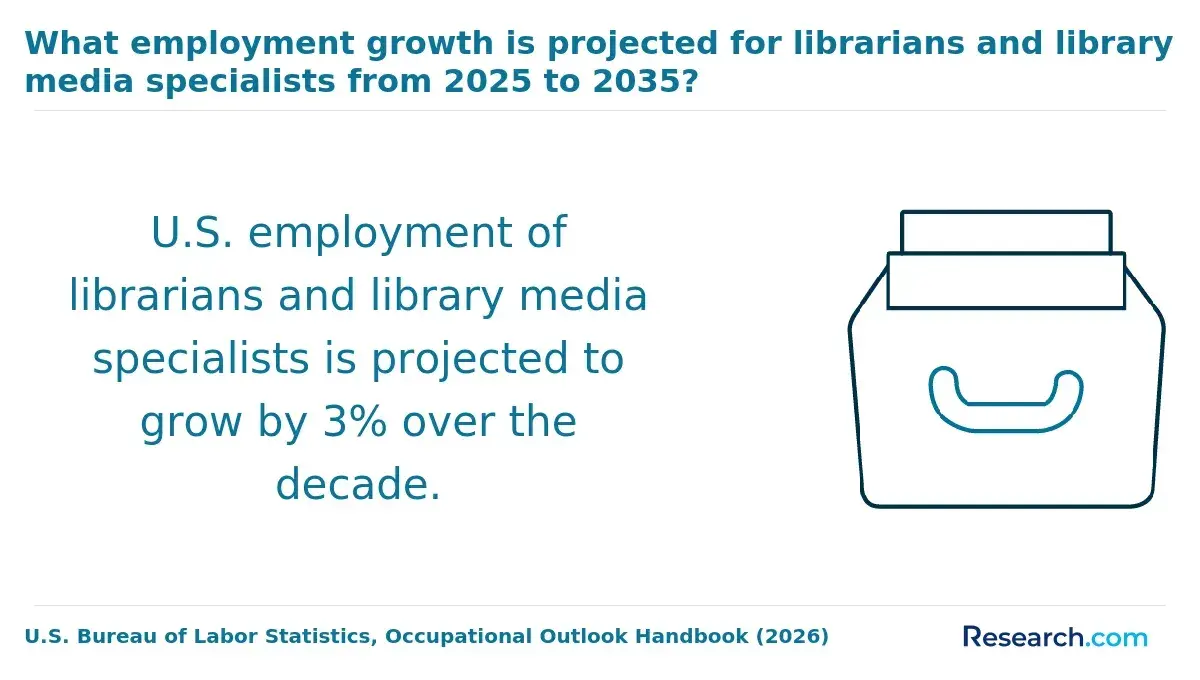
- BLS projects 2.6% employment growth for librarians and media collections specialists from 2025 to 2035, but it does not publish a separate outlook for information policy analysts.
What is an MLIS program for information policy analysts?
An MLIS is a graduate degree in library and information science. For an aspiring information policy analyst, its value lies in connecting decisions about access, privacy, ownership, and retention to the systems and organizations those decisions affect. An analyst might evaluate a library's data-collection practices, help draft records policies, or assess the accessibility and fairness of an information service.
"MLIS program for information policy analysts" usually describes a career-oriented course of study, not necessarily an officially named concentration. Schools also award degrees titled MLS, Master of Science in Library Science, or Master of Information; the title alone does not establish identical coursework or accreditation. For a broader explanation of what is a library science degree, compare degree names with each school's actual curriculum.
What education does an information policy analyst need?
There is no single degree required across all information policy analyst jobs. An MLIS can be a strong fit when the work centers on libraries, archives, public access, information organization, or records. Employers working primarily in legislation, regulatory compliance, cybersecurity, or public administration may instead value a policy, law, public administration, or technical background. The job description - not the title alone - should guide the choice.
Useful preparation combines policy research and clear writing with an understanding of how information is collected, described, shared, secured, and deleted. Students can build that combination through coursework and applied work in a library, government office, nonprofit, or records unit. If target postings consistently ask for legal interpretation or security engineering rather than LIS expertise, compare an MLIS with a more directly aligned degree or certificate before enrolling.
How does ALA accreditation affect MLIS program and career options?
ALA accreditation applies to specific graduate programs, not automatically to every program at an institution. It matters most if you want to remain eligible for professional librarian positions whose employers specify an ALA-accredited master's degree. Some policy jobs accept other graduate degrees, so accreditation may be less decisive for those roles.
Confirm the exact degree in the current ALA directory before applying, particularly if a university offers several information-related master's programs. Then examine the catalog separately: ALA accreditation does not verify that a policy elective, concentration, internship, or online option exists. If you may pursue school librarianship, also check the relevant state education authority; state certification requirements are distinct from program accreditation.
Should you choose an online or campus-based MLIS program?
Choose the format that lets you complete relevant coursework and applied work, not simply the one that sounds most flexible. Online study may suit someone already employed in a policy-adjacent setting, while campus study may make local partnerships and in-person networking easier. Either format can include scheduled classes, group work, or a practicum with site-specific requirements.
When comparing best online librarian education options, ask whether policy electives are offered online, how often they run, whether live attendance is required, and whether a proposed practicum site can be approved near you. A catalog listing establishes that a course exists; it does not guarantee a seat during your intended term.
What do MLIS programs teach aspiring information policy analysts?
A useful curriculum pairs LIS foundations - such as information organization, research methods, and services - with opportunities to examine how rules shape access and use. Depending on the program, relevant electives may address privacy, intellectual freedom, copyright, records management, data governance, accessibility, or technology policy. Confirm whether each subject is required, elective, or available only through an independent project.
Applied work is especially valuable when it produces a writing sample. A student might evaluate a public-facing privacy notice, compare records-retention practices against an organization's stated policy, or prepare a brief on access barriers. Such projects show an employer how the student identifies stakeholders, weighs evidence, and explains trade-offs. If considering a flexible library information degree, verify how its assessments allow you to demonstrate those specific skills rather than assuming flexibility includes policy-focused study.
What are the admission requirements for MLIS programs?
Applicants generally need a bachelor's degree and must follow each program's published application requirements. Common materials include transcripts, a statement of purpose, recommendations, and a résumé; test, prerequisite, and minimum-grade policies vary. A policy-focused statement should connect a concrete problem you want to study - such as patron privacy or public records access - to the program's documented courses or projects.
Before applying, ask whether relevant graduate credits can transfer and whether policy electives have prerequisites or restricted enrollment. Transfer approval is program-specific and should not be assumed from undergraduate transfer rules. Applicants with substantial professional experience should likewise ask how it is considered; experience does not automatically replace a stated degree requirement.
How long do MLIS programs take and how much do they cost?
Completion time depends on required credits, course load, sequencing, and whether needed electives or practica are available when you can take them. Ask each program for a term-by-term plan based on your intended enrollment pace; a published minimum completion time may not reflect your schedule.
For a comparable cost estimate, multiply required credits by the tuition rate that applies to you, then add mandatory fees, materials, and any travel or practicum expenses. Check whether tuition differs by residency or delivery format. This calculates an estimated gross cost, not your out-of-pocket cost after confirmed aid or employer support, and not the amount you would borrow. Use library science degree affordability and pay as a starting point for comparing value, then verify current charges with each institution. Do not rely on tuition per credit alone when programs require different numbers of credits.
What careers can you pursue with an MLIS and policy focus?
Possible roles include information policy analyst, privacy or information governance specialist, records analyst, and librarian positions involving access, intellectual freedom, or institutional policy. Titles overlap, but responsibilities differ: one employer may need legislative research, while another needs a retention schedule or a privacy review of a library service.
An MLIS may be required or preferred for a professional librarian post, but it is often one of several possible qualifications in adjacent policy and governance work. Search postings from your target employers and separate required credentials from preferred ones. For entry-level applications, a concise policy brief, documented records project, or evaluated privacy workflow can provide more relevant evidence than a list of course titles. Remove confidential information and obtain permission before sharing workplace projects.
How much do information policy analysts earn?
BLS does not provide a single salary figure for "information policy analyst" across settings. Its May 2025 median of $68,270 for librarians and media collections specialists offers context for library-centered roles, not an earnings prediction for policy analysts or MLIS graduates. Pay for a particular opening depends on its duties, employer, location, and required experience.
For a realistic comparison, gather posted salary ranges for the roles and locations you would actually pursue, and compare them with your current earnings and expected education costs. A library degree salary comparison can provide broader context, but it cannot replace evidence from your target job market.
What is the job outlook for information policy analysts?
There is no single BLS projection covering every information policy analyst role. BLS projects 2.6% growth for librarians and media collections specialists from 2025 to 2035. That modest growth is relevant to library-based career planning, but it should not be applied to privacy, compliance, or government policy openings with different hiring patterns.
Before committing to a program, review current postings from organizations where you would work. Note recurring requirements for policy writing, records practices, privacy, accessibility, and technical collaboration; then check whether the degree provides opportunities to demonstrate them. This gives you a more useful local outlook than treating a broad occupational projection as a forecast for your specialization.
Other Things You Should Know About Library Science
No. Policy analysis evaluates evidence, options, and likely effects; lobbying seeks to influence a policy decision. A position may involve both, so read its duties and employer expectations carefully.
Only if your employer permits it. Remove personal and confidential information, document your own contribution, and consider creating a public-data or hypothetical version when permission is uncertain.
A short brief that defines a specific problem, identifies affected groups, uses credible evidence, compares feasible options, and explains a recommendation and its limitations.
Speak with people doing policy or governance work, read job descriptions from your target organizations, and try a small public-information research project. Use what you learn to test whether the work - and the requested credentials - match your goals.
References
- Policy Analysis Positions | U.S. Office of Personnel Management https://www.opm.gov/policy-data-oversight/classification-qualifications/general-schedule-qualification-standards/specialty-areas/policy-analysis-positions/
- Artificial Intelligence and Privacy - Issues and Challenges | Office of the Victorian Information Commissioner https://ovic.vic.gov.au/privacy/resources-for-organisations/artificial-intelligence-and-privacy-issues-and-challenges/
- Cost of Attendance (Budget) | 2025-2026 Federal Student Aid Handbook https://fsapartners.ed.gov/knowledge-center/fsa-handbook/2025-2026/vol3/ch2-cost-attendance-budget
- Frequently Asked Questions | Office of the Registrar https://registrar.arizona.edu/faqs
- Data for Policy Analysis and Management | Crown Family School of Social Work, Policy, and Practice https://crownschool.uchicago.edu/academic-programs/course-catalog/data-policy-analysis-and-management-48500
- Master of Library and Information Science (MLIS) | du.edu https://morgridge.du.edu/academics-advising/programs-gr/mlis-library-and-information-science
- Cost of Attendance | Florida Atlantic University https://www.fau.edu/finaid/other/cost-of-attendance/
- Cost and Aid | Undergraduate Admissions https://admissions.oregonstate.edu/cost-and-aid
- Cost of Attendance - Financial Aid and Scholarships | The University of Utah https://financialaid.utah.edu/tuition-and-fees/cost-of-attendance.php
- Tuition in Detail - One Stop Student Services https://onestop.utk.edu/billing-payments/tuition-detail/


