2027 International Nursing Qualifications: Licensure Evaluation vs College Admission
Audited and Verified:
Our Editorial and Data Verification Process
Research.com uses government datasets, official education statistics and primary institutional information to support its career and degree guides. Our review process checks factual accuracy, occupational definitions, source dates and the requirements associated with the credentials discussed.
How This Article Was Fact-Checked
Our editorial team verifies salary estimates, employment projections, education requirements and program information against original data providers and official organizations. Salary figures are checked against the relevant occupational definitions and reporting periods. Information about licensure, accreditation and required in-person training is reviewed separately.
Fact-checked and verified on:

Co-Founder and Chief Data Scientist
An international nursing qualification can be acceptable to a U.S. college but insufficient for RN licensure - or sufficient for a state board's review without requiring another degree. That distinction can determine whether you spend months applying to schools or move directly toward a licensing examination. This guide is for internationally educated nurses and prospective nursing students weighing those options. It explains who evaluates your records, how admission and licensure decisions differ, and what to confirm before paying for an evaluation or enrolling.
Key Things You Should Know
- Two separate decisions: A college decides admission and transfer credit; a state board of nursing decides whether you qualify for its RN licensure process.
- One examination, when required for initial RN licensure: A qualifying degree or credential evaluation does not replace the NCLEX-RN or a state license.
- Three common education routes: A prelicensure associate degree, prelicensure BSN, or eligible accelerated BSN may lead toward initial RN licensure; an RN-to-BSN ordinarily assumes you are already licensed.
What Is the Difference Between Licensure Evaluation and College Admission?
Licensure evaluation asks whether your prior nursing education meets a state board's requirements for an RN license. College admission asks whether you meet a school's entry requirements and, separately, which prior courses it will apply to a particular degree. An evaluation provider may authenticate and compare records, but the board or college makes its own decision.
The distinction matters because these reviews can reach different conclusions about the same qualification:
| Decision | Who has final authority? | What does a favorable result mean? |
| RN licensure eligibility | The state board of nursing | You may proceed with that state's remaining licensing steps; it does not award college credit. |
| College admission | The institution and, where separate, its nursing program | You may enter the approved course or program; it does not establish NCLEX eligibility. |
| Transfer credit | The receiving institution or nursing program | Specified coursework may count toward specified requirements; clinical or sequenced nursing courses may still need repeating. |
Start with the outcome you need. If you are already a qualified nurse seeking an initial U.S. RN license, ask your intended state board about its internationally educated applicant process before assuming another degree is necessary. If you need a U.S. credential or your prior preparation has gaps, ask a school for a written degree audit. Even when comparing ADN-to-MSN nursing programs, confirm whether the route requires an existing U.S. RN license rather than preparing you for one.
How Are International Nursing Qualifications Evaluated for U.S. Licensure?
Requirements vary by state. A board may require a specified credential evaluation, verification of your nursing license abroad, English-language evidence, or a review of theory and supervised clinical education. It may require records to come directly from your school or licensing authority. Do not purchase a general academic evaluation until the board identifies the report and provider it accepts.
A practical sequence keeps the regulatory decision ahead of any unnecessary enrollment:
- Choose the state where you intend to seek initial licensure and read its instructions for internationally educated RN applicants.
- Ask which evaluation report, source documents, translations, and language evidence the board requires.
- Request detailed transcripts and, if required, descriptions of nursing courses and supervised clinical experiences from your institution.
- Submit the required application and resolve any deficiencies identified by the board before committing to a degree solely for licensure.
An evaluation is evidence for a decision, not a license or a promise of examination eligibility. The same principle applies to advanced practice: overseas specialty experience does not automatically satisfy a U.S. population-focused program or certification requirement. If that is your later goal, assess those requirements separately before comparing post-master's FNP study options.
What Are the Admission Requirements for International Nursing Students?
Schools set their own admission rules. Common requirements include evaluated academic transcripts, prerequisite sciences with acceptable grades and labs, evidence of English proficiency when applicable, and proof that the applicant can participate in required clinical learning. Admission to a university may not include admission to its competitive nursing major; ask about both decisions.
Before applying, request written answers about the evaluation service and report the school accepts, whether your science courses meet its content and recency rules, and whether prior nursing coursework can satisfy requirements in the nursing sequence. Also check clinical-site requirements, which may include background screening, health documentation, and eligibility to attend placements. These are not necessarily the same as academic admission conditions.
If your prior qualification is outside nursing, exploring nursing study without previous nursing training may help you identify prelicensure options. Confirm that any program you consider actually admits international applicants and prepares students for initial RN licensure; a program marketed to graduates may instead require an active RN license.
Prelicensure associate degree in nursing (ADN or ASN), BSN, and eligible accelerated BSN programs prepare students to seek initial RN licensure. Completing one does not itself issue a license: the graduate must meet the applicable board's requirements. Program approval and the graduate's intended licensing state are more important to this decision than the degree's name alone.
Use your current license status to distinguish these routes:
| Route | Typical entrant | Initial RN preparation? |
| Prelicensure ADN/ASN or BSN | Applicant who is not yet a U.S.-licensed RN | Yes, subject to program and board requirements |
| Accelerated prelicensure BSN | Applicant with a prior bachelor's degree and required prerequisites | Yes, if the specific track is prelicensure |
| RN-to-BSN or most RN-to-MSN routes | Already-licensed RN | No; these normally build on existing RN licensure |
If your state board accepts your international education for the licensing process, another degree may be unnecessary for that immediate goal. If you are already licensed and want academic advancement, comparing lower-cost BSN-to-MSN routes addresses a different decision - not how to obtain an initial RN license.
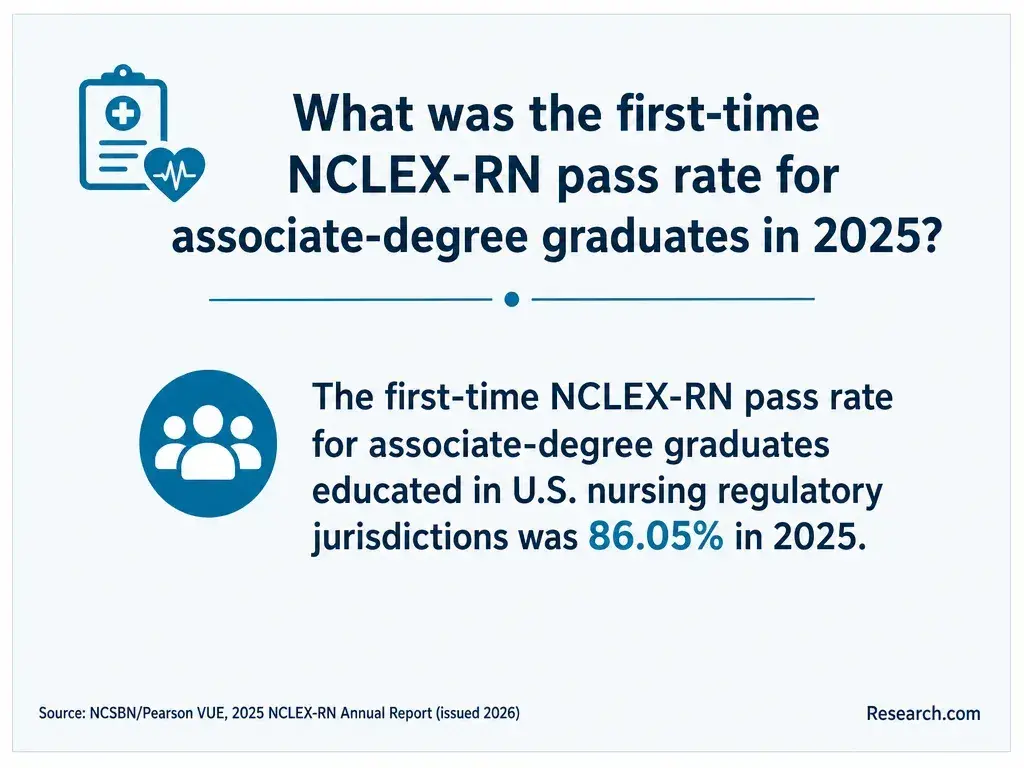
Internationally educated nurses seeking initial U.S. RN licensure generally must qualify for and pass the NCLEX-RN, then satisfy the licensing state's remaining requirements. The board determines eligibility to take the examination; passing it is not the same as receiving an active license. A nurse who already holds a U.S. RN license and seeks licensure in another state may instead follow that state's endorsement process, subject to its rules.
Keep four milestones separate: credential review, authorization to test, examination passage, and license issuance. Employment also depends on lawful work authorization and employer requirements. An online program or a favorable credential evaluation does not supply either of those.
The NCLEX-RN concerns entry-level RN licensure, not advanced practice certification. For example, short-format family NP degree and certificate routes address later graduate preparation; they do not substitute for initial RN licensing steps.
State board approval and accreditation answer different questions. Board approval or recognition concerns a nursing program's standing under the applicable regulator's rules. Institutional accreditation addresses the institution; specialized nursing accreditation, such as ACEN or CCNE accreditation where applicable, addresses a defined nursing program. None should be inferred solely from the others.
For a U.S. prelicensure program, verify its current board approval and ask whether graduates can seek licensure in the state where you plan to practice. Check the exact program and campus or delivery track, not just the university name. If you expect to move, ask both the school and the destination board about eligibility before enrolling; a school cannot grant another state's license.
The distinction remains important after RN licensure. When reviewing leadership-focused online DNP program comparisons, do not mistake a non-APRN program for a track that qualifies graduates for nurse practitioner certification or state advanced practice recognition.
Some nursing theory can be taught online, but prelicensure programs require approved hands-on learning that may include campus labs, simulation, and supervised clinical placements. "Online" therefore does not mean that an applicant can complete every requirement from abroad. Schools may restrict enrollment by location or be unable to arrange clinical placements where a student lives.
Ask for the exact locations and schedules of labs, campus visits, examinations, and clinical shifts. Confirm who secures placements and whether the school permits overseas enrollment. Live sessions may also be impractical across time zones. U.S. admission and online enrollment do not establish visa eligibility, permission to enter the country, or employment authorization.
Placement responsibility matters in graduate study too: family NP placement policies before enrollment should be checked against the student's location and intended licensing jurisdiction, rather than assumed from an online label.
Prelicensure curricula commonly combine anatomy and physiology, microbiology, pharmacology, health assessment, nursing judgment, and supervised care across patient populations and settings. Schools determine which prior courses meet their prerequisites or degree requirements. A course with a similar title may still differ in laboratory work, content, or clinical supervision.
For an internationally educated nurse considering study to address a board-identified gap, the useful question is not simply how many credits will transfer. Ask whether the school can provide the specific approved coursework or clinical experience needed, how it documents completion, and whether the board will accept that remedy. Employment experience and simulation should not be assumed to replace required supervised clinical education.
Graduate specialty study is a separate decision with its own population-focused clinical requirements. When comparing psychiatric NP program costs, verify clinical-site access and required preparation as well as tuition; a lower published price does not resolve a placement gap.
Time and cost depend first on whether you need a U.S. degree at all. A board-accepted international qualification may let you pursue licensure without repeating an entire nursing program. If additional study is necessary, prerequisites, accepted credits, nursing-course sequencing, and clinical availability can substantially change the completion date. Ask each school for a degree audit and term-by-term plan rather than relying on an advertised program length.
Compare written estimates of tuition and mandatory fees alongside credential-evaluation charges, books, equipment, health and background requirements, clinical travel, testing, and licensure fees. International applicants should also check payment options and eligibility for any advertised aid rather than assuming domestic-student terms apply. Work restrictions, relocation, or reduced earnings can be more consequential than a difference in tuition.
If you are already an RN considering later graduate education, cost comparisons across online NP pathways can inform a separate budget. Do not add that expense to an initial-licensure plan unless advanced practice is actually your goal.
What Careers, Salaries, and Job Outlook Can Nursing Graduates Expect?
An active RN license can support applications for nursing roles in hospitals, ambulatory care, long-term care, home health, and community settings, subject to employer qualifications and orientation. A degree graduate who has not yet received a license cannot assume RN practice authority. International applicants must also distinguish professional eligibility from authorization to work in the United States.
The U.S. Bureau of Labor Statistics publishes national RN median wages and employment projections, but an occupation-wide median is not a starting salary or a return on a particular degree. Location, setting, shifts, experience, and employer affect offers. Use current RN occupational data alongside local job postings and a school's documented outcomes - not salary claims alone - when weighing the cost of additional education.
Advanced roles involve separate qualifications. For a licensed RN weighing leadership or practice-focused doctoral study, planning an accelerated DNP pathway is a later career decision, not a shortcut around entry-level licensure, required clinical preparation, or role-specific certification.
Other Things You Should Know About Nursing
Do not assume so. Ask the organization requesting the record whether it requires a certified translation and whether both the original and translation must arrive directly from an approved source.
Ask the state board or college what alternative records it accepts, then contact the school's successor, records custodian, or relevant education authority. Acceptance of substitute documentation is not guaranteed.
No. Immigration-related screening and state RN licensure serve different purposes. Confirm each applicable requirement with the responsible authority; neither credential alone establishes employment authorization.
Ask each evaluator what identity documents it requires to connect the records. Gather official evidence of any name change before requesting records, especially when documents must be sent directly by another institution.
- REGULATIONS Vol. 34 Iss. 6 - November 13, 2017 https://register.dls.virginia.gov/details.aspx
- Information for nurses educated outside of the United States | mass.gov https://www.mass.gov/info-details/information-for-nurses-educated-outside-of-the-united-states
- Approved Credential Evaluation Service (CES) Providers | texas.gov https://www.bon.texas.gov/bon-ces.asp.html
- Nursing Licensure Guide | Department of State https://www.pa.gov/agencies/dos/resources/professional-licensing-resources/licensure-processing-guides-and-timelines/nursing-guide
- Reports for Internationally Educated Nurses | ECE® https://www.ece.org/ECE/Applicants/nursing-reports
- New York Nursing Credentials Evaluation | TruMerit https://www.trumerit.org/licensure/new-york/
- Can You Work in the U.S. With a Foreign Nursing License? | NursingEducation https://nursingeducation.org/insights/foreign-nursing-license/
- U.S. Nursing Licensure for Internationally Educated Nurses | NCSBN https://www.ncsbn.org/nursing-regulation/licensure/internationally-educated-nurses.page
- Nursing Credential Evaluation by Board of Nursing | IEE Blog https://iee.com/blog/nursing-credential-evaluation-by-board-of-nursing/
- Credentials Verification and Evaluation for Regulatory Authorities - CGFNS International, Inc. https://www.cgfns.org/organizations/regulatory-authorities/