
2027 Game Player Retention Capstones: What to Look for in a Data Science Master's

Co-Founder and Chief Data Scientist
A game player retention capstone can be an effective way to test whether a data science master's supports your career goals - but only if you can obtain suitable data, define a meaningful question, and evaluate your work responsibly. This guide is for prospective students interested in game analytics. It explains what a strong project entails and how to distinguish a program that could support one from a program that merely lists a capstone requirement.
Key Things You Should Know
- Look for a capstone that connects a clearly defined player cohort to a decision a game team could make, rather than simply predicting who will stop playing.
- Confirm data access and project approval before enrolling; a required capstone does not mean the program offers game-studio data or permits your chosen topic.
- Prioritize training in SQL, experimentation, longitudinal analysis, and reproducible workflows. The U.S. Bureau of Labor Statistics projects 35% employment growth for data scientists from 2025 to 2035, but that occupation-wide forecast does not predict game-industry hiring.
What is a game player retention capstone in a data science master's program?
It is a culminating project that investigates whether players return to a game and what a team might do with the findings. A focused question might be whether completing an onboarding step is associated with returning the following week. The deliverables could include a documented dataset, analysis, limitations, and a recommendation for a product or live-operations team.
The strongest topic is feasible as well as interesting. It specifies the game population, observation window, definition of a returning player, and decision-maker. A program's general capstone requirement is not proof that faculty will approve a game topic, provide data, or arrange a studio sponsor. Ask what students may propose and what happens when an external partner cannot supply usable data.
How do data science master's programs analyze game player retention?
A sound analysis starts by defining an eligible cohort - for example, new players who installed during a specified period - and a consistent return event. Students then examine how retention varies across onboarding experiences, acquisition channels, platforms, or player segments. They must account for players who have not yet had enough time to reach the measured return point.
Descriptive cohort analysis explains what happened; predictive models estimate who may return; experiments can provide stronger evidence about whether a change caused an improvement. These are different questions. A capstone that finds an association between tutorial completion and retention should not claim that forcing everyone through the tutorial will improve retention without a credible causal design.
What skills should a game retention capstone demonstrate?
A portfolio-worthy project shows that the student can translate a product question into trustworthy evidence. That includes constructing player histories from event logs, checking missing or duplicated events, selecting an appropriate baseline, and explaining model performance in terms a game team can use. Reproducible code and clear documentation matter more than an elaborate model that no one can audit.
Evaluation should match the proposed use. If a team would target at-risk players, a student should consider whether the model identifies them early enough to act and whether an intervention could inconvenience players who were likely to return anyway. Where appropriate, the project should examine differences across player groups and avoid treating high engagement as an unqualified good. A polished dashboard is useful only when the underlying definitions and caveats remain visible.
Which courses prepare students for game player retention research?
Look beyond course titles for assignments that use event-level data. Database systems and SQL support cohort construction; statistics and experimental design support valid comparisons; machine learning supports prediction; and data visualization helps communicate findings. Courses in time-to-event analysis or causal inference can add depth when the capstone asks when players leave or whether a game change altered behavior.
Data engineering is particularly valuable when the project must turn raw telemetry into reliable player-level features. If you are comparing adjacent AI degrees, examine whether their data engineering coursework in AI master's degrees offers that preparation. A passing reference to analytics in a syllabus is weaker evidence than graded work involving event pipelines, experiment analysis, or a substantial applied project.
What data and methods are used to measure player retention?
Projects commonly need timestamped activity events, a stable player identifier, and enough history to observe whether eligible players return. The table separates useful measures by the question each answers; none should be reported without its cohort and time-window definition.
| Measure or method | Question it addresses | Important limitation |
| Day-N retention | Did a player return on a specified day after a starting event? | Results depend on the starting event, calendar rules, and what counts as a return. |
| Cohort retention curve | How does return behavior change over time for comparable groups? | Newer cohorts have less follow-up time. |
| Survival analysis | How long until a defined inactivity event? | "Churn" must be defined; players may return after a long absence. |
| Randomized experiment | Did a tested change affect a measured retention outcome? | Requires sound assignment, sufficient observation, and attention to other player effects. |
Privacy and permission constrain the design. A student should establish who owns the data, which identifiers can be used, whether consent or institutional review is required, and what results may be published. A smaller authorized dataset with documented limitations is preferable to an inaccessible or improperly shared production dataset.
How do online and campus data science programs support capstone projects?
Either format can support a rigorous retention project. The decisive questions are operational: how students find an adviser, obtain feedback on technical work, access approved computing resources, and resolve data-sharing obstacles. For a team project, ask how meetings are scheduled and how individual contributions are assessed. For an employer-sponsored project, ask whether the program accepts restricted deliverables and whether a public portfolio version is possible.
Campus access may help students who want in-person collaboration; an online format may suit students using data from their current job. Neither arrangement guarantees a game-industry connection. If mentorship and introductions matter to your search, investigate actual project and mentoring opportunities rather than assuming that alumni relationship building in AI graduate education automatically translates into a capstone sponsor.
What are the admission requirements for a data science master's program?
Requirements vary by institution. Programs may assess quantitative preparation, programming experience, prior coursework, and application materials, but applicants should use the current admissions page for each program rather than assume a universal prerequisite list. For this capstone goal, readiness to work with SQL, probability, and Python or another analytical language is useful even when those skills are not formal admission requirements.
If application effort is a constraint, machine learning master's programs that do not require an application essay offer a point of comparison. An easier application process does not establish that a program supports game analytics. Confirm capstone eligibility, relevant coursework, and data access separately.
How long does a data science master's take, and what does it cost?
Time and cost depend on credits, enrollment pace, tuition policy, fees, and whether a project needs an additional term. No single duration or price describes all programs. Request the current tuition and mandatory-fee schedule, then estimate the total for your intended pace. Include computing or software charges where applicable, plus any travel required for campus sessions.
Capstone timing deserves its own question: Can students begin securing data and an adviser before the final term, and what happens if project approval is delayed? Students comparing shorter data science master's programs and career considerations should weigh speed against the time needed to complete a credible project. A faster degree is not necessarily the better value if its schedule leaves little room for data agreements, iteration, and feedback.
Which careers use game analytics and player retention expertise?
Relevant roles can include game or product data analyst, data scientist, experimentation analyst, and live-operations analyst. Their work may involve monitoring cohorts, assessing feature changes, forecasting player behavior, or explaining trade-offs to designers and product managers. Job titles and technical expectations vary by employer, so compare postings for the roles you want with the work you could show from your capstone.
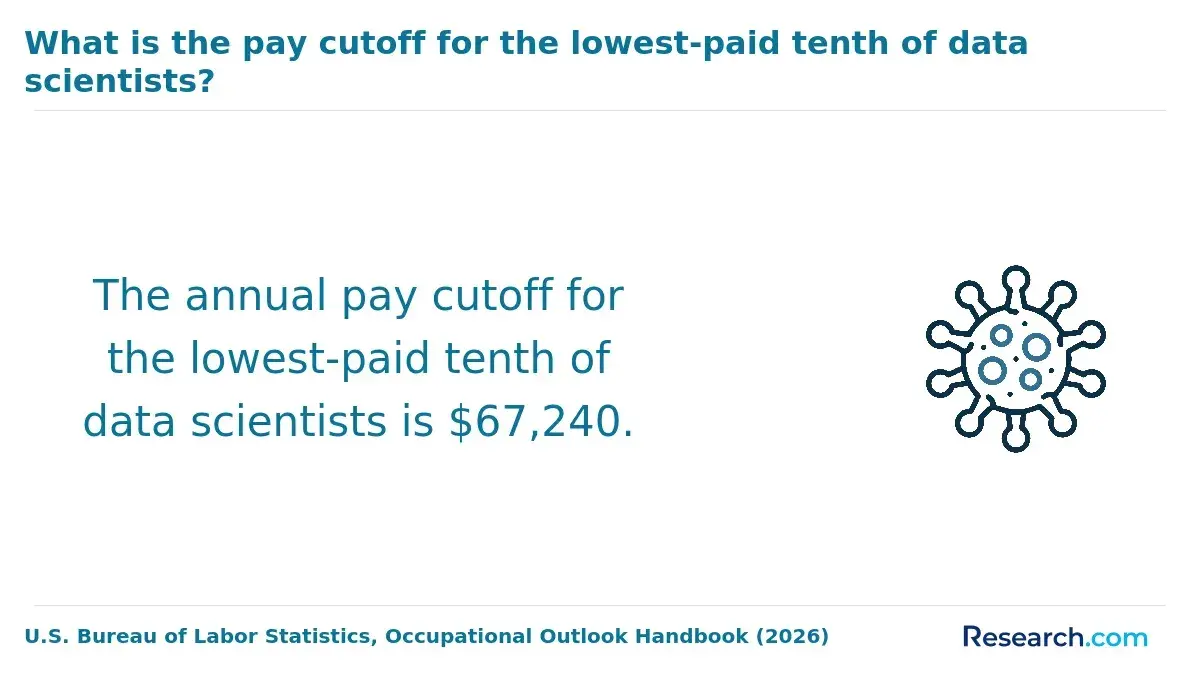
The Bureau of Labor Statistics reports a May 2025 median annual wage of $120,230 for U.S. data scientists. That figure covers the broader occupation, not game analytics specifically, and is not a forecast of any graduate's pay. Use it as labor-market context, not as a return-on-tuition calculation or a reason to assume a game studio will hire you.
How can students evaluate accredited data science programs and capstone quality?
Start by verifying the institution's current accreditation through its official disclosures and the accreditor's records. Accreditation is an important institutional check, but it does not establish that a particular adviser, dataset, or game retention project will be available. Project feasibility needs separate evidence.
Before committing, ask the program for answers to these questions. They distinguish a workable capstone pathway from a promising description with no clear implementation.
- Can students propose a game retention topic, and who approves its scope?
- What examples of completed analytics capstones can applicants review, and what data sources did those students use?
- When are advisers assigned, and what support exists for experiments, longitudinal methods, and data engineering?
- What are the alternatives if a sponsor withdraws, data access falls through, or confidentiality prevents a public portfolio?
A warning sign is a program that advertises industry projects but cannot explain how students obtain data or what happens when a partnership fails. If your priority is broader AI work rather than behavioral analytics, compare the curriculum and total price with lower-cost artificial intelligence degrees online. Choose based on the work you want to demonstrate, not the degree label alone.
Other Things You Should Know About Data Science
No, unless a specific program or project sponsor requires it. Familiarity with game design can help you frame useful questions, but analytical preparation and an achievable data plan are more important.
No. The core deliverable is an analysis of player behavior and its implications. Building a game may create a data source, but it can also consume time better spent on analysis.
Only within the permissions set by the data owner and your program. Ask early whether you can publish a sanitized methodology, synthetic demonstration, or summary that reveals no restricted information.
Not universally. Requirements depend on the role and employer. Review current job descriptions to determine whether the positions you want emphasize graduate research, applied analysis, or production experience.
References
- Video Game Telemetry as a Critical Tool in the Study of... - PMC https://pmc.ncbi.nlm.nih.gov/articles/PMC3776738/
- Data Science in Gaming: Careers and Industry Applications | University of San Diego Online Degrees https://onlinedegrees.sandiego.edu/data-science-in-gaming/
- Data Science Capstone Experience - Purdue Online https://www.purdue.edu/online/data-science/data-science-capstone-experience/
- What Is Privacy-by-Design and Why It's Important? | IEEE Digital Privacy https://digitalprivacy.ieee.org/publications/topics/what-is-privacy-by-design-and-why-it-s-important/
- Transparency by design in data-informed research | sciencedirect.com https://www.sciencedirect.com/science/article/pii/S0267364920300078
- MDS Capstone Guidelines | U-M LSA Department of Statistics https://lsa.umich.edu/stats/masters_students/mastersprograms/data-science-masters-program/mdscapstoneguidelines.html
- MSDS Capstone Projects - College of Information Science https://infosci.arizona.edu/ms-data-science/capstone-projects
- Special Issue on Open Game Data for Games for Impact | IEEE Transactions on Games https://transactions.games/special-issue/special-issue-on-open-game-data-for-games-for-impact
- Projects | Game Analytics Resources https://andersdrachen.com/publications/


