2027 From Seasonal Management to Year-Round Office Work: When Does a BS in Business Administration Make Sense?
Audited and Verified:
Our Editorial and Data Verification Process
Research.com uses government datasets, official education statistics and primary institutional information to support its career and degree guides. Our review process checks factual accuracy, occupational definitions, source dates and the requirements associated with the credentials discussed.
How This Article Was Fact-Checked
Our editorial team verifies salary estimates, employment projections, education requirements and program information against original data providers and official organizations. Salary figures are checked against the relevant occupational definitions and reporting periods. Information about licensure, accreditation and required in-person training is reviewed separately.
Fact-checked and verified on:

Co-Founder and Chief Data Scientist
Managing a seasonal team may have given you experience with schedules, customers, inventory, and budgets - but office employers may not recognize those skills from your job title alone. If you want steadier, year-round work, a BS in Business Administration could help you build missing skills and meet degree requirements.
It could also cost more time and money than your target role requires. This guide helps seasonal managers identify realistic office jobs, compare education with shorter routes, and check whether a program fits the way they earn a living.
Key Things You Should Know
- A BS in Business Administration makes the most sense when your target office jobs require or favor a bachelor's degree and you need broader accounting, operations, or analytical skills - not just a new job title.
- For an adjacent move into scheduling, purchasing support, or office coordination, documented seasonal experience and targeted training may be a faster route than a full degree.
- The U.S. Bureau of Labor Statistics reports a May 2025 median annual wage of $75,940 for human resources specialists; that occupation-wide figure is not an expected starting salary for a seasonal manager changing fields.
What Is a BS in Business Administration?
A Bachelor of Science in Business Administration is an undergraduate degree covering how organizations manage money, people, customers, information, and operations. It can give a seasonal manager a common vocabulary for work already done - such as staffing or purchasing - while adding skills for office-based decisions that continue throughout the year.
The degree name does not guarantee a particular curriculum. A BBA or BA in Business may serve similar goals, while a specialized degree may offer more depth in one function. If human resources is your specific destination, compare HR curricula and career directions rather than assuming a general business degree provides the same preparation.
When Does a BS in Business Administration Make Sense?
Start with the work you want to do after the season ends. A BS is a stronger choice if postings for that work consistently call for a bachelor's degree, you lack transferable college credit or formal business preparation, and you want options across several functions rather than one immediate office opening. It may be especially useful when your seasonal role already includes measurable responsibility but advancement is limited by degree requirements.
A shorter route may make more sense if local employers will consider you now for an adjacent role, such as operations coordinator or purchasing assistant. In that case, translate your experience into evidence: schedules built, vendors contacted, spending monitored, staff trained, and problems resolved. Fill a specific gap - perhaps spreadsheets or bookkeeping - before committing to a degree. If you do need the credential while keeping seasonal employment, examine business administration programs supporting continued employment, then confirm their actual attendance and deadline rules.
What Jobs Can You Get With a Business Administration Degree?
Seasonal management experience often transfers most directly to office roles involving coordination rather than immediate responsibility for an entire department. The table connects likely target roles to evidence an employer can assess; a degree can strengthen an application, but it does not replace role-specific experience.
| Potential role | Typical work | Useful evidence from seasonal management |
| Operations or administrative coordinator | Schedules, records, suppliers, and process follow-up | Staffing plans, documented procedures, and issue resolution |
| Purchasing or inventory assistant | Orders, stock records, and vendor communication | Reorder decisions, inventory tracking, and supplier contact |
| HR assistant or coordinator | Hiring logistics, employee records, and onboarding support | Interview scheduling, training, and careful handling of staff information |
| Project coordinator | Task tracking, meeting notes, and schedule updates | Opening or closing plans, event coordination, and deadline management |
HR work may require deeper knowledge of employment practices than supervising seasonal hires provides. If you already have college credit and want that function specifically, investigate whether you could finish an HR bachelor's using previous college credits. Ask the receiving school which credits satisfy major requirements; accepted electives alone may not shorten the path much.
Common subjects include accounting, finance, marketing, management, operations, statistics, and business communication. For a seasonal manager, the value is not merely recognizing these topics: it is learning to explain a staffing choice, interpret a budget, evaluate a process, and present a recommendation using sound evidence. Check each program's required courses and available electives rather than assuming all BS programs offer the same depth.
Look for assignments that let you demonstrate office-ready work, such as a spreadsheet model, process map, or written recommendation. Use public or fictionalized information unless your employer permits use of workplace data; employee and customer records should not become class materials by default. If project coordination is your goal, compare the program's project coursework with a dedicated pathway - and compare project management bachelor's credit transfer rules if prior college work could affect the choice.
A bachelor's degree commonly takes about four years of full-time study from the beginning, but your remaining time depends on approved transfer credit, course sequencing, and how many courses you can sustain while working. A seasonal schedule may allow heavier study during the off-season and lighter enrollment during peak months. That pattern only works if required courses are offered when you need them.
Ask for an official degree audit and a term-by-term plan showing remaining general education, business core, electives, and any residency requirements. Before choosing a faster format, compare shorter pathways to an online business degree against your peak-season workload. A shorter calendar does not mean fewer required learning hours, and an unavailable prerequisite can delay an otherwise workable plan.
There is no useful single price for this decision without knowing your remaining requirements. Compare schools using written estimates of tuition and required fees for the courses you would actually take. Add books, software, travel or proctoring costs, loan interest, and any income you would give up to attend. For seasonal workers, the timing of payments matters too: tuition may be due during a low-income month even if an employer reimburses it later.
When reviewing the cheapest online business administration degrees, compare estimated completion cost, not advertised per-credit price alone. Ask financial-aid staff how your intended enrollment pace affects aid, and obtain the employer's reimbursement rules in writing before counting on that benefit.
Online study can reduce commuting during a busy season; it does not necessarily let you submit work whenever you have time. Live sessions, group meetings, fixed weekly deadlines, proctored exams, and internships can conflict with unpredictable shifts. Campus study may offer easier face-to-face access to instructors and local employers, but travel and fixed class times can be harder to manage.
Request sample syllabi for courses you would take during peak season and check meeting times, assessment rules, and support hours. Use affordable school choices for online business students as a starting set, then compare scheduling fit as carefully as price. The best format is one you can complete without repeatedly withdrawing when work intensifies.
Schools may ask for a secondary-school credential, transcripts from every prior college, and evidence that applicants meet institutional or business-major requirements. Mathematics or introductory business preparation varies by program. Seasonal employment can strengthen an application or support a credit-for-prior-learning request where offered, but experience does not automatically satisfy a course requirement.
Gather transcripts first, then ask admissions whether you apply directly to the major or enter it after completing prerequisites. If you have prior coursework, request a separate evaluation of how it applies to the degree. Review business administration degree entry requirements to prepare questions, and rely on the school's current catalog and written evaluation for the final answer.
Check the institution's accreditation with the accreditor and confirm that the institution and campus or online offering you plan to attend are covered. Then check any claimed business accreditation - such as AACSB, ACBSP, or IACBE - against the accreditor's listing and its stated scope. Institutional accreditation and business-school or programmatic accreditation answer different questions; neither guarantees a job.
A school's appearance among ranked US college pathways in online business is a reason to investigate, not a substitute for verification. Before enrolling, confirm the exact degree title, current accreditation status, and whether the school's credit and graduation policies work for your plan.
What Salary and Job Outlook Can Business Graduates Expect?
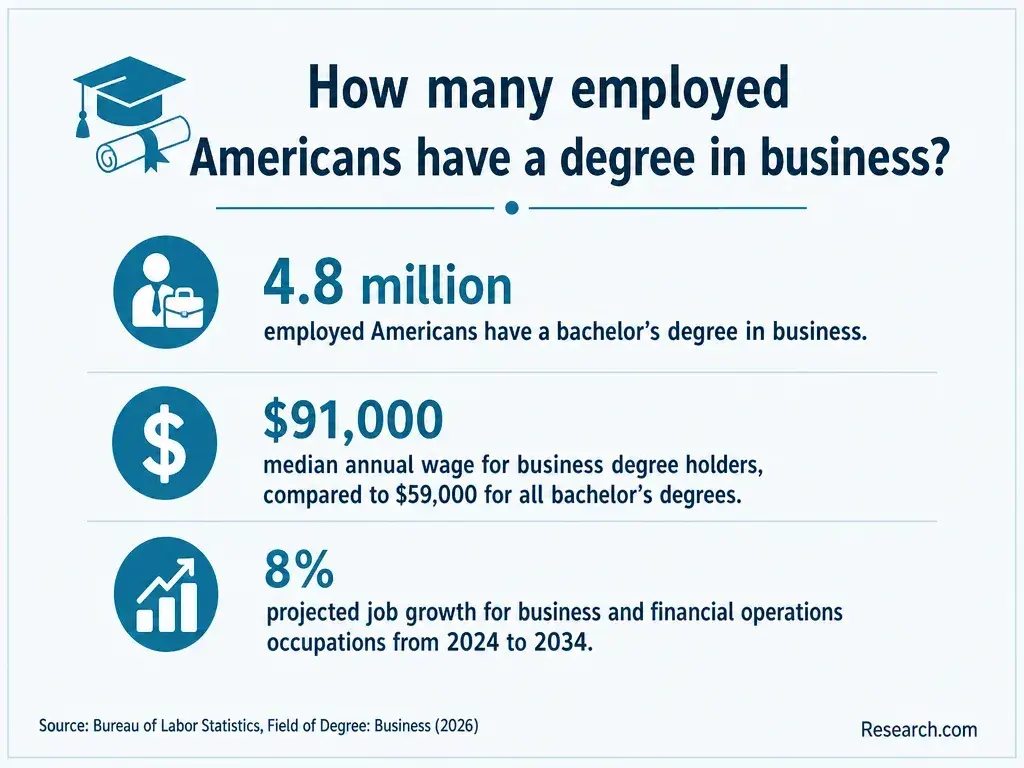
Pay depends on the occupation, location, industry, and experience - not on the degree title alone. For one possible destination, the U.S. Bureau of Labor Statistics reports a May 2025 median annual wage of $75,940 for human resources specialists and projects 6% employment growth from 2025 to 2035. Those figures describe the occupation as a whole, including experienced workers; they are not a salary forecast for someone entering HR from seasonal management.
Use local postings to compare your current qualifications with roles you could realistically seek now and after graduation. If your aim is broader supervisory work rather than a specific business function, shorter online bachelor's pathways in organizational leadership may also be worth comparing. Neither degree substitutes for demonstrated responsibility or an employer's hiring criteria.
Other Things You Should Know About Business Administration
Describe the work, not just the season: scheduling, purchasing, training, recordkeeping, and resolving customer or staff issues. Include accurate scale or results you can substantiate without disclosing confidential information.
Yes. Ask a supervisor who observed your work, confirm their preferred contact information, and remind them which responsibilities are most relevant to your target role.
Only with appropriate permission. Remove private customer, employee, and financial information; if permission is unavailable, create a clearly labeled sample using public or fictional data instead.
No. Hours and security vary by employer and industry. Compare the proposed job's schedule, benefits, contract terms, and advancement opportunities rather than relying on its office setting.
- Seasonal Employment / Part-Time Information | dol.gov https://www.dol.gov/general/topic/workhours/seasonalemployment
- 11 Types of Business Degrees You Can Pursue in 2026 | University of North Dakota https://und.edu/blog/types-of-business-degrees.html
- Equivalences for Education and Experiences | Human Resources https://www.etsu.edu/human-resources/hiring/equivalences.php
- How Much Does a Bachelor's Degree Cost: Factors & Tips | Franklin University https://www.franklin.edu/blog/how-much-does-a-bachelors-degree-cost
- Marketing vs. Human Resources vs. General Business Degree | NMSU Global Campus https://global.nmsu.edu/blog/business-and-marketing/marketing-vs-hr-vs-general-business-degree/
- How Do Transfer Credits Work When You Go Back to School? | Whitworth Online https://online.whitworth.edu/news-articles/how-do-transfer-credits-work-when-you-go-back-to-school/
- 10 Best Business Degrees for High Pay and Career Growth | Pace University New York https://www.pace.edu/news/best-business-degrees-undergrad-grad
- What Can You Do With a Business Administration Degree? | snhu.edu https://www.snhu.edu/about-us/newsroom/business/what-can-you-do-with-a-business-administration-degree
- Business Management vs. Business Administration: Which Degree Is Right for You? | Cal Lutheran https://www.callutheran.edu/programs/articles/business-management-vs-business-administration/
- Business Administration vs. Business Management | devry.edu https://www.devry.edu/blog/business-administration-vs-business-management.html