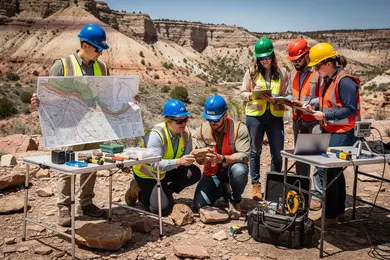
2027 Fastest Accredited Online Geoscience Degree Programs That Accept Transfer Credits

Co-Founder and Chief Data Scientist
Transfer students often have the same question: which accredited online geoscience degree will let previous credits count and shorten graduation? NCES data released in 2024 show that more than half of U.S. college students took at least one distance education course, making online degree completion a mainstream option.
This guide is for students with prior college, military, exam, or workforce learning who want the fastest legitimate route to a geoscience-related bachelor's degree. You will learn how to compare transfer limits, residency rules, accreditation, costs, and realistic timelines before enrolling.
Key Things You Should Know
- The fastest realistic path is usually a regionally accredited online bachelor's program that allows up to 90 semester transfer credits and requires about 30 credits in residence, which can put some well-prepared transfer students within about 12 months of completion.
- SNHU, Fort Hays State University, Arizona State University Online, Oregon State University Ecampus, and University of Florida Online are among the more transfer-relevant accredited options for geoscience, geology, geography, GIS, environmental science, or earth science pathways, but the "fastest" choice depends on which credits apply to the major.
- Do not compare schools only by maximum transfer credits; a program that accepts 90 credits institutionally may still require lab science, upper-division geoscience, field, capstone, or residency credits that determine the actual graduation date.
What Are the Fastest Accredited Online Geoscience Degree Programs That Accept Transfer Credits?
The fastest accredited online geoscience degree programs are usually bachelor's degree-completion pathways in geosciences, geological sciences, geography, GIS, environmental science, or earth science that combine online delivery with generous transfer-credit evaluation. For most transfer students, the best program is not simply the one with the highest transfer cap; it is the one that accepts the most credits into the degree plan, especially general education, math, chemistry, physics, GIS, statistics, and lower-division earth science courses.
The table below compares accredited U.S. online or primarily online options that are relevant to geoscience students. Program names, delivery formats, lab requirements, and transfer evaluations can change, so use this as a decision framework and confirm details directly with the school before applying.
| School | Online geoscience-related option | Why it can be fast for transfer students | Key transfer or completion factor to verify | Best fit |
| Southern New Hampshire University | BS in Geosciences | Accepts up to 90 transfer credits toward a 120-credit bachelor's degree, leaving about 30 credits for students who transfer the maximum applicable amount | Which prior lab science, math, and major electives apply to the geosciences curriculum | Adult degree completers who want a broad online geoscience bachelor's pathway |
| Fort Hays State University | Online geosciences, geography, or GIS-related pathways | Known for online undergraduate delivery and transfer-friendly bachelor's completion policies | Minimum resident credit requirement and upper-division major course availability | Students with community college credits or GIS-related coursework |
| Arizona State University Online | Earth and space exploration or geological sciences-related online pathways | Large online catalog, structured degree maps, and transfer tools can help students see remaining requirements early | Community college transfer caps, lab science sequencing, and upper-division requirements | Students seeking a research university brand and a structured online science pathway |
| Oregon State University Ecampus | Environmental sciences, geography, geospatial, and earth science-related options | Quarter-term structure and year-round course availability can help motivated students maintain momentum | Quarter-credit conversion, major option requirements, and final-credit residency rules | Students interested in environmental geoscience, natural resources, GIS, or spatial analysis |
| University of Florida Online | Geography or earth/environment-related online pathways | Can be efficient for students with strong lower-division preparation, especially those transferring with an associate degree | State articulation rules, upper-division prerequisites, and whether the major matches geoscience career goals | Florida transfer students or students seeking a public university online degree |
If you are still deciding whether geoscience is the strongest long-term academic fit, compare it with other best majors for the future. Geoscience can be valuable, but students should weigh fieldwork expectations, graduate-school plans, GIS skills, and environmental or energy-sector career goals before committing.
These programs are most useful for students who already have 30 to 90 transferable credits. They are less ideal for students who have no prior college credit, need extensive in-person lab or field geology preparation, or plan to enter a career path that strongly favors an on-campus geology curriculum with intensive field mapping.
How Fast Can You Complete an Online Geoscience Degree With Transfer Credits?
A bachelor's degree in the U.S. typically requires about 120 semester credits, or 180 quarter credits. Transfer credits can shorten the path only when they satisfy actual degree requirements, not merely when the institution accepts them as elective credit.
The table below shows realistic timelines for a 120-credit bachelor's program. It assumes the remaining courses are offered online often enough for continuous enrollment and that the student can handle the workload.
| Applicable transfer credits | Credits remaining | Realistic full-time completion | Realistic part-time completion | Main risk to timeline |
| 90 credits | 30 credits | About 9 to 12 months | About 15 to 24 months | Upper-division major or capstone courses may not run every term |
| 75 credits | 45 credits | About 12 to 18 months | About 24 to 30 months | Lab science prerequisites may delay advanced geoscience courses |
| 60 credits | 60 credits | About 18 to 24 months | About 30 to 42 months | General education may be complete, but major sequencing may still take time |
| 30 credits | 90 credits | About 30 to 36 months | About 4 years or more | The student is closer to a traditional transfer path than an accelerated completion path |
| 0 credits | 120 credits | About 4 years | More than 4 years | Acceleration depends on course load, summer terms, exams, and prior learning options |
Students sometimes ask whether a bachelor's degree can be finished as quickly as short-format credentials or an associate degree in 6 months online. For geoscience bachelor's programs, that is usually unrealistic unless the student already has nearly all lower-division and elective requirements completed and needs only a small number of resident credits.
To estimate your own fastest timeline, request an official or pre-admission transfer evaluation and then map remaining courses by term. The most important question is not "How many credits will you take?" but "When are the exact remaining required courses offered?"
How Many Transfer Credits Can You Apply Toward an Online Geoscience Degree?
Many online bachelor's programs allow a maximum of about 60 to 90 semester transfer credits, but geoscience students must look deeper. A school may accept credits as general electives while still requiring specific courses in calculus, chemistry, physics, earth systems, GIS, mineralogy, hydrology, environmental science, statistics, or field methods.
The table below explains the difference between advertised transfer limits and the credits that actually reduce time to graduation.
| Transfer-credit category | How it affects speed | What to ask the school |
| Institutional maximum | Sets the upper limit on credits the university may accept toward the bachelor's degree | What is the maximum number of transfer credits allowed for this specific program? |
| Degree-applicable credits | Directly reduces remaining general education, major, elective, or prerequisite requirements | How many of my credits apply to the geoscience degree, not just to the university? |
| Upper-division major credits | Often determines whether a student can graduate quickly after transferring many lower-division courses | How many upper-division geoscience or GIS credits must be completed at your institution? |
| Science labs and field courses | Can slow completion if prior science courses lacked labs or do not match the program's sequence | Will my prior lab science credits satisfy the major's lab requirements? |
| Elective credits | Helpful only if the degree has open elective space remaining | Will excess transfer credits become unused credits if my electives are already full? |
Before choosing a program, send transcripts from every prior college and ask for a degree audit, not just an admissions estimate. A fast program should show exactly which requirements are complete, which remain, and whether any courses must be taken in a fixed sequence.
For online geoscience degrees, institutional accreditation is the baseline requirement. In the U.S., students should look for regional or nationally recognized institutional accreditation listed by the U.S. Department of Education or the Council for Higher Education Accreditation. This matters because accreditation affects federal financial aid, transferability, employer recognition, and graduate-school eligibility.
Accreditation checks are especially important for accelerated programs because speed should never replace legitimacy. Use the following steps before you apply or pay a deposit:
- Confirm that the institution is accredited by an agency recognized by the U.S. Department of Education or CHEA.
- Verify that the online program is offered by the same accredited institution, not by an unrelated third-party provider using similar branding.
- Check whether the degree name on the transcript will match the advertised online program.
- Ask whether any required labs, field experiences, internships, or proctored exams must be completed in person.
- Confirm that the degree supports your goal, especially if you plan to pursue graduate study in geology, environmental science, hydrology, GIS, teaching, or engineering-related fields.
Unlike some fields, most general geoscience bachelor's programs do not have a single required programmatic accreditor. That differs from more regulated education paths such as online clinical psychology programs, where licensure alignment and programmatic standards can be more central to the decision.
A red flag is any school that emphasizes "fast," "easy," or "life experience degree" language without clearly publishing accreditation, degree requirements, tuition, faculty, course descriptions, and transfer policies. A legitimate accelerated program still requires college-level work and verifiable academic credit.
Online geoscience programs may accept several types of previous learning, but each type is evaluated differently. The best credits for fast completion are those that match specific requirements in the degree plan.
These are the transfer-credit categories most likely to matter for geoscience students:
- Regionally accredited college courses, especially general education, math, statistics, chemistry, physics, biology, environmental science, geology, geography, and GIS.
- Completed associate degrees, which may satisfy lower-division general education requirements at public universities with articulation agreements.
- Advanced Placement, International Baccalaureate, or CLEP exam credit, when the school accepts the exam and score for a specific requirement.
- Military credit evaluated through the American Council on Education, especially technical, mapping, environmental, engineering, or geospatial training.
- Credit for prior learning portfolios, when a school allows students to document college-level learning from professional experience.
- Professional certificates or industry training in GIS, remote sensing, surveying, environmental compliance, data analysis, or related technical areas, if the institution has an evaluation process.
The biggest mistake is assuming all science credits transfer cleanly. For example, a non-lab environmental science course may help with general education but may not replace a required geology lab, chemistry sequence, or field methods course.
Residency requirements are the minimum number of credits you must complete through the degree-granting institution. In many bachelor's programs, the common minimum is about 30 semester credits, even when the school accepts up to 90 transfer credits. Some universities also require a certain number of upper-division major credits, final credits, or capstone credits to be completed in residence.
The table below shows why a generous transfer policy may still leave different students with different timelines.
| Requirement | What it means | How it can slow a transfer student | What to verify |
| Institutional residency | Minimum credits taken at the university awarding the degree | A student with more than 90 transferable credits may still need 30 credits at the school | Minimum resident credits for the bachelor's degree |
| Major residency | Minimum credits in the geoscience major taken at the university | Transferred electives may not replace required upper-division major courses | Number of geoscience major credits that must be completed after transfer |
| Upper-division requirement | Required junior- and senior-level credits | Community college credits may satisfy lower-level courses but not upper-level requirements | How many 300- or 400-level credits remain |
| Capstone requirement | Final project, research, internship, or applied course | Usually cannot be transferred and may be offered only in specific terms | Term availability and prerequisites |
| Lab or field requirement | Hands-on science learning requirement | May require kits, local fieldwork, short campus visits, or approved substitutions | Whether fully online completion is possible |
To avoid delays, ask for a semester-by-semester plan before enrolling. If two schools accept the same number of transfer credits, the faster choice is usually the school with fewer remaining sequenced major courses and more frequent online course availability.
Yes, but these credits help most when they replace specific requirements rather than filling unused elective space. Prior learning and exam credit can be especially helpful for general education, introductory science, statistics, computer applications, technical electives, or GIS-related requirements.
Students with workforce learning should collect documentation before applying. Schools may ask for official score reports, Joint Services Transcripts, ACE recommendations, syllabi, certificates, work samples, supervisor verification, or portfolio narratives.
- Use CLEP or similar exams for general education only after confirming the school accepts the exam for a remaining requirement.
- Submit military transcripts early because technical training may require additional faculty review.
- Ask whether GIS, environmental compliance, remote sensing, surveying, or data credentials can be reviewed for credit.
- Avoid paying for a portfolio assessment unless the school first confirms that portfolio credit can apply to your degree plan.
- Compare the assessment fee with the cost and time of simply taking the course online.
Credit for prior learning is common across career-oriented online education, from technical certificates to a bookkeeping course, but geoscience programs may be stricter because lab, field, and upper-division science outcomes are harder to document through experience alone.
The practical rule is simple: prior learning can speed up graduation, but it should be treated as a bonus after transcript credit, not as the foundation of your completion plan.
Transfer credits can reduce total cost because you pay only for remaining credits, but tuition is not the only expense. Online students may also pay technology fees, lab kit fees, course materials, proctoring fees, graduation fees, and travel costs for any required field or campus experiences.
College Board's 2024 Trends in College Pricing reported published tuition and fees of about $11,610 for in-state students at public four-year institutions and $30,780 for out-of-state students. For transfer students, the key takeaway is that reducing even one full year of remaining credits can materially lower total tuition exposure, especially at out-of-state or private nonprofit rates.
Use the following cost categories when comparing programs:
- Tuition per credit for online students, including whether out-of-state online learners pay a different rate.
- Number of remaining credits after the official transfer evaluation.
- Mandatory online, technology, lab, field, proctoring, transcript, and graduation fees.
- Books, GIS software, field equipment, lab kits, mapping tools, or data-analysis subscriptions.
- Financial aid eligibility, including Pell Grants, federal loans, employer tuition assistance, military education benefits, and scholarships.
- Opportunity cost, especially whether a faster full-time schedule would reduce work hours.
A low per-credit price is not always the cheapest route if the school accepts fewer credits into the major. Conversely, a higher per-credit program may cost less overall if it accepts more degree-applicable transfer credits and offers the remaining courses frequently enough to prevent extra terms.
Fast online degrees can use different academic formats. Geoscience students should be cautious because science programs often require sequenced courses, labs, data analysis, and applied projects that do not always fit pure self-paced models.
The table below compares common online acceleration models and how well they usually fit geoscience degree completion.
| Format | How it works | Speed advantage | Geoscience limitation | Best for |
| Accelerated terms | Courses run in shorter sessions, often 5 to 8 weeks | Students can complete more courses across the year | Heavy science courses may be demanding in compressed formats | Organized students with strong time management |
| Year-round online enrollment | Fall, spring, and summer courses are available | Reduces idle time between required courses | Not every upper-division major course may be offered every term | Transfer students with 30 to 60 credits remaining |
| Competency-based education | Students progress by demonstrating mastery | Can be very fast for experienced learners | Less common for lab-heavy geoscience majors | Students completing general education or applied technical requirements |
| Self-paced courses | Students complete work within a flexible time window | May help with electives or prerequisites | Field, lab, and collaborative projects may still have fixed schedules | Working adults who need scheduling flexibility |
| Traditional online semesters | Courses follow standard academic terms | Predictable pacing and broader course availability | May be slower if required courses are not offered often | Students balancing work, family, and science coursework |
Accelerated online degrees are common in many disciplines, including 1 year MSW programs online no BSW, but geoscience students should not assume the same pacing applies. A compressed social science or professional curriculum may be easier to schedule than a geoscience curriculum with labs, prerequisites, mapping work, and field-based learning outcomes.
The best acceleration strategy is usually a hybrid of transfer credit, summer enrollment, carefully chosen course loads, and early completion of prerequisites. Students who work full time should be wary of taking multiple compressed lab science courses at once.
Are Fast Accredited Online Geoscience Degrees Respected by Employers and Graduate Schools?
A fast online geoscience degree can be respected when it comes from an accredited institution, appears as a legitimate bachelor's degree on the transcript, and includes the skills expected for the student's target path. Employers and graduate schools typically care less about whether coursework was online and more about accreditation, curriculum rigor, relevant experience, technical skills, and fit for the role.
The U.S. Bureau of Labor Statistics Occupational Outlook Handbook updated in 2024 reported a 2023 median annual wage of $92,580 for geoscientists and projected 5% employment growth from 2023 to 2033. This does not mean a bachelor's degree alone will lead to that wage; many geoscientist roles prefer field experience, GIS skills, strong quantitative preparation, or graduate education.
To strengthen the value of a fast online degree, prioritize programs and course plans that build evidence of practical skills:
- GIS, remote sensing, spatial analysis, and data visualization.
- Statistics, Python or R, database work, and environmental data interpretation.
- Hydrology, climate science, soil science, environmental assessment, or energy systems coursework aligned with your career goal.
- Field, internship, research, or capstone projects that produce portfolio-ready work.
- Faculty advising that supports graduate-school prerequisites if you plan to pursue geology, hydrology, environmental science, or geotechnical study.
Common mistake: choosing the fastest available program without checking whether it supports your desired outcome. A broad geosciences degree may be suitable for environmental, GIS, education, or technical roles, while some professional geology or research paths may require more in-person field geology, advanced science, or graduate preparation.
Other Things You Should Know About Geoscience
Some do, and some do not. Programs focused on geology may require field methods, labs, or short in-person experiences, while geography, GIS, environmental science, or earth science pathways may be easier to complete fully online. Always ask whether any requirement cannot be completed remotely.
Some accredited online geoscience degree programs offer accelerated completion through summer sessions, enabling students to finish in 2.5 years instead of the traditional span. These programs often require students to enroll in intensive, short-term courses during the summer.
Often yes, especially for general education courses. However, schools may apply age limits or extra review to science, math, technology, or major courses because content changes over time. Ask whether older credits will apply directly or count only as electives.
Send official transcripts from every college attended, exam score reports, military transcripts if applicable, and syllabi for science, lab, GIS, or technical courses. A syllabus can help faculty determine whether an older or differently titled course matches a required geoscience course.
- Online Geoscience Degrees: Top Schools and All Programs in 2026 https://www.gisdegree.org/online/geoscience-degrees/
- Transferology https://www.transferology.com/
- Southwestern College - Professional Studies https://ps.sckans.edu/news/view/110/
- Transfer credits | Study https://www.uottawa.ca/study/undergraduate-studies/transfer-credits
- Geology (Earth Space Science Secondary Education) with MA in Education https://western.edu/undergraduate/accelerated-geology-education/