2027 DNP Family NP Programs for Nurses in Wyoming: BSN and MSN Entry Routes and Clinical Training
Audited and Verified:
Our Editorial and Data Verification Process
Research.com uses government datasets, official education statistics and primary institutional information to support its career and degree guides. Our review process checks factual accuracy, occupational definitions, source dates and the requirements associated with the credentials discussed.
How This Article Was Fact-Checked
Our editorial team verifies salary estimates, employment projections, education requirements and program information against original data providers and official organizations. Salary figures are checked against the relevant occupational definitions and reporting periods. Information about licensure, accreditation and required in-person training is reviewed separately.
Fact-checked and verified on:

Co-Founder and Chief Data Scientist
A Wyoming nurse considering family nurse practitioner practice needs more than a doctorate with a convenient schedule. The program must match the nurse's existing education, prepare graduates for FNP certification, and provide feasible supervised care across the lifespan. This guide examines the in-state option, BSN and MSN entry routes, clinical placement questions, costs, and the steps between graduation and practice. It is designed to help licensed nurses determine whether a Wyoming DNP FNP program fits - or whether another route would meet their goal with less duplicated study.
Key Things You Should Know
- The University of Wyoming is the principal in-state school to investigate for a DNP family nurse practitioner track; confirm that the track is accepting applicants for your intended term.
- A BSN-to-DNP FNP route prepares an RN for a new advanced practice population focus; an MSN-to-DNP route does not necessarily include FNP preparation.
- Before enrolling, obtain written answers about Wyoming clinical-site approval, total required practice hours, campus attendance, full-program cost, and FNP certification eligibility.
What are DNP Family Nurse Practitioner programs in Wyoming?
A doctor of nursing practice (DNP) FNP program combines graduate preparation for family nurse practitioner care with practice-focused doctoral study. FNP preparation covers primary care for patients across the lifespan. The doctoral component typically emphasizes evidence appraisal, systems improvement, and a practice project. These are postlicensure programs for registered nurses, not routes to an initial RN license.
The distinction between DNP degree and FNP track is decisive: a leadership-focused DNP does not, by its degree title alone, prepare a nurse for FNP certification. Nurses whose actual goal is psychiatric-mental health practice need that population-focus preparation instead; comparing psychiatric NP program costs is useful only after confirming the intended specialty.
Which Wyoming schools offer BSN-to-DNP FNP programs?
The University of Wyoming is the in-state institution prospective BSN-to-DNP FNP applicants should investigate first. Its Fay W. Whitney School of Nursing has offered doctoral NP preparation, but applicants should verify the FNP track's current admission status, entry route, curriculum, and required visits for their proposed start term. Do not assume that every Wyoming school offering nursing degrees also offers an FNP doctorate.
For a nurse willing to enroll outside Wyoming, the comparison expands - but a lower advertised tuition figure is not enough. Use NP programs organized by tuition as an initial screen, then ask each school whether it enrolls Wyoming residents and can approve clinical experiences in Wyoming. Written confirmation matters more than a general claim that a program is "online" or available nationwide.
Can MSN-prepared nurses enter a Wyoming DNP FNP program?
Potentially, but the right route depends on what the MSN prepared the nurse to do. An MSN-prepared, certified FNP seeking a practice doctorate has a different educational gap from an MSN-prepared nurse educator - or an adult-gerontology NP - seeking initial FNP eligibility. A post-master's DNP may develop doctoral competencies without adding a new NP population focus.
Ask the receiving program for a written review of graduate transcripts, advanced assessment, pharmacology and pathophysiology coursework, prior supervised clinical-hour records, and existing certification. The school determines which work applies to its curriculum; the FNP certifying body determines examination eligibility. Prior employment or an MSN degree alone cannot substitute for required FNP clinical preparation. When comparing entry policies, comparing GPA and experience policies for DNP study can help identify questions to take to an admissions adviser, but it cannot establish whether an MSN applicant has an FNP-ready curriculum.
Check three separate issues: the university's institutional accreditation, the scope and status of its graduate nursing program accreditation, and whether the specific FNP pathway satisfies applicable certification and Wyoming practice requirements. Nursing accreditation commonly involves the Commission on Collegiate Nursing Education (CCNE) or the Accreditation Commission for Education in Nursing (ACEN); a school's general accreditation is not a substitute for checking its nursing program.
Confirm the school and program directly with the accreditor, then ask the program which FNP certification examinations its graduates are prepared to pursue. This is especially important when comparing an APRN track with leadership-focused online DNP program comparisons: a doctorate designed without new supervised NP preparation should not be treated as an FNP pathway.
Expect a program to review an appropriate nursing degree, current RN licensure, academic transcripts, professional references, and evidence of readiness for graduate study. It may also specify GPA thresholds, an interview, clinical experience, or requirements tied to a particular application cycle. An MSN applicant should expect an additional review of graduate coursework and the intended FNP entry route.
Ask separately about academic admission and eligibility to begin clinical placements. A site may require background screening, immunizations, documentation, and an approved preceptor even after the university admits a student. Entrance tests associated with prelicensure nursing should not be assumed to apply to a postlicensure doctorate; a guide to admission requirements beyond TEAS and HESI provides context, but the FNP program's current application instructions control.
FNP coursework generally integrates advanced health assessment, pathophysiology, pharmacology, diagnosis, treatment planning, health promotion, and management of common conditions across age groups. Supervised experiences should expose students to the populations and competencies required by the program. DNP study adds evidence-based practice, quality improvement, leadership, and a practice-focused project; it is not the same as a research-focused PhD dissertation.
Check the actual course sequence rather than relying on the degree name. If the desired work is primarily psychiatric-mental health care, FNP training is not a shortcut to that specialty; shorter psychiatric-mental health nursing master's pathways may be more relevant for an appropriately qualified RN. Likewise, an already-certified FNP who wants doctoral leadership skills may not need to repeat initial FNP preparation.
Online coursework can reduce routine travel, but it does not remove live classes, supervised clinical shifts, skills assessments, or possible campus visits. Campus-based study may make faculty contact and scheduled activities easier to anticipate, while requiring more frequent travel. Neither format eliminates the need for approved patient-care sites and faculty oversight.
Request a term-by-term schedule showing synchronous sessions, visit dates, clinical-hour expectations, and who arranges preceptors. This is particularly important for nurses balancing shifts or caregiving: a site's hours may be far less flexible than an asynchronous lecture. Advertised 12-month family NP study schedules should not be mistaken for the expected length or clinical workload of a BSN-to-DNP FNP route.
A BSN-entry doctorate normally requires substantially more study than a post-master's doctorate because it must include initial FNP preparation as well as doctoral work. An MSN applicant's timeline depends on the school's review of prior coursework and practice hours. Published schedules can change with course sequencing, part-time enrollment, and clinical-site availability; request the plan for your entry cohort.
For cost, obtain a full degree audit and an itemized estimate rather than multiplying one semester's tuition. Include mandatory fees, books and technology, background checks, clinical travel, any campus visits, certification and licensing expenses, and income lost to reduced work hours. Compare estimates on the same route and enrollment intensity. Listings of shorter online DNP programs may help frame questions about pacing, but a short post-master's DNP that does not teach FNP competencies is not an equivalent price or timeline comparison.
FNP students need program-approved supervised care with appropriate patients and qualified preceptors. Depending on the curriculum and available sites, placements may include primary care clinics, community health settings, and practices serving children and adults. Rural distance can make access, travel, and exposure across age groups more consequential than the location of online lectures.
Before accepting an offer, ask whether the school identifies sites, assists with placement, or expects students to propose them; who secures affiliation agreements; and how it handles an unavailable preceptor. Ask how direct patient-care hours, simulation, prior graduate hours, and DNP practice hours are counted and documented. An RN job or self-arranged clinic does not become an approved rotation automatically. For MSN-prepared nurses considering a new population focus, post-master's family NP clinical training requirements offer a useful alternative to compare against another full doctorate.
What careers, salaries, and licensing follow a Wyoming DNP FNP?
An FNP may seek primary care roles in outpatient, community, or other appropriate settings, subject to the position's duties and the jurisdiction's practice rules. Completing a DNP does not itself grant NP authority. A graduate must meet the applicable FNP national certification requirements and obtain Wyoming APRN authorization before practicing in that role; employers may impose additional credentialing and onboarding requirements.
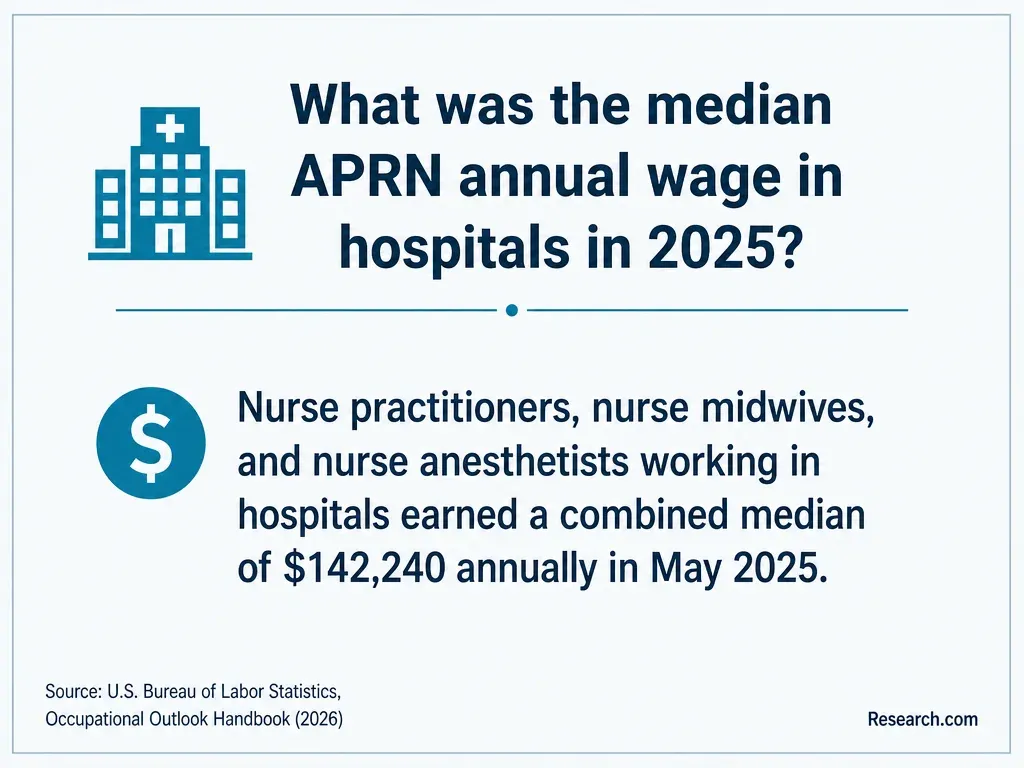
For pay comparisons, use the U.S. Bureau of Labor Statistics nurse practitioner occupation, not a claimed "DNP salary." Occupational medians combine NPs with different degrees, specialties, experience levels, and locations; they cannot predict a new Wyoming FNP's offer. Compare actual local positions, schedules, benefits, and scope of duties with the total cost and time of training. If the goal is FNP practice rather than a doctorate itself, a suitable MSN FNP route may deserve consideration; a BSN-to-MSN program affordability guide is a starting point, provided the specific program includes FNP preparation and meets certification and Wyoming requirements.
Other Things You Should Know About Nursing
It can support teaching applications, especially in clinical education, but faculty roles may require teaching experience, specific graduate preparation, or other employer-defined qualifications.
Not automatically. Check the laws and professional authorization requirements where the patient is located, along with employer and payer rules.
Not necessarily. The school and project site determine the required review, permissions, and privacy safeguards. Do not access patient data before obtaining the necessary approvals.
It may. Federal employment and tribal settings can involve distinct credentialing or jurisdictional arrangements. Confirm the position's requirements with the employer and the relevant licensing authorities.
- WSBN - Education - Wyoming State Board of Nursing https://wsbn.wyo.gov/education
- MSN to DNP: How the post-master's path works and how long it takes | Chamberlain University https://www.chamberlain.edu/blog/msn-to-dnp-how-the-post-masters-path-works-how-long-it-takes-and-what-to-check
- BSN to DNP vs. MSN to DNP: Choosing the Right Doctoral Pathway in Nursing | wayne.edu https://nursing.wayne.edu/news/bsn-to-dnp-vs-msn-to-dnp-choosing-the-right-doctoral-pathway-in-nursing-70065
- Precepting DNP Students FAQs | uwyo.edu https://www.uwyo.edu/nursing/preceptor-info/dnp-precepting-faqs-page.html
- How to Become a Family Nurse Practitioner: A Step-by-Step Guide for RNs | University of the Cumberlands https://www.ucumberlands.edu/blog/how-become-family-nurse-practitioner-step-step-guide-rns
- BSN to DNP vs. MSN to DNP: Which Pathway Works for You? | Herzing University https://www.herzing.edu/blog/bsn-dnp-vs-msn-dnp-which-pathway-works-you
- Clinical Requirements - School of Nursing https://nursing.umn.edu/academics/doctor-nursing-practice/admissions/post-masters-dnp/clinical-requirements
- Federal Regulation & State Authorization | The University of Kansas https://codl.ku.edu/federal-regulation-state-authorization
- Identifying Preceptors and Clinical Sites | Frontier Nursing University https://frontier.edu/identifying-preceptors-clinical-sites/
- Best DNP Programs in Wyoming - 2027 Rankings | RegisteredNursing.org https://www.registerednursing.org/degree/dnp/wyoming/