
2027 DNP Family NP Programs for Nurses in Montana: BSN and MSN Entry Routes and Clinical Training
Audited and Verified:
Our Editorial and Data Verification Process
Research.com uses government datasets, official education statistics and primary institutional information to support its career and degree guides. Our review process checks factual accuracy, occupational definitions, source dates and the requirements associated with the credentials discussed.
How This Article Was Fact-Checked
Our editorial team verifies salary estimates, employment projections, education requirements and program information against original data providers and official organizations. Salary figures are checked against the relevant occupational definitions and reporting periods. Information about licensure, accreditation and required in-person training is reviewed separately.
Fact-checked and verified on:

Co-Founder and Chief Data Scientist
For a Montana nurse considering family practice, the consequential choice is not simply whether to earn a DNP. It is whether a particular Family Nurse Practitioner (FNP) track accepts your current education, can arrange appropriate clinical training where you live, and prepares you for certification and Montana advanced practice licensure.
This guide compares BSN and MSN entry routes, online and on-campus obligations, costs, and career implications so you can identify a workable program before committing time or tuition.
Key Things You Should Know
- A BSN-to-DNP FNP track includes initial NP preparation; an MSN-to-DNP track may or may not include FNP preparation. Confirm the award, population focus, and certification eligibility in writing.
- Online coursework does not eliminate supervised clinical placements, possible campus visits, or DNP practice requirements. The AACN describes at least 1,000 post-baccalaureate practice hours as a DNP preparation benchmark; ask how a program counts yours.
- The U.S. Bureau of Labor Statistics reported a $129,210 median annual wage for nurse practitioners in May 2024. That national, occupation-wide figure is not a Montana FNP salary or a DNP earnings guarantee.
What are DNP Family Nurse Practitioner programs in Montana?
A Doctor of Nursing Practice FNP program combines practice-focused doctoral education with preparation to assess, diagnose, and manage patients across the lifespan in the family nurse practitioner population focus.
It is a postlicensure RN pathway, not a route to initial RN licensure. Montana State University is a Montana-based institution to investigate for DNP FNP study; verify its current track, entry options, clinical geography, and admission term directly with the school rather than assuming every DNP offering leads to FNP certification.
Population focus should drive the decision. FNP preparation is broadly oriented toward family and primary care; it is not interchangeable with psychiatric-mental health NP preparation. If psychiatric care is your actual goal, compare FNP study with lower-cost mental health advanced practice study instead of choosing FNP because a local DNP happens to be available.
What BSN and MSN entry routes are available for Montana DNP Family NP programs?
The entry credential determines whether you need the full FNP curriculum or primarily doctoral-level study. An MSN does not, by itself, establish that its holder is already an FNP.
The comparison below identifies what each route must deliver. Availability and credit awards depend on the individual Montana program and entry term.
| Starting point | Route to investigate | Critical eligibility question |
| RN with a BSN | BSN-to-DNP FNP | Does the track include the full FNP curriculum and qualifying supervised care? |
| RN with a non-APRN MSN | MSN-entry DNP FNP or another FNP-qualifying route | Will the school formally assess missing FNP courses and clinical experiences? |
| Certified FNP with an MSN | Post-master's DNP | Can prior documented practice hours count toward the school's DNP requirements? |
An RN whose highest nursing credential is an associate degree will generally need another academic step before a BSN-entry DNP. ADN-to-MSN bridge programs can be worth comparing, but a bridge's MSN title does not establish that it includes FNP preparation or qualifies its graduate for a particular DNP entry route.
What are the admission requirements for DNP Family Nurse Practitioner programs in Montana?
Expect a program to review your nursing degree and transcripts, active RN license, academic record, relevant practice experience, recommendations, and professional goals. Exact GPA thresholds, experience expectations, interviews, and prerequisite courses are school-specific. Admission to the university is not the same as acceptance into its FNP track or clearance for clinical placement.
If your RN preparation began with an associate degree, obtain a written evaluation showing which bachelor's-level nursing requirements remain. Some RN-to-BSN programs without traditional clinical rotations may help you complete the degree, but their structure does not waive a later FNP program's supervised patient-care requirements.
For an MSN applicant, submit course descriptions, transcripts, certification records if applicable, and documentation of supervised clinical hours. Ask the receiving program for a formal gap analysis: prior employment or a non-APRN MSN cannot automatically substitute for FNP population-focus preparation. Clinical sites may also require background checks, immunizations, and other clearances after academic admission.
"Online" usually describes where didactic courses occur, not where a student completes direct patient care. A Montana nurse may be able to study through an in-state hybrid program or an out-of-state online program, provided the school enrolls Montana residents and can support approved Montana placements. Campus-based study may offer more face-to-face contact but can add commuting obligations.
Before comparing schedules, get written answers about synchronous sessions, required campus or simulation visits, where clinical placements are permitted, and who identifies and approves preceptors. Online FNP programs that provide preceptors are a useful comparison point, but "placement assistance" can mean anything from offering leads to arranging an approved site. Neither format guarantees a nearby placement or an evening-and-weekend clinical schedule.
FNP study typically builds on advanced health assessment, pathophysiology, and pharmacology, then develops lifespan primary-care judgment through supervised patient encounters. DNP work adds evidence appraisal, systems improvement, and an applied practice project. The precise courses, patient populations, and assessment methods belong to the program's published curriculum.
Ask the school to separate faculty-supervised direct patient-care hours from simulation, prior employment, and DNP project or other practice hours. The AACN's DNP benchmark of at least 1,000 post-baccalaureate practice hours does not mean every hour is a new FNP patient encounter, nor does it establish that a certifier will accept every hour. Faculty, clinical sites, and preceptors must approve and evaluate the experiences the program requires.
A DNP project may address a real practice-improvement problem, but access to patient records or organizational data requires site permission and appropriate privacy and oversight review. When comparing DNP practice and project requirements, distinguish a post-master's completion track for an existing APRN from an FNP track preparing someone for a new advanced practice role.
A BSN-entry student generally has more FNP coursework and supervised training to complete than an already-certified MSN-prepared FNP. An MSN-entry nurse without FNP preparation may still need substantial specialty coursework and clinical care.
Published completion times can change with course sequencing, part-time enrollment, placement availability, and project progress; online DNP completion time options are not substitutes for a term-by-term plan for your specific track.
Compare each school's written estimate using the same assumptions: tuition charged per credit or term, total required credits, mandatory fees, likely travel and lodging, clinical-site expenses, and the cost of reducing paid work. Request separate estimates for BSN-entry and MSN-entry study. A quoted post-master's completion price may omit the FNP education a non-APRN MSN graduate still needs.
Employer Confidence in Online vs. In-Person Degree Skills, Global 2024

Check three different matters: the university's institutional accreditation; the nursing program's accreditation and the scope of the accredited degree, such as through CCNE or ACEN where applicable; and the program's ability to provide education leading toward the intended certification and Montana practice authorization. Accreditation is not an individual license, and a school's authorization to enroll a Montana student does not alone settle clinical-placement or licensure eligibility.
Ask admissions to identify the exact FNP track covered by its published accreditation information and to explain eligibility for your entry term and clinical location. Apply the same checks if considering master's nursing education on a BSN graduate's budget as a less costly alternative to a DNP; a lower price is useful only if the specific curriculum meets your FNP goal.
A graduate needs more than a DNP diploma to practice as an FNP. The usual sequence involves maintaining an appropriate RN license, completing an FNP-qualifying graduate program, meeting a national certifier's eligibility requirements, passing an FNP certification examination, and obtaining Montana APRN licensure through the Montana Board of Nursing.
The American Nurses Credentialing Center and the American Academy of Nurse Practitioners Certification Board offer FNP certification pathways; applicants should check the current requirements of the certifier they select.
Montana practice authority, prescribing requirements, and any additional authorization must be confirmed with the board before practice begins. A multistate RN privilege does not itself confer APRN authority. Likewise, an FNP credential does not automatically authorize practice in a different NP population focus.
An FNP considering psychiatric practice should investigate a qualifying route, such as those discussed in an online PMHNP certificate program guide, and obtain the required certification and state authorization before changing roles.
FNPs may work in primary-care clinics, community health centers, rural health settings, and other services that need lifespan-focused care. Actual duties, patient mix, onboarding, and available physician or specialist consultation depend on the employer and setting. A new FNP should evaluate mentorship and workload as carefully as the job title.
The U.S. Bureau of Labor Statistics' May 2024 $129,210 median annual wage for nurse practitioners is a national figure covering NP specialties and education levels. It cannot predict a Montana offer or isolate a DNP pay premium.
Compare local offers using compensation, benefits, call expectations, travel, patient volume, and orientation, not degree title alone. If the position does not require a doctorate, lower-cost online NP degree options may offer a more proportionate route, subject to the same clinical and credential checks.
How strong is demand for Family Nurse Practitioners in Montana?
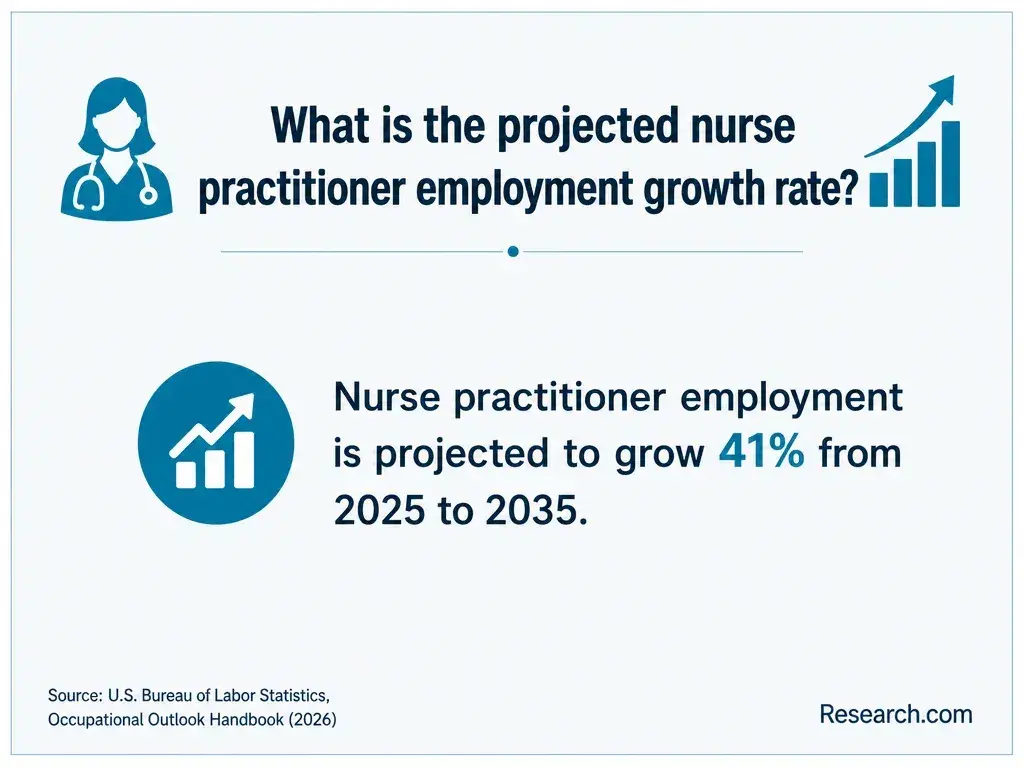
Montana's rural communities and travel distances make access to primary care an important workforce consideration, but statewide need is not the same as a funded FNP vacancy in a location where you can work. National BLS projections indicate strong growth for nurse practitioners; those projections cover the occupation, not Montana FNP openings or individual hiring prospects.
Test demand against actual employers in your preferred region. Compare posted population-focus requirements, experience expectations, schedules, and support for new NPs, then ask prospective schools about approved clinical sites in that area.
Demand should not push a nurse into an unrealistically compressed route: 12-month FNP coursework and clinical expectations deserve close scrutiny for placement feasibility and certification eligibility, especially when balanced against RN employment.
Other Things You Should Know About Nursing Programs
Often, yes, but ask for the expected weekly clinical schedule by term. Supervised placements may run during ordinary clinic hours even when lectures are online, making full-time RN work difficult during some rotations.
Not automatically. The program must approve the site, learning activities, supervision, and documentation. Work performed in an RN role is not necessarily supervised FNP education.
Not automatically. Each state determines APRN authorization under its own rules. Check the destination state's nursing board and any applicable certification requirements before relocating or providing care to patients there.
Usually not to continue practicing solely because of the degree title. Consider a post-master's DNP if its practice-improvement, leadership, or academic preparation serves a specific goal and justifies the cost and time.
- The request for a clinical placement in Montana must include | mt.gov https://rules.mt.gov/policy-library-documents/text/html/d1155a66cc1a9451f10d42fde506776640ead4dd9ad6e4ec448fe5966645a898
- Family Nurse Practitioner - UW School of Nursing https://nursing.uw.edu/academics/dnp/fnp/
- How to Become a Family Nurse Practitioner: Education and Licensure Path | The University of Scranton https://gradadmissions.scranton.edu/blog/articles/healthcare/family-nurse-practitioners-certifcation-and-licensure.shtml
- Online MSN Nurse Practitioner specializations | Capella University https://www.capella.edu/online-nursing-degrees/msn-np-nursing-program/
- BSN to DNP Family Nurse Practitioner - OU College of Nursing https://nursing.ouhsc.edu/programs-academics/doctor-of-nursing-practice/bsn-to-dnp-family-nurse-practitioner
- Family Nurse Practitioner, MS | Pace University New York https://www.pace.edu/program/family-nurse-practitioner-fnp-ms
- DNP Family Nurse Practitioner Option | Montana State University https://www.montana.edu/nursing/graduate/DNP_FamilyNursePractitionerOption.html
- Best Online DNP Programs for Montana Students (2027) | RegisteredNursing.org https://www.registerednursing.org/degree/dnp/montana/


