
2027 Data Science Master's vs. a Company Rotation Program for Business Professionals

Co-Founder and Chief Data Scientist
A data science master's can build technical depth and a portable credential; a company rotation program can provide paid experience solving problems across an employer's teams. For business professionals, the better choice depends on whether the goal is to become a technical data scientist, move into an analytics-focused business role, or advance within the current company.
This comparison shows what to verify about each opportunity before committing time or money.
Key Things You Should Know
- Choose a master's when you need structured preparation in statistics, programming, and modeling that your current job cannot provide.
- Choose a rotation when it offers substantial analytical work, strong mentorship, and a credible path to the role you want - especially if you can remain employed while learning.
- Data scientist employment is projected to grow 35% from 2025 to 2035, according to the U.S. Bureau of Labor Statistics (BLS), but that forecast does not establish which pathway will get an individual hired.
What is the difference between a data science master's and a company rotation program?
A data science master's is a graduate degree with defined academic requirements. A company rotation program is an employer-run arrangement that moves participants among teams or assignments; its duration, selection rules, and learning objectives depend on the employer. The distinction is not simply classroom learning versus practical learning: many degrees include applied projects, while some rotations offer formal training.
The comparison below focuses on what each pathway is designed to provide. Individual programs may differ substantially.
| Decision factor | Data science master's | Company rotation program |
| Primary benefit | Structured technical education and a graduate credential | Exposure to business functions, internal networks, and employer-specific work |
| Technical depth | Depends on required courses and projects | Depends on actual assignments and mentorship |
| Portability | Degree remains with you when you change employers | Experience can transfer, but internal relationships and systems knowledge may not |
| Financial arrangement | Tuition and fees, potentially offset by aid or employer support | May be part of paid employment; compensation and eligibility vary |
For a business professional, the decisive question is what work the rotation actually includes. A placement that primarily involves reporting or observing teams is not equivalent to building models, evaluating results, and explaining decisions to stakeholders.
Which option offers better data science career preparation?
For a technical data scientist role, a rigorous master's is generally the better way to address major gaps in mathematics, coding, and model evaluation. A rotation may be stronger for someone who already has those skills and needs production experience, business context, and colleagues who can assess their work. Neither option replaces evidence that you can solve relevant problems.
Business professionals often bring valuable skills: framing decisions, understanding customers or operations, working with stakeholders, and communicating trade-offs. A degree can add the technical methods needed to test those decisions. A rotation can show how analytical work survives budget constraints, imperfect data, and organizational review.
Choose by target role rather than by program label. For business analytics or product analytics, an analytically substantial rotation may be a direct route. For roles requiring independent statistical modeling or machine learning, inspect the master's required courses and the rotation's assignments before assuming either provides adequate depth. The strongest evidence from either route is work you can explain: the question, data limitations, method, evaluation, and business decision.
What are the admission requirements for a data science master's program?
Requirements vary by institution. Applicants generally need to check the program's published degree, mathematics, programming, transcript, and application-material rules rather than assume business experience either qualifies or disqualifies them. Preparation that helps you succeed is not necessarily a formal prerequisite that an admissions office will accept.
Before applying, compare your background with each program's stated requirements. Ask whether prior coursework must appear on an official transcript, whether professional coding work can demonstrate readiness, and whether prerequisite courses may be completed after admission. Some applicants also prioritize essay-free application options for an ML master's, but a simpler application does not imply lighter technical coursework.
A common mistake is treating a program's willingness to admit applicants from varied majors as proof that its first statistics or programming course is beginner-level. Review course descriptions and, if possible, sample assignments before enrolling.
What do you learn in a data science master's curriculum?
Curricula vary, but the most relevant courses for this decision are those that teach a business professional to work independently with data: programming, data management, statistical inference, predictive modeling, and evaluation. Applied projects matter because they test whether you can connect technical choices to a defensible business recommendation.
Look beyond a course titled "machine learning." Determine whether the program requires students to prepare messy data, select a baseline, guard against data leakage, assess model performance, and communicate limitations. If your aim is analytics leadership rather than model development, coursework in decision-making, experimentation, and responsible use of data may be at least as important as advanced electives.
Compare these requirements with what the rotation would teach on the job. If your intended work centers on AI rather than broader data science, matching an AI degree to your professional goals can help you distinguish a relevant specialization from a credential chosen mainly for its name.
How do online and campus-based data science master's programs compare?
Delivery format changes access and scheduling, not the importance of curriculum quality. An online program may let you keep working and apply new methods immediately; a campus-based program may make in-person collaboration and recruiting more accessible. Neither format establishes how much direct instruction, feedback, or project support you will receive.
Ask about live attendance, time zones, group meetings, exams, access to computing resources, and whether any campus visits are required. Compare the workload against the hours a rotation would demand, especially if you are considering doing both. For professionals with a firm deadline, accelerated AI master's program options may be worth comparing, provided the pace leaves enough time to master the required technical work.
How long does each pathway take, and what does it cost?
There is no reliable universal duration or price for either pathway. A master's timeline depends on credits, course availability, and enrollment pace; a rotation depends on the employer's schedule and placements. Obtain written details for the specific opportunities you are comparing rather than using a degree's advertised minimum completion time or assuming a rotation has no financial cost.
Build a like-for-like comparison of what you will pay, earn, and give up. These are the cost categories to check before accepting either offer:
- Master's: Tuition, mandatory fees, materials or computing costs, travel if required, financing costs, and income lost if you reduce work hours.
- Rotation: Compensation changes, relocation or travel expenses, required training, and the opportunity cost of delaying another role or promotion.
- Offsets: Scholarships, employer tuition assistance, paid study time, or reimbursed rotation expenses - subject to eligibility and repayment conditions.
Do not treat a future data scientist salary as the financial return caused by either pathway. Your existing pay, target role, location, and probability of making the transition all matter. If tuition is the limiting factor, compare the full cost of eligible programs rather than tuition alone; cost-conscious artificial intelligence study options may provide an additional comparison if an AI-focused degree fits your goal.
How can you verify a data science program's accreditation and quality?
Verify that the institution holds recognized institutional accreditation through the accreditor's directory or the U.S. Department of Education's accreditation database. Then evaluate the specific program: accreditation of an institution does not, by itself, establish the depth of a data science curriculum or the quality of its career support. If studying online from another state, confirm that the institution can enroll you where you live.
Ask for the current catalog requirements, instructor qualifications, examples of substantial student projects, and evidence behind any employment claims. For a rotation, request the assignment plan, selection criteria for placements, expected mentors, and how final-role decisions are made. A vague promise of "exposure to data science" is a red flag when you need hands-on technical experience.
What data science jobs and salaries can each pathway lead to?
Possible destinations include data scientist, business or product analyst, analytics manager, and analytics-focused roles within your existing function. A master's may help demonstrate technical preparation to employers beyond your current company; a rotation may position you for an internal role where your business knowledge is already valued. Job titles alone are unreliable - compare the work and technical expectations in actual postings.
The BLS reports a $120,230 median annual wage for U.S. data scientists in May 2025. That occupational median describes workers across experience levels and employers; it is not an entry-level offer, a graduate outcome, or the salary increase attributable to a master's or rotation.
Industry knowledge can also shape the destination. A professional aiming to apply analytics in clinical or health-system settings, for example, may want to compare healthcare-focused career paths through an AI master's with opportunities to gain supervised, domain-specific experience at work.
What is the job outlook for data science and analytics careers?
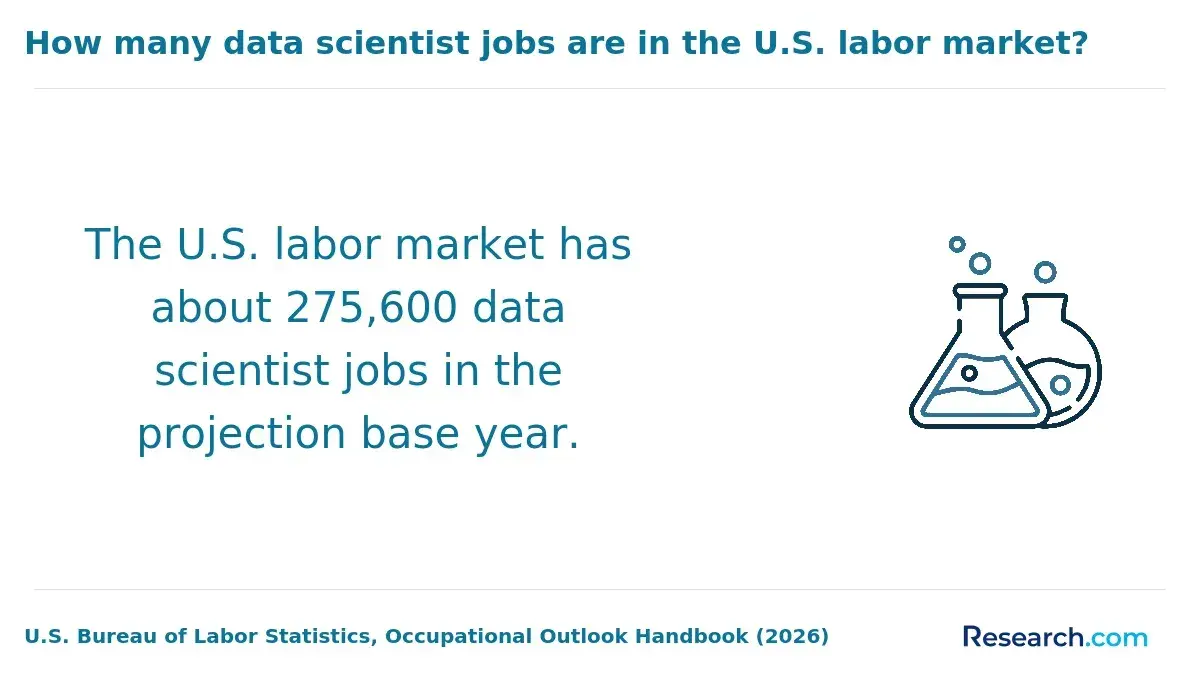
The BLS projects about 24,800 U.S. data scientist openings per year on average from 2025 to 2035, including openings created when workers change occupations or leave the labor force. That signals a substantial national market, but it does not indicate how many openings are suitable for a business professional changing fields or available in a particular location.
Use the outlook as context, then examine current postings for your target role. Note which require statistical programming, experimentation, deployed models, or domain experience. Rapidly changing AI tools make this especially important: choose the pathway that teaches you to evaluate outputs and make sound decisions, not merely to use a named tool.
Do data science careers require licenses or professional certifications?
Data scientist roles generally do not have a single, occupation-wide professional license. Particular jobs can still impose employer, industry, security, or regulatory requirements. Check the rules attached to your intended role rather than assuming a master's or an internal rotation satisfies them.
Optional certifications can document familiarity with a tool or platform, but they are not substitutes for the degree's technical coursework or a rotation's demonstrated work. Before paying for one, check whether the employers and roles you want actually request it.
Other Things You Should Know About Data Science
Possibly, if both schedules allow it. Confirm whether rotations require travel or changing work hours, and whether your degree courses have live sessions or group deadlines. Employer tuition assistance may also have eligibility rules.
Only with your employer's permission. Confidential data, code, and business results may be restricted. Ask whether you can publish an approved, anonymized description of your methods or build a separate project using public data.
Not automatically. A university must approve any academic credit under its own policies. Ask about prior-learning assessment or internship credit before assuming workplace assignments will shorten a degree.
Ask whether you can take on a defined analytics project with a data team, including a mentor and deliverables. That can help you test your interest and identify skill gaps before deciding whether to apply for a master's or seek a role elsewhere.
References
- MS Data Science - Notre Dame financial aid https://financialaid.nd.edu/apply-or-renew/graduate-students/graduate-program-costs/ms-data-science/
- 13 Top Data Science Careers: Key Insights | Syracuse University https://ischool.syracuse.edu/data-science-careers/
- 15 Transferable Skills That Work Across Industries | CityU of Seattle https://cityu.edu/transferable-skills/
- What preparations do I need for graduate education? | Statistics & Data Science Graduate Interdisciplinary Program https://stat.arizona.edu/what-preparations-do-i-need-graduate-education
- Program: Statistics and Data Science, MS - UH Publications https://publications.uh.edu/preview_program.php
- Top Transferable Skills Employers Want Across Industries | Missouri Baptist University Online https://online.mobap.edu/about/news/essential-transferable-skills-for-modern-career-success/
- MS in Data Science: Graduate Program | rochester.edu https://www.hajim.rochester.edu/dsc/graduate/ms.html
- What You Can Do with a Master's in Data Science and Artificial Intelligence | Harvard Extension School https://extension.harvard.edu/blog/what-you-can-do-with-a-masters-in-data-science-and-artificial-intelligence/
- What Can You Do With a Master's in Data Science? | WU https://willamette.edu/academics/computing/data-science/career-options
- Five-Step Career Decision Making Process | Yale University https://ocs.yale.edu/blog/2022/12/11/explore-five-step-career-decision-making-process/


