2027 Data Science Master's Programs for Professionals Seeking Experimentation Leadership

Co-Founder and Chief Data Scientist
Choosing a data science master's for experimentation leadership means looking beyond a program's title. Professionals who want to lead product tests, policy evaluations, or other evidence-based decisions need training in causal inference, experimental design, and communication - not just predictive modeling. This guide shows how to assess those capabilities, weigh a degree against your existing experience, and identify the program features worth confirming before you apply.
Key Things You Should Know
- Prioritize programs where experimental design and causal inference appear in substantial coursework and applied projects, not only in a course description.
- For working professionals, access to relevant projects, faculty feedback, and a workable schedule may matter more than whether a program is online or campus-based.
- The U.S. Bureau of Labor Statistics projects 35% growth in data scientist employment from 2025 to 2035, but that occupation-wide forecast does not predict openings in experimentation leadership or a graduate's promotion prospects.
What Is a Data Science Master's Degree for Experimentation Leadership?
It is a data science master's selected and shaped around a particular responsibility: deciding whether an intervention caused an outcome, then helping an organization act on the evidence. That intervention might be a product feature, a marketing offer, an operational change, or a clinical workflow. The relevant degree could be called data science, statistics, analytics, or a related field; its coursework and projects are more informative than its name.
Experimentation leaders do more than run A/B tests. They help define the decision, choose meaningful outcomes, assess whether randomization is feasible, anticipate bias and unintended effects, and explain uncertainty to stakeholders. A program dominated by model-building may be a poor fit if it offers little opportunity to practice those tasks. Professionals comparing adjacent credentials can also consider advanced degree options in data analytics, provided they examine the same causal-methods and project evidence.
What Career Paths Can Data Science Master's Graduates Pursue?
Relevant paths include experimentation scientist, product data scientist, causal-inference specialist, measurement lead, and analytics manager. Job titles are inconsistent: two employers may use "data scientist" for substantially different work. Read the responsibilities for ownership of study design, interpretation, and decisions rather than relying on the title.
A professional already working in product, marketing, operations, or healthcare may be able to combine domain judgment with new statistical skills. For example, healthcare innovation work can involve evaluating whether a workflow change improves outcomes while protecting sensitive information. Professionals pursuing that setting can compare graduate AI training for healthcare innovation careers with programs offering stronger experimental-design preparation; the better choice depends on whether the target work centers on building AI systems or evaluating interventions.
A master's is not automatically required to lead experiments. If you already design sound studies and influence decisions, a stronger project portfolio or a change in responsibilities may be the more direct next step. A degree becomes more compelling when you need sustained training in statistics, causal methods, and research practice that your current role cannot provide.
How Much Do Data Science Professionals Earn After Graduate School?
The U.S. Bureau of Labor Statistics reports a $120,230 median annual wage for data scientists in May 2025. That is a wage for the occupation as a whole, not a starting salary, a master's-graduate outcome, or a measure of pay for experimentation leaders specifically. Prior experience, management scope, industry, and location can all affect an individual offer.
When judging a program's potential financial value, compare its full cost with a realistic change in roles or responsibilities - not the occupational median. If a school publishes graduate salaries, check who responded, whether respondents had substantial experience before enrolling, and whether the figure represents salary level or salary increase. For more context on variation across employers, see a guide to industry-specific data science salaries.
What Skills Does an Experimentation-Focused Data Science Curriculum Teach?
The strongest fit combines statistical foundations with practice making decisions under imperfect conditions. Prospective students should look for randomization, power and sample-size reasoning, hypothesis testing, causal inference, observational-study design, data engineering, and clear reporting of uncertainty. Coding in tools such as Python, R, and SQL supports that work, but tool proficiency alone does not establish experimental judgment.
Course listings can signal very different levels of preparation. This distinction helps separate substantive training from a passing mention of experimentation.
| Curriculum evidence | What it may indicate | Remaining uncertainty |
| Topic mentioned in a general course | Introductory exposure | Whether students design or critique a study |
| Dedicated experimental-design or causal-inference course | Room for sustained methodological work | Whether the course includes messy data and implementation constraints |
| Advanced elective plus applied project | Potential to develop and demonstrate depth | Whether the elective runs when needed and the project permits a relevant topic |
A useful project should specify the intervention, comparison group, outcome, assumptions, analysis plan, and consequences of a mistaken conclusion. It should also show how findings would be communicated to someone deciding whether to scale, revise, or stop the intervention. Ask for recent syllabi and project examples rather than assuming a course title proves that depth.
What Are the Admission Requirements for Data Science Master's Programs?
Requirements vary by institution. Programs may ask for evidence of quantitative preparation, programming ability, academic readiness, and relevant professional goals; particular prerequisite courses, tests, or work experience must be checked against each program's current admissions policy. Experience conducting business experiments can strengthen an application, but it does not necessarily satisfy a formal mathematics or computing prerequisite.
Before applying, compare your transcript and work against published requirements. If calculus, linear algebra, probability, or programming is a gap, ask whether a graded course, approved foundation course, or other preparation is accepted for admission. AI master's programs with prerequisite preparation illustrate an adjacent route for applicants considering AI as well, but any bridge option must be verified for the specific degree you intend to enter.
How Long Do Data Science Master's Programs Take and What Do They Cost?
Completion time and cost depend on required credits, course availability, enrollment pace, and institutional charges. Without a specific program and current tuition schedule, a reliable total cannot be stated. For a working professional, the important comparison is the cost and time of a feasible path to graduation - not an advertised fastest completion time that assumes full-time study.
Build an estimate using the school's current published rates and your intended schedule. Include tuition, mandatory fees, required materials or technology, and any travel for campus sessions; then account for possible tuition increases, financing costs, and time away from paid work. Ask whether key methods courses run often enough for part-time students and whether an employer's tuition benefit covers the program. A lower tuition quote can be misleading if it excludes mandatory charges or requires a pace you cannot maintain.
Are Online or Campus-Based Data Science Master's Programs Better for Professionals?
Neither format is inherently better for experimentation leadership. Online study may preserve work continuity and let you test methods in your existing setting. Campus study may offer easier access to faculty, peers, and research activities. The decisive question is whether the format lets you complete rigorous methods courses and a relevant project while meeting your professional obligations.
For online programs, confirm live-session times, group-work expectations, exam rules, faculty access, project supervision, and any required campus visits. For campus programs, check course meeting times and whether essential electives conflict with work. Professionals who need scheduling flexibility can start with online data science master's options for professionals, then verify each program's actual timetable and project arrangements.
How Can Professionals Verify Data Science Program Accreditation and Quality?
First, confirm that the institution holds recognized institutional accreditation through the U.S. Department of Education or the Council for Higher Education Accreditation. Then verify the degree in the institution's current catalog and check any state authorization relevant to where you will study. Institutional accreditation is an important baseline, but it does not by itself establish that a particular curriculum teaches experimentation well.
Quality evidence for this goal is more specific: current syllabi, faculty expertise in experimental or causal methods, access to appropriate electives, project supervision, and examples of student work. Ask whether part-time students can actually take the advertised courses and whether employer-based projects are permitted. Treat an impressive course list without clear availability or applied work as a reason to investigate further, not proof of fit.
What Is the Job Outlook for Data Science and Experimentation Leadership Roles?
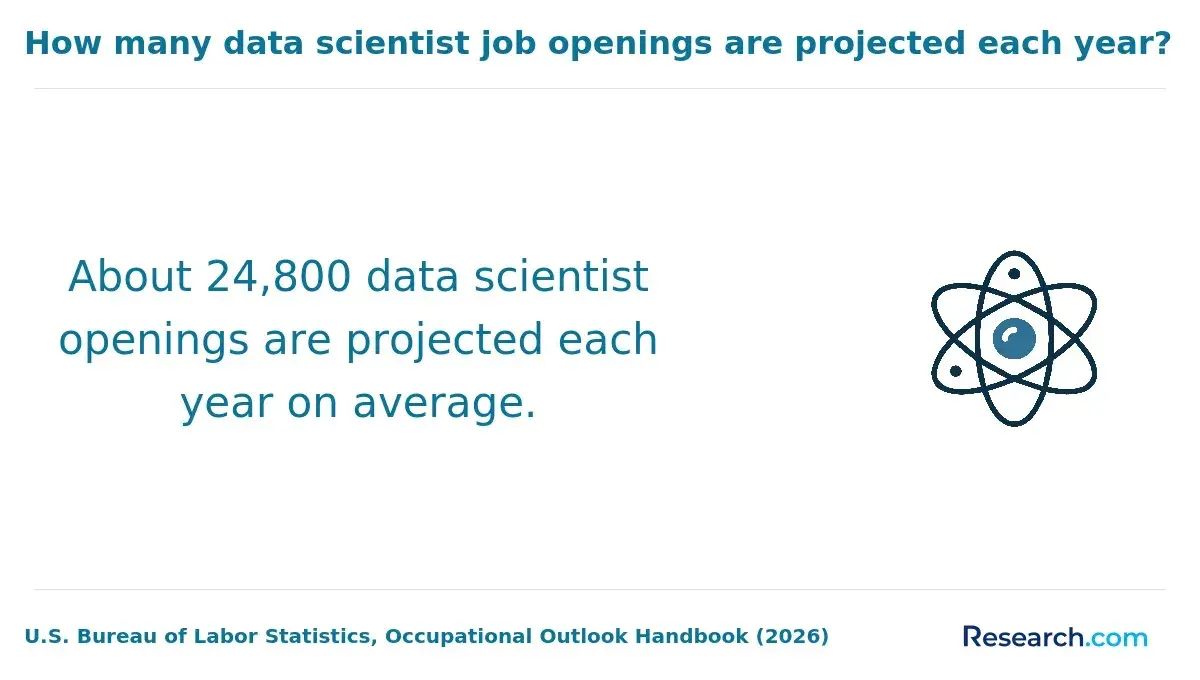
The Bureau of Labor Statistics projects about 24,800 data scientist openings per year, on average, from 2025 to 2035. Many are expected to replace workers who leave the occupation or workforce. This supports investigating data science as a career field, but it does not isolate experimentation roles, measure demand for master's degrees, or guarantee openings at a desired seniority level.
AI and automation can change how teams generate analyses, making the human responsibilities of choosing valid comparisons, checking assumptions, and interpreting effects especially relevant to this career goal. Assess current job postings for those responsibilities alongside technical requirements. A program is a better match when it prepares you to defend a decision, not merely produce an analysis faster.
Do Data Science Leaders Need Professional Certifications or Licenses?
There is no general U.S. professional license for data science or experimentation leadership. An employer may value a certification in a particular platform, but it should not be confused with authorization to practice or with demonstrated ability to design valid studies. Regulated settings can impose separate requirements on the underlying work, data, or licensed professionals involved; those rules depend on the role and jurisdiction.
If you are choosing between a degree and a certification, match the credential to the gap. A short credential may help with a specific tool. A master's is more relevant when you need broad, assessed preparation in statistical reasoning, causal methods, and applied research - provided the program actually delivers it.
Other Things You Should Know About Data Science
Possibly, but obtain employer approval and confirm the university's rules before committing. Confidentiality, privacy, data ownership, and publication restrictions may require a de-identified dataset or a different project.
Experimentation expertise remains useful. You may need an observational or quasi-experimental design, with explicit assumptions and careful discussion of what the evidence cannot establish.
Choose based on the work you want to demonstrate. A thesis may suit deeper methodological research; an applied capstone may better show how you frame a decision and work within operational constraints. Confirm the available supervision and project scope.
No. Leadership can mean setting study standards, coordinating stakeholders, and influencing decisions without direct reports. Management experience matters more when the target role explicitly includes hiring, supervision, or team strategy.
References
- Healthcare data scientist qualifications, skills, and job focus | nih.gov https://pmc.ncbi.nlm.nih.gov/articles/PMC7787353/
- Virtual and Hybrid Programs | Texas Education Agency https://tea.texas.gov/curriculum-and-instruction/learning-support-and-programs/virtual-and-hybrid-education/virtual-and-hybrid-programs
- Research Your Options: U.S. Online Learning | EducationUSA https://educationusa.state.gov/your-5-steps-us-study/research-your-options/online-learning
- Types of Financial Aid: Grants, Work-Study, and Loans | studentaid.gov https://studentaid.gov/understand-aid/types
- Automated causal inference in application to randomized controlled clinical trials | Nature Machine Intelligence https://www.nature.com/articles/s42256-022-00470-y
- Paying for Your MBA: Scholarships, Employer Benefits and Loans | Jenkins MBA https://mba.ncsu.edu/2026/05/07/paying-for-your-mba-scholarships-employer-benefits-and-loans/
- Admission Requirements | uw.edu https://bime.uw.edu/bime-admission-requirements/
- Graduate/Professional College Financing Plan | Academic Affairs https://uwm.edu/finances/finances/consumer-information/graduate-college-financing-plan/
- What Is a Capstone Project? - Boston University Questrom https://www.bu.edu/questrom/blog/what-is-a-capstone-project/
- Admissions | Statistics & Data Science Graduate Interdisciplinary Program https://stat.arizona.edu/admissions