
2027 Choosing an Online Data Science Master's for a Career in Telehealth

Co-Founder and Chief Data Scientist
Choosing an online data science master's for a telehealth career means looking beyond the degree title. A program may teach excellent machine learning yet offer little practice with clinical data, patient privacy, or the decisions telehealth teams actually make.
This guide is for prospective students comparing programs, including healthcare professionals moving into analytics. It explains which coursework and projects matter most, how to check practical fit and cost, and when a broader data science degree may be enough.
Key Things You Should Know
Key Things You Should Know
- Prioritize statistical and machine learning depth alongside healthcare data, privacy, and a project grounded in a telehealth problem; a healthcare-themed course title alone is weak evidence of preparation.
- Verify institutional accreditation and compare total required costs, not tuition alone; program prices and online participation requirements vary by school.
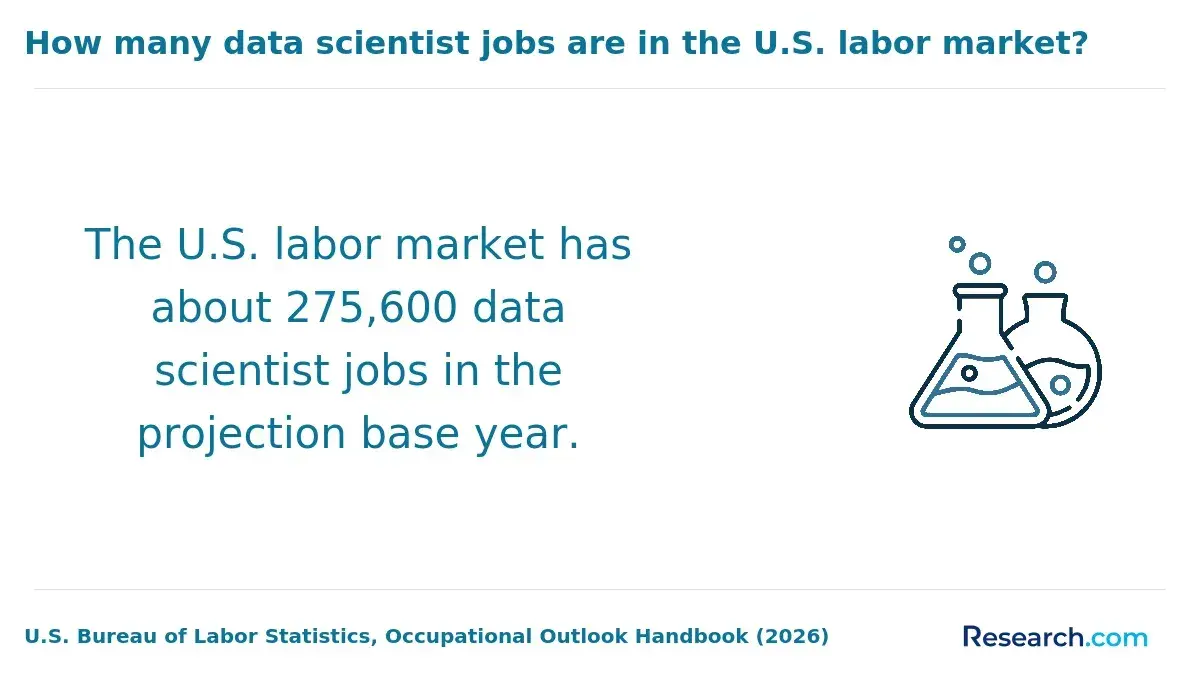
- The U.S. Bureau of Labor Statistics projects 35% growth in data scientist employment from 2025 to 2035, but that national projection is not a telehealth-specific hiring forecast.
What Is Data Science in Telehealth?
Telehealth data science applies statistical analysis, software, and machine learning to care delivered or supported at a distance. Work might involve forecasting virtual-visit demand, identifying gaps in follow-up, evaluating remote patient monitoring, or studying whether a service improves access. The aim is to inform a clinical or operational decision - not merely to produce an accurate model.
The data can include scheduling and encounter records, electronic health record extracts, patient-reported information, device measurements, and service-use logs. Those sources differ in quality and meaning: a missed video appointment, for example, might reflect a connectivity problem rather than a lack of interest in care. Strong analysts test such assumptions with clinicians and operations staff before drawing conclusions.
Telehealth also raises questions a general-purpose data science course may barely address. Patient information requires appropriate privacy and security controls; models can perform differently across patient groups; and a prediction that cannot fit into a care team's workflow may have little value. These are reasons to seek applied healthcare experience, not to assume every telehealth role involves building clinical AI.
How Can an Online Data Science Master's Prepare You for Telehealth Careers?
A suitable master's builds the ability to frame a healthcare question, prepare imperfect data, select and evaluate a method, and explain its limitations to people who may act on the result. Online delivery can make graduate study possible while working, but it does not itself provide healthcare experience. The strongest fit is a program that lets you apply its technical core to a health-related elective, practicum, or substantial project.
Compare possible degrees against your intended work. A data science master's suits applicants who want broad analytical options, including healthcare. A health informatics program may be a better fit for work centered on clinical systems and implementation; a biostatistics program may fit research-intensive evaluation.
If your goal is primarily model development, ML graduate study with a budget below $20,000 offers another comparison point - but check whether that narrower emphasis leaves enough room for healthcare context.
Before applying, ask whether students can obtain an approved telehealth-related project without access to protected patient information. A program that offers methodological depth but no feasible way to practice with healthcare questions may require substantial independent work to bridge that gap.
Which Online Data Science Master's Programs Are Accredited?
There is no single telehealth-specific accreditation that identifies the right online data science master's. Check the institution's accreditation through the accreditor or the U.S. Department of Education's accreditation records, then separately assess the degree's curriculum. Institutional accreditation should not be confused with an endorsement of every course or specialization.
For any school on your shortlist, confirm that its online degree is offered by the accredited institution named on the diploma. Also ask whether the school can enroll students residing in your state; accreditation and state authorization answer different questions. If an employer offers tuition assistance, verify its eligibility rules before committing. Avoid treating an unverified claim that a program is "accredited for healthcare data science" as a substitute for these checks.
What Courses Should a Telehealth-Focused Data Science Master's Include?
Look first for a rigorous core in statistics, programming, databases, machine learning, and model evaluation. Then examine whether you can apply those methods to healthcare data and decisions. Course names are a starting point; syllabi, assignments, and project options provide better evidence of what students actually do.
A useful curriculum review should distinguish essential technical preparation from telehealth-specific practice. These are the areas to look for and the work that would demonstrate meaningful depth:
- Statistics and study design: interpreting uncertainty, missing data, and selection effects when evaluating a virtual-care service.
- Data engineering and interoperability: joining and validating records from clinical, scheduling, and device systems rather than analyzing a clean demonstration file alone.
- Machine learning and evaluation: comparing models against relevant baselines and checking performance across patient groups, not reporting accuracy in isolation.
- Healthcare context and governance: understanding clinical workflows, permitted data use, access controls, and how analytical recommendations affect patients and staff.
AI-related courses are most useful when students examine failure modes and oversight as well as model performance. When comparing AI ethics coursework in master's programs, look for assignments that connect governance principles to a concrete healthcare decision. A dedicated course or substantial assessed project offers stronger evidence than a passing mention in a syllabus.
What Are the Admission Requirements for an Online Data Science Master's?
Requirements vary by program. Schools may assess an applicant's bachelor's degree, prior mathematics and programming coursework, academic record, professional experience, recommendations, and statement of purpose. Some accept applicants from varied majors; others specify preparation in calculus, linear algebra, statistics, or coding. Check each program's current admissions page rather than assuming healthcare experience replaces a formal prerequisite.
For a telehealth goal, use your application to connect existing experience to a specific analytical problem. A clinician might describe a workflow question they want to evaluate; a software professional might demonstrate data-pipeline skills while explaining the healthcare knowledge they need to build. If you lack a stated prerequisite, ask admissions whether a particular course will satisfy it before enrolling. Self-study can improve readiness without necessarily meeting a formal requirement.
How Long Does an Online Data Science Master's Take and Cost?
Both completion time and price depend on the school, course load, residency rules, and whether required courses run every term. An advertised tuition figure may omit mandatory fees, materials, technology, or travel for an in-person requirement. Request a current program-wide estimate based on the pace you can sustain, along with the school's policy on tuition changes.
To compare programs fairly, gather the same cost components for each one. The following checklist helps prevent a low advertised price from obscuring a higher total commitment:
- Multiply required credits by the applicable tuition rate, then add mandatory per-term and program fees.
- Identify situational expenses, including software, equipment, travel, and any required campus visit.
- Ask how part-time enrollment changes the timeline, fees, and access to financial aid or employer benefits.
- Consider foregone earnings if a schedule would require reducing work hours.
If affordability is decisive, use inexpensive online master's degrees in data science as a shortlist, not a substitute for current school fee schedules. A lower-cost program can be the better choice when it also supports a credible healthcare project; a pricier program needs a specific advantage you will use.
How Does Online Learning Compare With Campus-Based Data Science Programs?
Neither format is inherently better for telehealth preparation. Online study may let an employed student keep their job and apply coursework to real operational questions. Campus study may make scheduled collaboration or access to local research groups easier. In either format, the decisive question is whether you can obtain useful instruction, feedback, and an appropriate project - not where lectures take place.
For an online program, ask whether classes are live or self-paced, when group meetings occur, how instructors supervise projects, and whether any visit is required. These details matter especially if you work clinical shifts or across time zones. Advice on program selection for employed data science master's applicants can help you test scheduling fit separately from academic quality.
Choose online study if its timetable is sustainable and you can build healthcare contacts or project access where you live. A campus option may be preferable if its particular lab, practicum, or employer partnership provides experience an online alternative cannot match. Do not assume "online" means entirely asynchronous.
What Jobs Can You Get With a Data Science Master's in Telehealth?
Potential roles span care-delivery organizations, health systems, insurers, remote-monitoring companies, and telehealth technology vendors. Job titles are inconsistent, so compare responsibilities and required healthcare knowledge rather than searching only for "telehealth data scientist." The table shows how several role types differ.
| Role type | Typical telehealth question | Especially relevant preparation |
| Data analyst or healthcare analyst | Where are patients dropping out of virtual-care workflows? | SQL, dashboards, study design, stakeholder communication |
| Data scientist | Can a model help a team prioritize follow-up? | Statistics, machine learning, evaluation, bias assessment |
| Data engineer | Can encounter and device data be made reliable for analysis? | Databases, pipelines, data quality, security controls |
| Clinical informatics analyst | How should an insight fit into clinical systems and workflows? | Healthcare processes, implementation, cross-functional work |
A master's may strengthen candidacy, but job requirements differ, and some entry-level analytics roles do not require one. Healthcare experience can be valuable for interpreting workflows, while technically experienced applicants may need to demonstrate domain understanding. The breadth of the BLS data scientist occupation also means its national growth projection should not be read as a promise of openings at a particular telehealth employer.
Connections to practitioners can help students find feedback on realistic projects. If that is a priority, compare access to mentors and graduates; AI master's programs with strong graduate networks provide a useful comparison, but a network matters most when it includes people doing work relevant to your target role.
How Much Do Telehealth Data Science Professionals Earn?
The U.S. Bureau of Labor Statistics reports a $120,230 median annual wage for data scientists in May 2025. That is a national figure for the occupation, not a telehealth-specific salary or an expected starting wage for master's graduates. Pay for a particular position depends on its duties, employer, location, and the applicant's prior experience.
Use the BLS figure as broad labor-market context, then evaluate actual postings for the roles you could credibly pursue. When weighing a degree's cost, compare those roles with your current earnings and advancement options. A higher salary after graduation would not, by itself, show that the degree caused the increase.
What Certifications and Skills Support Telehealth Data Science Careers?
Employers may value evidence of skill in SQL, Python or R, statistical reasoning, data pipelines, model evaluation, and clear communication. Telehealth work adds the ability to interpret clinical workflows, protect sensitive information, and explain when a model should not guide a decision. A focused project that demonstrates those abilities can be more informative than a long list of tool names.
Certificates in cloud platforms, analytics tools, or healthcare informatics can support a specific skills gap, but they are not universal hiring requirements or substitutes for a degree. Check job postings for your target role before paying for one. Similarly, learn how the Health Insurance Portability and Accountability Act (HIPAA) relates to the work you want to do, while recognizing that an employer's legal and compliance teams determine permitted data access and use.
A useful final program test is whether you can graduate with a defensible project: a clear telehealth question, appropriately accessible data, a reproducible analysis, meaningful evaluation, and an explanation of privacy and patient-impact limits. If a program cannot support that work, plan how you will build the evidence outside the degree before enrolling.
Other Things You Should Know About Data Science
Yes. Public or synthetic data can demonstrate methods, provided you label its source and limitations accurately. Do not imply that a simulated analysis has been clinically validated.
Not generally for nonclinical analytics work. A role that involves practicing a licensed profession or making clinical decisions has different requirements; check the position description and applicable state rules.
Not necessarily. Employers may restrict work locations for legal, security, operational, or tax reasons. Confirm permitted locations with the employer before making plans to relocate.
Explain the decision it was intended to support, how you evaluated it, where the data could be misleading, and what human review would be needed. Clear limits make a project more credible than an unqualified performance claim.
References
- Telehealth Interventions to Improve Chronic Disease | cdc.gov https://www.cdc.gov/cardiovascular-resources/php/data-research/telehealth.html
- Data privacy in healthcare: Global challenges and solutions | nih.gov https://pmc.ncbi.nlm.nih.gov/articles/PMC12138216/
- Cost of Attendance (Budget) | 2025-2026 Federal Student Aid Handbook https://fsapartners.ed.gov/knowledge-center/fsa-handbook/2025-2026/vol3/ch2-cost-attendance-budget
- Summary of the HIPAA Privacy Rule | hhs.gov https://www.hhs.gov/hipaa/for-professionals/privacy/laws-regulations/index.html
- Developing a remote patient monitoring strategy | hhs.gov https://telehealth.hhs.gov/providers/best-practice-guides/telehealth-and-remote-patient-monitoring/developing-remote-patient
- Admissions | Data Science & Applied Statistics https://dsas.arizona.edu/admissions
- Prerequisite Key Topics - UVA School of Data Science https://datascience.virginia.edu/pages/prerequisite-key-topics
- Student Workload in Online Learning | Florida Gulf Coast University https://www.fgcu.edu/digitallearning/online-education/student-workload-in-online-learning
- How to Become a Data Scientist | Harvard SEAS https://seas.harvard.edu/news/how-become-data-scientist
- Master of Science in Healthcare Data Science | USC Online https://online.usc.edu/programs/master-science-healthcare-data-science/


