2027 Choosing a BS in Business Administration When Your Employer Will Not Allow a Work-Based Student Project
Audited and Verified:
Our Editorial and Data Verification Process
Research.com uses government datasets, official education statistics and primary institutional information to support its career and degree guides. Our review process checks factual accuracy, occupational definitions, source dates and the requirements associated with the credentials discussed.
How This Article Was Fact-Checked
Our editorial team verifies salary estimates, employment projections, education requirements and program information against original data providers and official organizations. Salary figures are checked against the relevant occupational definitions and reporting periods. Information about licensure, accreditation and required in-person training is reviewed separately.
Fact-checked and verified on:

Co-Founder and Chief Data Scientist
Your employer can refuse to sponsor a student project without ending your plans for a BS in Business Administration. The important question is whether a prospective program offers another way to meet its applied-learning requirements - and whether that option works with your schedule, budget, and career goals.
This guide is for employees who cannot obtain workplace approval, data, or supervision for coursework. It explains which alternatives may count, what to verify before enrolling, and how to choose a degree you can finish without putting your job or your employer's information at risk.
Key Things You Should Know
- An employer-sponsored project is not a universal BS in Business Administration requirement; ask each program whether its internship, capstone, or other applied requirement has an approved nonworkplace route.
- A case study, simulation, community project, or independently sourced internship counts only if the program approves it for the specific requirement. Do not use company data or present workplace results without authorization.
- Compare the remaining required credits and total cost alongside project rules: a typical US bachelor's degree is around 120 semester credits, but transfer applicability and graduation requirements vary by school.
What is a business administration degree without an employer-sponsored project?
It is a business bachelor's degree whose requirements can be completed without making your current employer a project sponsor. A BS in Business Administration generally combines general education with accounting, finance, marketing, management, operations, and quantitative coursework. Some programs require an internship or capstone; others use cases, simulations, or projects that do not depend on a student's workplace. The degree title alone does not tell you which model applies.
Employer sponsorship can mean several different things: permission to study a business problem, access to company records, a supervisor willing to assess your work, or approval to implement a recommendation. A refusal on any one of these points matters. Even if you can discuss your job in class, that does not authorize a formal project using internal information.
Ask for the current catalog requirement and the applied course syllabus before treating a program as workable. If you need to keep your job while studying, you can compare business administration degrees for working learners, then confirm each program's project policy directly. If every acceptable program requires workplace participation you cannot obtain, a program with a different applied requirement may be a better choice than trying to change your employer's decision.
How can students complete experiential learning without workplace project approval?
Start by identifying the exact requirement. An internship provides supervised work experience; a capstone assesses an academic deliverable; credit for prior learning evaluates documented existing knowledge. They are not interchangeable. The following alternatives may offer practical experience, but only the school can determine whether they satisfy a particular requirement.
| Possible route | What it can demonstrate | Important limitation |
| Public-data or fictional-case capstone | Analysis, assumptions, and recommendations | May not satisfy a requirement for a real client or implementation |
| Faculty-run simulation | Decisions under changing business conditions | May not replace supervised field hours |
| Approved nonprofit or small-business project | Stakeholder communication and a practical deliverable | Requires the host's permission and any required faculty approval |
| Internship outside the current job | Documented tasks and supervisor feedback | May create scheduling, travel, or pay constraints |
Before committing to a project, obtain written answers from the academic adviser or course coordinator: Which alternatives meet this requirement? Who approves the site and supervisor? What evidence and hours are required? Can the deliverable rely entirely on public or fictional data? If you approach another organization, establish its data-use and portfolio permissions separately from the school's academic approval. A proposed improvement is not proof that an organization adopted it.
If your goal is specifically project coordination rather than broad business study, online project management bachelor's programs accepting transfer credits offer another pathway to examine. Check their applied requirements too; changing majors does not necessarily remove the need for an approved project.
How do you choose an accredited business administration program?
First, confirm that the institution holds recognized institutional accreditation. Then check whether its business school or the specific program has applicable AACSB, ACBSP, or IACBE accreditation; those are separate questions, and the accreditor's scope matters. Accreditation does not establish that an employer-free capstone is available.
Request the catalog and applied-course rules for your intended enrollment term. Ask whether a nonworkplace option is routinely offered, how often its required course runs, who approves exceptions, and what happens if an outside placement falls through. A written answer tied to the requirement is more useful than a general assurance that the program is "flexible." You can use online business degree rankings for US college applicants to build a shortlist, but verify accreditation, project rules, and student support with each school before applying.
The business core typically develops financial-statement literacy, budgeting, marketing, organizational behavior, operations, statistics, and business communication. Those subjects can support a capstone built around a public-data market analysis, a hypothetical operating budget, or a simulated process decision rather than your employer's records. Such work demonstrates your reasoning and its limitations - not a verified business result.
Compare concentrations by their actual required courses, prerequisite sequence, and approved projects. For example, an operations or supply chain focus may be useful if your target work involves purchasing or inventory, but an elective in that subject is not necessarily an official concentration. If that is your intended specialty, planning an affordable supply chain education route can help you compare a broad business degree with more focused study. Neither route should be chosen until you know how its applied requirement can be completed.
Neither format automatically solves the project problem. An online program may offer an asynchronous simulation yet require live team meetings, proctored exams, or a locally arranged internship. A campus program may provide easier access to faculty-led projects or community partners but require travel and fixed class times. Compare the actual assessments, not the delivery label.
For each finalist, request a sample course schedule and ask when team meetings, presentations, site visits, and capstone milestones occur. Consider whether those obligations fit your work hours without employer support. Online degrees with accelerated terms may shorten the calendar, but compressed deadlines can make an outside project harder to arrange; confirm course availability and workload before choosing that pace.
Requirements vary by institution and by whether you enter as a first-year, transfer, or returning student. Schools may request prior transcripts and evidence that you meet their academic standards; entry to the business major may also depend on completing specified introductory or quantitative courses. Employer project approval is usually a graduation-planning question, not something to assume is an admission condition.
If you have previous college work, obtain an official evaluation showing which credits apply to general education, the business core, electives, and residency requirements. Accepted credits do not necessarily replace required courses. Ask admissions and the business adviser about project alternatives before paying to enroll, even if you are considering fee-free applications for online college; avoiding an application fee does not resolve a graduation obstacle.
A bachelor's degree commonly involves around 120 semester credits in total, but your remaining credits depend on the school's degree audit, transfer decisions, course sequencing, and residency rules. A nonworkplace capstone might fit an ordinary final term; an outside internship could require a separate search and a schedule you cannot combine with full-time work.
Compare schools using the cost of remaining required courses, mandatory fees, books or software, travel, and any term added by the applied requirement. Ask financial aid how a change in enrollment pace would affect eligibility, and ask your employer whether tuition assistance is available even though project sponsorship is not. If a project-management degree is an alternative you are seriously considering, compare aid and tuition at online project management schools using the same remaining-credit and scheduling assumptions. Advertised program prices alone cannot tell you your completion cost.
Relevant entry routes may include operations coordinator, administrative specialist, marketing coordinator, HR assistant, or project coordinator. The best match depends on your existing responsibilities and the work samples you can discuss without disclosing employer information. For example, someone who already schedules vendors and tracks purchasing may be closer to an operations role than to an HR specialist role, even with the same degree.
Choose coursework and an approved project that produce evidence for the tasks in your target job posting: a clearly documented budget model, process map, or research brief can demonstrate method and communication. It does not substitute for required experience or prove that you managed an organization. If your goal is principally people leadership, explore shorter organizational leadership bachelor's programs as a comparison, while checking their own project requirements and whether their curriculum fits the role.
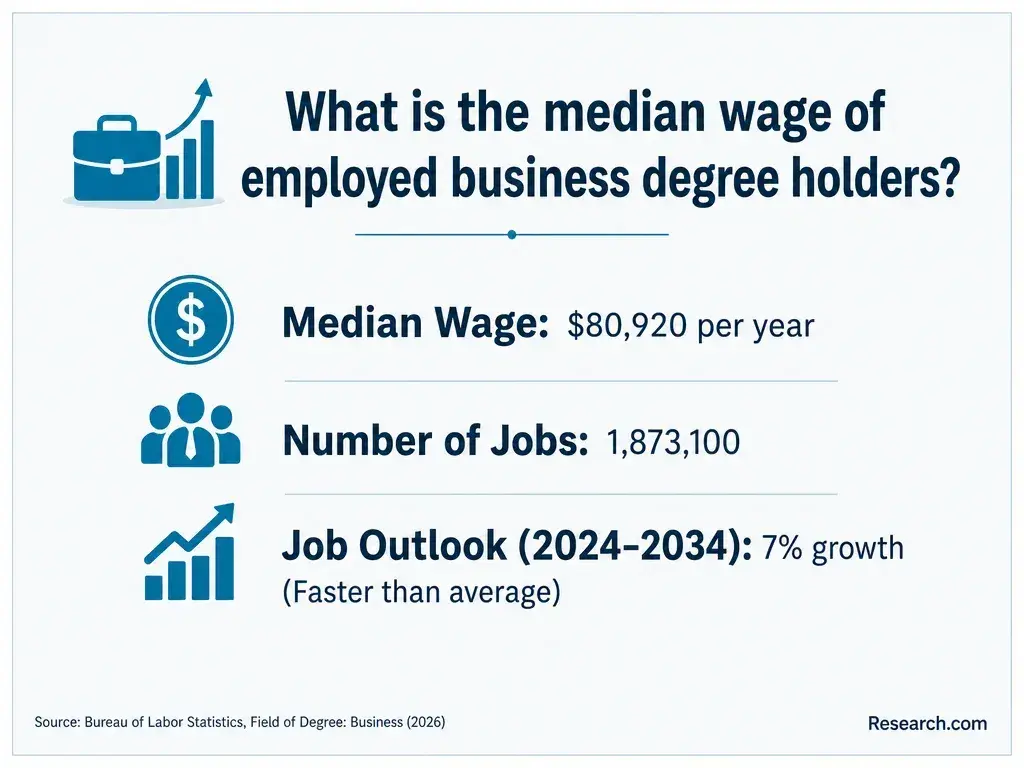
A degree does not carry a single salary; compensation follows the occupation, location, industry, and experience level. The US Bureau of Labor Statistics reports a May 2025 median annual wage of $75,940 for human resources specialists. That occupation-wide median includes experienced workers and is not a predicted starting salary for a BS in Business Administration graduate. Use postings for the specific entry-level roles you could realistically pursue when weighing degree cost against career opportunity.
If you are comparing programs partly on price or time, compare shorter business administration college programs, then obtain individual degree audits and full cost estimates. A lower advertised tuition or faster term schedule is valuable only if the required courses - including an acceptable applied option - are available to you.
Do business administration graduates need certifications or licenses?
There is no general license to hold a BS in Business Administration or work in many business-support roles. Particular jobs can have separate requirements: CPA licensure, for example, is governed by state accounting rules, while financial-services activities may require applicable licenses. Voluntary HR or project-management certifications have their own eligibility criteria. A business course, concentration, or capstone does not automatically satisfy them.
If you mainly want project-management training, compare a relevant certification's eligibility and cost with coursework or a degree rather than assuming another bachelor's is necessary. Online degree options in project management at lower cost are worth examining only if the credential level and curriculum serve your goal; confirm whether any required internship or project is feasible without your employer's approval.
Other Things You Should Know About Business Administration
A brief clarification can help you avoid proposing an equally unsuitable project. Respect a final refusal, and do not pressure a supervisor to approve data access or supervision outside their authority.
Possibly, but removing the company name does not necessarily protect confidential processes, customer details, or intellectual property. Follow workplace policy and the instructor's guidance; use a fully fictional example when uncertain.
Ownership depends on institutional rules, any host organization's agreement, and the circumstances of the work. Check those terms before sharing a deliverable publicly or adding it to a portfolio.
Do not plan around a possible policy change. Keep the approved nonworkplace route available, and ask your adviser whether a later workplace project would require a new proposal or formal approval.
- Overview of Accreditation in the United States | ed.gov http://www.ed.gov/laws-and-policy/higher-education-laws-and-policy/college-accreditation/overview-of-accreditation-united-states
- Cost of Attendance (Budget) | 2025-2026 Federal Student Aid Handbook https://fsapartners.ed.gov/knowledge-center/fsa-handbook/2025-2026/vol3/ch2-cost-attendance-budget
- 34 CFR Part 675 -- Federal Work-Study Programs | ecfr.gov https://www.ecfr.gov/current/title-34/subtitle-B/chapter-VI/part-675
- Online Bachelor's Degree in Business Administration | Purdue Global https://www.purdueglobal.edu/degree-programs/business/bachelor-business-administration/
- Credit for Experiential Learning Policy | mvcc.edu https://mvcc.edu/records-registration/credit-for-experiential-learning-policy.php
- Credit for Prior Learning Experiences | Hudson CCC PROD Catalog https://catalog.hccc.edu/policiesandprocedures/pla
- Two Approaches to Experiential Learning | AACSB https://www.aacsb.edu/insights/articles/2023/04/two-approaches-to-experiential-learning
- Bachelor of Science in Business Administration Online | SDSU Global Campus https://globalcampus.sdsu.edu/program/business/bachelor-science-business-administration-online-degree-completion-program/
- How aid is determined | sandburg.edu https://www.sandburg.edu/admissions-aid/paying-for-college/how-aid-is-determined.html
- Key Financial Aid Terms | passhe.edu https://www.passhe.edu/students/financial-aid-terms.html