
2027 Choosing a BS in Business Administration When Your Employer Requires a Degree from an Approved Institution
Audited and Verified:
Our Editorial and Data Verification Process
Research.com uses government datasets, official education statistics and primary institutional information to support its career and degree guides. Our review process checks factual accuracy, occupational definitions, source dates and the requirements associated with the credentials discussed.
How This Article Was Fact-Checked
Our editorial team verifies salary estimates, employment projections, education requirements and program information against original data providers and official organizations. Salary figures are checked against the relevant occupational definitions and reporting periods. Information about licensure, accreditation and required in-person training is reviewed separately.
Fact-checked and verified on:

Co-Founder and Chief Data Scientist
Your employer requires a degree from an "approved institution," but that phrase may refer to accreditation, an internal school list, a particular degree, or all three. Enrolling before you know which rule applies could leave you with a degree that does not qualify for reimbursement or advancement. This guide is for employees choosing or finishing a BS in Business Administration. It explains how to get the requirement in writing, verify a school and program, and compare completion plans against your work schedule, costs, and career goal.
Key Things You Should Know
- Ask HR to confirm in writing whether "approved" means recognized institutional accreditation, an employer-approved school or program, specific business accreditation, or a combination.
- Check the exact degree, campus or online format, accreditation scope, and expected graduation date against your employer's policy before paying a deposit.
- A bachelor's degree commonly requires about 120 semester credits, but accepted transfer credit, remaining requirements, and employer reimbursement rules determine your actual time and cost.
What Is a BS in Business Administration from an Approved Institution?
A Bachelor of Science in Business Administration is an undergraduate degree combining general education with business subjects such as accounting, finance, management, marketing, and operations. "Approved institution" is an employer-defined eligibility condition, not a separate kind of degree. The employer might require a college with recognized institutional accreditation, restrict reimbursement to schools on its own list, or specify an eligible field of study.
Do not assume a BBA, BA in Business, or BS in Management satisfies a policy that expressly names a BS in Business Administration. These degrees can overlap academically while differing in their official titles and requirements. If your objective is a supervisory role rather than compliance with a specifically named degree, undergraduate leadership programs with shorter timelines offer a comparison - but ask your employer whether the alternative degree qualifies before applying.
How Do You Verify a Business School's Institutional and Programmatic Accreditation?
Start with the institution, then check the business program if your employer's policy calls for it. Institutional accreditation applies to the college or university; programmatic accreditation may apply to a business school, a set of programs, or particular degrees. AACSB, ACBSP, and IACBE do not necessarily cover every program an institution offers.
Use this verification sequence before treating a school's marketing language as proof of eligibility:
- Find the institution's current listing in the U.S. Department of Education's accreditation database or the Council for Higher Education Accreditation directory; match the legal school name and location.
- If the employer specifies AACSB, ACBSP, or IACBE, check that accreditor's directory for the relevant school, degree level, and program scope.
- Ask the school which institution awards the degree and whether your intended online or campus program falls within the accreditation represented.
- Send the results and exact degree title to HR or the benefits administrator for written confirmation under the policy that will apply to your enrollment.
Accreditation does not override a narrower employer list. Conversely, a school can have recognized institutional accreditation without separate business-program accreditation. If application costs matter while you narrow eligible schools, accredited colleges offering free online applications provide possible starting points, not proof of employer approval.
Which BS in Business Administration Programs Meet Employer Education Requirements?
The qualifying program is the one that satisfies the actual wording of your employer's policy and can award the required degree on a workable timeline. Compare the policy with the school's catalog, not just its admissions page. The distinctions below help identify where an apparently suitable program may fail an employer check.
| Employer requirement | Program evidence to compare | Potential mismatch |
| Degree from an approved institution | Degree-granting institution and its accreditation status | A partner advertises classes, but another institution awards the degree |
| BS in Business Administration | Official degree title on the catalog and eventual transcript | The award is a BBA or a BS in another major |
| Approved business program | Named program and applicable business-accreditor scope | The business school has accreditation, but the proposed program is outside its scope |
| Employer tuition assistance | Eligible school, courses, enrollment dates, grades, and payment terms | The degree meets a promotion rule but not the reimbursement policy |
For an employee who cannot stop working, eligibility is only the first filter. Compare required attendance, available courses, advising, and workplace-project rules as well. Working-adult business administration program comparisons can help build a shortlist; obtain the current catalog and employer approval for each finalist.
Choose the format that lets you complete the approved degree without repeatedly conflicting with work. Online may remove commuting but still require live sessions, fixed deadlines, proctored exams, group meetings, or campus visits. Campus classes can provide predictable face-to-face access yet create travel and shift-coverage costs.
Ask each school for a recent course schedule, assessment rules, required visits, and the frequency of required upper-level business classes. Then test a realistic term against your busiest work period. If a faster online schedule appeals to you, business bachelor's rankings focused on completion speed can suggest programs to investigate; advertised speed does not establish that your credits apply or that the pace fits your job.
Programs commonly combine general education with financial and managerial accounting, economics, statistics, finance, marketing, organizational behavior, operations, business law, and a strategy or capstone course. The mix and quantitative depth vary. Compare the required courses with both your employer's field-of-study rule and the responsibilities you want next: budgeting, for example, calls for more than a leadership elective.
A concentration may add focused courses in areas such as human resources, analytics, or supply chain management, but an elective cluster is not necessarily an official concentration. Check whether the focus appears on your academic record and whether prerequisites add terms. If supply chain work is your goal, compare a general BS with supply chain bachelor's programs with compressed schedules; a specialized degree may offer deeper preparation, provided your employer accepts its degree title.
Schools generally distinguish admission to the university from entry into the business major. Depending on the program and your previous study, you may need a high school credential, college transcripts, a minimum academic record, or specified mathematics, accounting, economics, or statistics courses. A transfer applicant should also ask which accepted credits satisfy degree requirements rather than merely count as electives.
Request an official degree audit before committing to a completion date. Give the adviser your transcripts, ask about course recency and residency requirements, and confirm when any missing prerequisites must be finished. Prior education requirements for business administration applicants can help frame those questions; the receiving institution makes the binding admissions and credit decisions.
A full bachelor's curriculum commonly totals about 120 semester credits and takes roughly four academic years of full-time study from the beginning. Your completion time depends on credits applied to the degree, prerequisite sequencing, course availability, and how many classes you can take while employed. A shorter advertised program is not necessarily a shorter path for you.
Compare schools using the same starting point: an official credit evaluation and a proposed remaining-course schedule. Price the remaining tuition and mandatory fees, books and software, any travel or proctoring, and borrowing costs. Then separate total cost from cash flow: employer reimbursement may arrive only after you pay, finish a course, and meet a grade rule. Evaluating price, duration, and outcomes of business administration degrees can help organize a shortlist, but request a school-specific estimate and your employer's current benefit terms before relying on a projected total.
For an experienced employee, the immediate payoff may be eligibility to compete for an internal role previously blocked by a bachelor's-degree rule - not an automatic promotion. Your existing responsibilities matter: someone who already tracks budgets or improves workflows can pair the degree with documented results when seeking operations, project coordination, procurement, or administrative roles.
Changing functions may require additional evidence. Human resources work, for example, involves personnel processes and employment practices that a general business core may cover only briefly. Relevant electives, supervised work, or a more focused degree can help. Employees considering that route can compare transfer admission options for human resources majors, while first confirming that HR rather than business administration satisfies their employer's degree rule. A degree alone does not confer managerial authority or meet every specialist job requirement.
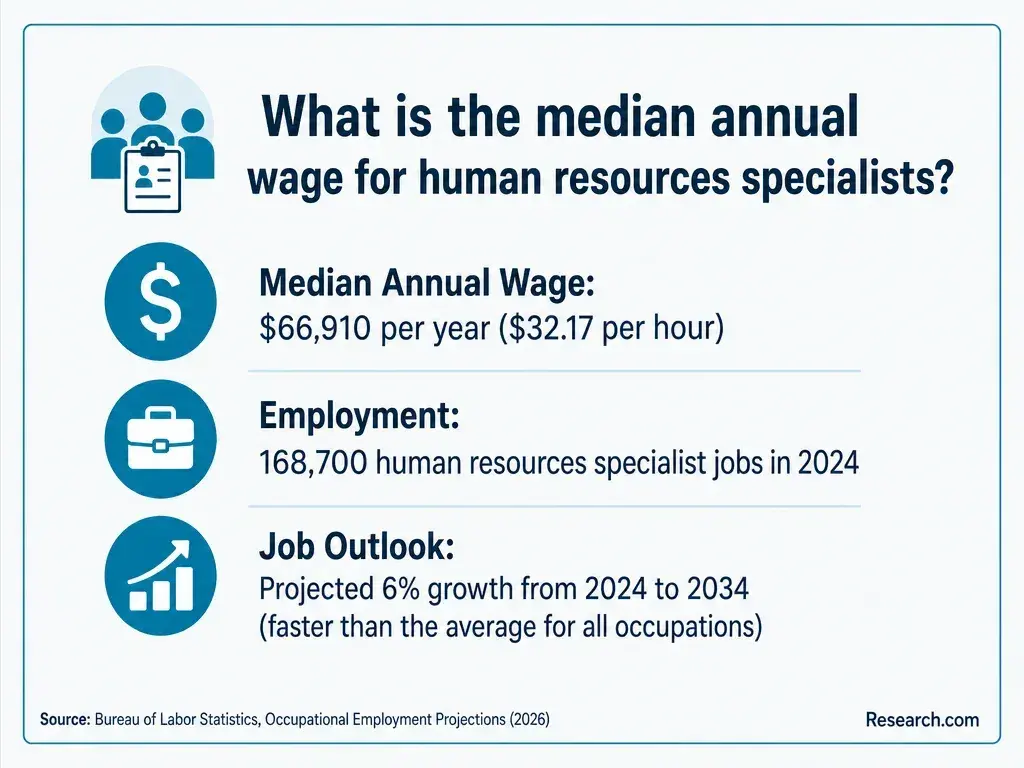
There is no single salary or employment projection for holders of a BS in Business Administration. The U.S. Bureau of Labor Statistics reports results by occupation, not by this degree title. For context, its May 2025 median annual wage for human resources specialists was $75,940, with employment projected to grow 6% from 2025 to 2035. That is an occupation-wide median - not a starting salary, an internal promotion estimate, or a predicted return on tuition.
Use the occupation closest to your intended job, then compare actual openings with your experience, location, and employer's pay structure. If you are weighing general business against a supply chain pathway, supply chain program tuition, time, and earnings context offers a separate comparison; neither field's occupational wage figures establish what an individual graduate will earn.
Which Certifications or Professional Credentials Complement a Business Administration Degree?
A credential is useful when the target job values a defined skill that the general degree does not demonstrate on its own. Project management, human resources, and accounting each have distinct credentials, eligibility rules, and sometimes experience or examination requirements. A business course or concentration does not automatically qualify you for certification or professional licensure.
Check job postings and your employer's advancement criteria before paying for an additional credential. If project work is your aim, first determine whether you need degree eligibility, stronger project experience, a qualifying certification, or some combination. For a student considering a project-focused undergraduate alternative, comparing grants for project management undergraduates may inform the financing decision - but confirm that the alternative degree meets your employer's approval rule.
Other Things You Should Know About Business Administration
Ask the registrar for an official transcript or documentation connecting the former and current institutional names. Give that record to HR rather than assuming its system will recognize the change.
Only if the posting or HR policy permits it. Ask whether a degree-in-progress notation is acceptable and what date the degree must be conferred.
Contact the school, its accreditor, and your employer promptly. Acceptance may depend on the timing of the change, your graduation date, and the employer's written policy; do not assume prior approval remains valid.
Possibly. Ask HR whether it accepts international degrees and requires a credential evaluation. That determination may save you from pursuing a second bachelor's degree solely to meet an education rule.
- Programmatic Accrediting Agencies | congress.gov https://www.congress.gov/crs_external_products/R/HTML/R43826.web.html
- Employer-offered educational assistance programs can help pay for college | Internal Revenue Service https://www.irs.gov/newsroom/employer-offered-educational-assistance-programs-can-help-pay-for-college
- Accreditation in the U.S. | ed.gov http://www.ed.gov/laws-and-policy/higher-education-laws-and-policy/college-accreditation/accreditation-in-the-us
- School Program Approval - Education and Training https://www.benefits.va.gov/GIBILL/school_program_approval.asp
- Online Bachelor's Degree in Business Administration | Purdue Global https://www.purdueglobal.edu/degree-programs/business/bachelor-business-administration/
- Online Bachelors of Science in Business Administration | Global Supply Chain Institute https://haslam.utk.edu/undergraduate/bsba/
- Transfer credit practices - UC Admissions https://admission.universityofcalifornia.edu/counselors/preparing-transfer-students/transfer-credit-practice.html
- Employer Tuition Reimbursement: How It Works and How to Pay for College | Winston-Salem State University https://ramsonline.wssu.edu/blog/employer-education-benefits/


