2027 Choosing a BS in Business Administration: How to Check a Graduate Success Story That Is Not a Typical Outcome
Audited and Verified:
Our Editorial and Data Verification Process
Research.com uses government datasets, official education statistics and primary institutional information to support its career and degree guides. Our review process checks factual accuracy, occupational definitions, source dates and the requirements associated with the credentials discussed.
How This Article Was Fact-Checked
Our editorial team verifies salary estimates, employment projections, education requirements and program information against original data providers and official organizations. Salary figures are checked against the relevant occupational definitions and reporting periods. Information about licensure, accreditation and required in-person training is reviewed separately.
Fact-checked and verified on:

Co-Founder and Chief Data Scientist
A business school may feature a graduate who quickly became a manager, launched a company, or earned an unusually high salary. That story can show what is possible, but it may be a poor forecast for someone choosing a BS in Business Administration now.
This guide is for prospective and returning students who want to separate an inspiring example from a typical outcome. You'll learn what to ask about the graduate, which program-wide evidence matters, and how to decide whether the degree's likely value fits your own career starting point and costs.
Key Things You Should Know
- One graduate's promotion or salary is an individual result, not a program employment rate; ask for the graduating cohort, response rate, and definition of a successful outcome.
- Compare the featured graduate's prior work experience, location, employer, and time since graduation with your own circumstances before treating the story as relevant.
- The Bureau of Labor Statistics reports a May 2025 median of $75,940 for human resources specialists, but that occupation-wide figure is not a starting salary or a BS in Business Administration graduate outcome.
What Is a Bachelor's Degree in Business Administration?
A BS in Business Administration is an undergraduate degree combining general education with business subjects such as accounting, management, marketing, finance, and operations. Its precise requirements depend on the institution. A BBA or a specialized business bachelor's degree may cover some of the same subjects without offering the same courses, concentration, or transfer pathway.
That distinction matters when reading a success story. Confirm that the featured person earned the same degree and program version you are considering, rather than an MBA, a different business major, or a credential earned later. Ask whether their reported achievement followed internships, earlier employment, or further education. If you have previous college study, check prior education requirements for business administration applicants against the school's current catalog; an alumnus's path does not establish how your credits will apply.
Is a Business Administration Degree Worth It for Career Goals?
Judge the degree against the role you want and the experience you already have. For an employee who needs a bachelor's credential to compete for an internal opening, completion may be valuable even without a dramatic promotion. For someone seeking a technical project role, relevant experience or a more specialized program might be a better fit; comparing project management programs with lower total costs is useful only after checking which qualification target employers actually request.
A featured graduate's achievement is strongest as evidence that a pathway can work, not that it usually does. The following distinctions help put a school's claims in proportion.
| Evidence | What it can tell you | Important limitation |
| Named graduate story | How one person used coursework, contacts, or experience | The person may have started with unusual advantages |
| Program-wide outcomes report | Reported results for a defined group of graduates | Nonrespondents and outcome definitions can change its meaning |
| Job postings for your target role | Qualifications employers currently request | A posting does not show who was hired or what they earned |
Ask the school for outcomes from the same degree, location or delivery format, and graduating period you are evaluating. Look for the number of graduates eligible for the survey, the number who responded, when outcomes were measured, and whether employment includes jobs held before enrollment. If those details are unavailable, treat the story as an example - not an estimate of your return on investment.
How Do You Verify Business School Accreditation?
Accreditation helps establish whether an institution or business program meets a recognized accreditor's standards. It does not verify a graduate's job claim or promise that other students will reproduce it. Check the institution's accreditation in the U.S. Department of Education's or accreditor's directory, then confirm separately whether AACSB, ACBSP, or IACBE accreditation covers the particular business unit and degree under consideration.
Record the school name, degree, delivery location, and accreditor's stated scope rather than relying on an accreditation logo beside a testimonial. If an application fee affects which schools you can compare, you can explore fee-free online university applications; verify both the current fee policy and accreditation independently.
Coursework can give students a common language for reading financial statements, analyzing customers, interpreting business data, and improving processes. A success story may credit "the degree" for a promotion without identifying which of those skills the graduate used - or whether they learned the decisive skill at work. Compare required courses and assessed assignments with the tasks in your target job, not just with the featured graduate's title.
Look for a relevant, feasible way to demonstrate learning, such as a supervised internship or an approved capstone. A classroom simulation is not evidence of results at a real company, and current employment does not automatically qualify for academic credit. If your goal is specifically project coordination, compare the business curriculum with specialized options and investigate colleges accepting coursework toward project management bachelor's study before assuming the same prior courses shorten either route.
Choose the format in which you can complete the required work and gain credible experience. Online delivery may reduce travel, but live sessions, group presentations, proctored exams, and internship hours can still conflict with a job or caregiving. Campus study may offer easier access to certain events or employers, but those opportunities are useful only if you can attend them.
If the featured graduate attributes their success to networking or an employer-connected project, ask whether students in your format have access to the same activity. Request sample course schedules, assessment rules, and career-service eligibility. Guidance on how to balance employment and business administration college study can help frame those questions, but the school's current policies control your actual schedule.
Admission rules vary by school and sometimes by business major. An applicant may need secondary-school records or college transcripts, while transfer applicants may face separate prerequisite or GPA rules. Being admitted, receiving transfer credit, and having that credit satisfy a business-core requirement are different decisions.
Do not assume the graduate in a testimonial entered with your academic background. Ask admissions which requirements apply to you and request a written transfer evaluation or degree audit from the office with authority to issue one. If you are comparing a specialized project management degree, project management bachelor's aid application planning can help you prepare a separate financing discussion; admission alone does not establish aid eligibility or the amount you would receive.
The relevant measure is your remaining time and net cost, not how quickly the featured graduate finished. Ask each school for a degree audit showing where accepted credits apply, which required courses remain, when those courses run, and any residency requirements. An accelerated calendar may shorten elapsed time without reducing required work or total charges.
Compare tuition and mandatory fees alongside books, software, travel, possible lost work hours, grants, and borrowing. If a testimonial cites a rapid payoff, find out whether the graduate had employer reimbursement or extensive transfer credit that you lack. Use consistent assumptions when you compare inexpensive business administration degree options; a lower advertised tuition rate does not necessarily produce a lower completion cost.
Graduates may pursue roles such as operations coordinator, marketing coordinator, HR assistant, sales support specialist, or project coordinator. Duties and entry requirements differ by employer. A manager featured in a school profile may have accumulated supervisory experience before enrollment or years after graduation; the degree alone did not confer managerial authority.
To test whether the story maps to your goal, work backward from job postings: note the actual tasks, required experience, software, industry knowledge, and examples of results an applicant must show. Then identify which gaps the program can address and which require work experience or an internship. Flexible fast-track routes in business education may change when you finish the credential, but they do not remove an employer's experience requirements.
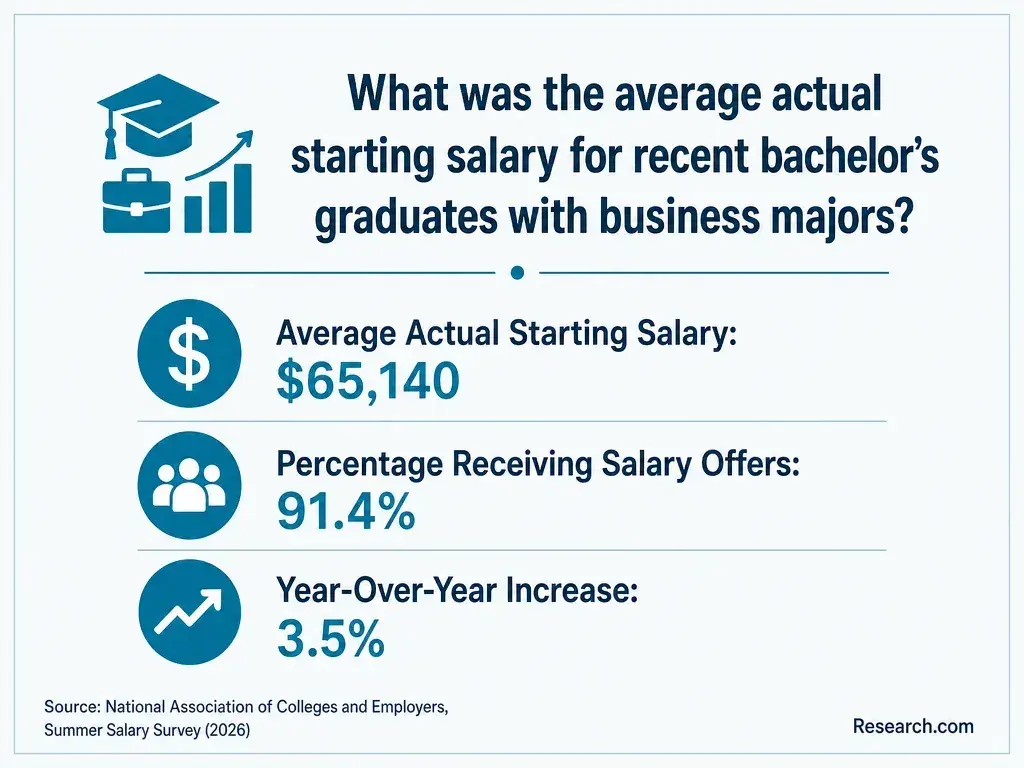
There is no single salary for a BS in Business Administration graduate. Pay depends on occupation, experience, location, industry, and responsibility. The U.S. Bureau of Labor Statistics reports a May 2025 median annual wage of $75,940 for human resources specialists and projects 6% employment growth from 2025 to 2035. Those are occupation-wide figures - not the pay or job prospects of new business graduates.
When a school highlights one alumnus's salary, ask whether it is base pay or total compensation, when it was earned, what the person did before graduation, and whether the figure was independently checked. Compare that account with reported outcomes for the whole program and with postings for roles you could realistically enter. Lists of economical business administration degrees with quicker study routes can inform a cost comparison, but no school's advertised earning potential substitutes for evidence about your likely first role.
Which Certifications or Licenses Support Business Careers?
A graduate profile may mention a professional credential alongside the BS. Identify who awarded it, when the graduate earned it, and which additional education, experience, examination, or state rules applied. A business degree or concentration does not itself grant CPA licensure, a financial-services license, or a project management certification.
Check credential requirements with the responsible certifying body or regulator and decide whether the role you want calls for that credential at entry. If your immediate goal is to meet a bachelor's requirement, accelerated degree options for working adults may be worth comparing; if the missing qualification is a specific license or demonstrated experience, a faster general degree may not solve it.
Other Things You Should Know About Business Administration
You can ask the school whether the graduate has agreed to speak with prospective students. Respect their choice and privacy; a conversation may add context, but it still represents one person's experience.
No. It can illustrate how someone used the degree. Check whether the curriculum, career services, hiring conditions, and graduate's circumstances have changed before using it to guide an enrollment decision.
Ask what it does collect and why the figures are unavailable. Then give more weight to verifiable curriculum, costs, student support, and external job requirements. Do not infer either strong or weak outcomes from missing data alone.
Treat it as another individual account. Look for specific, checkable details and consider why that person chose to post. Neither a glowing review nor a complaint establishes what most students experience.
- Accreditation in the U.S. | ed.gov http://www.ed.gov/laws-and-policy/higher-education-laws-and-policy/college-accreditation/accreditation-in-the-us
- Cost of Attendance (Budget) | 2025-2026 Federal Student Aid Handbook https://fsapartners.ed.gov/knowledge-center/fsa-handbook/2025-2026/vol3/ch2-cost-attendance-budget
- Post-Secondary Employment Outcomes (PSEO) Help and Documentation | U.S. Census Bureau https://lehd.ces.census.gov/data/pseo_documentation.html
- Fast Facts: Undergraduate graduation rates (40) | ed.gov https://nces.ed.gov/fastfacts/display.asp
- Your financial path to graduation | consumerfinance.gov https://www.consumerfinance.gov/paying-for-college/your-financial-path-to-graduation/
- Students & Recent Graduates | U.S. Office of Personnel Management https://www.opm.gov/policy-data-oversight/hiring-information/students-recent-graduates/
- Everything you need to know before choosing an undergraduate business degree - Penn State World Campus https://www.worldcampus.psu.edu/about-us/news-and-features/choosing-a-business-degree-program
- What Job Titles Do Our Graduates Hold? | PSC DU https://professionalstudies.du.edu/blog/what-job-titles-do-our-graduates-attain/
- AACSB Global Standards for Business Education https://www.aacsb.edu/educators/global-standards
- Navigating Postcollegiate Earnings Data: A Comparison of Key Tools | Institutional Data and Research https://idr.umn.edu/policy-and-research/briefs/navigating-postcollegiate-earnings-data