2027 Choosing a BS in Business Administration: How to Check a Construction Business Track Without Contractor Licensure
Audited and Verified:
Our Editorial and Data Verification Process
Research.com uses government datasets, official education statistics and primary institutional information to support its career and degree guides. Our review process checks factual accuracy, occupational definitions, source dates and the requirements associated with the credentials discussed.
How This Article Was Fact-Checked
Our editorial team verifies salary estimates, employment projections, education requirements and program information against original data providers and official organizations. Salary figures are checked against the relevant occupational definitions and reporting periods. Information about licensure, accreditation and required in-person training is reviewed separately.
Fact-checked and verified on:

Co-Founder and Chief Data Scientist
A construction-focused business degree may prepare you to manage budgets, purchasing, schedules, and company operations - but it does not authorize you to work as a licensed contractor. That distinction matters if you are choosing a BS in Business Administration for a construction career without pursuing licensure. This guide shows you how to check what a school's "construction track" actually includes, which jobs it may support, and where state licensing rules still apply. You can then compare the degree with more direct project-management, supply-chain, or work-based routes before committing time and tuition.
Key Things You Should Know
- A construction track is an academic focus, not a contractor license; verify the official credential on the transcript and the licensing rules for any work you intend to perform.
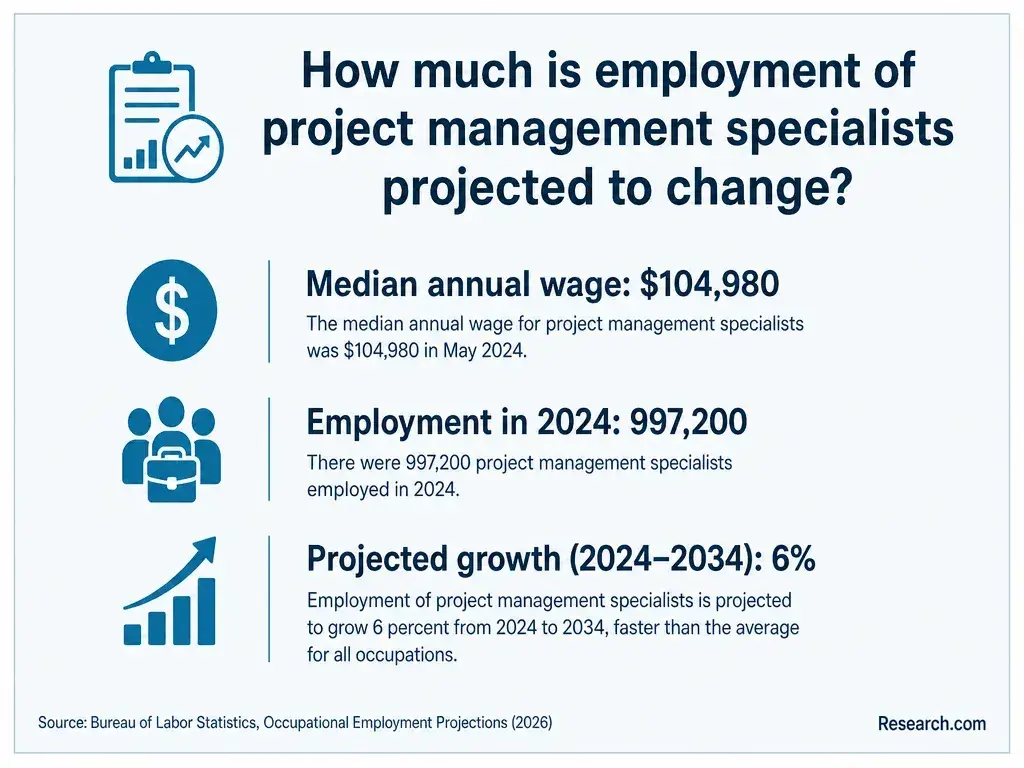
- For nonlicensed business roles, prioritize construction-specific courses and supervised experience over the track's name. The projected 2025-2035 growth rate for the broader project management specialist occupation is 7%, but that is not a placement forecast for graduates.
- Before enrolling, request a degree audit, the track's required-course list, and a total-cost estimate; a construction elective alone does not establish a formal concentration.
What Is a Business Administration Construction Management Track?
A construction management track within a BS in Business Administration typically pairs a general business core with courses or projects related to construction firms and projects. The business core may cover accounting, finance, operations, management, and business law; the construction component might address estimating, contracts, scheduling, or procurement. "Track" is not a standardized credential name. At one school it may be a recorded concentration; at another it may be an elective cluster with no separate notation.
The distinction matters most when you know the work you want to do. These pathways overlap, but they emphasize different preparation:
| Pathway | Primary emphasis | Potential limitation for a construction goal |
| BS in Business Administration with a construction track | Business operations with some industry-specific study | May offer limited technical construction coursework |
| Specialized construction management degree | Construction methods, estimating, scheduling, and project delivery | May offer less breadth in general business functions |
| Project management degree or concentration | Planning, coordination, risk, and project controls across industries | May not cover construction codes or field practices in depth |
If your target is company operations or purchasing, a business degree with relevant construction work may fit well. If it is field supervision or technical project delivery, inspect a specialized curriculum alongside the business track. You can compare affordable project management schools as another option, but check whether their courses actually address construction.
Does a Construction Business Degree Require Contractor Licensure?
Generally, no: earning a business degree or taking a construction track does not itself require a contractor license. Licensure governs particular contracting activities under state and sometimes local rules; it is separate from admission, coursework, and graduation. Equally important, the degree does not grant a license or substitute for a licensing board's experience, examination, insurance, bonding, or other requirements.
Check the activity, not just the job title. An employee who analyzes bids or coordinates purchasing may have different obligations from a person or company that advertises contracting services, enters regulated contracts, or performs licensed work. Rules also differ by trade, project type, jurisdiction, and whether work occurs under a licensed business. Ask the relevant state licensing board - and, where applicable, the local authority - about your intended duties before bidding, signing, or performing work.
If you want a construction-adjacent business role without a licensure pathway, procurement and logistics may warrant comparison. Supply chain degree cost and duration comparisons can help you weigh a more specialized education route; they cannot determine whether a particular construction activity is exempt from licensing.
What Careers Can You Pursue With This Business Administration Degree?
Start with the responsibilities you can already document. Construction trade experience can provide knowledge of materials, workflows, and jobsite constraints; office or business experience may transfer to budgets, vendors, customer communication, and reporting. The degree can help connect those skills, but employers still assess role-specific experience and technical competence.
Potential starting or adjacent roles include project coordinator, purchasing assistant, construction office administrator, estimating assistant, and operations coordinator. A project coordinator may track schedules, documents, and changes; a purchasing employee may compare quotes and monitor deliveries. Estimating positions often demand stronger plan-reading and quantity-takeoff skills than a general business track provides. Construction manager and senior estimator are typically experience-dependent goals, not automatic graduation outcomes.
For someone already employed by a contractor, the strongest case for this degree may be advancement into broader financial or operational responsibility while continuing to work. Compare the school's schedule and applied assignments with flexible business administration programs for career progression.
Accreditation attaches to an institution or to a specifically defined school or program - not automatically to every track named in a catalog. Verify the institution's recognized accreditation first. Then check whether the business school holds AACSB, ACBSP, or IACBE accreditation and whether its published scope includes the BS in Business Administration. A construction-focused option within an accredited business degree is not necessarily separately accredited as a construction management program.
Ask admissions or the business department for the degree's official title, the track's transcript notation, its required courses, and the accreditor's current program listing. If a competing project management program advertises accreditation, use the same scope check rather than treating the word "accredited" as a comparison of job outcomes. Affordability checks for accredited project management programs can help frame the cost comparison after you confirm what each accreditation claim covers.
There is no universal construction-track curriculum. Look for a business foundation in accounting, finance, operations, and organizational management, then inspect the incremental construction study: estimating and cost controls, contracts and risk, procurement, scheduling, and construction-specific casework. A course title alone does not show depth; review descriptions, prerequisites, software used, and sample assignments.
A useful test is whether students must produce work resembling the target role's tasks. For purchasing, that might be a documented vendor comparison; for project coordination, a schedule and change log. Ask whether an internship or capstone is required, who approves the placement, and whether a current job can be used. Employer records and client information require permission before use in coursework.
If you have previous college study, request an official evaluation showing credits applied to the business core, construction requirements, electives, and institutional residency - not merely credits accepted. The same issue arises when students finish project management studies with transferred college credits: an accepted course may not replace a required major course.
Choose the format that lets you complete the required construction work, not just the business core. Online courses may work well for accounting, contracts, and scheduling software, but check for live meetings, timed exams, group projects, site visits, internships, or campus requirements. Campus study may offer easier access to equipment, faculty, and local employers, though travel and fixed class times can conflict with construction work hours.
Request a recent course schedule and ask when every track requirement is offered. An online program with one required course offered infrequently may take longer than expected. If speed matters, compare that schedule with faster-paced business degree study options; accelerated terms reduce calendar time only if you can sustain the workload and take courses in the necessary sequence.
Schools commonly review secondary-school or previous college records, but requirements vary by institution and by whether you enter as a first-year or transfer student. Some business majors have separate admission standards or require introductory accounting, mathematics, economics, or statistics before upper-level courses. Being admitted to the university does not necessarily mean immediate admission to the major or construction track.
Ask for the current catalog requirements and a written review of any prior coursework or industry training. In particular, confirm whether the track has its own entry point, prerequisite sequence, and enrollment limits. For a broader explanation of possible prerequisites, see business administration degree entry requirements; the school retains authority over your admission and credit evaluation.
A full-time bachelor's path is commonly planned across four academic years, but your completion time depends on accepted and applicable credits, prerequisites, course frequency, and enrollment pace. Do not estimate savings from transfer credit until the school shows which requirements it satisfies. A track that adds courses beyond the BS requirements may increase both time and cost; one built entirely from existing electives may not.
For a meaningful price comparison, request a term-by-term plan and a school-issued estimate covering remaining tuition, mandatory fees, books, software, travel or site visits, and any internship costs. Include earnings you might forgo if the schedule reduces work hours. Financial aid and employer reimbursement depend on eligibility and policy, so compare likely out-of-pocket costs rather than advertised tuition alone. Business administration degree cost versus career outlook is a useful comparison framework, not a substitute for your personal degree audit.
There is no reliable single salary for graduates of a construction-focused business track. Pay depends on the actual occupation, location, employer, and experience. The following U.S. Bureau of Labor Statistics figures describe entire occupations, not new graduates or construction-only positions:
| Occupation | Median annual pay, May 2025 | Projected employment growth, 2025-2035 |
| Project management specialist | $102,320 | 7% |
| Logistician | $82,320 | 18% |
These occupations can provide context for longer-term project or supply-chain pathways, but neither median is an expected starting salary for a construction business graduate. Compare local postings for the entry role you can qualify for now, including their experience and software requirements. If you already work in construction, also weigh whether flexible business administration programs for career progression would let you retain income while building qualifications.
If your real goal is construction recruiting or employee relations rather than project operations, colleges accepting credits toward human resources study may appear relevant, but do not assume prior credits will satisfy that different major.
Which Certifications Strengthen a Construction Business Career?
Choose an optional credential for a specific skill gap or employer requirement, not as a substitute for contractor licensure. Project-management credentials may help demonstrate planning knowledge; construction-industry credentials may be more relevant to field-facing roles. Eligibility, exams, fees, and renewal rules depend on the issuing organization and credential, so verify them before enrolling in preparation courses.
OSHA outreach training can be useful where an employer wants documented safety training, but an OSHA course-completion card is not a professional certification or contractor license. Likewise, a university certificate and a voluntary industry certification are different credentials. If your target job mainly requires business fundamentals, a short course or employer training may be more direct than another qualification; if a bachelor's degree is required, compare completion plans - including application-cost-free online school options - rather than assuming a certification will meet that requirement.
Other Things You Should Know About Business Administration
Possibly. Some schools assess documented prior learning or offer credit for approved training. Ask whether any award would satisfy a specific requirement or only count as an elective.
Only if the school approves the project and your employer permits the necessary data use. You may need to remove client, employee, pricing, or other confidential information.
Not automatically. Government positions have their own education, experience, hiring, and procurement requirements. Compare the duties and qualifications in the particular job announcement.
Not generally for administrative, purchasing, or business-support work. Engineering-design duties and protected professional titles have separate requirements that a business degree does not meet.
- College Accreditation | U.S. Department of Education http://www.ed.gov/laws-and-policy/higher-education-laws-and-policy/college-accreditation
- Step 1: Before Applying for the Examination - CSLB https://www.cslb.ca.gov/contractors/applicants/contractors_license/exam_application/before_applying_for_license.aspx
- Cost of Attendance (Budget) | 2025-2026 Federal Student Aid Handbook https://fsapartners.ed.gov/knowledge-center/fsa-handbook/2025-2026/vol3/ch2-cost-attendance-budget
- Tuition and Fees Information - Washington, DC | American University https://www.american.edu/finance/studentaccounts/tuition-and-fees-information.cfm
- What Makes a Project Management Certificate Credible to Employers Today? - Northeastern Online https://online.northeastern.edu/resources/what-makes-a-project-management-certificate-credible-to-employers-today/
- Co-op Program | Civil, Construction and Environmental Engineering https://ccee.udel.edu/academics/co-op-program/
- Construction Management, BPS - School of Architecture | Pratt Institute https://www.pratt.edu/architecture/construction-management-facilities-management-and-real-estate-practice/construction-management-bps/
- Online Learning Programs | wichita.edu https://www.wichita.edu/academics/oal/online_programs/index.php
- Council for Higher Education Accreditation (CHEA) https://www.chea.org/
- Project Manager Development Program | Associated General Contractors of America https://www.agc.org/education/project-managment/project-manager-development-program