2027 Choosing a BS in Business Administration for Business Roles in Business Process Outsourcing Companies
Audited and Verified:
Our Editorial and Data Verification Process
Research.com uses government datasets, official education statistics and primary institutional information to support its career and degree guides. Our review process checks factual accuracy, occupational definitions, source dates and the requirements associated with the credentials discussed.
How This Article Was Fact-Checked
Our editorial team verifies salary estimates, employment projections, education requirements and program information against original data providers and official organizations. Salary figures are checked against the relevant occupational definitions and reporting periods. Information about licensure, accreditation and required in-person training is reviewed separately.
Fact-checked and verified on:

Co-Founder and Chief Data Scientist
Business process outsourcing (BPO) companies need people who can manage client relationships, measure service performance, coordinate projects, and improve operations. A BS in Business Administration can prepare you for that work, but its value depends on the role you want and the experience you already have.
This guide explains which courses and work samples matter, where graduates can realistically enter the field, and how to compare programs without mistaking a degree for a guaranteed management job.
Key Things You Should Know
- Choose courses and projects around your target BPO function: operations, client services, workforce planning, analytics, or project delivery.
- A BS can support entry into coordinator and analyst-track roles; supervising a client account or large delivery team usually requires relevant results and experience.
- The May 2025 median wage for U.S. project management specialists was $102,320, but that occupation-wide figure is not a starting salary or a BPO-specific wage.
What is a BS in Business Administration for BPO careers?
A BS in Business Administration is an undergraduate degree covering business functions such as accounting, management, operations, and data-informed decision-making. It is not a BPO-specific credential.
Business process outsourcing means a client contracts another company to perform a business process, such as customer support, payroll administration, claims processing, or finance operations. Some providers also run technology-intensive or specialized services.
That setting changes what makes a degree useful. BPO employees must understand both the provider's operations and the client's expectations: service agreements, quality measures, escalation procedures, staffing, and data-handling rules.
A broadly structured BS is a sensible choice if you want room to move among these functions. If your goal is specifically to coordinate client implementations, compare its project coursework with low-cost project management degree options; the better choice depends on the curriculum, total cost, and opportunities to gain delivery experience.
A BBA may cover similar ground, while a specialized bachelor's degree may provide more depth in one function. The degree label alone does not establish which program offers better BPO preparation.
What education and skills do BPO business roles require?
Requirements vary by employer and account. Support and coordination openings may emphasize customer communication, spreadsheets, and reliable execution over a particular major. Analyst and specialist positions may prefer a bachelor's degree plus evidence of quantitative or function-specific ability.
Client leadership and operations management typically call for a record of handling service problems, budgets, staff, or contracts, not just graduation.
For a business-side BPO role, look for ways to demonstrate that you can interpret a service-level agreement, distinguish a missed target from a data error, document a process, and communicate a corrective action to both colleagues and clients.
Coursework can build the foundation; an internship, supervised workplace assignment, or appropriately anonymized project can show how you apply it.
Match preparation to the process being outsourced. Procurement and fulfillment accounts may reward supply chain knowledge, while contact-center operations emphasize staffing, service quality, and customer experience.
If logistics is your intended specialty rather than BPO work broadly, compare the BS with shorter supply chain degrees and career value before choosing a general business curriculum.
Which BPO jobs can you get with a business administration degree?
Job titles differ across providers, so compare duties rather than relying on a title. The table separates plausible entry routes from roles that usually require a stronger track record; none is awarded automatically with a degree:
| Role or pathway | Typical BPO responsibilities | Evidence to build |
| Operations or workforce coordinator | Track schedules, volume, exceptions, and service reports | Spreadsheet analysis and accurate process documentation |
| Client services coordinator | Prepare account updates and follow up on requests or escalations | Professional writing and stakeholder communication |
| Quality or process analyst | Review performance patterns and propose workflow changes | Defined measures, sound analysis, and a feasible improvement proposal |
| Project coordinator | Track implementation tasks, deadlines, and handoffs | Project plans, status reporting, and cross-team collaboration |
| Account or operations manager | Own delivery decisions, staffing, budgets, or client commitments | Prior responsibility and demonstrated service results |
For an early-career applicant, a coordinator role can be a credible route into account ownership: learn the service, document improvements, and seek progressively greater responsibility. Experienced employees may enter at a higher level if they can substantiate comparable client-facing or operational work.
If your primary goal is people leadership across industries rather than outsourced-service delivery, three-year organizational leadership bachelor's options offer another curriculum to compare, though a shorter advertised path is not a promise of supervisory employment.
The most useful curriculum connects business fundamentals to decisions a BPO team actually makes. Accounting helps you understand costs and margins; operations courses address capacity and workflow; statistics supports performance measurement; and management and business communication help you handle cross-functional work.
Information systems and business law may add useful context for reporting, contracts, and responsible data use.
Look beyond course titles. A strong BPO-relevant assignment might ask students to map a service process, define a quality measure, identify an operational bottleneck, and explain the limits of the available data. It should distinguish a proposed improvement from a measured result and avoid using client or employee information without permission.
If you want to lead service transitions, examine the depth and sequencing of project courses, not merely whether "project management" appears once in the catalog.
Compare any added tuition and available support; project management bachelor's tuition assistance options may be relevant when weighing a specialized degree against a general BS. Confirm whether a concentration is officially recorded and whether its courses add credits or delay completion.
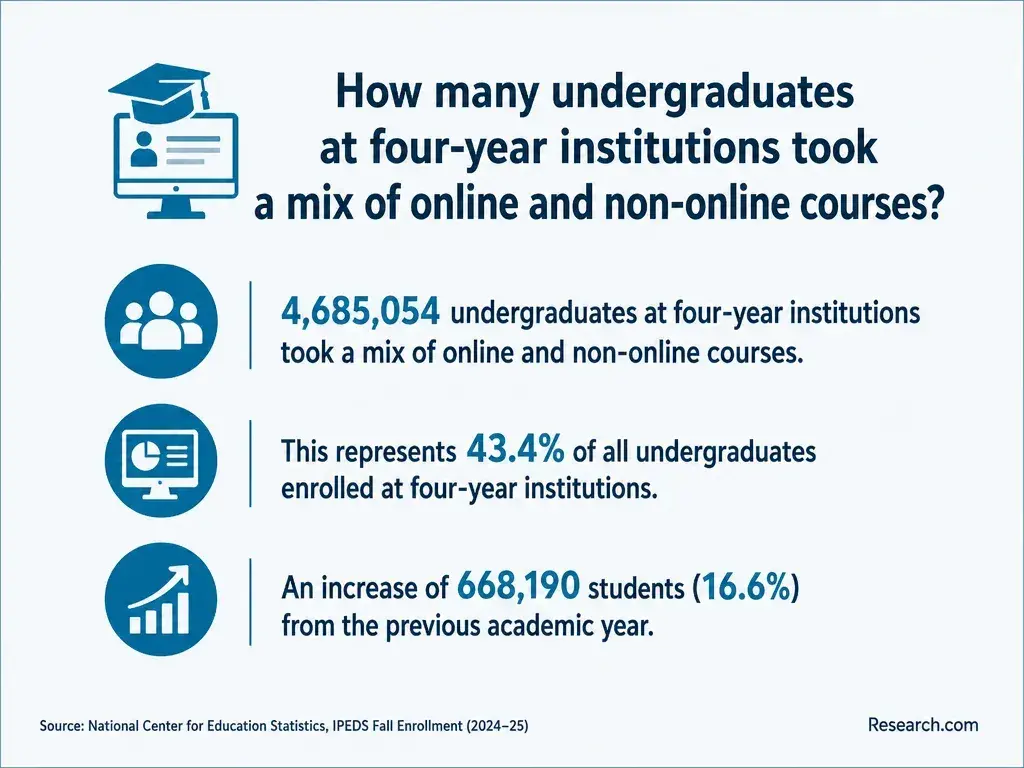
Online study can fit a BPO employee's shifts or an applicant who lives far from campus. It is not necessarily self-paced: group presentations, live meetings, timed exams, and weekly deadlines may still conflict with rotating schedules.
Campus study may offer easier access to local employer events and face-to-face project teams, but commuting and fixed class times have costs of their own.
Ask each program how often required courses run, which sessions require live attendance, whether internships can be completed at a current employer, and what technology or campus visits are mandatory.
Compare the answers against your actual work schedule. Online undergraduate business rankings for shorter study paths can help you find programs to investigate, but confirm your personal timeline through a degree audit and course schedule rather than an advertised completion estimate.
First, verify the institution's recognized accreditation and the exact degree it awards. Then check whether any claimed business-specific AACSB, ACBSP, or IACBE accreditation covers the school or program you are considering.
Institutional accreditation and business-program accreditation are different claims; neither, by itself, proves that graduates obtain BPO jobs.
For this career goal, compare required operations, analytics, and communication courses; access to internships or approved workplace projects; career services; and connections to employers that deliver outsourced services.
Ask for outcomes that identify the graduating group and reporting period. US business college rankings for online learners can provide a shortlist, but the current catalog, accreditation scope, and evidence of relevant student opportunities should control your decision.
Schools commonly request evidence of secondary education or prior college study, transcripts, and an application. Transfer applicants may face separate rules for entry to the institution and entry to the business major. Mathematics, accounting, economics, or statistics courses may be prerequisites at some schools rather than universal conditions of admission.
Before applying, request an evaluation that shows not only which credits are accepted but which satisfy general education, the business core, and any concentration.
Ask when outstanding prerequisites must be finished and whether a required course is offered in your intended format. For a fuller admissions checklist, review business administration degree entry requirements, then verify the policies of each school on your shortlist.
A full-time bachelor's path commonly spans about four academic years; prior applicable credits, part-time enrollment, course availability, and residency rules can change the finish date. A shorter calendar path is not automatically cheaper if it carries different fees, reduces work hours, or requires courses that do not apply to your degree.
Compare schools using the remaining requirements in each official degree audit. Add tuition and mandatory fees for those courses, then account for books, software, travel, borrowing, and time away from paid work. Ask the financial aid office about eligibility and the employer about any reimbursement timing or grade conditions.
A business administration degree tuition savings guide can help identify lower-cost candidates, but a published price cannot tell you your final cost until your credits and aid are evaluated.
There is no single reliable salary for "a BPO professional with a BS in Business Administration." Pay depends on the function, responsibilities, experience, employer, and location.
As one occupation-specific benchmark, the U.S. Bureau of Labor Statistics reports a $102,320 median annual wage for project management specialists in May 2025. That figure covers the occupation across industries and experience levels; it is neither a BPO-specific figure nor an expected offer for a new graduate seeking a coordinator job.
For a useful return-on-education comparison, examine actual local postings for the roles you could qualify for now and after gaining experience.
Compare their stated pay and requirements with your remaining education cost, without assuming a promotion or wage increase. If financing affects that decision, use FAFSA planning for affordable business administration study as a starting point, then confirm aid eligibility and your offer directly with each institution.
What is the job outlook for business roles in BPO companies?
U.S. labor projections describe occupations, not BPO-company hiring specifically. BLS projects 7% employment growth for project management specialists from 2025 to 2035. That suggests demand for project work across the economy, but it cannot predict openings at a particular outsourcing provider or guarantee a path from coordinator to specialist.
Outsourced services also differ: a provider adding complex client implementations may seek different capabilities from one focused on routine transaction processing. Before committing to a degree, sample current BPO postings in your region, note repeated requirements, and ask whether your coursework and experience would produce evidence for those tasks.
If you already work in the industry and need a credential while remaining employed, compare the scheduling and credit policies of accelerated business education for working adults against the time you can realistically devote to study.
Other Things You Should Know About Business Administration
Not always. Some roles are remote or based at the provider's office; others involve client visits or travel during implementations. Check the specific posting and ask about travel frequency before accepting an offer.
Yes, if you can explain the processes you know and document responsibilities such as quality reporting, scheduling, training, or resolving escalations. Avoid presenting frontline experience alone as account-management experience.
It can matter for accounts serving customers or teams in more than one language. Employers may test proficiency, and language ability usually complements - not replaces - the operational skills required for the role.
Only if you have the necessary permission and remove confidential, personal, and proprietary information. A clearly labeled project built with public or hypothetical data is a safer alternative when client materials cannot be shared.
- Soft Skills: The Competitive Edge | dol.gov https://www.dol.gov/agencies/odep/publications/fact-sheets/soft-skills-the-competitive-edge
- 17 types of business degrees and the jobs they can lead to | ASU Online https://asuonline.asu.edu/newsroom/online-learning-tips/types-business-degrees-jobs/
- Work Experience Guide for Students | Los Rios Community College District https://losrios.edu/academics/work-experience-and-internship-program/work-experience-internships-student-resources/work-experience-guide-for-students
- Career Path for Business Operations Managers in the USA | Edgewood College https://online.edgewood.edu/blog/business-operations-manager-career-path-in-the-usa/
- Is Project Management a Good Career? Pay & Path | uttyler https://online.uttyler.edu/degrees/business/mba/project-management/career-path-and-salary/
- Career paths in operations: roles, responsibilities and skills | Capella University https://www.capella.edu/blog/business/career-in-operations/
- Business Administration Jobs: Roles, Skills & Career Paths | Florida Coastal University https://www.floridacoastaluniversity.com/business-administration-jobs-career-paths-skills-and-how-to-get-started/
- What Are Employers Looking for When Reviewing College Students' Resumes? | NACE https://www.naceweb.org/talent-acquisition/candidate-selection/what-are-employers-looking-for-when-reviewing-college-students-resumes