
2027 Cheapest Online Interdisciplinary Studies Associate Degree Programs That Pay Well: Tuition, Duration, and Career Outcomes

Co-Founder and Chief Data Scientist
Choosing the cheapest online interdisciplinary studies associate degree is really a cost-versus-outcome decision. The degree can help adults, transfer students, and career changers combine general education with business, technology, social science, communication, or human services coursework. College Board's 2024 data shows average published tuition and fees at public two-year colleges were $4,050, making this route one of the lowest-cost college options. This guide explains tuition, duration, transfer value, and realistic career outcomes so readers can compare programs based on affordability, flexibility, and long-term payoff.
Key Things You Should Know
- The best low-cost options are usually regionally accredited public community colleges that offer online AA, AS, or AAS pathways in interdisciplinary studies, general studies, liberal arts, or multidisciplinary studies.
- A typical associate degree requires about 60 credits; at $100 per credit, tuition alone is about $6,000, but fees, books, technology charges, and transfer-credit limits can change the real cost.
- BLS May 2024 wage data shows higher-paying associate-accessible paths are usually skill-specific, such as web development, computer support, paralegal work, technical sales, or management-support roles, not the interdisciplinary major by itself.
Which Are the Cheapest Online Interdisciplinary Studies Associate Degree Programs That Lead to Well-Paying Careers?
The cheapest online interdisciplinary studies associate degree programs are usually not national private programs with large marketing budgets. They are often public community college programs that charge low in-district, in-state, or flat online tuition and allow students to complete general education and electives remotely.
Because schools use different names for similar degrees, students should search for interdisciplinary studies as well as general studies, liberal arts, multidisciplinary studies, university studies, and individualized studies. The table below shows common low-cost program types to prioritize and the career value each can offer.
| Program type to compare | Common credential | Why it can be affordable | Best career or transfer fit | Important caution |
| Public community college interdisciplinary studies | AA or AS | Often priced at resident community college rates | Transfer to a bachelor's degree in business, education, communication, psychology, or public service | Career outcomes depend heavily on electives, internships, and transfer planning |
| Online general studies associate degree | AA, AS, or AGS | Frequently accepts prior college credit, military credit, and exam credit | Adult students with unfinished credits who need a flexible completion pathway | May be too broad for students who need a job-specific credential immediately |
| Liberal arts or liberal studies online pathway | AA | Usually built around low-cost general education courses | Students planning to transfer into humanities, social sciences, communication, or education | Students should confirm that courses meet bachelor's general education requirements |
| Career-focused multidisciplinary studies | AAS or applied associate degree | Can combine workforce courses with general education | Students targeting administrative support, human services support, business operations, or technology-adjacent roles | Some AAS credits may not transfer as smoothly to bachelor's programs |
| Statewide online community college transfer programs | AA or AS transfer degree | State systems may offer low tuition and articulation agreements | Students who want the cheapest route into a public university | Benefits are strongest when the student stays within the same state transfer system |
For many students, the strongest low-cost choice is the accredited public community college in their state that offers a fully online transfer-oriented AA or AS. A slightly more expensive program may be worth it if it accepts more transfer credits, has stronger advising, or guarantees a smoother pathway into a bachelor's degree.
Students should be careful with programs that appear cheap but lack clear transfer maps, publish vague fee information, or describe career outcomes in broad marketing language. A low price matters only if the credits count, the student can finish on time, and the degree connects to a realistic employment or transfer goal.
How Much Does an Online Interdisciplinary Studies Associate Degree Cost?
An online interdisciplinary studies associate degree usually costs less than a bachelor's degree because it requires fewer credits and is commonly offered by community colleges. Still, the true cost is more than tuition; online course fees, textbooks, graduation fees, exam proctoring, technology requirements, and transcript charges can add up.
The table below shows how students can think about cost using a standard 60-credit associate degree structure. These are planning scenarios, not guaranteed prices, because tuition varies by state, residency, institution, and aid eligibility.
| Cost factor | What to check | Why it matters |
| Tuition per credit | Resident, nonresident, and online rates | A low per-credit rate is the biggest driver of affordability, especially for students taking most credits at one school |
| Required credits | Usually about 60 credits | Programs with the same tuition rate can differ in cost if one requires extra prerequisites or remedial coursework |
| Online fees | Technology, distance learning, proctoring, and course fees | A program with low tuition can become less affordable if online fees are high |
| Books and materials | Open educational resources, textbook costs, software subscriptions | Programs using free or low-cost materials can reduce out-of-pocket expenses |
| Transfer-credit acceptance | Prior college, AP, CLEP, military, workplace, or portfolio credit | Accepted credits can reduce both tuition and time to completion |
| Residency rules | Minimum credits required at the graduating institution | A school may accept many credits but still require a set number of credits to be completed there |
College Board reported in 2024 that average published tuition and fees at public two-year colleges were $4,050. That figure is useful as a benchmark, but online learners should compare total program cost rather than assuming every online associate degree will match the average public two-year price.
A practical way to compare programs is to calculate tuition separately from total attendance cost. Students should multiply the per-credit rate by required credits, then add mandatory fees, estimated books, and any credits that will not transfer. This avoids the common mistake of choosing the lowest advertised tuition without seeing the full bill.
How Long Does It Take to Complete an Online Interdisciplinary Studies Associate Degree?
Most online interdisciplinary studies associate degrees take two years of full-time study, but many adult learners finish faster or slower depending on transfer credit, course load, work schedules, and whether the program offers accelerated terms. A full-time student typically takes about 15 credits per semester, while a part-time student may take six to nine credits.
The table below compares common completion timelines and the financial trade-offs behind each option.
| Enrollment pace | Typical timeline | Best for | Financial trade-off |
| Full-time | About 2 years | Students who can handle 12 to 15 credits per term | Faster completion may reduce time out of the workforce but can limit work hours |
| Part-time | About 3 to 4 years | Working adults, parents, and students paying out of pocket | Lower term-by-term cost, but a longer timeline can delay career or transfer benefits |
| Accelerated online terms | Potentially less than 2 years with enough course availability | Motivated students with strong time management and prior credits | Can improve ROI if tuition is stable, but compressed courses require more weekly study time |
| Transfer-credit completion | Varies based on accepted credits | Students with previous college, military, or exam credit | Often the cheapest route if the school accepts credits that apply directly to degree requirements |
Faster is not always better. Students who rush through broad electives without choosing a career or transfer concentration may finish quickly but still lack the skills employers expect. The better goal is to finish efficiently while building a transcript that supports the next step.
Before enrolling, students should ask whether required courses are offered every term, whether asynchronous classes are available, and whether the school limits the number of credits taken in accelerated sessions. A program that advertises speed but rarely offers key courses online may take longer than expected.
An interdisciplinary studies associate degree does not point to one single occupation. Its value depends on how students use electives, certificates, work experience, and transfer plans to build a marketable profile. The highest-paying outcomes usually come when the degree is paired with technical, legal, business, healthcare-administrative, or human services skills.
The table below uses BLS May 2024 median wage data for occupations that may be accessible with an associate degree, some college, related experience, or additional training. Median wages are not entry-level wages, and requirements vary by employer and state.
| Career path | Relevant interdisciplinary focus | Median annual wage from BLS May 2024 | How the associate degree can help |
| Web developer or digital design support | Technology, communication, design, business | $95,380 | Students need a portfolio and technical coursework; the associate degree can provide general education and electives |
| Wholesale or manufacturing sales representative | Business, communication, psychology, technology | $76,980 | The degree can support advancement when paired with product knowledge and sales experience |
| Executive assistant or administrative services support | Business, communication, office technology | $70,310 | Employers often value writing, organization, software, and professional communication skills |
| Computer support specialist | Information technology, communication, problem solving | $61,550 | Students should add IT coursework or certifications to compete for technical support roles |
| Paralegal or legal assistant | Legal studies, writing, research, public administration | $61,010 | Some roles prefer paralegal-specific training, so electives or a certificate may be needed |
| Human resources assistant | Business, psychology, communication | $48,890 | The degree can support entry into HR support, especially with spreadsheet, payroll, or office software skills |
| Social and human service assistant | Human services, psychology, sociology, public health | $44,240 | Students interested in direct support roles may benefit from a more specialized pathway such as an accelerated human services degree online |
The main salary lesson is that interdisciplinary studies is a flexible academic platform, not a guaranteed high-wage credential. Students seeking stronger earnings should choose electives that build job-specific competencies, such as data literacy, customer relationship management, basic coding, legal research, case documentation, bookkeeping, or professional writing.
A common mistake is comparing tuition with national median wages and assuming the median is a likely first job salary. Entry-level pay may be lower, and wages differ by region. Students should compare local job postings, required credentials, and wage data for the occupations they actually plan to pursue.
The best ROI does not always come from the school with the lowest tuition. Return on investment improves when the program is affordable, credits transfer cleanly, the student graduates without unnecessary courses, and the degree supports a realistic job or bachelor's pathway.
The table below shows how different affordable associate degree structures tend to perform from an ROI perspective.
| Program structure | ROI strength | Best-fit student | Potential weakness |
| Low-cost transfer AA or AS at a public community college | Strong for students planning a bachelor's degree | Students who know their intended bachelor's major and target university | Weak ROI if credits do not apply to the bachelor's major |
| General studies completion degree with generous transfer credit | Strong for adults with prior credits | Students close to finishing an associate degree | May lack a clear career identity unless paired with work experience |
| Applied interdisciplinary AAS with workforce electives | Potentially strong for immediate employment | Students targeting administrative, technical, or support roles | May not transfer as fully into a bachelor's program |
| Private online general studies associate degree | Variable | Students needing national online access, frequent start dates, or high transfer-credit acceptance | Higher tuition can reduce ROI unless completion is much faster |
| Very cheap but poorly aligned program | Weak | Rarely the best choice | Low tuition cannot offset poor advising, limited transfer value, or weak career fit |
Students can run a basic ROI check by comparing total program cost with likely first-step outcomes. If a program costs less but delays transfer, requires repeated courses, or does not build employable skills, its real ROI may be lower than a moderately higher-cost program with stronger advising and transfer agreements.
The most practical ROI question is: "Will this degree reduce my cost to reach the next credential or job?" If the answer is unclear, students should ask the school for transfer maps, program outcomes, typical job titles, and examples of elective combinations aligned with their goals.
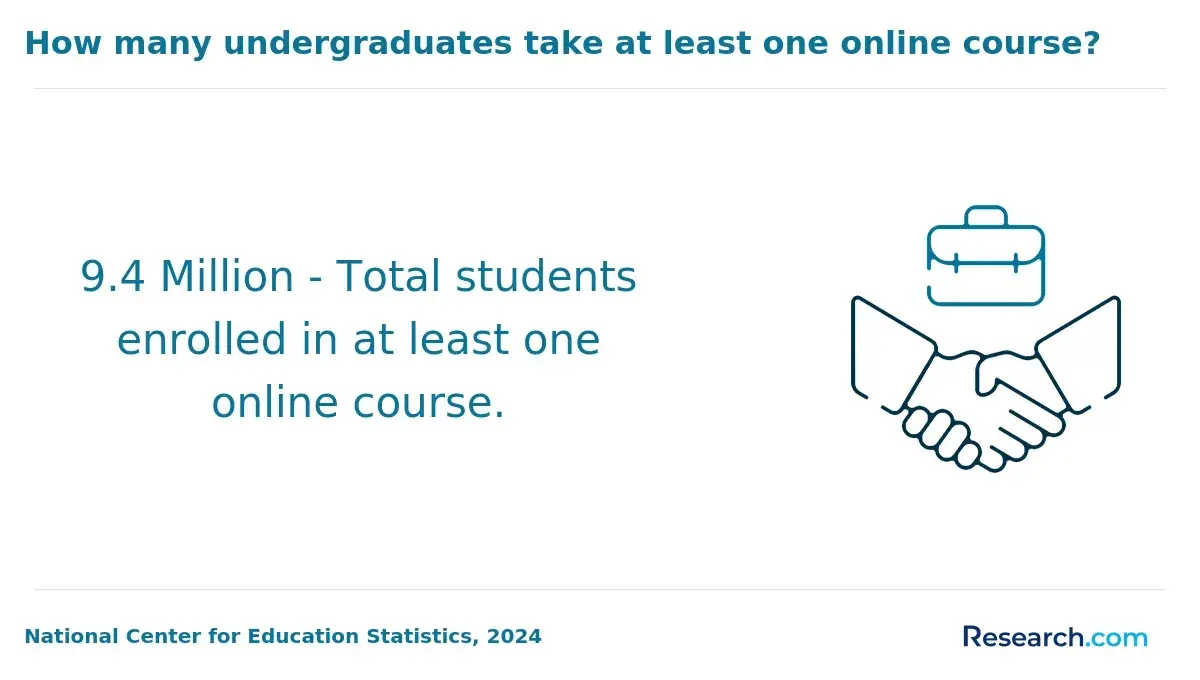
Total students enrolled in at least one online course.
Financial aid can make an already affordable online associate degree much cheaper, especially at public two-year colleges. Students should complete the FAFSA even if they plan to attend part time, because grants, work-study, state aid, and some scholarships use FAFSA information.
The aid options below are the most important to compare before committing to a program.
- Federal Pell Grant: The maximum Pell Grant for the 2025-26 award year is $7,395, and eligibility depends on financial need, enrollment intensity, and federal rules.
- State grants and promise programs: Many states and local systems offer last-dollar or first-dollar aid for community college students, but residency, income, and enrollment rules vary.
- Institutional scholarships: Community colleges may offer small awards for online, adult, transfer, first-generation, or career-pathway students.
- Employer tuition assistance: Working adults should ask whether their employer reimburses job-relevant coursework or requires a minimum grade.
- Military and veteran education benefits: Eligible students should ask how benefits apply to online enrollment, fees, and required course loads.
- Credit for prior learning: AP, CLEP, DSST, military training, professional certifications, and portfolio review can reduce the number of credits a student must pay for.
Students should compare net price, not sticker price. A school with slightly higher tuition may cost less out of pocket if it offers stronger grants, accepts more transfer credits, or provides free textbooks through open educational resources.
Borrowing should be approached carefully for a broad associate degree. If loans are necessary, students should borrow only what is needed and avoid using loans for programs that lack clear transfer or employment value.
Accreditation is one of the biggest value factors for an online interdisciplinary studies associate degree. Regional accreditation matters because it affects credit transfer, federal financial aid eligibility, employer recognition, and admission into bachelor's programs.
Students should verify institutional accreditation directly with the school and recognized accrediting databases. For an interdisciplinary studies associate degree, programmatic accreditation is usually less common than institutional accreditation, but specialized career goals may require additional checks.
Quality signals are easier to compare when students look beyond tuition. The most useful indicators include clear degree maps, transparent online course availability, transfer agreements, accessible advising, career services, and published policies for prior learning credit.
Counseling is a good example of why accreditation and career pathway matter. An associate degree can introduce psychology or human services topics, but professional counseling roles typically require more education and licensure; students considering that direction should compare a transfer-focused associate degree with a more targeted pathway such as the cheapest online counseling degree.
Red flags include unclear accreditation claims, pressure-heavy admissions tactics, vague transfer promises, missing fee schedules, and programs that imply broad associate-level study is enough for licensed or regulated professions. When a target career is licensed, students should check state board rules before enrolling.
Flexible and accelerated online interdisciplinary studies programs are best for students who need to balance school with work, caregiving, military service, or prior college credits. Flexibility can improve affordability because it helps students stay enrolled and finish without paying for repeated or unused credits.
The table below compares common flexibility features and what each means for cost and completion.
| Flexibility feature | How it works | Why it matters for affordability |
| Asynchronous online courses | Students complete weekly work without set class meeting times | Helps working adults avoid schedule conflicts that can cause dropped courses |
| Eight-week or accelerated terms | Courses are shorter and more intensive | Can speed completion if students can manage the workload |
| Multiple start dates | Students can begin in fall, spring, summer, or shorter sessions | Reduces waiting time and may help students use financial aid efficiently |
| Prior learning assessment | Schools evaluate exams, military learning, workplace training, or portfolios | Can lower total credits needed for graduation |
| Stackable certificates | Certificate courses count toward the associate degree | Students can build job skills while progressing toward graduation |
| Transfer-friendly curriculum | General education courses match public university requirements | Prevents students from paying twice for similar courses after transfer |
Students should not assume every online program is self-paced. Many online courses still have weekly deadlines, group projects, proctored exams, or required virtual sessions. The best accelerated option is one that matches the student's study time, not simply the shortest advertised timeline.
Before enrolling in an accelerated format, students should ask how many hours per week each course requires, whether financial aid covers shortened terms, and whether key courses are available often enough to stay on track.
An online interdisciplinary studies associate degree can lead to career advancement, but its strongest long-term value is often as a stepping stone to a bachelor's degree. This is especially true for students interested in education, counseling, management, public administration, communication, social services, or psychology-related fields.
The best transfer outcomes happen when students choose courses backward from the bachelor's degree they want. A student planning to major in business should choose math, economics, accounting, and communication electives differently from a student planning psychology, social work, or education.
Students who already work in administrative support, customer service, sales, healthcare offices, or community organizations may use the associate degree to qualify for internal promotions or meet minimum education requirements. However, roles requiring licensure, advanced clinical responsibility, or professional certification usually require additional education beyond the associate level.
For example, students interested in mental health careers should view the associate degree as an early step, not the final credential. Many professional paths require graduate study, so it can be useful to understand future options such as online masters programs for counseling before choosing associate-level electives.
Students should ask each school for articulation agreements, transfer equivalency guides, and bachelor's completion partners. A cheap associate degree becomes much more valuable when it transfers cleanly into the next credential without excess credits.
How Should Students Choose the Cheapest Online Interdisciplinary Studies Associate Degree for Their Career Goals?
Students should choose the cheapest online interdisciplinary studies associate degree by starting with the outcome they want, then working backward to the lowest-cost program that supports that outcome. The right program for a future bachelor's student may be different from the right program for someone seeking immediate workplace advancement.
The following step-by-step process helps students compare affordability and career value without being distracted by marketing claims.
- Identify the primary goal: immediate employment, promotion, transfer to a bachelor's degree, career change, or completion of unfinished credits.
- Choose the best degree type: AA for liberal arts or transfer goals, AS for more math or science-oriented transfer plans, or AAS for applied workforce preparation.
- Calculate total cost using tuition, required credits, online fees, books, graduation fees, and any credits that will not transfer.
- Verify regional accreditation and confirm the school participates in federal financial aid if aid is needed.
- Check transfer maps before enrolling, especially if the plan is to continue into a bachelor's degree.
- Review local job postings to see whether target roles require an associate degree, bachelor's degree, certificate, license, or specific software skills.
- Ask whether online courses needed for graduation are offered frequently enough to finish on time.
- Compare advising quality, career services, internship options, and prior learning credit policies.
- Avoid programs that promise high salaries without explaining employer requirements, regional wage variation, or additional credentials.
Students should avoid choosing an associate degree based only on the lowest tuition if the program does not fit their next step. Low cost matters most when the program also offers transferable credits, clear advising, useful electives, and a realistic timeline.
Long-term career plans should also shape the decision. A student who eventually wants a clinical, academic, or leadership career may need graduate education later, so comparing pathways early, including options such as the cheapest online PhD in counseling, can help prevent unnecessary credits and poor sequencing.
The best final choice is the program that balances five factors: low total cost, manageable duration, accreditation, transfer value, and career relevance. If one of those factors is weak, students should ask whether a slightly different degree, a targeted certificate, or a direct bachelor's pathway would produce a better return.
Other Things You Should Know About Interdisciplinary Studies
Interdisciplinary studies usually means combining coursework from multiple academic areas around a theme or goal. General studies is often broader and may focus more on completing general education requirements or finishing prior credits.
Employers are more likely to respect the degree if it comes from a regionally accredited college and the applicant can show relevant skills. Work experience, certificates, software skills, writing ability, and a clear career focus often matter as much as the degree title.
The difficulty depends on course choices. A student who selects writing-heavy humanities courses will face different challenges than one who adds statistics, technology, business, or science electives. Online students also need strong time management.
Some programs allow students to build a customized focus, while others require a set list of approved electives. Students should ask an advisor whether their chosen courses will count toward graduation and transfer to a future bachelor's program.
- Top 50 Scholarships for Non-Traditional Students to Apply for in July 2026 https://bold.org/scholarships/by-type/non-traditional-scholarships/
- Interdisciplinary Studies (AA) | Online - Cairn University https://cairn.edu/online-interdisciplinary-aa/
- Associate of Arts in Interdisciplinary Studies Online https://www.baypath.edu/academics/undergraduate-programs/interdisciplinary-studies-2/
- How We Calculated the Return on Investment of Associate Degrees and Certificates - Freopp https://freopp.org/whitepapers/how-we-calculated-the-return-on-investment-of-associate-degrees-and-certificates/
- How does a college degree improve graduates’ employment and earnings potential? - APLU https://www.aplu.org/our-work/4-policy-and-advocacy/publicuvalues/employment-earnings/
- Alma Career – A better world of work for everyone https://www.almacareer.com/blog/how-does-a-university-degree-influence-pay


