2027 BS in Business Administration: Self-Paced Courses Versus Instructor-Led Courses
Audited and Verified:
Our Editorial and Data Verification Process
Research.com uses government datasets, official education statistics and primary institutional information to support its career and degree guides. Our review process checks factual accuracy, occupational definitions, source dates and the requirements associated with the credentials discussed.
How This Article Was Fact-Checked
Our editorial team verifies salary estimates, employment projections, education requirements and program information against original data providers and official organizations. Salary figures are checked against the relevant occupational definitions and reporting periods. Information about licensure, accreditation and required in-person training is reviewed separately.
Fact-checked and verified on:

Co-Founder and Chief Data Scientist
Choosing between self-paced and instructor-led business courses can determine whether a degree fits around work and other responsibilities - or becomes difficult to finish. Both formats can lead to a BS in Business Administration, but they differ in deadlines, feedback, collaboration, and how quickly students can move through required courses.
This guide is for prospective students and returning learners comparing flexible programs. It explains what each format requires, where apparent flexibility has limits, and what to confirm with a school before enrolling.
Key Things You Should Know
- Choose self-paced courses if you can manage independent study and need control over when you complete lessons; choose instructor-led courses if scheduled feedback and discussion help you stay on track.
- "Online" does not mean "self-paced." Check exam windows, group work, course start dates, and any live attendance requirements.
- Compare the approved degree audit and total cost, not just the advertised pace: required courses, transfer-credit applicability, and tuition rules can determine when you actually graduate.
What Is a Self-Paced BS in Business Administration?
A self-paced BS in Business Administration lets students move through at least some coursework without the weekly schedule typical of an instructor-led class. Students may complete readings, practice activities, and assessments as they demonstrate readiness. The degree is still awarded by the institution, not by the delivery format, and students must satisfy its academic requirements.
Self-paced does not mean deadline-free. A school may set term end dates, minimum progress rules, exam appointments, or fixed start dates for particular courses. A program advertised as self-paced may also include instructor-led accounting courses, a scheduled capstone, or assessments that require faculty review. Students balancing employment with a degree can use a guide to business administration education for employed professionals as a starting point, then verify the schedule of every required course with the school.
How Do Self-Paced and Instructor-Led Business Courses Compare?
Instructor-led online courses generally follow a faculty-set calendar, though they need not require live attendance. Self-paced courses generally give students more control over the order and timing of their study. The comparison below highlights the obligations most likely to affect completion.
| Decision factor | Self-paced courses | Instructor-led courses |
| Deadlines | More control within program or term limits | Regular assignment and discussion deadlines |
| Feedback | May arrive after a submitted assessment or upon request | Usually tied to scheduled assignments and class activity |
| Collaboration | May rely more on individual work, but requirements vary | More likely to include scheduled discussions or group milestones |
| Progress | Can accelerate when courses are available and assessments can be completed | Predictable course sequence, with less room to move ahead |
Neither column describes every program. For example, an instructor-led course can be asynchronous, while a self-paced course can require a proctored exam at an approved time. Compare actual course schedules and assessment policies - not delivery labels - when using a US online business college selection guide.
Which BS in Business Administration Format Fits Your Learning Style?
Self-paced study tends to fit students who can set a study schedule, identify when they need help, and resume work after interruptions. It can be especially useful when work shifts change. Its main risk is that optional study time can repeatedly give way to other obligations. Instructor-led study offers recurring deadlines and more predictable interaction, but a fixed assignment calendar can be difficult during busy work or caregiving periods.
Test the fit against a real week rather than an ideal one. Identify when you could study, whether you need prompt explanations in accounting or statistics, and whether group meetings or exams would conflict with work. Ask for a sample syllabus and the policies on late work, tutoring, accessibility accommodations, and temporary breaks. If cost is as important as scheduling, compare online business programs for cost-conscious students using the courses you would still need to complete.
Programs commonly combine general education with accounting, economics, finance, marketing, management, operations, quantitative reasoning, and business communication. Some add electives, a formal concentration, or a capstone. The exact curriculum matters more than the BS label: a course in project management is not necessarily a project management concentration, and an elective does not confer a separate credential.
Format matters most where learning requires practice and feedback. A self-paced accounting course should provide a way to resolve errors before a high-stakes assessment; an instructor-led analytics course may provide more opportunities to discuss assumptions and revise work. For students targeting HR work, a human resources program selection guide can help distinguish broad business coverage from deeper HR study. Check whether any required internship, team project, or capstone has fixed dates regardless of the other courses' pace.
Institutions set their own admission rules. Applicants may need a high school credential or prior college transcripts; transfer applicants may face separate minimums or prerequisites before entering the business major. Admission to a university does not establish that previous coursework will satisfy accounting, statistics, general education, or concentration requirements.
Returning students should request a written evaluation showing both accepted credits and where those credits apply in the degree audit. If deciding between general business and HR, compare the remaining requirements in both pathways; resources on online HR bachelor's programs accepting transfer credits can help frame that comparison, but the receiving institution makes the final credit decision. Ask whether admission and credit-review steps differ between self-paced and instructor-led versions of the program.
Completion time depends on the credits that apply to the degree, enrollment intensity, required course availability, and prerequisite order. Self-paced study can shorten the calendar only if students can complete assessments promptly and move into the next required course. It cannot remove required credits or bypass a course offered only on a scheduled calendar. Instructor-led study may take longer for a student ready to move ahead, yet its regular milestones may help another student maintain steady progress.
Before relying on an accelerated timeline, ask an adviser to map every remaining requirement by term or enrollment period, including any capstone. Compare that plan with the claims in US rankings for accelerated business bachelor's degrees. A published fast-completion path may assume transfer credits, full-time study, or uninterrupted course availability that does not match your situation.
Neither format is automatically cheaper. Schools may charge by credit, course, term, or subscription period. A faster self-paced student might pay for fewer subscription periods, while a student who needs more time could pay for additional ones. An instructor-led program may have a more predictable course bill but still involve technology, materials, or proctoring charges.
Request an individualized estimate based on your evaluated credits and planned pace. Include required fees, books or software, financing costs, and the effect of a delayed course on later enrollment. If project management is your intended field, compare the business degree's costs with those of a more targeted pathway; information on FAFSA grants and scholarships for project management students may help identify funding questions to raise with each school's financial-aid office. Aid eligibility and award amounts must be confirmed for your program and circumstances.
First, confirm the institution's accreditation and its current status through the accreditor or a recognized US education database. Then check whether a claimed business-school accreditation - such as AACSB, ACBSP, or IACBE - covers the school and degree you are considering. Institutional accreditation and business-program accreditation have different scopes; neither alone tells you whether a particular course is self-paced or whether graduates obtain jobs.
Ask which institution awards the degree and whether the self-paced and instructor-led options appear under the same accredited institution and academic program. For a cost-focused search, accredited business administration programs and federal student aid are related screening topics, but confirm current accreditation status and federal-aid participation directly before applying.
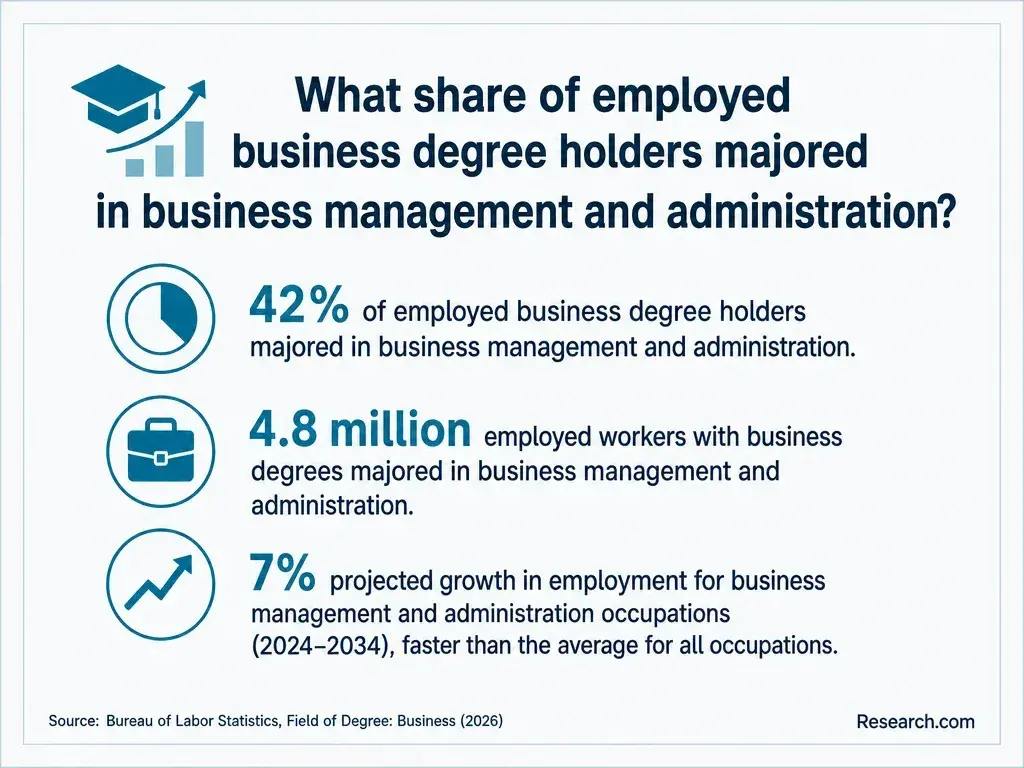
A BS in Business Administration can support applications for roles in operations coordination, HR support, marketing coordination, purchasing, sales operations, and project coordination. The format is less important to employers than relevant skills and evidence that you can use them. A new graduate might demonstrate spreadsheet analysis through a class project; an employed student might describe approved process-improvement work without disclosing confidential information.
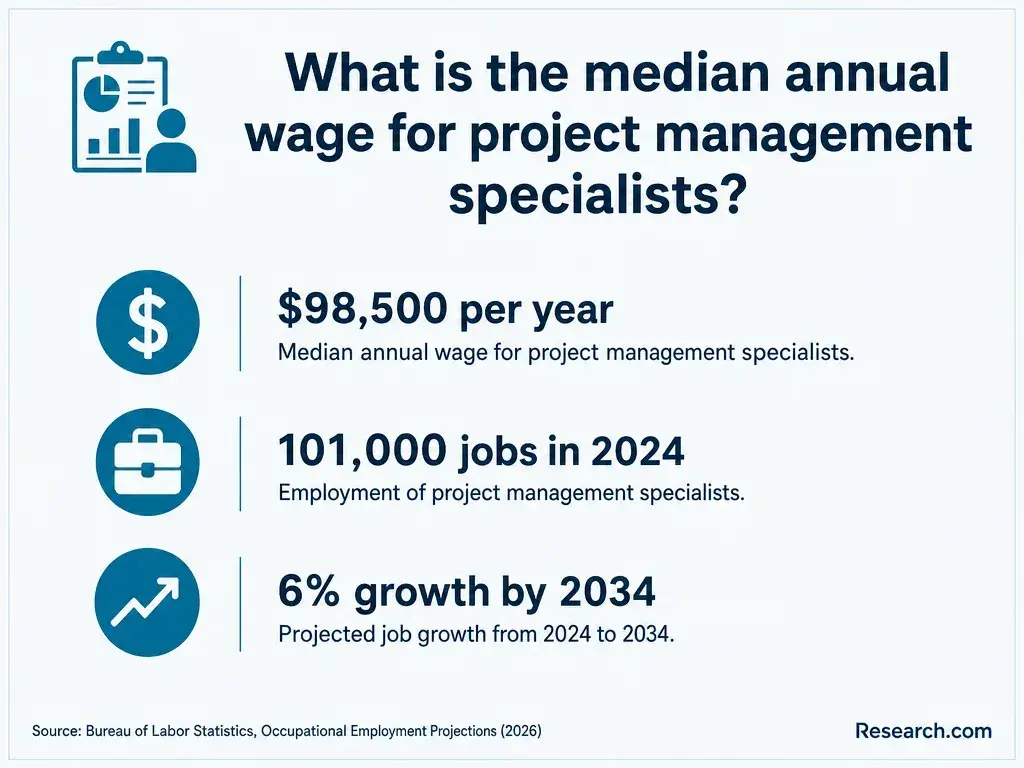
Match the curriculum to the work you want to do. Project coordination, for example, calls for scheduling, communication, and tracking risks as well as general management knowledge. If that is your target, compare the BS with options to finish project management studies with transferred college credits. Neither degree format substitutes for experience, and a business degree alone does not award a professional license or an immediate management position.
What Salary and Job Outlook Can Business Graduates Expect?
There is no single salary or job-growth figure for a BS in Business Administration: labor statistics describe occupations, not the earnings of graduates from a particular degree format. As one relevant example, the US Bureau of Labor Statistics reports a May 2025 median annual wage of $75,940 for human resources specialists and projects 6% employment growth for that occupation from 2025 to 2035. The wage covers workers across experience levels; it is not a starting salary or a return promised by an HR course, a business degree, or either delivery format.
Use the occupation that matches your intended work, then compare its hiring requirements with the skills you can demonstrate. For a project-management goal, comparing economical project management degree programs with a general business BS may be more useful than treating an occupation-wide wage as evidence that one course format pays better.
Other Things You Should Know About Business Administration
Possibly. Ask whether both formats count toward the same degree plan, whether required courses are offered in each, and whether changing formats affects tuition or enrollment status.
Transcript conventions vary by institution. Request a sample transcript or ask the registrar how the courses and degree appear on the official record.
Contact your adviser before stopping. Withdrawal, leave, reentry, and financial-aid rules can differ, particularly when courses have term or subscription end dates.
Often, but the type and availability of help vary. Ask how to contact faculty, when feedback is returned, and whether tutoring is available for quantitative courses.
- Fast Facts: Tuition costs of colleges and universities (76) | ed.gov https://nces.ed.gov/fastfacts/display.asp
- Understanding College Costs | studentaid.gov https://studentaid.gov/resources/prepare-for-college/students/choosing-schools/consider-costs
- Transfer credit policies - Office of Admissions https://admit.washington.edu/apply/transfer/policies/
- Student Services - Metropolitan Community College https://mycatalog.mccneb.edu/content.php
- Understanding Accreditation for Online Degrees | UMass Global https://www.umassglobal.edu/blog-news/online-degrees-accredited-identify-quality-distance-learning-programs
- BS in Business Administration | Online Bachelor's Degree | Capella University https://www.capella.edu/online-business-degrees/bs-business-program/bachelors-business-administration/
- Business Administration, B.S.: Degrees: Indiana University | iu.edu https://online.iu.edu/degrees/business-administration-bs-undergraduate.html
- Navigating Campus Resources: What Are Student and Academic Support Services? | Post University https://post.edu/blog/navigating-campus-resources-what-are-student-and-academic-support-services/
- The Role of Student Support Services in College | snhu.edu https://www.snhu.edu/about-us/newsroom/education/the-role-of-student-support-services
- Bachelor of Science in Business Administration | missouri.edu https://online.missouri.edu/degrees-programs/mu/business/business-administration/bs-ba