2027 BS in Business Administration Math Planning: Timed Math Tests Versus Applied Assignments
Audited and Verified:
Our Editorial and Data Verification Process
Research.com uses government datasets, official education statistics and primary institutional information to support its career and degree guides. Our review process checks factual accuracy, occupational definitions, source dates and the requirements associated with the credentials discussed.
How This Article Was Fact-Checked
Our editorial team verifies salary estimates, employment projections, education requirements and program information against original data providers and official organizations. Salary figures are checked against the relevant occupational definitions and reporting periods. Information about licensure, accreditation and required in-person training is reviewed separately.
Fact-checked and verified on:

Co-Founder and Chief Data Scientist
A business administration program can be a good academic fit even if timed math tests are not your strongest way to show what you know. But choosing a program based on its applied projects alone can backfire if required statistics or accounting courses still rely heavily on exams. For prospective and current BS in Business Administration students, this guide separates the math you need to learn from the ways schools assess it. You'll be able to inspect course requirements, compare assessment formats, and make a realistic preparation plan before enrolling or choosing electives.
Key Things You Should Know
- Expect quantitative work in accounting, economics, statistics, and finance, but check the specific degree audit: a BS in Business Administration does not have a universal math course list.
- Timed tests primarily assess independent accuracy under a deadline; applied assignments also assess modeling, interpretation, and communication. Most programs use both, so compare grading weights and assessment rules course by course..
- Before choosing a program, request representative syllabi and confirm exam duration, proctoring, permitted tools, assignment deadlines, and the sequence of math prerequisites.
What math courses are required in a BS in Business Administration?
Common requirements include a general education math course, statistics or business statistics, and quantitative work embedded in accounting, economics, and finance. Depending on the institution, the standalone math course might be college algebra, finite math, quantitative reasoning, or calculus. A business analytics or operations concentration may add further prerequisites.
Read the catalog and degree audit together. The catalog describes requirements; the audit shows how your completed and planned courses apply to your degree. If you have transfer credit, ask whether a previous math course satisfies a specific requirement rather than merely counting as an elective. Also check whether statistics must precede analytics or other upper-level courses. Even among the fastest online business bachelor's programs in the US, a short advertised timeline does not remove prerequisites or guarantee that every required course is offered when you need it.
How do timed math tests compare with applied assignments in business programs?
A timed test asks you to solve or interpret problems independently within a set duration. An applied assignment asks you to use quantitative methods to inform a business decision, often with a spreadsheet, written explanation, or presentation. Neither format is inherently easier: projects allow revision but can demand more planning and judgment.
This comparison shows what each format tends to reveal - and what to check in a syllabus before deciding which learning environment suits you.
| Assessment | What it can demonstrate | Potential difficulty | Syllabus detail to check |
| Timed test | Independent recall, calculation, and interpretation | Time pressure or restricted tools | Duration, grading weight, calculator rules, and retake policy |
| Applied assignment | Model selection, spreadsheet use, explanation, and revision | Ambiguous inputs, longer workload, or team coordination | Rubric, data source, deadlines, and individual versus group grading |
Compare the entire required sequence, not a program's featured capstone. If two programs offer suitable assessment policies, lower-priced college options for business majors can help frame a cost comparison - but confirm remaining credits, fees, and course availability before treating one as cheaper for you.
Which math skills are most important for business administration careers?
For many early-career business roles, the most transferable skills are spreadsheet fluency, percentages and rates, basic financial-statement interpretation, descriptive statistics, and the ability to explain what a calculation does not prove. An operations employee might track process measures; a marketing coordinator might compare campaign results; an HR employee might review staffing and turnover measures while protecting employee information.
Prioritize skills against a target function rather than trying to master every quantitative specialty. If HR is your goal, what to expect from an HR degree provides a useful point of comparison with a general business curriculum. In either path, interpreting workforce data responsibly matters more than producing a chart without context.
The topics usually build from arithmetic, algebra, and graphs toward business applications. Accounting uses relationships among revenue, expenses, assets, and cash flows. Finance introduces concepts such as interest and the time value of money. Statistics covers variation, sampling, and uncertainty; operations courses may use forecasts, capacity measures, or inventory calculations.
Look for assignments that require you to state units, time periods, and assumptions. A revenue forecast is not a profit forecast, and an observed relationship between two measures does not establish causation. If estimating project schedules and budgets is your main interest, compare the business curriculum with project management schools with competitive tuition; then inspect the actual quantitative courses rather than assuming a degree title indicates their depth.
Either format can include timed exams, homework platforms, spreadsheet models, presentations, and team projects. Campus exams may take place during class; online exams may have a limited opening window, a separate time limit once started, and remote proctoring. An asynchronous course can still impose fixed test times or group-meeting deadlines.
Ask for the assessment rules in required math-intensive courses, including technology and accessibility procedures. Check whether you need a particular spreadsheet program, webcam, testing location, or paid proctoring service. Those details belong in a completion-cost comparison alongside tuition and aid; a list of federal aid options at accredited business administration colleges is a starting point, not confirmation of your eligibility or a course's assessment format.
Not necessarily. Some programs require calculus or more extensive statistics; others meet their standalone math requirement through algebra, finite math, or quantitative reasoning. Finance, analytics, and operations electives can demand more mathematical preparation than the general business core. The degree's "BS" label alone cannot settle the question.
If you want a more quantitative function, do not choose solely by seeking the least advanced requirement. Check whether the course sequence prepares you for your intended work. For example, budget-friendly supply chain degrees with shorter schedules may warrant comparison if supply chain analysis is your goal, but verify their statistics, operations, and prerequisite requirements individually. Conversely, if your goal calls for general business fluency, extra calculus may offer less value than stronger applied coursework.
Preparation should target both the underlying skill and the exam conditions. First, find out whether the test emphasizes calculations, interpretation, or both. Then practice with the permitted calculator or software; a method you can perform with unrestricted notes may feel different under exam rules.
A workable preparation sequence is:
- Review prerequisite algebra, percentages, graphs, and any concepts identified in the course's diagnostic materials.
- Practice representative problems without a clock until your method is reliable, then add the actual test time limit.
- Check answers for units and business meaning, not just arithmetic accuracy.
- Use instructor office hours, tutoring, and approved practice tests to investigate recurring errors before the exam.
If you are still selecting schools, compare assessment and support policies before applying. Lists of accredited colleges offering free online applications may make it easier to consider alternatives, but an application fee tells you nothing about a required course's test format.
An applied assignment should connect a calculation to a choice. A student might compare budget scenarios for a proposed project, identify which costs are assumptions, and explain what additional evidence a decision-maker needs. The strongest work distinguishes a forecast from an observed result and shows how changing an uncertain input affects the recommendation.
Classroom cases and simulations can provide usable data without implying access to an employer's records. For a workplace-based assignment, obtain required faculty and employer permission before using internal figures; remove personal or proprietary information from any portfolio version. If project-focused work is shaping your education choice, review scholarship search options for project management majors when comparing a specialized program's cost with a business degree. Funding options and a project-heavy curriculum are separate claims to verify.
Institutional accreditation and business-specific accreditation serve different purposes. Business accreditors such as AACSB, ACBSP, and IACBE evaluate programs or business units within their stated scope, but their recognition does not prescribe an identical math course or require every instructor to favor projects over exams. Confirm that any advertised business accreditation covers the program you are considering.
Use accreditation as one quality check, then inspect the curriculum map and representative syllabi for evidence of quantitative learning and assessment. Similarly, advice on how to reduce tuition spending on an online business administration degree is useful only alongside checks of accreditation scope, required courses, and total completion cost. Neither a low price nor an accreditation label establishes that the assessment style fits you.
Which business careers use quantitative skills after graduation?
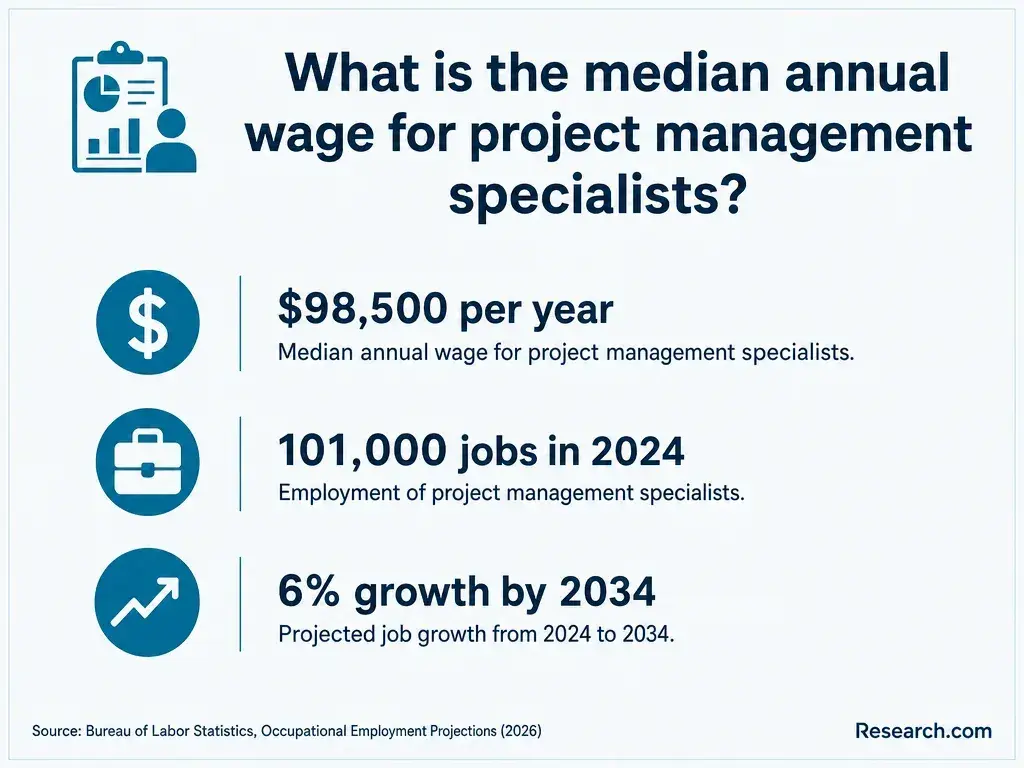
Quantitative skills appear in market research, financial analysis, procurement, logistics, project coordination, HR, and operations. The methods differ: market research analysts interpret customer and market data, while project staff track schedules, budgets, and risks. A new graduate may enter through an assistant or coordinator role; a degree alone does not establish specialist expertise or qualify someone to manage staff.
For context, the US Bureau of Labor Statistics reports a May 2025 median annual wage of $78,760 for market research analysts. That is an occupation-wide median, not an expected starting salary for business administration graduates. If your aim is people leadership rather than a quantitative specialist role, compare the business degree's coursework with undergraduate leadership programs with shorter timelines, while checking whether either path provides the financial and analytical preparation your target jobs require.
Other Things You Should Know About Business Administration
Yes, if you are eligible under your institution's process. Contact its disability or accessibility services office early to learn what documentation and advance notice it requires; an instructor should not be expected to change exam conditions informally.
Only the receiving institution can decide. Submit an official transcript and, if requested, a syllabus; ask whether the course fulfills the specific math or statistics requirement rather than elective credit.
Rules vary by course and assessment. Check the syllabus and exam instructions for approved devices, spreadsheet functions, formula sheets, and any restrictions on outside assistance.
Ask an academic adviser about repeat rules, prerequisite delays, and the effect on your degree plan. Check with financial aid before changing enrollment or repeating a course, because eligibility rules may affect your options.
- ADA Requirements: Testing Accommodations https://www.ada.gov/resources/testing-accommodations/
- Four Empirically Based Reasons Not to Administer Time-Limited Tests - PMC https://pmc.ncbi.nlm.nih.gov/articles/PMC7314377/
- Math Placement Tests & Exemptions | fitnyc.edu https://www.fitnyc.edu/admissions/undergraduate-applicants/placement-tests/math.php
- How Much Math Do You Need to get a Degree in Business Administration? | Southern Nazarene University https://www.snu.edu/blog/how-much-math-do-you-need-to-get-a-degree-in-business-administration
- Overview of Quantitative Courses for 2026-2027 | uchicago.edu https://voices.uchicago.edu/qrmeth/courses/
- Mathematics & Business Administration | D'Amore-McKim School of Business https://damore-mckim.northeastern.edu/programs/bs-mathematics-business-administration/
- Quantitative Methods | Babson College https://www.babson.edu/undergraduate/academics/concentrations/quantitative-methods/
- Get Ready for Business School by Brushing Up on Quantitative Skills | Syracuse University https://onlinegrad.syracuse.edu/blog/get-ready-business-school-brushing-quantitative-skills/
- First-Year Placement Testing - New Student Programs https://newstudents.dasa.ncsu.edu/firstyear/placement/
- How Online MBA Exams and Assignments Work | bduedu.in https://www.bduedu.in/online-mba/online-mba-exams-assignments-how-it-works