2027 BS in Business Administration and Supply Chain Management and Logistics: Choosing Courses for Your First Related Job
Audited and Verified:
Our Editorial and Data Verification Process
Research.com uses government datasets, official education statistics and primary institutional information to support its career and degree guides. Our review process checks factual accuracy, occupational definitions, source dates and the requirements associated with the credentials discussed.
How This Article Was Fact-Checked
Our editorial team verifies salary estimates, employment projections, education requirements and program information against original data providers and official organizations. Salary figures are checked against the relevant occupational definitions and reporting periods. Information about licensure, accreditation and required in-person training is reviewed separately.
Fact-checked and verified on:

Co-Founder and Chief Data Scientist
A supply chain concentration can put several appealing courses on your schedule, but not all will help equally with your first job. A purchasing assistant needs different preparation from an inventory analyst or transportation coordinator. For students choosing a BS in Business Administration - and for employees hoping to move into supply chain work - this guide connects courses to entry-level tasks, useful work samples, and realistic hiring expectations. It also shows what to check before committing to a program, so your electives, time, and tuition support the role you actually want.
Key Things You Should Know
- For a first supply chain job, prioritize operations, statistics, spreadsheets, and a role-specific course in procurement, inventory, or transportation; seek an assignment that demonstrates those skills.
- A concentration is useful when its required courses match your target role and fit your graduation plan. An elective cluster is not necessarily an officially awarded concentration.
- The U.S. Bureau of Labor Statistics reports a $82,320 median annual wage for logisticians in May 2025 and projects 18% employment growth from 2025 to 2035; neither figure represents a new graduate's starting pay or a job guarantee.
What is a BS in Business Administration with Supply Chain Management and Logistics?
It is a business bachelor's degree that combines a general business core with focused study of how organizations source goods or services, manage inventory, coordinate transportation, and deliver to customers. Supply chain management spans the flow from suppliers through delivery; logistics focuses more specifically on movement, storage, and related coordination. Procurement, operations, and logistics overlap, but employers may hire for distinct tasks within each.
Schools structure this study differently: supply chain may be an official concentration, a major within a business degree, or simply a set of electives. Check the transcript designation and required courses rather than relying on the program's marketing name. A general business degree may be enough for a student with relevant warehouse or purchasing experience; a formal concentration can offer more structured preparation when that experience is missing. Compare the added courses and cost with budget-conscious online business administration education if a broader degree plus relevant work experience would meet your goal.
What courses prepare graduates for their first supply chain job?
Start with the job description, not the concentration label. For most entry-level paths, operations management explains process flow, statistics and spreadsheet work support decisions from imperfect data, and accounting builds cost awareness. Then choose depth in the function where you want to work. Course titles vary, so read syllabi and confirm prerequisites; academic preparation for business administration applicants can help you identify subjects to review before quantitative coursework.
The comparison below connects common course subjects to tasks a new hire might encounter. It describes useful preparation, not a promise that completing a class qualifies someone for the role.
| Course subject | Entry-level task it supports | Useful evidence of learning |
| Operations and process management | Documenting a workflow or identifying a bottleneck | A process map with stated assumptions |
| Statistics, analytics, and spreadsheets | Checking demand patterns or inventory records | A documented analysis with data-quality limitations |
| Procurement and sourcing | Comparing supplier quotes and tracking purchase orders | A comparison that accounts for price, lead time, and risk |
| Inventory and transportation | Monitoring stock, shipments, or delivery exceptions | A replenishment or shipment-tracking exercise |
If you can take only one advanced elective, choose procurement for purchasing roles, inventory or forecasting for planning roles, and transportation or distribution for logistics coordination. Pair it with a supervised internship, approved workplace project, or substantial class assignment where possible. A simulation is evidence of practice, not a completed employer project. Confirm whether an elective requires earlier statistics or operations courses and whether it is offered before your planned graduation date.
What careers can you start with a supply chain management degree?
Possible first roles include purchasing assistant, procurement coordinator, inventory analyst, logistics coordinator, and operations coordinator. Purchasing staff help process orders and communicate with suppliers; inventory staff reconcile records and investigate shortages; logistics coordinators monitor shipments and resolve delivery exceptions. An analyst title may require stronger spreadsheet and data skills, while some employers expect prior industry experience even for a coordinator opening.
Look for postings whose daily tasks match work you have done in class, at an internship, or in a warehouse, retail, service, or operations job. A student with customer-service experience may have evidence of exception handling and stakeholder communication but still need practice with inventory records or purchase orders. If your preferred work is recruiting or employee relations rather than sourcing and distribution, college pathways into human resources are a more direct comparison. The degree alone does not make a graduate a supply chain manager.
First, confirm that the institution holds recognized institutional accreditation. Then check whether business-school accreditation from AACSB, ACBSP, or IACBE applies to the school and program you are considering; these have different scopes and do not replace institutional accreditation. Neither type guarantees internship access or employment.
For course selection, the more revealing questions are whether required supply chain electives run often enough to finish on time, whether students can use relevant software and realistic assignments, and whether career services connect them with purchasing, planning, or logistics employers. Ask for the current catalog, a sample degree plan, internship rules, and an explanation of where transferred courses apply. If you are weighing another concentration, transfer admission options for human resources majors may inform that separate comparison - but only the prospective supply chain school can determine how your credits apply to its degree.
Choose the format that lets you complete the specific courses and applied work you need. Online study can reduce commuting, but an online operations class may still have scheduled discussions, group presentations, proctored exams, or fixed deadlines. Campus study may make local employer events and in-person collaboration easier, but it can conflict with work schedules.
Request a recent syllabus for the advanced electives, not just a general statement that the degree is flexible. Check live-session times, software access, internship arrangements, and whether a required course runs every term. Fastest bachelor's-level business study options are worth comparing only if their pace leaves room for the supply chain courses and relevant experience you need; a shorter calendar does not automatically mean less work or lower cost.
Requirements depend on the institution and whether you apply as a first-year or transfer student. Schools commonly request prior academic transcripts, while admission to the business major or concentration may involve separate rules and prerequisite courses. Mathematics, statistics, accounting, or economics may also be needed before upper-level supply chain classes, even when they are not admission requirements.
Ask admissions what qualifies you to enter, then ask an academic adviser for a degree audit showing which prior credits satisfy the business core, prerequisites, and concentration. Accepted elective credit does not necessarily replace a required operations course. If completion speed matters, compare bachelor's programs for faster completion against the actual prerequisite sequence; accelerated admission will not remove a course dependency.
A bachelor's degree commonly takes about four academic years of full-time study from the start, but transfer credit, part-time enrollment, course availability, and prerequisite sequencing can substantially change your remaining time. A concentration may fit within ordinary electives or require courses that extend your schedule. Some three-year supply chain undergraduate degree routes rely on particular credit loads or accepted prior study; verify the plan against your own degree audit.
To compare costs, request a school-specific estimate covering remaining tuition and required fees, books and software, internship travel if applicable, and any credits that will not count toward graduation. Add the income you might forgo if the schedule reduces work hours. Compare that total - not an advertised tuition rate - with the value of the courses and recruiting opportunities you will actually use.
Entry-level postings often call for accurate records, spreadsheet analysis, clear supplier or customer communication, and careful follow-up when an order or shipment goes wrong. Depending on the role, employers may use enterprise resource planning systems, warehouse management systems, transportation management systems, or reporting dashboards. Products differ, so learn the underlying workflow and data fields rather than assuming one classroom package will be used everywhere.
Build a work sample that explains the question, checks the data, shows a calculation or process, and states what remains uncertain. Use public, synthetic, or approved data; do not put confidential prices, customer information, or employer records in a portfolio. Project scheduling is helpful in some operations roles, but it is not the same specialty as supply chain planning. If project delivery is your stronger interest, compare the coursework in lower-cost colleges for project management majors before committing to supply chain electives.
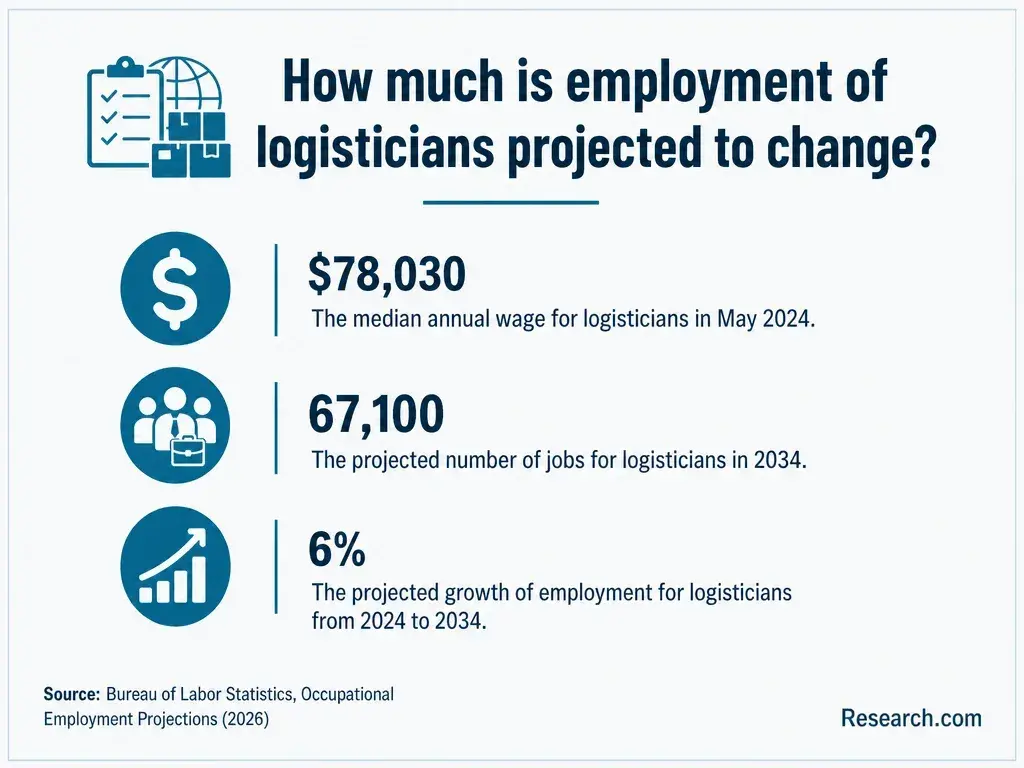
The U.S. Bureau of Labor Statistics reports a $82,320 median annual wage for logisticians in May 2025 and projects 18% employment growth from 2025 to 2035. That growth suggests substantial demand for the occupation, but the median includes experienced workers and is not a starting salary for someone with a new bachelor's degree. A purchasing assistant or inventory coordinator may also fall under a different occupation with different pay.
For a useful personal estimate, compare local postings for the exact entry-level title, their experience requirements, and their posted pay where available. Weigh those findings against your remaining education cost and time. Supply chain education costs and career prospects can provide another comparison, but neither national occupation figures nor a program's advertised outcomes predict your offer.
Do supply chain professionals need certifications or licenses?
Most entry-level purchasing, inventory, and logistics coordination roles do not require a general supply chain professional license. Voluntary certifications can signal knowledge, but eligibility rules, exams, experience expectations, and employer recognition vary by credential. Some specialized work - for example, regulated customs activities - has separate requirements that a business degree does not satisfy.
Read several target job postings before paying for a credential. If employers prioritize spreadsheets, purchasing-system experience, or industry knowledge, a relevant course and supervised work may be the better first investment. If you already have a bachelor's degree, targeted training or experience may be more direct than earning another one. Compare that choice with a business administration degree affordability duration and value guide, using your remaining requirements rather than an assumed return on either credential.
Other Things You Should Know About Business Administration
Yes. Use a public dataset, synthetic records, or a clearly labeled classroom scenario. State your assumptions and limitations, and do not describe simulated findings as employer results.
Not necessarily. Prioritize the tasks in your target postings. Trade documentation and cross-border rules matter more for import, export, and global logistics roles than for many domestic inventory positions.
Ask an instructor, internship supervisor, alumni contact, or local professional group for a short conversation about a specific role. Bring questions about daily tasks, tools, and skills to develop rather than asking for a job.
Usually, first determine whether your target job requires one. Relevant work experience and evidence of functional skills may be more useful for an initial supply chain role; revisit graduate study when you have a defined advancement goal.
- Applying Experiential Learning to Career Development... - PMC https://pmc.ncbi.nlm.nih.gov/articles/PMC8711830/
- Essential Data Analyst Skills to Land a Job in 2025 | Syracuse University https://ischool.syracuse.edu/data-analyst-skills/
- 10 Experiential Learning Examples for Graduate Students | Northeastern University Graduate Programs https://graduate.northeastern.edu/knowledge-hub/experiential-learning-examples/
- Bachelor of Science in Supply Chain Management | DeSales University https://www.desales.edu/programs/undergrad/supply-chain-management
- Supply Chain Careers: Jobs, Salary & How to Start | Northern Kentucky University Online https://onlinedegrees.nku.edu/programs/undergraduate/bsba/global-supply-chain-management/career-opportunities-salary-outlook/
- Supply Chain Management - Lehigh Catalog https://catalog.lehigh.edu/coursesprogramsandcurricula/businessandeconomics/supplychainmanagement/
- Experiential Learning | nyu.edu https://www.nyu.edu/students/student-information-and-resources/career-development-and-jobs/find-a-job-or-internship/experiential-learning.html
- Online BSBA in Supply Chain Management & Logistics | USC Upstate https://online.uscupstate.edu/degrees/undergraduate/bsba-supply-chain-management-logistics/
- Supply Chain Management | Iowa State University Catalog https://catalog.iastate.edu/previouscatalogs/2011-12/collegeofbusiness/supplychainmanagement/
- What Is Supply Chain Management? A Guide to Careers, Salaries & Certifications | UW-Stout Polytechnic https://www.uwstout.edu/programs/bs-supply-chain-management/what-is-supply-chain-management-guide