2027 Best Undergraduate Degrees With No Live Class Requirement

Co-Founder and Chief Data Scientist
Choosing an online degree is harder when your work schedule, caregiving duties, or time zone makes live classes unrealistic. A no-live-class undergraduate degree uses asynchronous coursework so you can study on your own schedule while still earning a legitimate credential.
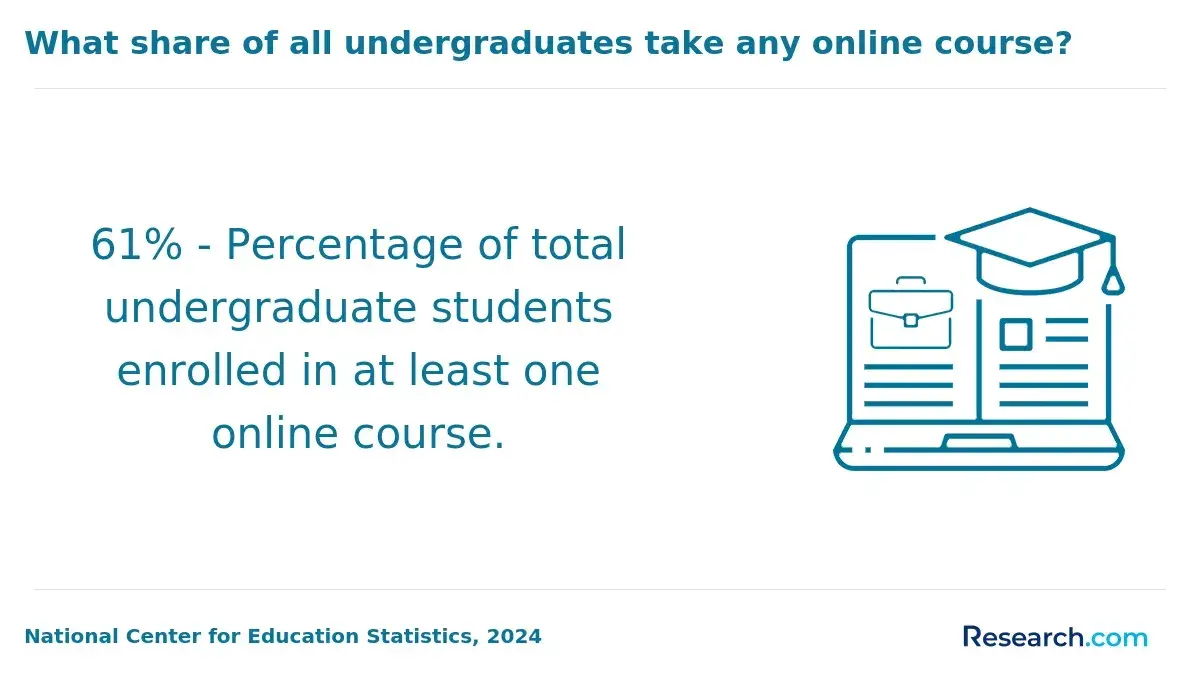
NCES reported in 2024 that 26% of U. S. undergraduates were enrolled exclusively in distance education in fall 2022, showing how common online-only study has become. This guide helps working adults, transfer students, military learners, and career changers compare majors, costs, accreditation, workload, and career outcomes before enrolling.
Key Things You Should Know
- No-live-class programs are usually asynchronous, meaning lectures, discussions, assignments, and quizzes are completed by deadlines rather than at scheduled meeting times; labs, clinicals, student teaching, internships, and proctored exams may still require fixed times or local placements.
- The best-fit majors for fully asynchronous study tend to be business, information technology, computer science, cybersecurity, psychology, criminal justice, and some healthcare administration programs because much of the coursework can be completed through readings, projects, simulations, and discussion boards.
- ROI depends more on accreditation, total net cost, transfer credits, and career alignment than on format alone; BLS reported 2024 median weekly earnings of $1,543 for bachelor's degree holders, compared with $930 for workers whose highest credential was a high school diploma.
Top 10 2026 Best Undergraduate Degrees With No Live Class Requirement
Business Degrees
Business is one of the strongest choices for a no-live-class undergraduate degree because coursework often centers on accounting, management, marketing, finance, analytics, and written case analysis. It fits students who want broad career flexibility or plan to move into supervisory roles.
Look for concentrations tied to a clear outcome, such as accounting, supply chain, human resources, or business analytics. If you need CPA eligibility, verify state credit-hour and accounting-course rules before enrolling.
Healthcare Degrees
Healthcare administration, health information management, public health, and health sciences can work well asynchronously when the program focuses on policy, operations, data, compliance, or management. These degrees are best for students who want healthcare careers without direct patient-care licensure.
Be cautious with programs that imply quick access to clinical roles. If your goal is nursing, radiologic technology, respiratory therapy, or another licensed field, confirm required clinical hours, state authorization, and placement support.
Information Technology Degrees
Information technology degrees are practical for asynchronous learners because many assignments involve labs, troubleshooting exercises, cloud platforms, networking tools, and documentation. IT is often better than computer science for students who want applied roles in systems administration, technical support, network operations, or IT project coordination.
Strong programs include hands-on labs, certification alignment, and career services that help students build a portfolio. Ask whether software, virtual labs, and exam vouchers are included in tuition.
Computer Science Degrees
Computer science is a strong option for self-directed students who enjoy programming, math, algorithms, databases, and software design. It can be completed asynchronously when lectures are recorded and coding projects are submitted through learning platforms.
This major fits students aiming for software development, quality assurance, data engineering, or graduate study. It may not fit learners who need frequent real-time tutoring, because debugging and abstract theory can be difficult without strong academic support.
Cybersecurity Degrees
Cybersecurity degrees often translate well to no-live-class formats because students can complete labs in virtual environments and learn through scenarios, risk assessments, and incident-response exercises. Look for coursework in networking, Linux, cloud security, scripting, governance, and digital forensics.
The best programs also prepare students for industry certifications. Avoid programs that skip foundational IT skills; many entry-level cybersecurity roles still expect networking, systems, or help desk experience before specialized security work.
Psychology Degrees
Psychology is a flexible asynchronous major for students interested in human behavior, research, social services, business, or graduate school. A bachelor's degree alone usually does not qualify graduates to become licensed psychologists, counselors, or therapists.
It can, however, support entry-level roles in case management, human services, behavioral health support, research assistance, and HR. Choose this major if you understand the graduate-school pathway and want strong writing, research, and interpersonal-systems training.
Nursing Degrees
Nursing requires special caution. Pre-licensure nursing programs cannot be fully asynchronous because students must complete supervised clinical hours and skills training. However, RN-to-BSN programs are often designed for licensed registered nurses and may have no live class requirement for academic coursework.
If you are already an RN, an asynchronous BSN can help with advancement. If you are not licensed, verify clinical placement, state board approval, and NCLEX eligibility before applying.
Education Degrees
Education degrees can include asynchronous coursework, but teacher licensure programs usually require field observations and student teaching during school hours. A fully asynchronous format may be easier for non-licensure tracks such as early childhood administration, instructional design, education studies, or paraprofessional advancement.
If your goal is classroom teaching, confirm that the program is approved for licensure in your state and that local placements are available near you.
Criminal Justice Degrees
Criminal justice is a good no-live-class option for students interested in law enforcement, courts, corrections, victim advocacy, emergency management, or policy. Coursework typically emphasizes legal systems, ethics, criminology, research, and report writing.
Some law enforcement roles do not require a bachelor's degree, so compare the degree against academy, civil service, and agency requirements in your state. This major is strongest when paired with internships, writing samples, data skills, or public administration coursework.
Engineering Degrees
Engineering is harder to complete with no live requirement because many programs require labs, team design projects, proctored exams, and sometimes campus residencies. Fully asynchronous options are more common in engineering technology, industrial technology, or completion programs for students with prior technical credits.
If you need professional engineering licensure later, check ABET accreditation and state board rules. Do not assume an online engineering-related degree has the same licensure pathway as an accredited engineering bachelor's.
What does it mean to earn an undergraduate degree with no live class requirement?
A no-live-class undergraduate degree is a college program that does not require students to attend scheduled real-time lectures, webinars, or class meetings. The common term is asynchronous online learning. Students usually watch recorded lectures, read materials, post in discussion boards, complete quizzes, submit projects, and meet weekly deadlines through a learning management system.
This format is not always the same as self-paced learning. In many asynchronous programs, you can choose when to study during the week, but you cannot ignore due dates. Some programs use eight-week or six-week terms, while others follow a traditional semester calendar.
The comparison below shows the differences students should understand before choosing a program. It matters because "online" does not always mean "no scheduled class meetings."
| Format | How it works | Best for | Main limitation |
| Fully asynchronous | Students complete coursework by deadlines without live meetings | Working adults, parents, military students, shift workers | Requires strong time management and independent learning |
| Synchronous online | Students attend scheduled virtual classes | Learners who want real-time discussion and instructor access | Less flexible for unpredictable schedules |
| Hybrid online | Online coursework is mixed with campus, lab, or field requirements | Students in clinical, teaching, lab, or technical fields | May require travel or daytime availability |
| Self-paced or competency-based | Students progress by demonstrating mastery, often within a subscription term | Experienced learners who can move quickly | Not ideal for students who need frequent structure |
Which types of undergraduate majors work best for fully asynchronous online study?
The best undergraduate majors for fully asynchronous study are those that rely heavily on reading, writing, coding, analysis, simulations, recorded demonstrations, and project-based assessment. Majors that require supervised practice, wet labs, studios, or live client interaction can still include asynchronous classes, but they are less likely to be entirely free of scheduled requirements.
This table summarizes which fields tend to fit the no-live-class model and where students should be careful. Use it as a first filter, not as a substitute for checking each school's catalog.
| Degree area | Asynchronous fit | Why it can work | Watch for |
| Business | High | Case studies, projects, accounting problems, and presentations can be submitted online | CPA, internship, or capstone requirements |
| Information technology | High | Virtual labs and cloud tools support hands-on learning | Software fees, lab access, and certification costs |
| Computer science | High | Coding, testing, and portfolio projects work well asynchronously | Math support and tutoring availability |
| Cybersecurity | High | Scenario labs and simulations can be completed remotely | Need for foundational IT experience |
| Psychology | Moderate to high | Research, writing, and theory courses adapt well online | Graduate degree requirements for licensed practice |
| Nursing | Low for pre-licensure; high for RN-to-BSN coursework | Licensed RNs can often complete theory courses online | Clinical, state board, and licensure requirements |
| Education | Moderate | Education studies and instructional design can work online | Student teaching and state licensure approval |
| Engineering | Low to moderate | Some engineering technology and completion programs offer online coursework | Labs, ABET accreditation, and licensure path |
As a rule, choose an asynchronous major when the learning outcomes can be demonstrated through projects, exams, papers, labs, and portfolios. Consider a hybrid program when the profession expects supervised practice before graduation.
How can you verify that a no-live-class online degree program is properly accredited?
Accreditation is the first quality check for any no-live-class degree. It affects credit transfer, financial aid eligibility, graduate school admission, employer recognition, and licensure pathways. The format of the class does not determine legitimacy; the institution's accreditation and, in some fields, the program's specialized accreditation do.
Before applying, verify accreditation through official sources rather than relying only on marketing language. Follow this sequence to reduce the risk of enrolling in a program that does not meet your goals.
- Confirm that the college or university is institutionally accredited by an accreditor recognized by the U.S. Department of Education or listed through CHEA-recognized channels.
- Check whether your field needs programmatic accreditation, such as AACSB or ACBSP for some business programs, ABET for engineering, CCNE or ACEN for nursing, CAEP for educator preparation, or specialized approval from a state licensing board.
- Ask whether the online program is covered under the same accreditation as the campus program and whether the transcript identifies the degree differently.
- For licensure fields, contact the state board where you plan to work and confirm that the program meets educational requirements there.
- Review transfer-credit policies, articulation agreements, complaint history, graduation data, and student support services before paying an enrollment deposit.
Red flags include vague claims such as "fully accredited" without naming an accreditor, pressure to enroll immediately, unusually large transfer-credit promises without transcript review, and programs that avoid written answers about licensure eligibility.
What are the typical admission requirements for fully asynchronous online bachelor's programs?
Admission requirements for fully asynchronous undergraduate programs vary by school, but many are designed for adult learners and transfer students. Bachelor's programs may admit first-year students, associate degree holders, military students, or adults with prior college credits. Completion programs often expect 45 to 90 transferable credits before upper-division coursework begins.
Most applicants should be ready to provide a core set of materials. Requirements are usually lighter than selective campus programs, but missing documents can delay transfer evaluation and financial aid packaging.
- Official high school transcript, GED record, or proof of prior college attendance
- Official transcripts from every college previously attended, even if credits were not completed successfully
- Minimum GPA requirement, often with conditional admission options for students below the standard threshold
- English placement, math placement, or prerequisite coursework for majors such as business, IT, computer science, nursing, or education
- Personal statement, resume, or work-experience documentation for adult-focused, competency-based, or degree-completion programs
- Technology requirements, such as reliable internet, webcam access for proctoring, updated computer hardware, and specific software
If application cost is a barrier, compare schools that offer a free online college application, but do not choose a program only because it is easy to apply. The bigger financial impact usually comes from transfer credits, tuition rate, fees, and time to completion.
How do tuition, fees, and financial aid compare for no-live-class degrees and campus programs?
No-live-class degrees can be cheaper than campus programs, but the savings are not automatic. Online students may avoid housing, commuting, meal plans, parking, and relocation costs, yet they may still pay technology fees, proctoring fees, course materials, lab platforms, or out-of-state online tuition rates.
College Board's 2024 Trends in College Pricing reported the following average published tuition and fees for full-time undergraduates. These figures are sticker prices, so students should compare them with net price after grants, scholarships, employer tuition benefits, and transfer credits.
- Public four-year in-state tuition and fees: $11,610
- Public four-year out-of-state tuition and fees: $30,780
- Private nonprofit four-year tuition and fees: $43,350
The table below shows the cost factors that most often change the real price of an asynchronous degree. It is useful because two programs with similar tuition can have very different total costs.
| Cost factor | Why it matters | Question to ask |
| Transfer credits | Accepted credits can shorten the degree and reduce tuition | How many credits will apply to my major, not just to electives? |
| Online tuition rate | Some schools charge a flat online rate; others charge by residency | Will I pay in-state, out-of-state, or a special online rate? |
| Fees | Technology, proctoring, graduation, and lab fees can add up | What is the estimated total program cost including fees? |
| Course materials | Textbooks, software, exam vouchers, and lab platforms may be separate | Are digital materials, simulations, or certification exams included? |
| Pace | Accelerated terms can reduce time away from full earning potential but increase weekly workload | How many courses can I realistically complete while working? |
Federal financial aid, state grants, scholarships, employer reimbursement, military education benefits, and payment plans may apply if the school is eligible and the student qualifies. Borrow only after estimating monthly payments and comparing the degree's likely career value with its total net cost.
What is the curriculum and workload like in fully asynchronous online bachelor's degrees?
Most online bachelor's degrees require about 120 credits, including general education, major courses, electives, and a capstone or applied project. Associate degrees usually require about 60 credits. The no-live-class format changes when you learn, not necessarily how much work the degree requires.
In a typical asynchronous course, students log in several times per week, watch recorded lectures, complete readings, post discussions, submit assignments, and take quizzes or exams. Many accelerated online programs use shorter terms, which can help students finish faster but compresses deadlines.
The workload is manageable when students plan around course intensity rather than just credit count. Use the sequence below before each term starts.
- Check every syllabus for weekly deadlines, major projects, exam windows, and required group work.
- Block recurring study times on a calendar before work, after work, or on days off.
- Prioritize writing-heavy, math-heavy, or lab-heavy courses by taking fewer of them at the same time.
- Use tutoring, library support, advising, and office-hour alternatives early instead of waiting until grades drop.
- Save portfolio projects, lab reports, presentations, and capstones for job applications or graduate school applications.
Common mistakes include assuming asynchronous means "do it whenever," taking too many accelerated classes at once, ignoring group-project deadlines, and enrolling without confirming whether exams require live proctoring.
What careers and entry-level roles can you pursue with a fully asynchronous bachelor's degree?
A fully asynchronous bachelor's degree can support many of the same entry-level roles as an on-campus degree when the institution is properly accredited and the curriculum matches employer expectations. Employers generally care about degree level, major relevance, skills, work samples, experience, and licenses more than whether lectures were live.
The table below connects popular no-live-class degree areas with entry-level roles and the practical evidence employers may want to see. It helps you choose a major based on job tasks rather than degree title alone.
| Degree area | Possible entry-level roles | Skills or evidence to build |
| Business | Management trainee, HR assistant, marketing coordinator, operations associate | Spreadsheets, presentations, reporting, project coordination, analytics |
| Accounting or finance | Staff accountant, billing analyst, payroll specialist, financial operations assistant | Accounting software, Excel, reconciliation, compliance awareness |
| Information technology | Help desk analyst, systems support specialist, network technician, IT coordinator | Troubleshooting labs, ticketing systems, networking basics, certifications |
| Computer science | Junior developer, QA tester, web developer, data support analyst | GitHub portfolio, coding projects, databases, testing, documentation |
| Cybersecurity | Security operations associate, GRC assistant, vulnerability management support | Networking, Linux, logs, risk assessment, security labs |
| Psychology or human services | Case management aide, behavioral health technician, research assistant, HR assistant | Research writing, ethics, interviewing, documentation, data basics |
| Healthcare administration | Patient services coordinator, medical office manager trainee, health data assistant | Healthcare regulations, scheduling systems, billing concepts, quality improvement |
If speed and earnings potential are major priorities, compare degree paths with fast online degrees that pay well, but remember that shorter completion time only helps if the credential is credible and aligned with a real labor-market need.
What salary ranges and job outlook can graduates of no-live-class degrees expect?
Salary outcomes vary by occupation, location, experience, industry, and whether the role requires licensure or advanced education. A no-live-class degree should not be viewed as a salary guarantee. It is better to compare the target occupation's median wage, growth outlook, required credentials, and competition level before choosing a major.
BLS 2024 wage data shows why major choice matters. The examples below are national medians for occupations commonly connected to undergraduate fields, not promises for new graduates.
| Occupation | Common degree connection | 2024 median pay | BLS 2024-2034 outlook |
| Software developers | Computer science or software development | $133,080 | Much faster than average |
| Information security analysts | Cybersecurity or information technology | $124,910 | Much faster than average |
| Medical and health services managers | Healthcare administration or business | $117,960 | Much faster than average |
| Accountants and auditors | Accounting or business | $81,680 | About as fast as average |
| Registered nurses | Nursing | $93,600 | About as fast as average |
Use salary data carefully. Some roles listed above may require experience beyond graduation, state licensure, certification, or a graduate degree for advancement. If your goal is earnings maximization, compare the curriculum and career path with lists of the highest paying majors, then weigh that against your academic strengths and tolerance for math, science, technical work, or licensure requirements.
How can working adults choose the best no-live-class online degree for their goals?
The best no-live-class online degree is the one you can finish, afford, and use. A prestigious-sounding major is not helpful if the schedule is unworkable, the credits do not transfer, or the program does not meet licensure rules in your state.
Use this step-by-step checklist before enrolling. It focuses on decisions that have the biggest effect on cost, completion, and career value.
- Define the target role first, then work backward to the degree, major, license, certification, or graduate-school requirement.
- Confirm institutional accreditation and any required programmatic accreditation before discussing price or start dates.
- Ask for a written transfer-credit evaluation showing which credits apply to the major, general education, and electives.
- Compare total net cost, not only tuition per credit, including fees, books, software, exams, travel, and lost work time.
- Review the course format to confirm there are no required live lectures, live group sessions, campus visits, or daytime field placements you cannot attend.
- Evaluate support services for asynchronous learners, including tutoring, advising, library help, tech support, career coaching, and disability accommodations.
- Ask for recent graduate outcomes, employer partnerships, internship options, certification pass support, and portfolio-building opportunities.
- Choose a realistic pace, especially if you are working full time or caring for family members.
Some students should consider a certificate before or alongside a degree, especially when they need a faster skills signal for IT, project management, bookkeeping, healthcare administration, or digital marketing. If you are testing a new field, compare degree options with easy licenses and certifications to get online before committing to a multi-year program.
Avoid enrolling based only on ranking, advertising, or a promise of speed. The strongest choice is usually an accredited program with transparent costs, generous transfer policies, relevant coursework, strong student support, and a format you can sustain until graduation.
Other Things You Should Know About
They can be, as long as the school is properly accredited and the degree matches the role. Employers usually focus on accreditation, major relevance, skills, experience, licenses, and work samples rather than whether online classes were live or recorded.
Sometimes. Accelerated terms, transfer credits, prior learning assessment, and competency-based formats can shorten the timeline. Faster is not always better, though; compressed courses require steady weekly time and strong self-discipline.
Some do. Even if there are no live classes, a program may require labs, clinicals, student teaching, internships, intensives, or proctored exams. Always ask for written confirmation before enrolling.
The easiest option depends on your strengths. Business, criminal justice, psychology, and general studies may feel more manageable for strong readers and writers, while IT or computer science may fit students who prefer technical projects. Choose based on career goals, not ease alone.
References
- How to Pay for College - Perspectives & Insights Article | D.A. Davidson https://www.dadavidson.com/Perspectives-Insights/Perspectives-Insights-Article/ArticleID/7061/How-to-Pay-for-College
- What Is the Cost of Attendance and What Does It Include for Student Loans? https://www.lendkey.com/blog/general/what-is-the-cost-of-attendance-and-what-does-it-include-for-student-loans/
- Financial Aid Terms | PA State System of Higher Education https://www.passhe.edu/students/financial-aid-terms.html
- Fostering Fun: Engaging Students with Asynchronous Online Learning https://www.facultyfocus.com/articles/online-education/online-student-engagement/fostering-fun-engaging-students-with-asynchronous-online-learning/
- Top Degrees in Demand for the Future: 2026 & Beyond https://skillifysolutions.com/blogs/career-growth/top-degrees-in-demand-for-the-future/
- Average Cost of College [2025]: Yearly Tuition + Expenses https://educationdata.org/average-cost-of-college
- 2025 Most Affordable Online Colleges & Degrees https://www.onlineu.com/most-affordable-colleges
- How To Pay for College Without Financial Aid: Strategies and Tips https://www.dandarahwealthmanagement.com/blog/how-to-pay-for-college-without-financial-aid-strategies-and-tips
- Best Accredited Online Universities in 2025 https://www.study.eu/article/best-accredited-online-universities
- Best Online Degrees for Working Adults in 2026 https://www.straighterline.com/blog/degreecompletion-best-online-degrees-for-working-adults-in-2026