
2027 Best Two-Year Degrees With No Application Fee

Co-Founder and Chief Data Scientist
An application fee should not keep you from exploring an associate degree - but a free application does not make every program a good fit. College Board reported average 2024-25 tuition and fees of $4,050 for full-time, in-district students at public two-year colleges, making the larger cost of enrollment far more important than the cost of applying.
This guide is for students comparing career-focused and transfer-focused degrees. It identifies promising fields, names colleges where applications are free, and shows what to verify before committing to a program.
Key Things You Should Know
- Best depends on your goal: Business and psychology can support transfer; IT and some healthcare programs can prepare students for work; nursing adds a separate, competitive admission and licensing path.
- Plan beyond the application: Many associate degrees require about 60 credits, while prerequisites, clinical schedules, course availability, and part-time enrollment can extend completion beyond two years.
- Check the occupation, not just the degree: The U.S. Bureau of Labor Statistics reported a May 2024 median annual wage of $93,600 for registered nurses, but an associate nursing degree alone does not confer an RN license or predict an individual graduate's pay.
Top 10 Best Two-Year Degrees With No Application Fee
Business Programs
An Associate of Arts (AA) or Associate of Science (AS) in business administration often emphasizes accounting, economics, and general education for transfer to a bachelor's program. An Associate of Applied Science (AAS) may emphasize workplace software and operations for entry-level office roles. Choose the transfer route if your target job usually calls for a bachelor's degree; choose an applied program if its courses match the work you want to seek sooner. Before applying, confirm that the college offers your preferred business concentration and that intended transfer courses will count toward your bachelor's major.
Healthcare Programs
Healthcare associate degrees vary sharply. An applied degree in radiography or respiratory care can lead toward a defined occupation, but admission may be selective and clinical placements are typically in person. A general health sciences AS may instead prepare students to transfer or apply to a specialized program; it is not itself a clinical credential. Compare required science prerequisites, programmatic accreditation where applicable, clinical travel, and eligibility for the certification or license required in the state where you intend to work.
Information Technology Programs
IT associate degrees may cover networking, cybersecurity, programming, or technical support. An AAS can emphasize hands-on job skills; an AS may offer a clearer transfer route, depending on the college's agreements. Neither a degree title nor an included certification-preparation course guarantees a job or a passing exam score. Compare labs, current tools, internship access, and whether certification exam fees are included. If you plan to transfer, check how technical courses apply to the destination bachelor's degree.
Nursing / Pre-Nursing Programs
An Associate Degree in Nursing (ADN) is a route toward registered nursing, subject to state board eligibility and passing the NCLEX-RN. College admission and ADN admission are often separate: science prerequisites, grades, testing, background checks, and limited clinical seats may apply. Pre-nursing coursework prepares applicants but does not guarantee an ADN place. Verify nursing-program accreditation, state board approval, clinical scheduling, and any transfer pathway before enrolling in prerequisites - especially if you hope to continue toward a bachelor's degree in nursing.
Criminal Justice Programs
A criminal justice AA or AS commonly supports transfer through courses in law, government, and social science. An AAS may emphasize procedures used in public safety or corrections. The degree does not replace an employer's hiring standards, academy training, background investigation, or state certification where required. Ask whether local employers value the applied credential or whether a transfer-oriented program better supports your target role. For some applicants, an academy or employer training route may be more direct.
Psychology / Counseling Programs
A psychology AA or AS generally builds a transfer foundation through research, statistics, and human-behavior courses. Some applied human-services programs include supervised fieldwork and may support entry-level support roles. Neither path independently qualifies a graduate to practice as a licensed counselor or psychologist; those careers require substantially more education and other state-specific steps. Choose this field if its transfer agreement or supervised experience advances a specific goal, and check the requirements of the bachelor's program or employer you have in mind.
What Are the Best Two-Year Degrees With No Application Fee?
The best two-year degree with no application fee is the degree that fits your goal at a college that does not charge you to apply. "No application fee" describes a college's application policy, not a special type of degree or a waiver of later charges. Start with your intended occupation or bachelor's major, then compare programs on admission, total cost, delivery, and outcomes. For a broader school search, see these free application online colleges; confirm that the particular associate program you want is offered.
The comparison below shows where each field is strongest and the requirement most likely to change your decision.
| Degree field | Strongest fit | Decision-critical check |
| Business | Transfer or general office preparation | Whether courses apply to your intended bachelor's major |
| Healthcare | A defined clinical career or a transfer pathway | Clinical requirements and credential eligibility |
| Information technology | Technical entry-level work or transfer | Hands-on training and transfer treatment of technical credits |
| Nursing | Preparation for RN licensure | Separate ADN admission and state board approval |
| Criminal justice | Public-safety foundation or transfer | Employer and academy requirements |
| Psychology | Transfer toward further study | Education required for your eventual occupation |
AA and AS degrees are often transfer-oriented, while AAS degrees are often designed for workforce preparation; the college's curriculum and agreements matter more than the abbreviation. If you need a narrowly defined skill rather than an associate degree, compare certificates or apprenticeships before enrolling.
Which Accredited Colleges Offer Two-Year Degrees Without Application Fees?
Dallas College, Northern Virginia Community College (NOVA), and Austin Community College (ACC) are examples of institutionally accredited public colleges that advertise free applications and offer associate-degree options. Their inclusion is not a ranking or a claim that every major has open admission. Application policies and program availability can change, so confirm both on the college's admissions and program pages before applying.
These examples give you a starting point for comparing a free application with the degree and admission process you actually need.
| College | Associate-degree options to investigate | What to confirm before applying |
| Dallas College, Texas | Business, IT, and nursing pathways | Current application policy, campus or online availability, and separate nursing admission |
| Northern Virginia Community College, Virginia | Business, IT, criminal justice, and health pathways | Program-specific requirements and whether courses meet your transfer goal |
| Austin Community College, Texas | Business, IT, and health pathways | Residency-based tuition, program availability, and selective-admission steps |
All three are accredited by the Southern Association of Colleges and Schools Commission on Colleges. Institutional accreditation is one check; for a regulated healthcare field, also examine the relevant program accreditation and state approval. A free general college application does not rule out charges for tests, background checks, or other program requirements.
How Much Do Two-Year Degrees With No Application Fee Cost?
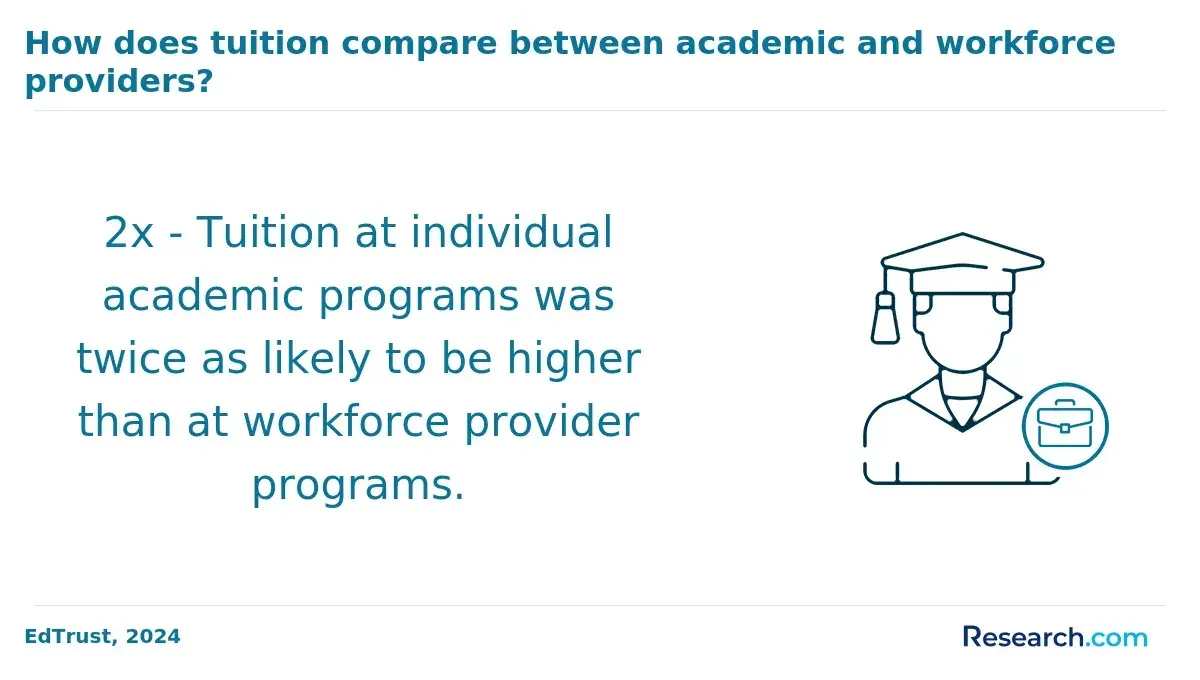
A free application saves only the application charge. The larger comparison is total cost to finish: tuition, mandatory fees, books and supplies, transportation or technology, and any lab, clinical, testing, or licensing expenses. College Board's 2024-25 public two-year in-district average of $4,050 in tuition and fees is a useful benchmark, not a quote for any school or a full-program price. Out-of-district rates and taking more than two years can substantially change the bill.
Ask each college for a program-specific estimate based on your residency, expected course load, and remaining credits. Then compare financial aid eligibility, scholarships, employer assistance, and the net amount you would pay. If cost is your main constraint, this guide to cheapest online colleges that accept FAFSA can widen your search; verify associate-degree availability and aid eligibility for the specific program. Do not choose a low per-credit rate without accounting for required fees and courses.
What Admission Requirements Apply to Two-Year Degree Programs?
Many community colleges admit applicants who have a high school diploma or equivalent, though they may use transcripts or placement information to identify appropriate starting courses. Admission to the college is not admission to every major. Nursing and other clinical programs may require prerequisite sciences, minimum grades, tests, immunizations, and a separate competitive application. Even when the general application is free, those later steps can have costs.
Before submitting applications, use this short sequence to avoid paying for courses that do not advance your goal:
- Check the current application-fee policy and any separate major application process.
- Request a written review of previous college credits and ask which credits satisfy degree requirements.
- Confirm prerequisites, selective-admission deadlines, and the earliest term you could enter major courses.
- If transfer is your goal, ask the destination university how each planned course will apply to your bachelor's requirements.
A typical associate degree requires about 60 credits, but accepted transfer work, prerequisites, course sequencing, and enrollment intensity determine your actual timeline. Ask for a term-by-term plan rather than assuming "two-year" is a completion promise.
Are Online Two-Year Degrees as Valuable as Campus-Based Programs?
Yes, an online associate degree can be as useful as a campus-based one when the institution is appropriately accredited and the program fits the same transfer, employment, or licensure goal. Delivery format does not erase practical requirements: an online nursing or allied-health student may still need in-person clinical work, while an online IT student may need scheduled labs or proctored assessments.
Compare the actual timetable, not just the "online" label. Asynchronous courses can allow more control over study hours but still have deadlines; scheduled live sessions can be difficult around work. If you are considering online colleges, confirm whether the exact associate program is offered online, where any in-person components occur, and whether the credential meets requirements in your state. Campus study may be preferable when you need regular access to equipment, clinical sites, or face-to-face support.
What Do Students Learn in Two-Year Degree Programs?
Most associate degrees combine general education - such as writing, mathematics, and social science - with courses in a major. Business students may study accounting and management; IT students may practice networking or programming; and criminal justice students may examine legal systems. Clinical degrees add specialized science, labs, and supervised practice. The mix matters because it determines both what you can do next and which credits might transfer.
Read the required course sequence before choosing a school. A transfer-focused curriculum may leave less room for occupation-specific practice, while an applied curriculum may include technical courses that a bachelor's program accepts only as electives. The right choice depends on whether your next step is employment, further study, or both.
What Jobs Can You Get With a Two-Year Degree?
Possible entry-level paths include office and administrative support, IT support, and certain human-services support roles, depending on the program, employer, and your skills. Occupation-specific healthcare degrees may prepare students to seek roles such as registered nurse, radiologic technologist, or respiratory therapist - but only after meeting the applicable examination, certification, and licensing requirements. A general health sciences or pre-nursing degree should not be mistaken for one of those occupation-specific credentials.
Work backward from job postings in your area: compare required education, software or clinical skills, credentials, and experience with the program's actual curriculum. For psychology or counseling goals, plan for further education; an associate degree is generally a first step, not a counseling qualification. Avoid selecting a major solely because its title resembles the job you want.
How Much Can You Earn With a Two-Year Degree?
Earnings depend on the occupation, location, employer, experience, and credentials - not simply on holding a two-year degree. The U.S. Bureau of Labor Statistics reported a May 2024 median annual wage of $93,600 for registered nurses. That figure covers employed RNs with varied education and experience; it is not a salary forecast for new ADN graduates. It is useful only if you also account for nursing-program admission, graduation, NCLEX-RN, and licensure.
To judge whether a program is worth its cost, compare the full amount you expect to pay and any borrowing with realistic local entry-level openings. A lower-cost transfer degree can be a strong choice if it avoids repeating credits later; a higher-cost clinical program may be reasonable if its credential requirements and placement opportunities fit your goal. Neither outcome is guaranteed.
Do Two-Year Degree Careers Require Licenses or Certifications?
Some do; others do not. Registered nursing requires state licensure after an approved education pathway and the NCLEX-RN. Radiography and respiratory care can involve state licensing and professional certification requirements. IT certifications are often optional credentials requested by particular employers, while public-safety roles may have academy or state-certification requirements separate from college coursework.
Psychology and counseling require particular caution: an associate degree does not qualify someone for independent clinical practice. Licensed counseling generally requires graduate education and additional supervised and examination requirements set by the state. If that is your long-term goal, compare later bachelor's and graduate pathways, including most valuable masters degrees, against the actual requirements of your state licensing board. Before enrolling in any regulated program, confirm that its accreditation, approval, and curriculum support the credential you intend to pursue where you plan to work.
Other Things You Should Know About
No. It means the college does not charge for that application. Tuition, mandatory fees, materials, and possible program-specific expenses still apply.
A college may have a free general application while its nursing program has a separate application, requirements, or related costs. Check both processes and deadlines.
It can, but a free application says nothing about transferability. Confirm how individual courses will satisfy requirements in your intended bachelor's program.
Possibly, depending on the program, course schedule, and your enrollment pace. Clinical placements or other in-person requirements may apply, and part-time study or prerequisites can extend the timeline.
References
- Recognition of Accrediting Agencies | Texas Higher Education Coordinating Board https://www.highered.texas.gov/recognition-of-accrediting-agencies/
- An Overview of Accreditation of Higher Education in the United States | congress.gov https://www.congress.gov/crs-product/R43826
- DAPIP | Homepage - Office of Postsecondary Education (OPE) https://ope.ed.gov/dapip/
- Policy on Programmatic Accreditation - The University of Kansas https://services.ku.edu/TDClient/818/Portal/KB/ArticleDet
- Cost of Attendance (COA) | University of Illinois Chicago https://financialaid.uic.edu/cost/cost-attendance-coa/
- Cost of Attendance - Financial Aid and Scholarships | The University of Utah https://financialaid.utah.edu/tuition-and-fees/cost-of-attendance.php
- How to Apply - The City University of New York https://www.cuny.edu/admissions/undergraduate/apply/
- Explanation of Fees | University of North Texas https://studentaccounting.unt.edu/explanation-fees.html
- What Career Paths Can I Pursue With an Associate Degree? - mwcc https://mwcc.edu/blog/career-paths-to-pursue-with-an-associate-degree/
- Transfer Credit Policy | Pace University New York - Academic Catalog https://catalog.pace.edu/undergraduate/academic/academic-policies-general-regulations/transfer-credit-policy/


