
2027 Best Two-Year Degrees for High-Paying Careers

Co-Founder and Chief Data Scientist
Choosing a two-year degree for a high-paying career means looking beyond the program name: Does it lead to an occupation you can enter, and what must you do after graduation? The U.S. Bureau of Labor Statistics (BLS) reports a 2024 median annual wage of $94,260 for dental hygienists, an occupation that typically requires an associate degree and state licensure.
That figure describes workers in the occupation - not new graduates or a guaranteed outcome. This guide compares realistic degree paths, explains their costs and requirements, and helps you identify which programs are worth investigating.
Key Things You Should Know
- Strong wage potential: BLS reports 2024 median annual wages of $94,260 for dental hygienists, $93,600 for registered nurses, and $89,340 for diagnostic medical sonographers. These are occupational medians, not associate-degree graduate salaries.
- Best direct-entry candidates: Accredited dental hygiene, diagnostic medical sonography, and associate degree nursing programs have clearer paths to well-paid occupations than broad transfer majors, but admission, clinical training, and licensure requirements can be substantial.
- Compare the complete path: A lower-cost or online degree is not necessarily the better choice if it lacks required clinical placements, does not meet state licensing rules, or leaves credits that will not apply to your intended bachelor's degree.
Top 10 Best Two-Year Degrees for High-Paying Careers
Business Programs
An Associate of Science (AS) in accounting or an Associate of Applied Science (AAS) in business administration can prepare students for bookkeeping, payroll, or administrative work. An Associate of Arts (AA) in business is often a better fit for students planning to transfer into a bachelor's program. These are flexible starting points, not reliable shortcuts to high-paying management roles: those positions commonly require experience or further education. Compare employer connections and transferable credits before choosing between immediate employment and a transfer pathway.
Healthcare Programs
Career-focused associate programs in dental hygiene, diagnostic medical sonography, respiratory therapy, and radiologic technology offer comparatively direct routes into specialized healthcare work. Their appeal is strong occupational wage potential, but admission can be selective, and programs typically include labs and supervised clinical experience. Required accreditation, examinations, and state rules differ by occupation. Check whether graduates are eligible for the credential needed where you intend to work; a general healthcare studies degree is not interchangeable with an occupation-specific program.
Information Technology Programs
An AAS in networking, cybersecurity, software development, or information systems can support entry-level technical work, especially when paired with projects, internships, or relevant certifications. An AS in computer science may be preferable if a bachelor's degree is the goal. Pay varies considerably by role and experience; an associate degree alone does not qualify someone for every cybersecurity or software position. Look for current equipment, opportunities to build a portfolio, and evidence that the curriculum matches local job postings.
Nursing / Pre-Nursing Programs
An associate degree in nursing (ADN) can provide an entry path to registered nursing after graduates meet state requirements and pass the NCLEX-RN. Pre-nursing is different: it usually covers prerequisites and does not itself qualify students for RN licensure. Nursing applicants should check separate program admission standards, clinical placement availability, approval by the state nursing board, and whether an RN-to-BSN agreement supports later advancement. Some employers prefer or require a bachelor's degree for particular nursing positions.
Criminal Justice Programs
An AA or AS in criminal justice often serves students planning to transfer; an AAS may emphasize public safety or corrections skills. Neither degree automatically qualifies someone to become a police officer or investigator. Agencies set their own hiring standards, and officers generally complete academy training. Choose this path for a specific agency requirement or a mapped bachelor's route - not because a degree title appears to lead directly to a high-paying investigative role.
Psychology / Counseling Programs
An AA or AS in psychology is usually a transfer degree. It can introduce counseling theory and research methods, but licensed counselor and psychologist roles require substantially more education and supervised training. Some graduates seek entry-level human-services support work, subject to employer requirements and typically lower pay than licensed roles. Choose this major when you have a credible bachelor's transfer plan; if you want to enter the workforce after two years, compare occupation-specific allied-health programs instead.
What Are the Best Two-Year Degrees for High-Paying Careers?
For a student seeking a relatively direct path from an associate program to a specialized occupation, dental hygiene, diagnostic medical sonography, and associate degree nursing are strong options to compare. "Best" depends on admission odds, clinical access, licensing eligibility, total cost, and whether you want the day-to-day work - not occupational pay alone.
This comparison separates direct-entry paths from broader degrees that may need further training. The wage figures are BLS 2024 medians for everyone working in each occupation, including experienced workers.
| Degree path | Potential occupation | 2024 occupational median wage | Key qualification to verify |
| Dental hygiene associate degree | Dental hygienist | $94,260 | Program accreditation and state licensure eligibility |
| Associate degree in nursing | Registered nurse | $93,600 | State board approval and NCLEX-RN eligibility |
| Diagnostic medical sonography associate degree | Diagnostic medical sonographer | $89,340 | Clinical training and employer-preferred credentials |
| Business, criminal justice, or psychology transfer degree | Varies by later education and work experience | Not comparable as a single occupation | Credits that apply to the intended bachelor's degree |
These paths suit different goals. If patient-facing work or selective clinical admission is a poor fit, an IT program with substantial hands-on work may be more useful than pursuing the highest wage in the table. If your goal is research or a licensed psychology career, plan for education well beyond an associate degree; even a PhD online is a later-stage option, not an alternative two-year credential.
How Much Do Two-Year Degree Graduates Earn?
There is no single useful salary figure for all associate-degree graduates. Earnings depend on occupation, location, experience, shift, employer, and whether a graduate completes required licensing or further education. BLS occupational medians describe workers already employed in a role; they should not be read as starting salaries or proof that the degree caused their pay.
For a realistic return-on-investment comparison, look at entry-level job postings in the area where you intend to work. Then compare likely pay with tuition, fees, equipment, commuting, and income you may give up during clinical training. Broad business or psychology degrees can be valuable transfer foundations, but using the salary of a manager or licensed psychologist to estimate an associate graduate's immediate earnings would be misleading. Later credentials, including online affordable master's programs, involve additional time and cost that belong in any long-term earnings calculation.
Which Two-Year Careers Have the Strongest Job Outlook?
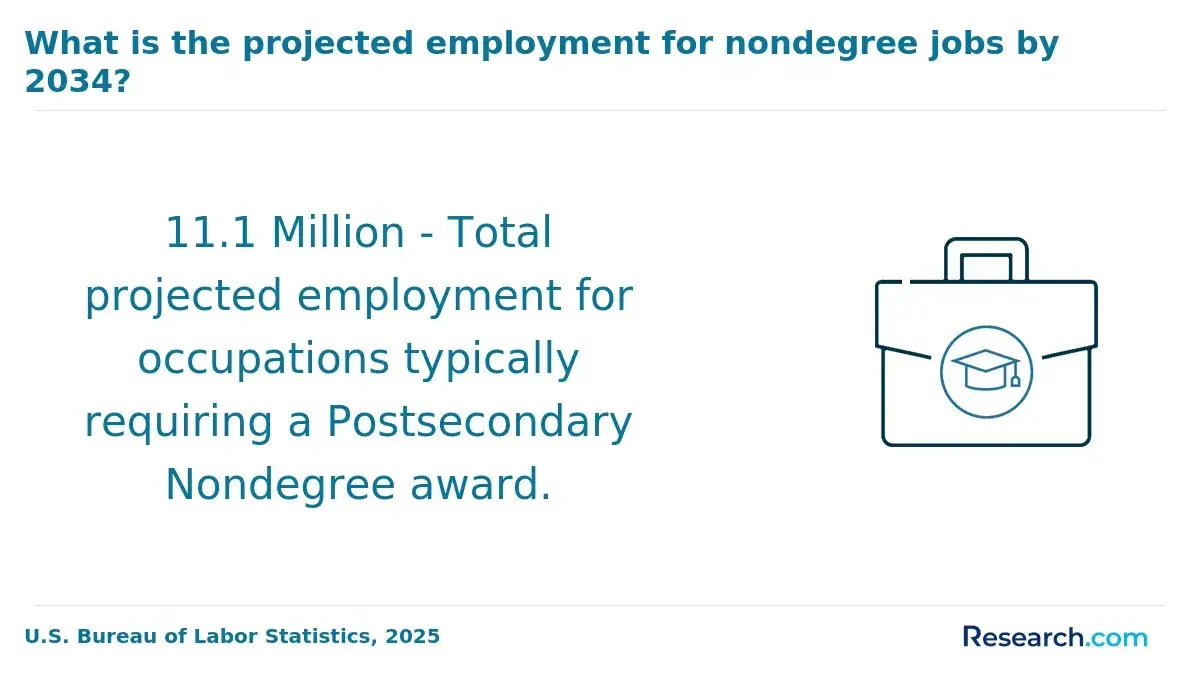
Healthcare occupations offer several clear associate-level pathways, but national projections cannot tell you whether local employers will have openings when you graduate. In its 2024-2034 projections, BLS expects diagnostic medical sonographer employment to grow 13%. That makes sonography worth investigating for students who can meet its clinical and credential requirements; it does not make admission or employment automatic.
Demand also needs to be weighed against working conditions. Nursing may involve nights and weekends, while dental hygiene can involve repetitive physical work. For IT, compare the exact skills in local postings rather than assuming every technology job accepts an associate degree. Before enrolling, ask a program which employers host its clinical placements or internships and what roles recent completers actually sought.
What Courses Do High-Paying Two-Year Degree Programs Include?
Most associate programs combine general education with major courses. An AS or AA commonly emphasizes coursework intended for transfer; an AAS commonly emphasizes occupational preparation. The designation is a clue, not a guarantee of either transfer or employment.
Dental hygiene and sonography typically include anatomy, specialized technical instruction, labs, and supervised clinical work. Nursing adds sciences, nursing practice, and clinical rotations. IT programs may cover networking, programming, security, and applied projects. Check the published course sequence: a prerequisite offered only once a year can delay graduation, and a lecture delivered online does not make its lab or clinical component optional.
Do High-Paying Two-Year Careers Require Licensure or Certification?
Registered nurses must meet state board requirements and pass the NCLEX-RN; dental hygienists must satisfy state licensing rules. Sonography and other allied-health employers may expect particular professional credentials, while applicable state requirements vary. In IT, certification can help demonstrate a skill but is not a universal legal requirement for employment.
Before paying an enrollment deposit, obtain written confirmation of which examinations the program prepares students for, whether its graduates are eligible to take them, and whether that preparation meets rules in your intended state. Be wary of a program that advertises occupational pay without clearly identifying the credential or supervised experience needed to enter the role.
How Long Do Two-Year Degree Programs Take and Cost?
Many associate degrees require roughly 60 semester credits, but prerequisites, selective admission, clinical schedules, part-time enrollment, and course availability can extend the calendar well beyond two years. Ask whether the advertised timeline starts when you enter college or only after you have completed prerequisites and secured a seat in the major.
As a benchmark, the College Board reported average published tuition and fees of $4,050 for in-district students at public two-year colleges in 2024-2025. That is a one-year sticker-price average, not the total price of a degree. Add mandatory program fees, books, supplies, uniforms, examinations, transportation, and living expenses; compare your likely financial aid and net cost. A cheaper college that cannot offer required courses when you need them may ultimately cost more.
Are Online Two-Year Degrees as Valuable as Campus Programs?
They can be when the institution is accredited, the program meets your career requirements, and you can complete every required component. Online business, psychology, and some IT coursework may fit students who need remote access. Nursing and allied-health students should expect in-person labs, clinical placements, or both, even if lectures are online.
Ask whether online courses are asynchronous, whether exams require scheduled attendance, and who arranges local experiential placements. Students considering accredited self-paced online courses for general education should first get written confirmation that the credits will satisfy their chosen degree's requirements. Flexibility matters only if the courses keep you on track to finish.
What Are the Admission Requirements for Two-Year Degree Programs?
Colleges commonly request a high school diploma or equivalent, transcripts, and placement information. Admission to a college does not guarantee admission to a competitive nursing, dental hygiene, or sonography cohort. Those programs may separately require science prerequisites, minimum grades, health documentation, background checks, or an entrance assessment.
Ask admissions staff for the major's requirements and the next available start date - not just the college's general acceptance policy. A student concerned about grades should also distinguish associate admissions from requirements at a possible later institution: resources on online graduate programs that accept 2.0 GPA concern a different stage of education and do not establish eligibility for a selective associate program.
How Can You Choose an Accredited Two-Year Degree Program?
Start by confirming institutional accreditation through the accreditor or the U.S. Department of Education's recognition information. For regulated healthcare work, also verify any relevant programmatic accreditation, state approval, and graduate eligibility for required examinations. Institutional accreditation alone may not answer those occupation-specific questions.
Next, request the full course sequence and an itemized cost estimate. Compare clinical or internship arrangements, recent examination results where published, and the school's process for evaluating transfer credit. If you intend to earn a bachelor's degree, confirm with the destination institution that credits will apply to your intended major, not merely transfer as electives. The strongest choice is the program whose verified requirements fit your career goal, budget, and ability to complete it.
Other Things You Should Know About
Some occupations have associate-level entry paths, but the degree may be only one requirement. Dental hygiene and registered nursing, for example, also require licensure. Pay varies by job and experience.
An occupation-specific, career-focused program is usually easier to evaluate for direct entry than a broad transfer major. Compare its licensing eligibility, local openings, and total cost with the work you actually want to do.
Not inherently. An AAS often focuses on workforce skills, while an AA or AS may better support transfer. Earnings depend on the occupation and qualifications you attain, not the degree abbreviation.
Usually not if the program requires hands-on labs or supervised clinical experience. Check each program's in-person requirements and who is responsible for securing a placement.
References
- Fast Facts: Tuition costs of colleges and universities (76) | ed.gov https://nces.ed.gov/fastfacts/display.asp
- Same occupation, different pay: How wages vary: Career Outlook | bls.gov https://www.bls.gov/careeroutlook/2015/article/wage-differences.htm
- After Everything: Projections of Jobs, Education, and Training Requirements through 2031 - CEW Georgetown https://cew.georgetown.edu/cew-reports/projections2031/
- College Price - AACC https://www.aacc.nche.edu/category/news/datapoints/college-price/
- Transfer Glossary | NCCCS https://www.nccommunitycolleges.edu/transfer-glossary/
- Career earnings by college major - The Hamilton Project https://www.hamiltonproject.org/data/career-earnings-by-college-major/
- 20 In-Demand Jobs You Can Get With a Two-Year Degree | bestcolleges.com https://www.bestcolleges.com/blog/in-demand-jobs-you-can-get-with-a-two-year-degree/
- What Is an Associate Degree? Requirements, Costs, and More | Coursera https://www.coursera.org/articles/what-is-an-associate-degree-key-information-to-know


