2027 Best Online Associate Degree Programs for Remote Jobs

Co-Founder and Chief Data Scientist
Choosing an online associate degree for remote work starts with a question: Can you do the work from home, and will employers consider you for it? The U.S. Bureau of Labor Statistics projects employment of medical records specialists to grow 7% from 2024 to 2034, illustrating demand in one remote-capable field - but not a promise of remote openings. This guide compares six degree fields by career fit, in-person requirements, cost, and credentials, so you can choose a path that matches the jobs you intend to pursue.
Key Things You Should Know
- For a direct route to remote-capable entry-level work, compare health information, bookkeeping-focused business, and IT support programs against actual job postings; none guarantees a work-from-home position.
- The 2024 median wage for medical records specialists was $50,250, according to the U.S. Bureau of Labor Statistics. That is an occupational figure, not an expected salary for associate degree graduates or remote workers.
- Check delivery details before enrolling: an online program may still require scheduled classes, local placements, campus labs, or exams.
Top 10 Best Online Associate Degree Programs for Remote Jobs
Business Programs
An online associate degree in accounting or business administration can prepare students for bookkeeping, billing, payroll support, and customer operations roles that some employers offer remotely. Accounting-focused coursework is usually a closer match for transaction-based work; broad business programs offer more flexibility if you plan to transfer. Look for spreadsheet and accounting-software practice, not just general management courses. Remote entry-level openings may require experience or set working hours, and bookkeeping duties are changing as software automates routine entries.
Healthcare Programs
Health information technology, medical coding, and healthcare administration associate programs can lead toward records, coding, claims, or patient-access work that may be done remotely. Coding employers often prefer certification and healthcare experience; patient-facing roles may require scheduled shifts and confidential workspace. Compare courses in medical terminology, electronic health records, privacy, and reimbursement. Verify whether any practicum is required and whether the curriculum meets the eligibility rules of the credential you want. Clinical allied-health degrees are a poorer match if you need the job itself to be remote.
Information Technology Programs
An associate degree in information technology, computer information systems, or cybersecurity can build skills for help desk, software support, and technical documentation roles. Some support teams operate remotely, but hardware repair and on-site troubleshooting cannot be done entirely from home. Favor programs with hands-on labs, ticketing systems, networking, and a portfolio-worthy project. Cybersecurity courses are useful, but a degree alone rarely makes an applicant competitive for specialized security positions without relevant IT experience.
Nursing / Pre-Nursing Programs
Pre-nursing associate coursework is generally a transfer or admissions pathway, not a nursing license or a direct route to remote work. An associate degree in nursing prepares students for licensure, but required labs and clinical placements occur in person; graduates must also meet state requirements and pass the licensing exam to practice as registered nurses. Some nursing jobs, including utilization review or care coordination, may offer remote work, typically after clinical experience. Choose this path if you want nursing practice first, not immediate work-from-home employment.
Criminal Justice Programs
An online criminal justice associate degree can support applications for records, compliance support, or administrative positions, but many core public-safety jobs require on-site work, agency training, and separate hiring qualifications. A transfer-oriented program may make more sense if your goal requires a bachelor's degree. Before enrolling, compare the curriculum with actual remote postings: courses in report writing, research, and records systems may be more useful for desk-based work than field-focused electives. Do not assume the degree qualifies you for an investigator role.
Psychology / Counseling Programs
An online psychology or human services associate degree can introduce counseling concepts and prepare students for some support or administrative roles. It does not qualify graduates to practice independently as counselors or therapists; those careers generally require further education, supervised experience, and state licensure. Telehealth counseling is therefore a long-term possibility, not an immediate associate-degree outcome. Choose an articulated transfer pathway if licensure is your goal, and confirm how its courses apply to your intended bachelor's program.
What online associate degrees lead to remote jobs?
Health information, accounting-focused business, and IT degrees offer the clearest connection to tasks that employers may assign remotely. "Remote-capable" describes the work, not a guarantee that an entry-level employer will offer a home-based position. Compare fields by the first job you could realistically seek, not by a distant career title.
This comparison separates likely starting points from their main limitations, so you can narrow your search before evaluating schools.
| Degree field | Remote-capable starting point | Important limitation |
| Health information or coding | Records or claims support | Coding roles may require certification or experience |
| Accounting or business | Billing, bookkeeping, or payroll support | Software proficiency and experience can matter more than a broad degree title |
| Information technology | Help desk or software support | Some support duties require on-site hardware access |
| Criminal justice | Records or administrative support | Many public-safety roles are inherently on-site |
| Nursing or psychology | Longer-term clinical or support pathways | Remote clinical roles commonly require further credentials or experience |
Associate of Arts (AA) and Associate of Science (AS) programs often emphasize transfer, while Associate of Applied Science (AAS) programs often emphasize workforce skills; schools differ. If target postings consistently require a bachelor's degree, compare an articulated associate pathway with 2 year accelerated bachelor degrees. Check admission and transfer-credit assumptions before treating an advertised timeline as achievable.
Which remote jobs can you get with an associate degree?
Potential targets include medical records support, billing assistant, bookkeeping clerk, help desk technician, and customer support specialist. Whether any opening is remote depends on the employer, location rules, schedule, and your experience - not simply your degree title.
Read postings for the same role across several employers. Note required software, credentials, experience, and whether "remote" still requires occasional office attendance. A school's career services or job board can help with the search, but neither demonstrates that graduates obtain remote jobs. Senior security, management, and licensed counseling roles usually require more than an associate degree; some later career paths may involve a bachelor's degree or one of the most in demand master's degrees.
How much do remote jobs pay with an associate degree?
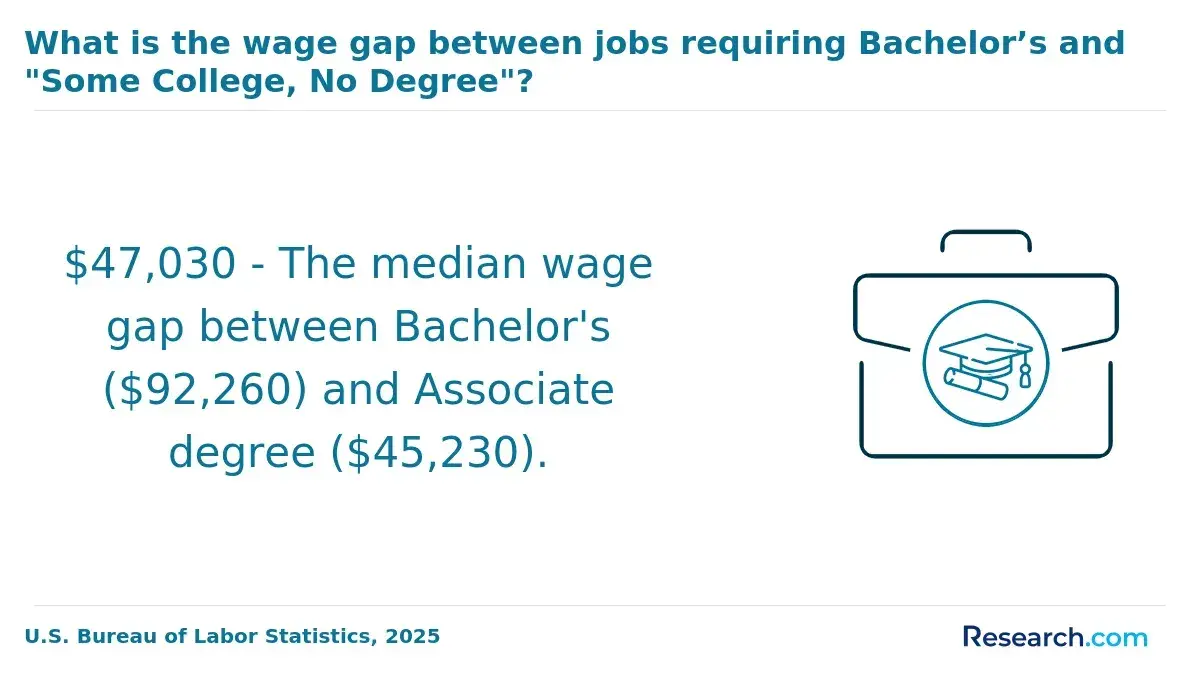
Pay varies by occupation, employer, experience, and location; there is no single reliable wage for "remote associate degree jobs." The U.S. Bureau of Labor Statistics reports a 2024 median wage of $50,250 for medical records specialists. That figure covers the occupation as a whole, not remote positions or graduates of a particular program.
Use occupational wages to compare career directions, then check pay ranges on openings you could qualify for now. Include required certifications, equipment, and any commuting costs when judging whether a job - or the education needed to pursue it - fits your budget.
Are online associate degree programs accredited?
Some are, but online delivery does not establish accreditation. Verify the college's institutional accreditation through the U.S. Department of Education's accreditation database or the accreditor itself. For fields such as nursing or health information, check separately whether relevant programmatic accreditation or approvals apply to your intended credential and state.
Accreditation matters for quality review and may affect federal aid eligibility, transfer, and credential eligibility. It does not mean every course will transfer or that a program satisfies every state's licensing rules. Ask the destination bachelor's program or licensing board to confirm the specific courses and requirements before you enroll.
What do online associate degree programs cost and how long do they take?
Many require about 60 semester credits. A full-time student may finish in roughly two years, while part-time study, prerequisites, limited course availability, and clinical requirements can extend the timeline. Accepted transfer credit can shorten it, but only after a school evaluates which credits apply to the degree.
College Board reported average published tuition and fees of $4,050 for in-district students at public two-year colleges in 2024-25. That benchmark is not a quote for an online program or its total cost: residency rates, technology fees, books, exams, and required travel can change the amount substantially. Compare a written estimate for all remaining credits and mandatory costs, then ask about federal aid eligibility, grants, employer assistance, and payment plans.
For scheduling, a self paced accredited online college may be worth comparing with fixed-term options. Confirm actual deadlines and course availability; self-paced does not necessarily mean you can start or finish every required course whenever you choose.
What courses do remote-focused associate degree programs include?
Most combine general education with field courses. Accounting paths may include financial accounting, spreadsheets, and business communication; health information paths may cover medical terminology, coding, records systems, and privacy; IT paths may include networking, operating systems, and technical support.
Look beyond course titles for practice with the tools used in target jobs. Ask whether labs use remote-access software, whether group work or exams require live attendance, and whether an internship or practicum must be arranged locally. A strong online curriculum should let you demonstrate usable skills without obscuring any in-person requirements.
What admission requirements apply to online associate degree programs?
Colleges commonly request a high school diploma or equivalent, an application, and prior college transcripts if applicable. Placement rules and prerequisite courses vary. Admission to a college does not necessarily mean admission to a selective nursing or allied-health major; those programs may have separate academic, clinical, or background-check requirements.
If you have previous credit, request an evaluation showing which courses satisfy general education and major requirements - not merely how many credits the college accepts. Ask whether older technical courses still count and which required courses must be completed at the institution. That evaluation is more useful for planning cost and completion time than a general transfer-credit maximum.
Which certifications or licenses improve remote career opportunities?
The right credential depends on the job. Medical coding employers may seek a recognized coding certification; IT support postings may request vendor-neutral or platform-specific credentials. Registered nursing requires state licensure after an approved education pathway and examination. A certificate or degree should never be mistaken for permission to practice a licensed profession.
Before paying for an exam, compare the credential named in local or remote job postings with its eligibility rules, fees, and renewal requirements. Some certifications online can supplement an associate degree, but neither a certification nor an online course guarantees remote employment.
How do you choose a reputable online associate degree program?
Start with several remote postings you would pursue after graduation, then evaluate programs against their requirements. This avoids the common mistake of choosing a flexible-sounding major that does not prepare you for an attainable first role.
Use these checks when speaking with admissions and program staff:
- Verify institutional accreditation and any field-specific approval needed for your goal.
- Request the full course sequence, including live meetings, labs, proctored exams, placements, and campus visits.
- Get a written estimate of remaining credits, mandatory fees, and likely completion time at your intended course load.
- Ask what tools students practice, what career support is available, and whether the school publishes relevant employment outcomes.
- If you may transfer, confirm with the receiving institution which credits will satisfy your intended bachelor's requirements.
The best fit balances credible instruction, manageable total cost, a workable schedule, and evidence that the curriculum matches your target jobs. Be wary of promises of guaranteed remote placement, unexplained fees, or claims that an online degree automatically meets licensure requirements.
Other Things You Should Know About
Possibly, especially in support, records, billing, or IT roles, but employers may prefer experience and may require set hours or occasional office visits. Check individual postings rather than assuming the occupation is always remote.
The major and curriculum matter more than the abbreviation. An AAS may focus on immediate job skills; an AA or AS may offer a clearer transfer route. Verify both career preparation and how credits apply if you expect to pursue a bachelor's degree.
No, if it prepares students for registered nursing practice: nursing education includes in-person clinical training, and programs may require campus labs. Licensure also requires meeting state rules and passing the required exam.
A certificate may be a faster, narrower option if target employers request a specific skill or credential. An associate degree may make more sense if you need broader coursework, general education, or a possible transfer pathway. Compare both against actual job requirements and total cost.
References
- Tuition and College Costs | WSAC https://wsac.wa.gov/tuition-and-college-costs
- Program Eligibility, Written Arrangements, and Distance Education | ed.gov https://fsapartners.ed.gov/knowledge-center/fsa-handbook/2024-2025/vol2/ch2-program-eligibility-written-arrangements-and-distance-education
- How Many Hours a Week Does an Online College Take? | University of the People https://www.uopeople.edu/blog/how-many-hours-a-week-does-an-online-college-take/
- Transfer Credit and Degree Applicability | University of Missouri Academic Catalog https://catalog.missouri.edu/academicpolicies/transfercreditanddegreeapplicability/
- 4.1.18 Credit Earned through Transfer, Examination, and Prior Learning | Illinois State https://policy.illinoisstate.edu/academic/4-1-18/
- Are there any proctored exams where I need to go to a testing site? - UW-Madison Online https://online.wisc.edu/knowledgebase/are-there-any-proctored-exams-where-i-need-to-go-to-a-testing-site/
- Online Student Placement Process | asu.edu https://clinicalpartnerships.asu.edu/online-student-placement-process
- How Internships, Practicums, and Clinicals Actually Work | Florida National University (FNU) https://www.fnu.edu/internships-practicums-clinicals-explained/
- Cost of attendance - Office of Admissions https://admit.washington.edu/costs/coa/
- 15 Work-From-Home Jobs That Don't Require a Degree | AARP https://www.aarp.org/work/job-search/work-from-home-jobs-no-degree/