
2027 Best Associate Degree Programs for Career Advancement

Co-Founder and Chief Data Scientist
Choosing an associate degree for career advancement means looking beyond the major's name: Will it qualify you for the work you want, and will the time and cost pay off? The College Board reported average published tuition and fees of $4,050 for in-district students at public two-year colleges in 2024-25, before books, transportation, and other expenses. That makes these programs worth considering, but not interchangeable. This guide compares career-focused and transfer-oriented paths, occupational pay and demand, licensing hurdles, and the questions to ask before enrolling.
Key Things You Should Know
- For a defined occupation, nursing and accredited allied-health programs offer clearer entry routes than broad majors - but clinical placement and licensing requirements are decisive.
- U.S. Bureau of Labor Statistics data put the May 2024 median wage at $93,600 for registered nurses and $94,260 for dental hygienists; these are occupational wages, not expected earnings for new graduates.
- An AA or AS often supports transfer, while an AAS often emphasizes workforce preparation. Confirm that required courses, credits, and credentials fit your intended job or bachelor's program.
Top 10 Best Associate Degree Programs for Career Advancement - Top Programs
Business Programs
Business administration, accounting, and supply chain associate programs can build skills for office operations, bookkeeping, purchasing support, or logistics coordination. Choose an AAS for applied coursework or an AA/AS with a verified transfer agreement if a bachelor's degree is your goal. Entry-level responsibilities vary by employer; an associate degree alone rarely qualifies someone for management. Compare spreadsheet and accounting software instruction, internships, and the availability of local jobs. Because automation affects routine administrative work, prioritize programs that develop analysis, communication, and adaptable software skills.
Healthcare Programs
Dental hygiene, respiratory therapy, radiography, and diagnostic medical sonography offer occupation-specific routes, usually with labs and supervised clinical work. Their requirements are not interchangeable: each occupation has its own credentialing rules, and program availability may be limited. Compare accredited programs based on clinical placement arrangements, examination eligibility, equipment access, and total required credits - not occupational pay alone. A general healthcare studies degree may support transfer or administrative work but typically does not replace an occupation-specific clinical program.
Information Technology Programs
IT associate programs commonly cover networking, systems administration, cybersecurity fundamentals, or software development. They may support applications for help-desk or junior technical roles, but employers also assess practical ability and experience. Look for hands-on labs, projects, internships, and preparation for relevant industry certifications. A transfer-oriented computer science AS may fit a future bachelor's degree better than a narrow AAS. Cybersecurity titles can sound entry-level, yet many security roles require prior IT experience; ask which jobs recent students actually entered.
Nursing / Pre-Nursing Programs
An approved associate degree in nursing can provide an educational route toward registered nurse licensure, but graduates must also meet state board requirements and pass the NCLEX-RN. Pre-nursing coursework alone does not qualify someone for RN licensure or guarantee admission to a nursing cohort. Nursing admission may be selective even at an open-admission college. Check prerequisites, clinical scheduling, program approval, accreditation where applicable, examination outcomes, and whether an RN-to-BSN agreement supports later advancement.
Criminal Justice Programs
Criminal justice associate programs introduce courts, corrections, policing, and public-safety systems. They can support applications for some entry-level roles or provide a transfer foundation, but eligibility for police or corrections positions depends on agency rules, background screening, physical standards, and academy training. Advancement often depends on experience. Compare the degree with a direct academy or employer-sponsored training route before paying for it solely to enter a particular agency.
Psychology / Counseling Programs
Psychology or counseling associate programs generally serve as transfer foundations, not routes to independent counseling practice. They may help students pursue certain human-services support jobs, subject to employer requirements. Licensed mental health counselor roles generally require graduate education, supervised experience, and state licensure. Before enrolling, verify how psychology and general education courses apply to the intended bachelor's program; an applied associate degree may transfer differently from an AA or AS.
What are the best associate degree programs for high-demand careers?
For a direct, high-demand occupation, start by comparing nursing and accredited allied-health programs. For a career with several possible entry routes, IT may offer more flexibility but less certainty about the job a degree alone will secure. "Best" depends on whether you want to enter the workforce after graduation or use the associate degree to reach a bachelor's-level career.
The comparison below focuses on how each field connects to work - not on a ranking of individual colleges. If you plan to continue studying, compare the associate path with best college degrees for the future before selecting transferable courses.
| Associate path | Strongest career fit | Main trade-off |
| Nursing or occupation-specific allied health | Students targeting a defined clinical role | Selective admission, clinical hours, and separate licensing or certification |
| Information technology | Students willing to build a portfolio and seek technical experience | Job requirements differ widely; the degree alone may not establish readiness |
| Business or supply chain | Students seeking broadly applicable workplace skills | Less direct connection to one occupation or promotion |
| Transfer-oriented AA or AS | Students whose target career requires a bachelor's or graduate degree | More education, time, and cost before reaching the target role |
How much do associate degree graduates earn in different careers?
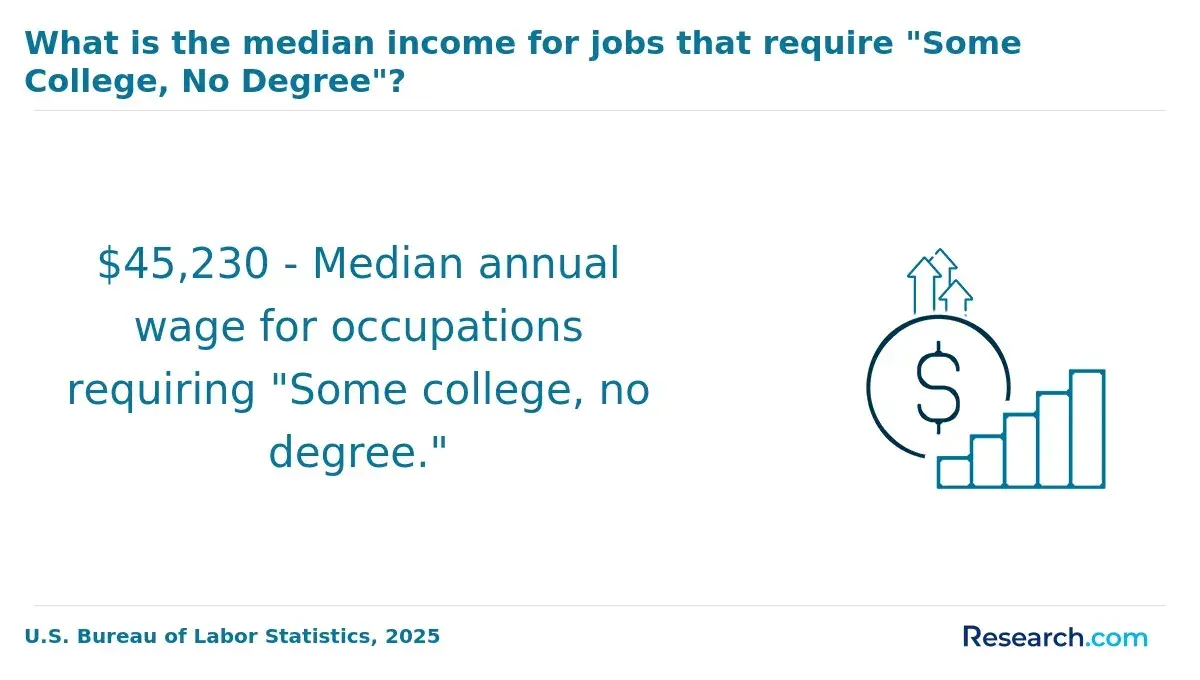
For your own return-on-investment estimate, compare likely local entry-level offers with the full price of completing the specific program. Include tuition, mandatory fees, supplies, commuting, and any earnings you may give up during clinical placements. A lower-paying entry job with little required borrowing may be a better first step than a higher-paying target occupation that requires additional years of study.
Which associate degree careers have the strongest job outlook?
Demand is strongest as a decision factor when it matches both a specific occupation and a program that meets its entry requirements. In projections published in 2024, the U.S. Bureau of Labor Statistics estimated employment growth from 2023 to 2033 of 6% for registered nurses and 9% for dental hygienists. Those national projections indicate opportunity, not openings in your area or a guarantee of employment.
Check local employers' requirements before treating any growing field as a good bet. Nursing and dental hygiene have defined credential pathways; business and IT cover a wider range of jobs, so a broad field label says less about demand for one graduate. Also consider schedules: a clinical occupation with promising growth may involve shifts or in-person work that do not fit your needs.
What types of associate degrees lead to healthcare, technology, and skilled-trade jobs?
Associate degrees prepare students for different kinds of work. An Associate of Applied Science (AAS) commonly emphasizes occupational courses; an Associate of Arts (AA) or Associate of Science (AS) often emphasizes transfer. These are tendencies, not guarantees - review the actual curriculum and agreements.
In healthcare, occupation-specific degrees combine science, labs, and clinical training. Technology programs may pair computing coursework with projects and internships. Skilled-trade routes can include associate degrees in areas such as industrial maintenance, but an apprenticeship or certificate may be a more direct entry route for a particular trade. Ask employers which credential they recognize. If a bachelor's degree is the eventual goal, confirm that credits will fulfill requirements in that major, not merely transfer as electives.
How do online and campus-based associate degree programs compare?
Online delivery is most useful when its actual schedule fits your life. Business, psychology, and some IT coursework may be offered online, while nursing and many allied-health programs still require in-person labs or clinical placements. "Online" can also mean live class meetings, fixed deadlines, proctored exams, or a required campus orientation.
Campus programs may simplify access to equipment and supervised practice but add commuting and scheduling constraints. Hybrid study can balance those needs. Before choosing, obtain a term-by-term schedule showing required in-person activities and ask who arranges clinical sites or internships. For a longer education plan, compare the cost and format of later cheapest online degrees separately; an inexpensive associate program is not necessarily the least expensive route to a bachelor's.
What accreditation should an associate degree program have?
Start with institutional accreditation, then check occupation-specific requirements. Verify that the college is accredited by an agency recognized by the U.S. Department of Education and that its status is current. Accreditation can affect federal aid eligibility and transfer evaluation, but it does not mean every course will count toward another school's degree.
For regulated healthcare fields, ask whether the specific program holds the accreditation or state approval required for examination or licensure eligibility in the state where you intend to work. Confirm that answer with the relevant licensing board rather than relying on a college-wide accreditation statement. A major red flag is a program that advertises a clinical career without clearly explaining its graduates' eligibility for the required credential.
What are the admission requirements, costs, and completion times?
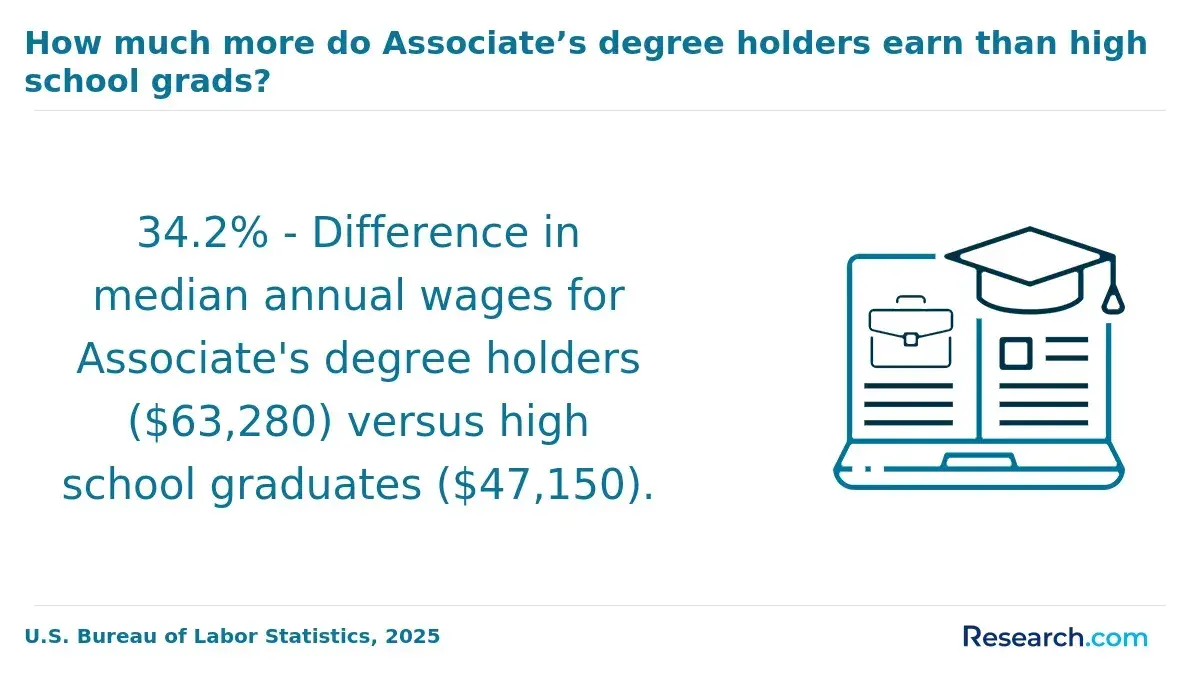
Many associate programs require roughly 60 semester credits, but clinical sequences, prerequisites, and other requirements can increase the total. Two years is a common full-time planning estimate, not a promise. Part-time enrollment, limited course availability, accepted transfer credit, and selective entry into a major can change the timeline.
College admission and program admission may differ. A school may admit applicants with a high school diploma or equivalent while its nursing or allied-health program separately requires prerequisite grades, screening, or an application cycle. Ask for both sets of requirements before building a schedule.
The College Board's 2024-25 average of $4,050 in published tuition and fees for in-district public two-year students is a benchmark, not a total program price. Residency, books, equipment, testing, transportation, and living costs can materially change what you pay. Compare the full remaining-credit estimate and ask about grants, scholarships, federal aid eligibility, employer assistance, and payment plans. Do not choose on per-credit tuition alone.
Which certifications or licenses do associate degree careers require?
A degree and a professional credential are separate achievements. An approved nursing education pathway is followed by state RN licensure requirements, including the NCLEX-RN. Dental hygienists must meet state licensing requirements; some IT jobs value certifications, but employers differ on which ones matter. Public-safety agencies may require academy training and their own eligibility screening.
Psychology and counseling require an especially careful distinction: an associate degree may begin the educational path, but independent licensed counseling generally calls for a qualifying graduate degree, supervised experience, and state approval. If that is your goal, research licensing requirements before comparing a quickest cheapest master's degree; speed or price alone cannot establish eligibility to practice.
How can you choose the right associate degree program for your goals?
Choose backward from the job or next degree you actually want. This prevents a common mistake: selecting an appealing major without checking whether it leads to the required credential or transfers into the intended bachelor's program. Use the same checks for each college on your shortlist:
- Identify target job postings or a bachelor's program, and record their education, experience, and credential requirements.
- Request a written degree map showing prerequisites, total credits, course availability, and a realistic completion schedule for your enrollment pace.
- Verify accreditation, clinical or internship arrangements, examination eligibility where relevant, and how transfer credits apply to your goal.
- Compare estimated total costs after likely aid, including fees, supplies, travel, and any extra terms caused by course sequencing.
If advancement ultimately requires a bachelor's degree, ask about an articulation agreement and evaluate bachelor degree programs for working adults as a later step. If a target employer accepts a certificate or apprenticeship instead, compare that shorter route before committing to an associate degree.
Other Things You Should Know About
An occupation-specific nursing or allied-health program may fit someone seeking a defined licensed role. IT or business may fit broader goals, while an AA or AS can be a better choice when advancement requires a bachelor's degree.
Some roles have associate-level education pathways, but employers may also require licensure, certification, experience, or a portfolio. Check requirements for the exact job and state where you plan to work.
An AAS often prioritizes job-specific training; an AA often prioritizes transfer. Neither is universally better. Choose based on the curriculum and written transfer or credential requirements for your goal.
Some programs may offer online coursework, but clinical, laboratory, or internship requirements can require in-person participation. Confirm the complete schedule before enrolling.
References
- Cost of Attendance (Budget) | 2025-2026 Federal Student Aid Handbook https://fsapartners.ed.gov/knowledge-center/fsa-handbook/2025-2026/vol3/ch2-cost-attendance-budget
- Annual Earnings by Educational Attainment - COE https://nces.ed.gov/programs/coe/indicator/cba/annual-earnings
- Transfer pathways | Minnesota MyHigherEd https://myhighered.mn.gov/transfer-students/transfer-pathways
- Professional Pre-Licensure - Regis College https://www.regiscollege.edu/academics/schools/richard-and-sheila-young-school-nursing/licensure-requirements/professional-pre
- Guaranteed Transfer - UCCS Transfer https://transfer.uccs.edu/guaranteed-transfer
- Transfer Agreements (Alphabetical by College/University) | Brookdale Community College - https://www.brookdalecc.edu/transfer-resources/transfer-agreements/


